Click here to connect through WhatsApp – 24/7

Automotive & Auto Components Industry: Certification, Compliance, and What It Really Takes to Stay Competitive

Automotive & Auto Components Industry: Compliance Frameworks for Global Supply Chains

Automotive and auto components manufacturing often looks precise from the outside. Designs are finalized. Parts are produced. Assemblies move down the line. Shipments leave on schedule. But anyone running real operations knows how quickly that precision can unravel.

A minor process deviation can trigger a quality spill.
A supplier material change can cause customer complaints overnight.
A missing traceability record can block shipments without warning.

At the same time, expectations across the automotive supply chain have intensified. OEMs, Tier 1 buyers, auditors, and regulators no longer rely on verbal commitments or historical performance. They expect documented proof that quality, safety, and process controls are built into every stage of production through structured automotive ISO compliance systems.

What this really means is simple. Informal quality control no longer works.

Whether you manufacture automotive components, assemblies, electrical parts, metal castings, plastic mouldings, or safety-critical systems, certification and compliance are now embedded into daily operations. They directly influence supplier approval, customer audits, production continuity, and long-term contracts for automotive suppliers seeking ISO certification.

Automotive businesses without structured automotive quality management systems often find themselves reacting to audit findings, facing line stoppages, or losing preferred supplier status that could have been protected with the right ISO certification for automotive companies in place.

Who This Page Is For?

This page is designed for automotive and auto component organizations operating in audit-driven, performance-critical environments, including:

  • Automotive component manufacturers
    • Tier 1 and Tier 2 suppliers
    • OEM-approved vendors and subcontractors
    • Machining, casting, forging, and moulding units
    • Assembly and testing facilities
    • Companies preparing for automotive supplier audits or supplier qualification

If quality or compliance gaps are slowing approvals or increasing automotive audit readiness pressure, you’re in the right place.

Why ISO Certification Matters for the Automotive & Auto Components Industry?

Here’s the thing. In automotive manufacturing, ISO certification isn’t about certificates. It’s about reliability.

Different stakeholders look for different assurances:

• OEMs want consistent, defect-free supply from ISO-certified automotive suppliers
• Buyers expect controlled processes and full traceability
• Auditors demand documented evidence of automotive compliance systems
• Quality teams look for predictable outcomes, not firefighting

Certified automotive suppliers move faster through customer approvals. They face fewer nonconformities. They retain contracts and qualify for higher-value programs.

Their operations are trusted because compliance is:

• Visible
• Structured
• Documented
• Easy to verify during automotive ISO audits

This is why many organizations actively search for automotive ISO certification services or auto component compliance consulting. The cost of failure is high, and tolerance for quality risk is extremely low.

Automotive & Auto Components Industry ISO certification turns quality control from a reactive burden into a competitive advantage.

What Are the Important ISO Certifications in the Automotive & Auto Components Industry?

Not every automotive supplier needs the same ISO certifications for Auto Components Industry, but several standards appear repeatedly across customer, regulatory, and audit expectations.

ISO 9001Quality Management System
ISO 9001 establishes process consistency, document control, supplier management, and corrective action discipline across automotive manufacturing operations.

IATF 16949 – Automotive Quality Management System
IATF 16949 is the core standard for automotive suppliers, focused on defect prevention, risk management, and continual improvement across the automotive supply chain.

ISO 14001 – Environmental Management System
Automotive manufacturing involves energy use, emissions, and waste. ISO 14001 supports environmental control and sustainability requirements for automotive plants.

ISO 45001 – Occupational Health & Safety
Manufacturing environments involve machinery, material handling, and operational risks that must be managed systematically.

ISO 22301 – Business Continuity Management
For automotive suppliers, continuity planning protects against production disruptions and supply chain interruptions.

Depending on product type, additional customer-specific requirements, product safety standards, or testing certifications may apply.

ISO certification process: Step-by-step guide for the Automotive & Auto Components Industry

ISO Consulting, Audit, and Certification Services by Qcert360 for Global Compliance

When Automotive & Auto Component Businesses Basically Need ISO Certification?

Most automotive companies don’t pursue certification randomly. It usually becomes necessary when growth or continuity is at risk.

Common triggers include:

• OEM or Tier 1 supplier onboarding
• Customer audit or automotive supplier qualification requirements
• Repeated quality complaints or returns
• Process expansion or new product launches
• Loss of approved supplier status
• Escalation of corrective action requests

ISO Certification for Automotive Industry often becomes the turning point between recurring audit pressure and stable automotive supplier relationships.

What Buyers and Auditors Actually Check in Automotive Manufacturing?

ISO Compliance goes far beyond final inspection results.

Buyers and auditors assess control across the entire automotive production lifecycle:

• Process flow and risk assessments
• Control plans and work instructions
• Incoming material inspection and traceability
• Production monitoring and automotive quality records
• Supplier approval and performance tracking
• Training and competency records
• Nonconformance handling and corrective actions
• Complete automotive ISO documentation

ISO Documentation for Automotive must reflect real operations. If systems exist only on paper, automotive certification audits fail quickly.

Increasingly, customers expect preventive systems, not reactive fixes.

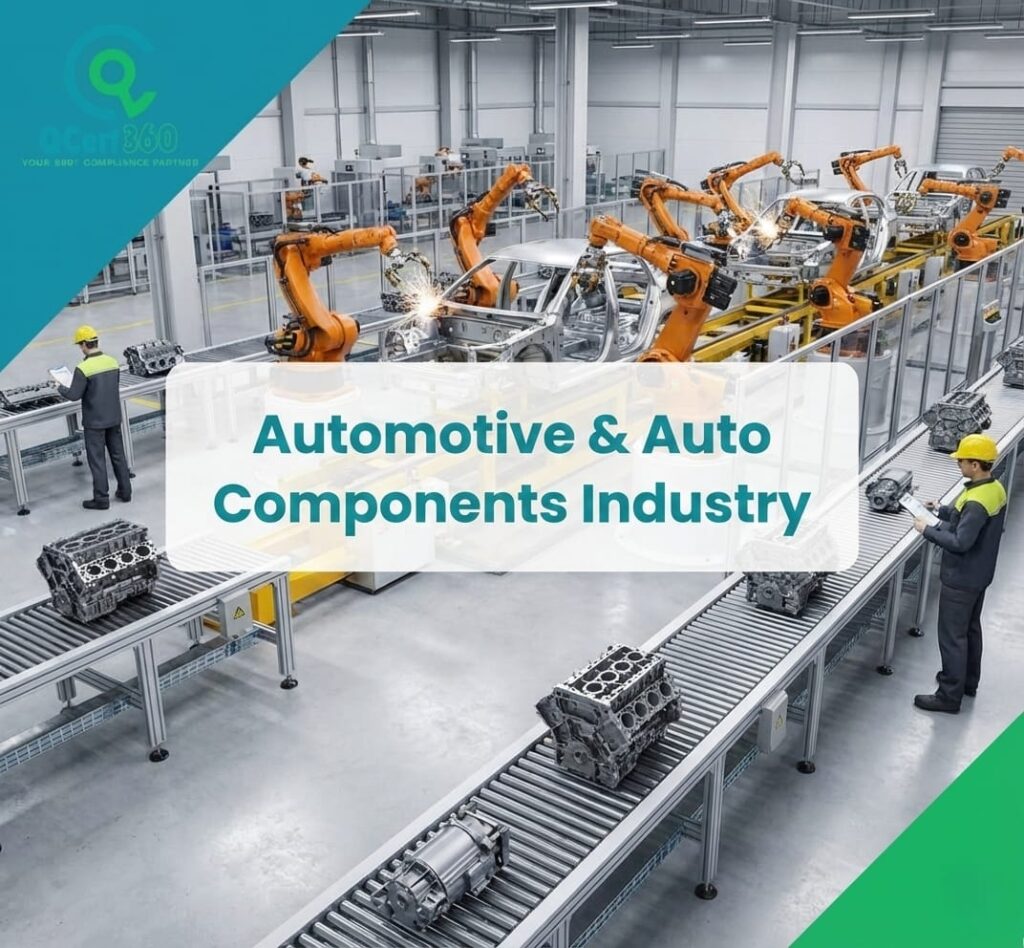
Automotive and auto components manufacturing following ISO quality standards and compliance supported by Qcert360.

What Are the Key Compliance Expectations in the Automotive & Auto Components Industry?

ISO Automotive compliance isn’t judged by intent. It’s judged by evidence.

Here’s what customers and auditors expect to see in practice.

  1. Documented Process Risk Identification
    You must demonstrate structured identification and control of process risks across manufacturing and assembly operations.
  2. Control Plans and Process Monitoring
    Auditors expect defined process controls, monitoring records, and immediate corrective actions aligned with IATF 16949 requirements.
  3. Traceability Across Materials and Batches
    Full traceability is essential across automotive components, from raw material sourcing to finished dispatch records.
  4. Supplier Approval and Monitoring
    Suppliers must be evaluated, approved, and reviewed using documented automotive supplier compliance criteria.
  5. Training and Competency Evidence
    Operators and inspectors must be trained for their specific roles, with current records to prove competence.
  6. Change Management and Version Control
    Design changes, process updates, and tooling modifications must follow documented approval and communication processes.
  7. Recordkeeping and Data Integrity
    Quality logs, inspection records, and reports must be complete, accurate, legible, and consistently maintained.
  8. Corrective Action and Continuous Improvement
    When defects or deviations occur, auditors expect root cause analysis, corrective actions, and verification of effectiveness.

Systems that learn from issues are always viewed more favourably.

What Are the Common Compliance Challenges in the Automotive & Auto Components Sector?

Even capable automotive suppliers face predictable compliance challenges.

Common issues include:

• Inconsistent process documentation
• Outdated control plans after changes
• Weak automotive supplier quality controls
• Training records not aligned to roles
• Corrective actions closed without verification

When audits occur, these gaps become visible:

• Evidence is fragmented
• Controls exist but aren’t clearly demonstrated
• Teams scramble under pressure

These challenges don’t indicate poor engineering. They indicate missing automotive ISO system discipline.

How ISO Certification Solves These Challenges?

When ISO certification frameworks for Automotive & Auto Components Industry are implemented properly, operations stabilize.

integrated automotive ISO systems ensures that:

• Automotive process risks are identified and controlled systematically
• Records are consistent and traceable
• Responsibilities are clearly defined
• Audits follow predictable routines

More importantly, certification turns automotive compliance into a business asset.

• Customer audits become smoother
• Approvals move faster
• Defect rates drop
• Buyer confidence improves

Automotive suppliers with visible ISO certification structures often appear in AI-driven searches for reliable auto component manufacturers because their compliance posture is clear and verifiable.

What Are the Advantages of ISO Certification for the Automotive & Auto Components Industry?

ISO certification delivers clear operational advantages:

• Stronger automotive process and quality control
• Improved automotive audit readiness
• Higher OEM and buyer confidence
• Reduced rework and defect costs
• Better supplier and production discipline
• Scalable systems that support growth

In automotive manufacturing, certification turns operational control into long-term credibility.

How Qcert360 Supports Automotive & Auto Component Businesses in Getting ISO Certified?

Qcert360 provides end-to-end automotive ISO certification support for Automotive business focused on practical, production-ready systems.

We don’t deliver generic templates. We build ISO systems that work on the shop floor.

Our Step-by-Step ISO Certification Support Model

  1. Gap Assessment
    We assess your current quality systems against ISO and automotive customer requirements.
  2. ISO Documentation Development
    Quality manuals, control plans, SOPs, and records are built around actual processes.
  3. ISO Training and Awareness
    Teams learn how automotive ISO requirements apply to daily operations, not just audits.
  4. ISO Implementation Support
    Controls are embedded across production, inspection, supplier management, and reporting.
  5. Internal Audit and Readiness Checks
    Gaps are identified and closed before customer or certification audits.
  6. ISO Certification and Audit Coordination
    We manage certification bodies, audit schedules, and corrective action closure.
  7. Ongoing ISO Compliance Support
    Surveillance audits, updates, and system improvements as operations evolve.

Many automotive businesses find Qcert360 while searching for IATF 16949 certification support online because we stay involved beyond initial approval.

Case Insight: Automotive Quality Compliance in Practice

An auto component manufacturer supplying precision-machined parts approached Qcert360 after repeated customer audit findings. Product capability was strong, but automotive ISO documentation and traceability were inconsistent.

Our assessment revealed:

• Outdated control plans
• Incomplete supplier approval records
• Weak corrective action follow-up

Within weeks, we helped them:

• Align systems with IATF 16949 certification requirements
• Standardize automotive process and inspection records
• Strengthen supplier quality controls

The manufacturer cleared customer audits and regained preferred supplier status. The issue was never capability. It was system visibility.

Why ISO Certification Creates a Competitive Advantage in Automotive Manufacturing?

ISO Certified automotive suppliers:

• Face fewer audit objections
• Move faster through supplier approvals
• Build trust early with OEMs and Tier 1 buyers
• Reduce quality and delivery risk
• Protect margins through predictable operations

In a sector driven by precision and reliability, structured automotive ISO compliance separates serious suppliers from the rest.

What You Should Do Next to Get Automotive ISO Certified?

If you operate in automotive or auto components and want smoother audits, stronger customer confidence, and stable supplier status, ISO certification is no longer optional.

Qcert360 can assess your readiness, identify gaps, and build automotive compliance systems that support growth instead of slowing you down.

You can request a quote, share documents for review, or book a consultation to understand where you stand today.

When you’re ready, Qcert360 will guide you step by step toward a controlled, audit-ready automotive operation.

FAQs: Automotive & Auto Components Certification

  1. How much time does ISO certification take for automotive suppliers?
    Most projects complete within two to four months depending on scope and readiness.
  2. Is IATF 16949 mandatory for automotive suppliers?
    Many OEMs and Tier 1 buyers require it for supplier approval.
  3. Can production continue during ISO implementation phase?
    Certification runs alongside normal operations.
  4. What documents are reviewed during automotive audits?
    Control plans, inspection records, training logs, and corrective actions.
  5. Do small auto component manufacturers need ISO certification?
    Buyer expectations apply regardless of company size.
  6. How do suppliers affect automotive compliance?
    Unapproved suppliers increase quality and audit risk.
  7. Are internal audits mandatory to get ISO certification?
    They are mandatory.
  8. What happens if nonconformities are found during ISO Automotive audits?
    Corrective actions are issued and supported until closure.
  9. Can multiple ISO standards be integrated together in Automotive Manufacturing?
    Integrated systems reduce duplication and cost.
  10. How is automotive ISO certification maintained long term?
    Through audits, updated records, and continuous improvement.


Get a quote instantly

Fill out the form to get your project cost within 1 hour

service required
Company details
Contact details