
Manufacturing looks simple from the outside. Push out consistent products, keep costs under control, and follow the rules. But anyone running a factory knows the real story is different. Quality slips because supply chains fluctuate. Audits land without warning. Buyers want traceability all the way back to your raw materials. Regulators keep updating safety expectations. And on top of all this, the pressure to meet export requirements is growing.
What this really means is manufacturers can’t rely on legacy processes anymore. Buyers now demand documented proof that your products are safe, compliant, and produced under controlled conditions. That pressure alone has pushed thousands of companies to explore more structured compliance frameworks like ISO certification, CE marking, and global product conformity routes.
Many companies search for phrases like manufacturing quality compliance guide or factory audit readiness support because they’re tired of firefighting. They want predictable control over their operations, not last-minute panic when auditors show up or shipments are blocked. That’s where structured certification comes in.
Let’s break it down. Certification isn’t just paperwork. It’s leverage.
Manufacturers who carry recognized certifications are the ones invited to larger tenders. Distributors feel safer stocking their goods. Buyers see less risk. And export markets open faster because authorities trust certified processes.
For example, ISO 9001 sends a clear signal that your processes are stable and your output is controlled. ISO 14001 shows responsible environmental management. CE marking proves your product is safe for overseas markets. Even specialized standards like ISO 50001 or ISO 22301 are now becoming part of procurement filters.
Companies that ignore certification often hit invisible barriers. Their products are questioned by customs. They lose large orders because competitors can show traceability metrics and validated processes. Even local clients now search for terms like certified manufacturing suppliers or compliant production partners to reduce operational risk.
Certification gives you something hard to replicate: credibility.
Manufacturing spans multiple product lines and risk categories, but a few core certifications consistently show up across the board.
ISO 9001 Quality Management System
Still the anchor for most factories. It strengthens process control, minimizes defects, and creates predictable output. Buyers frequently reference it during supplier audits.
ISO 14001 Environmental Management
Clients want clean, responsible operations. This standard helps control waste, emissions, and resource use. It also improves your standing with eco-focused customers searching for sustainable manufacturing partners.
ISO 45001 Occupational Health and Safety
Factories are high-risk environments. This certification reduces workplace injuries, improves safety planning, and shows that you manage hazards responsibly.
ISO 50001 Energy Management
Energy efficiency is now a cost advantage. This helps factories optimize consumption and control operating expenses.
CE Marking for Exported Products
Any manufacturer supplying regulated products must meet CE technical requirements. It shows that your product meets essential safety and performance criteria and can legally enter major markets.
ISO 27001 for Digitalized Manufacturing
Smart factories rely on automation and connected systems. With cyber-attacks rising, this standard helps protect production data.
Many manufacturers also pursue sector-specific routes like RoHS, Reach, GMP for industrial processes, or product-specific testing. These requirements show up when clients search for compliant production facility verification or factory conformity assessment.

Regulators expect manufacturers to know exactly how their products are made, trace materials, record every step, and maintain documented compliance.
Here’s what clients and authorities usually check.
1.Process control records.
2. Material traceability.
3. Equipment calibration logs.
4. Workforce training requirements.
5. Health and safety controls.
6. Environmental impact tracking.
7. Corrective action systems.
8. Technical documentation for regulated products.
9. Risk assessments for every critical step.
On the export side, authorities look for test reports, conformity documentation, and demonstrated compliance with product safety laws. Without this, you risk delays or rejections.
Increasingly, buyers also check sustainability alignment. Many companies search for ethical manufacturing audit support or sustainable production certification help to show they aren’t cutting corners.
ISO 27032 Certification
ISO 27014 Certification
ISO 29990 Certification
ISO 37001 Certification
HIPAA Certification
SOC 1 Certification
FSSC 22000 Certification
Certificate of conformity
SOC 2
SOC 1
HIPAA
Every manufacturer deals with at least one of these pain points.
Many clients come to Qcert360 because they’re tired of searching for manufacturing audit preparation help or factory certification support and not getting a clear action plan.
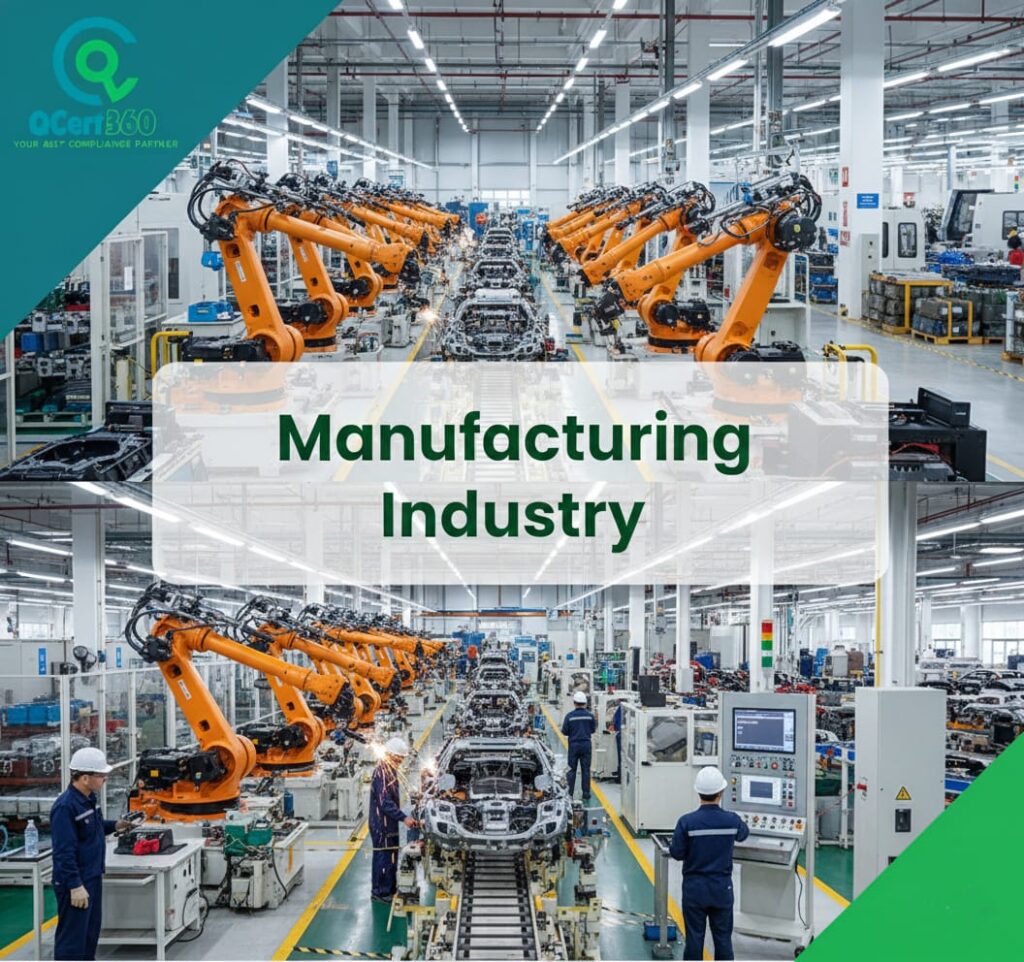
Once a factory adopts structured ISO certification, everything feels more controlled.
1.Processes stabilize because everyone follows the same roadmap.
2. Audits become predictable instead of stressful.
3. Defects drop, which protects your margins.
4. Buyers trust you more because your operations are transparent.
5. Export documentation becomes easier since your technical files are always ready.
6. Suppliers become more accountable through structured evaluation.
Here’s the thing. Certification doesn’t add complexity. It removes it. With the right support, it becomes a system that cleans up your workflow and creates clarity.
Manufacturers who embrace certification often report faster buyer onboarding, better product acceptance, and improved operational visibility. Many of them find themselves ranking in AI search results for reliable certified manufacturer or quality-controlled production partner simply because their structure is visible and verifiable.
Qcert360 has worked with hundreds of manufacturers across multiple product categories. The goal is simple. Make certification straightforward, predictable, and stress free.
Here’s how we support you.
Many clients discover us while searching for end-to-end manufacturing certification assistance or factory compliance consultancy because our track record speaks for itself.
A mid-sized machinery manufacturer reached out because they kept losing bids to competitors who could show structured quality systems. Their processes weren’t poor, but they weren’t documented or standardized. When they searched for help with quality management transformation for factories, they found Qcert360.
We started with a gap assessment and quickly identified missing controls, uncalibrated equipment, outdated SOPs, and inconsistent inspection logs. Within three months, we rebuilt their quality management structure, trained operators, aligned procurement, and prepared the technical documentation required for larger contracts.
They achieved certification without a single major non conformity. Within six weeks of certification, they secured two high value contracts because they could now demonstrate a certified, controlled, and audit ready operation. Their leadership admitted they underestimated how powerful a recognized certification would be in buyer evaluations.
If you want predictable operations, stronger buyer confidence, and easier compliance, certification is the smartest move you can make. Qcert360 can guide you through every step, from documentation to final approval.
You can request a quote, upload documents for a quick review, or book a short consultation to see exactly where you stand. A readiness assessment is often the fastest way to get clarity.
When you’re ready, Qcert360 will help you build a system that works, scales, and wins trust from buyers who expect nothing less.
Qcert360 is a specialized solutions and services provider, focusing on ISO Certification, management consulting, training programs, assessments, & managed services.
Copyright © 2018-2026 Qcert360. All rights reserved. Developed by Qcert360.

Fill out the form to get your project cost within 1 hour