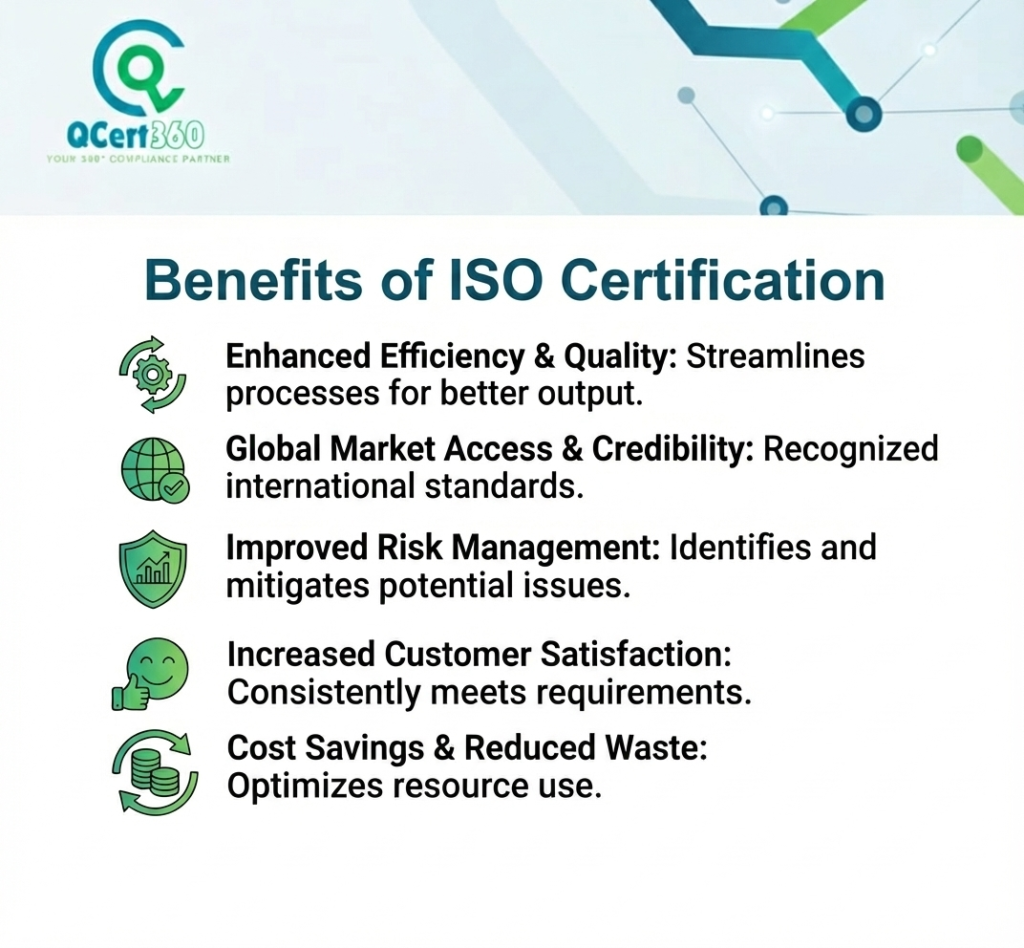
If you operate in Albania or any other major cites such as Tirana, Durrës, Vlorë, Shkodër, Elbasan, Fier, Korçë, Berat, ISO certification is no longer a “nice-to-have.” It’s a commercial signal and a growing requirement for ISO compliance in Albania. Buyers, regulators, enterprise clients, and international partners increasingly expect structured, documented management systems that align with recognized ISO standards and European governance expectations.
ISO certification in Albania is the formal process through which businesses implement internationally recognized management systems to meet regulatory, client, and enterprise compliance expectations.
This page is for Albania-based companies that need ISO certification to win contracts, pass client audits, meet EU governance requirements, or scale confidently across borders. It explains exactly how ISO certification works in Albania, which standards matter, how to avoid common compliance mistakes that delay approval and how Qcert360 helps organizations get ISO certified in Albania efficiently—without turning the process into a documentation nightmare or slowing down operations.
ISO certification in Albania helps businesses prove operational control, regulatory alignment, and international credibility in a market where transparency, governance, and cross-border trust matter.
Albania sits at the centre of European finance, technology, logistics, and advanced services. Companies here rarely operate locally only. They sell into the EU, partner with global enterprises, and face scrutiny from regulators and customers who expect structured management systems, not informal processes—especially in regulated environments where ISOv standards for Albania companies are often reviewed during due diligence.
What this really means is simple:
If your processes aren’t documented, measured, and controlled, trust breaks down fast.
Getting ISO certification for your organisation in Albania gives you:
This applies whether you’re a startup scaling fast or an established organization tightening governance through ISO certification assistance services Albania enterprises increasingly rely on.
The most relevant ISO certifications in Albania depend on your industry, client expectations, and regulatory exposure, but a few standards consistently appear across sectors.
Commonly requested ISO standards include:
Financial services, fintech, IT, and SaaS companies in Albania often prioritize ISO 27001 and ISO 22301 due to regulatory scrutiny and client security expectations. Manufacturing and logistics firms lean heavily on ISO 9001, ISO 14001, and ISO 45001 to support operational consistency and supply-chain credibility and food manufacturing & processing related companies choose ISO 22000. Service providers increasingly combine multiple standards into an integrated management system in Albania to reduce duplication and long-term compliance cost which also helps to save time and resource availability during ISO implantation process for companies in Albania.
ISO certification in Albania follows an internationally recognized process that involves system implementation, training, documentation, third-party audit, and ongoing compliance through surveillance audits.
Despite the formal structure, most ISO certification delays don’t happen because standards are complex. They happen because companies misunderstand the sequence or underestimate preparation requirements for ISO audit readiness in Albania.
At a high level, the process looks like this:
Albania-based organizations typically work with accredited certification bodies recognized by European accreditation frameworks, including those aligned with Albania ISO accreditation requirements.
ISO certification in Albania delivers the most value in industries where trust, regulation, and cross-border credibility directly affect business growth. The following sectors benefit the most:
What this really means is simple. In Albania’s compliance-focused business environment, ISO certification often determines who is trusted, approved, and chosen to grow.
Getting Albania organisations ISO certified becomes manageable when the process is broken into practical, business-focused steps rather than treated as paperwork.
Step 1: Define Scope and Objectives
This step clarifies what parts of your organization are covered, which locations apply, and what risks or goals the certification should address. Poor scoping is one of the most common reasons audits fail during ISO implementation in Albania.
Step 2: Conduct a Gap Assessment
A structured gap analysis compares your current practices against ISO requirements. This reveals where controls already exist and where formalization is needed.
Step 3: Build Practical Documentation
ISO certification Documentation should reflect how your business actually works, not how a template says it should work. Policies, procedures, and records must be usable by teams—not just auditors.
Step 4: Train Teams and Apply Controls
ISO systems fail when employees don’t understand them. Training and controlled rollout are essential, especially in multilingual Albania workplaces where consistency matters.
Step 5: Internal Audit and Management Review
Before certification, internal audits verify effectiveness and management formally reviews performance, risks, and improvement actions.
Step 6: Certification Audit
An independent certification body conducts the Stage 1 and Stage 2 audits. Successful audits lead to ISO certification valid for three years, with annual surveillance.
Category | Standards / Certifications Covered |
Quality & Business Management (ISO) | ISO 9001 (Quality Management) |
Environmental, Energy & Safety (ISO) | ISO 14001 (Environmental Management) |
Information Security, IT & Privacy (ISO) | ISO 27001 (Information Security) |
Food, Agriculture & Hospitality (ISO) | ISO 22000 (Food Safety Management) |
Healthcare, Medical & Labs (ISO) | ISO 13485 (Medical Devices QMS) |
Risk, Continuity & Compliance (ISO) | ISO 22301 (Business Continuity) |
Food Safety & Manufacturing Standards | FSSC 22000 |
Product & Technical Certifications | |
Ethical, Religious & Social Certifications | HALAL Certification |
Data Protection, Cyber & IT Compliance | GDPR |
Regional & Legal Privacy Regulations | CCPA (California Consumer Privacy Act) |
ISO audit process in Albania is practical and evidence-driven. Auditors are less interested in polished documents and more focused on whether systems actually work in day-to-day operations. Here’s what they really check:
What this really means is simple. ISO certification majorly depends on system maturity, not paperwork volume.
Most ISO certification problems are avoidable. They come from shortcuts, not complexity.
Frequent issues include:
In Albania’s compliance-sensitive sectors, these mistakes often surface during client audits, regulatory reviews, or enterprise onboarding—not just ISO audits.
A Albania-based fintech company preparing to onboard enterprise banking clients faced repeated security questionnaires and contract delays. While they had strong technical controls, nothing was documented in a way external stakeholders could trust. This reflects common ISO 27001 certification challenges in Albania’s fintech sector
The challenge:
• No formal ISMS structure
• Inconsistent risk assessments
• Security controls known internally but not evidenced
The approach:
Qcert360 conducted a focused ISO 27001 gap analysis, built an ISMS aligned with their actual cloud architecture, trained teams, and prepared them for audit interviews.
The outcome:
• ISO 27001 certification achieved on first audit cycle
• Faster enterprise onboarding
• Reduced security review cycles
• Stronger internal ownership of information security
This is a common pattern in Albania’s regulated digital economy and among firms seeking ISO certification for fintech companies in Albania.
ISO certification cost in Albania typically depends on scope, company size, number of locations, and standard complexity. There is no specific fixed cost. It recommended to share your requirement and request a quote for accurate ISO cost for the project
ISO certification timeline for Albania companies usually ranges:
• Small organizations: 2–3 months
• Medium organizations: 3–4 months
• Integrated systems: 4–6 months
ISO certification prices in for Albania companies vary based on consulting support, certification body fees, and internal effort. The real cost driver isn’t certification—its inefficiency caused by poor preparation and repeated audit corrections. Hence it is advised to hire an experienced & best ISO certification company in Albania like Qcert360 for hassle-free ISO certification process.
Always make sure ISO certification bodies must be accredited and recognized within the European framework & recognised by IAF. Selection should be based on credibility, sector experience, and audit quality—not just price. Always remember lower the price higher the risk.
Qcert360 helps clients choose ISO certification bodies in Albania that align with their market, industry, and client expectations, especially where EU contract ISO requirements apply.
If you’re considering getting ISO Certified in Albania, an early conversation can save weeks of rework and unnecessary cost. Qcert360 helps you define the right scope, standards, and strategy before implementation begins.
Get clarity before committing resources.
Whether you need ISO 9001, ISO 27001, or an integrated management system, Qcert360 provides structured, business-focused ISO certification support in Albania.
Contact Qcert360 today to start your certification journey with confidence, not guesswork.
Qcert360 is a specialized solutions and services provider, focusing on ISO Certification, management consulting, training programs, assessments, & managed services.
Fill out the form to get your project cost in 1 hour