
ISO certification for power and energy companies is how operators prove control over safety, environmental impact, asset reliability, and operational risk. Today, it is no longer just a compliance exercise. It is a commercial requirement for licensing, financing, tenders, grid approvals, and long-term credibility in the energy sector.
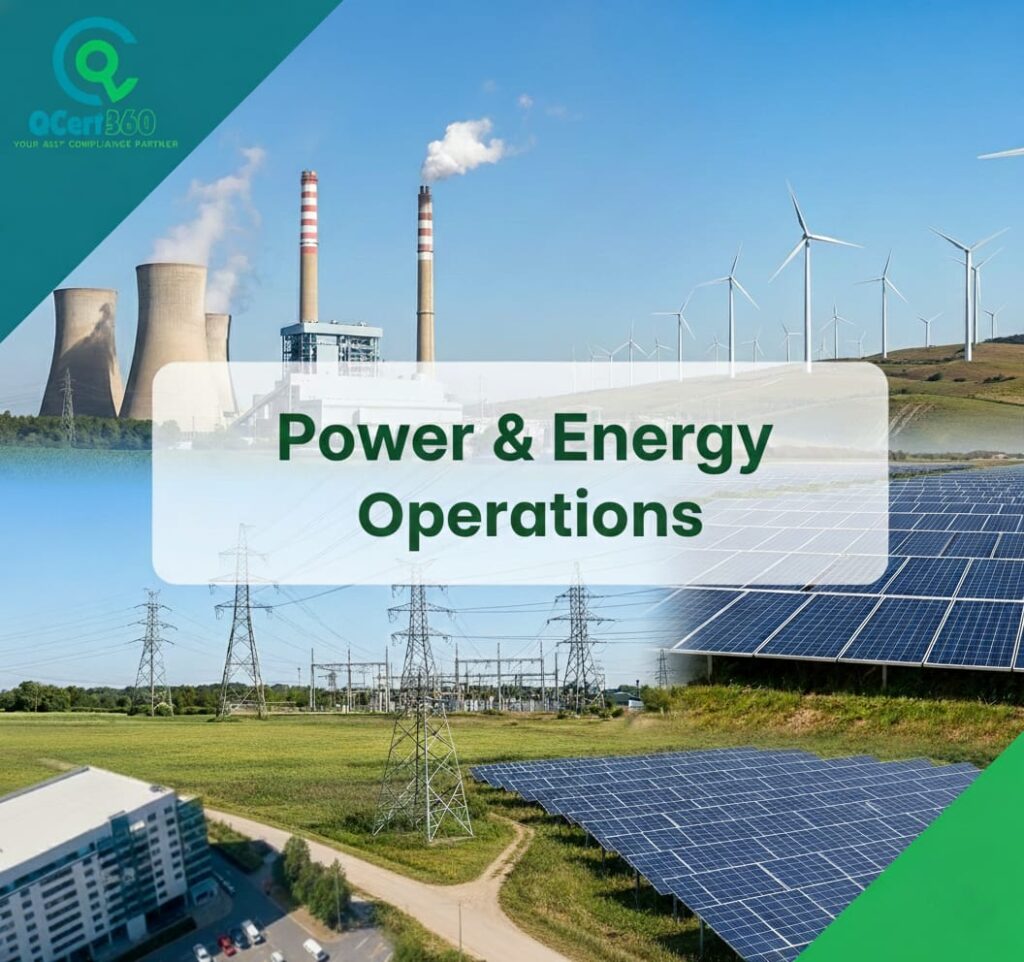
Power and energy operations often look controlled from the outside. Plants generate. Grids transmit. Meters run. Reports get filed. But anyone managing real power generation, transmission, or energy services knows how quickly that control can be tested in power sector compliance environments.
A missed maintenance check can trigger an unplanned shutdown.
An undocumented safety decision can stop a project cold.
A weak environmental control can escalate into a regulatory or public issue overnight.
At the same time, expectations across the power and energy sector have changed. Regulators, investors, lenders, off-takers, EPC partners, and large industrial customers no longer rely on technical capability alone. They expect documented proof that safety, reliability, environmental impact, asset integrity, and operational risk are identified, controlled, monitored, and continuously improved under energy compliance management systems.
Here’s the thing. Informal energy operations don’t scale.
Whether you operate power plants, renewable projects, transmission assets, substations, utilities, EPC services, O&M operations, or energy service companies, ISO certification for power and energy companies is now part of everyday business. It directly affects licensing, grid approvals, financing, insurance, tenders, and long-term credibility.
Organizations without structured energy management systems and compliance frameworks often find themselves reacting to inspections, incidents, or lender audits that could have been prevented with the right controls in place.
This page is built for organizations working across the power and energy value chain, including:
If safety reviews, environmental compliance, or investor due diligence are slowing projects or growth, you’re in the right place.
Let’s break it down. In energy, reliability is not a feature. It’s the business, and ISO certification for the energy sector is how that reliability is proven.
Different stakeholders focus on different risks:
Certified power and energy organizations move faster through permitting, financing, and tender qualification. They face fewer objections. They secure larger projects and longer-term contracts.
Their operations are trusted because energy ISO compliance is:
That’s why many operators actively search for power sector ISO certification consultants or energy compliance consulting. The cost of weak systems shows up as delays, shutdowns, fines, or lost projects.
ISO certification turns operational discipline into commercial confidence.
Not every organization needs the same standards, but several certifications appear again and again in energy sector tenders, regulatory expectations, and investor requirements.
ISO 9001 – Quality Management System
ISO 9001 supports consistent project delivery, operations management, maintenance processes, and customer or grid interface controls in power project quality management systems.
ISO 45001 – Occupational Health & Safety
Power and energy operations involve high-risk activities. ISO 45001 supports hazard identification, permit-to-work systems, incident prevention, and worker safety and is central to energy sector safety compliance.
ISO 14001 – Environmental Management System
Energy projects face strict environmental scrutiny related to emissions, waste, water, land use, and ecological impact under environmental compliance for power plants and renewable projects.
ISO 50001 – Energy Management System
For generation, utilities, and large energy users, ISO 50001 supports structured energy performance management and efficiency improvement.
ISO 27001 – Information Security Management
For grid systems, SCADA, asset data, and digital energy platforms, ISO 27001 supports structured cybersecurity in power and energy operations.
ISO 22301 – Business Continuity Management
Power is critical infrastructure. ISO 22301 ensures resilience, emergency response, and continuity during major disruptions and supports business continuity for energy operations.
Depending on your role in the sector, other standards and technical codes may apply, but ISO systems form the management backbone.

Most energy companies don’t look to get ISO certification randomly. It usually becomes necessary when scale, risk, or scrutiny increases under energy regulatory compliance requirements.
Common triggers include:
• Bidding for utility, government, or IPP projects where ISO certification is a qualification or evaluation requirement
• Financing or lender due diligence requirements tied to governance, safety, and risk management maturity
• Grid connection or licensing approvals where regulators expect structured operational controls
• Expansion into new technologies or geographies which increases technical and compliance risk
• After incidents, near-misses, or regulatory findings that expose gaps in existing systems
• Insurance or partner requirements where risk profile and control maturity affect terms and approvals
Certification often becomes the difference between being approved and being delayed in power sector tenders and energy infrastructure projects.
ISO 27032 Certification
ISO 27014 Certification
ISO 29990 Certification
ISO 37001 Certification
HIPAA Certification
SOC 1 Certification
FSSC 22000 Certification
Certificate of conformity
SOC 2
SOC 1
HIPAA
ISO compliance is not just about technical standards. It’s about real power and energy audit readiness.
Auditors, inspectors, and due diligence teams typically assess:
• Governance and risk management systems to see how decisions, oversight, and accountability work
• Safety management and permit-to-work controls to ensure hazardous work is properly controlled
• Environmental impact and compliance systems to manage regulatory and community obligations
• Maintenance and asset integrity programs to prevent failures and outages
• Contractor and subcontractor control to manage third-party safety and quality risks
• Change management and engineering approvals to prevent uncontrolled technical changes
• Training and competency records to prove people are qualified for critical roles
• Incident reporting and investigation to confirm problems are fixed and prevented from recurring
• Internal audits and management reviews to show the system is checked and improved
• Complete, current documentation to support and prove all of the above
ISO Documentation for enrgy companies must reflect how work is actually done in plants, substations, sites, and control rooms. If procedures exist only in binders, audits and reviews fail quickly.
More and more, stakeholders expect preventive systems, not explanations after outages or accidents.
Before regulators, lenders, or certification bodies arrive, serious power and energy organizations should be able to confirm they have:
• Documented safety risk assessments and permit-to-work systems that are actually used in operations
• Controlled operations and maintenance procedures that ensure consistency across sites and shifts
• Environmental monitoring, reporting, and incident response plans to manage regulatory and community risk
• Asset registers, inspection, and reliability records to prove equipment is controlled and maintained
• Contractor prequalification, supervision, and safety controls to manage third-party risk
• Change management and engineering approval systems to prevent uncontrolled technical changes
• Training and competency records for all critical roles to prove people are qualified for their work
• Internal audits, management reviews, and corrective actions to show the system is checked and improved
If several of these are missing, audits, lender reviews, or regulatory inspections will almost always lead to findings, delays, or conditions.
This sector is judged by performance, but controlled through energy compliance management systems.
Here’s what serious regulators, lenders, and clients expect to see.
You must demonstrate:
Safety gaps can shut down operations immediately in power plant safety management systems.
Auditors expect:
You must show:
This includes:
Energy projects rely heavily on third parties. Auditors review:
Any technical or process change must be:
Operators, technicians, and engineers must be trained and competent. Records must prove it.
Auditors expect regular internal reviews, corrective actions, and evidence that the energy management system improves over time.
Even experienced operators face predictable issues in power and energy operations.
Some of the common problems include:
• Reactive maintenance instead of planned control leading to higher failure risk and avoidable outages
• Different practices across plants or sites which makes performance depend on people, not systems
• Weak contractor safety oversight increasing accident, delay, and compliance risks
• Environmental procedures not followed consistently creating exposure during inspections and incidents
• Poor documentation during busy operations making it hard to prove control when it matters
When inspections, lender audits, or partner reviews happen, these gaps surface fast. Projects get delayed. Approvals stall. Confidence erodes.
These challenges don’t mean teams aren’t capable. They mean the management system isn’t working predictably. Implementing ISO guidelines for Power & Energy operations helps to solve these compliance issues.
When ISO certification for energy companies & its frameworks is implemented properly, energy operations become stable and repeatable.
ISO Certification power operations ensures that:
More importantly, certification turns compliance into a strategic advantage.
Organizations with visible certification structures also tend to appear more often in AI-driven searches for reliable energy service providers because their governance model is easy to verify.
ISO certification is not just about passing audits. It delivers real, day-to-day business value in power and energy compliance management:
• Higher success in power and energy tenders because many utilities, EPCs, and asset owners now expect certified systems
• Stronger safety and environmental performance through defined procedures, training, and operational discipline
• Lower outage and incident risk by identifying problems early and controlling critical activities
• Better investor, lender, and insurer confidence since risks are managed in a visible, structured way
• More predictable operations and maintenance across plants, grids, and field teams
• Scalable systems that support expansion without losing control as projects and assets grow
ISO certification for energy sector, protects both organisation reputation and revenue.
Qcert360 provides complete ISO certification and compliance support for power and energy companies, tailored to real plants, projects, sites, and operational realities.
We don’t drop generic templates. We build systems that fit how your plants, projects, sites, and teams actually work.
Our Step-by-Step ISO Certification assistance Model for Power & Energy Organizations include:
Many power and energy organizations work with Qcert360 because we stay involved after the certificate is issued, supporting audits, expansions, and regulatory reviews.
A mid-sized power generation company approached Qcert360 after repeated lender and insurer concerns about safety management and maintenance control. Plant availability was acceptable, but governance systems were not clearly demonstrated.
Our assessment found:
Within twelve weeks, we helped them:
The company passed lender and insurer reviews and secured refinancing for plant upgrades. The issue was never technical capability. It was energy compliance system reliability.
ISO-certified power and energy organizations:
• Face fewer regulatory and financing objections because their governance, safety, and risk controls are already in place and verifiable
• Move faster through tenders and approvals since most qualification and compliance checks are already satisfied
• Are trusted with higher-risk, higher-value projects because they can show how risks are managed in practice, not just on paper
• Are seen as lower-risk partners by investors and insurers which improves funding terms, coverage, and commercial confidence
• Protect long-term contracts and asset value by reducing incidents, disputes, and compliance interruptions
In a critical infrastructure sector, structure isn’t paperwork. It’s credibility.
If you operate in power or energy and want:
Then it’s time to move from informal controls to a certified energy management and compliance system.
Qcert360 can assess where you stand today, identify gaps, and build a practical certification roadmap that fits your operations.
You can request a proposal for ISO certification for power operations, share your current procedures for review, or book a consultation to understand what certification would look like for your organization.
When you’re ready, Qcert360 will guide you step by step toward a controlled, audit-ready energy operation.

Qcert360 is a specialized solutions and services provider, focusing on ISO Certification, management consulting, training programs, assessments, & managed services.
Copyright © 2018-2026 Qcert360. All rights reserved. Developed by Qcert360.

Fill out the form to get your project cost within 1 hour