
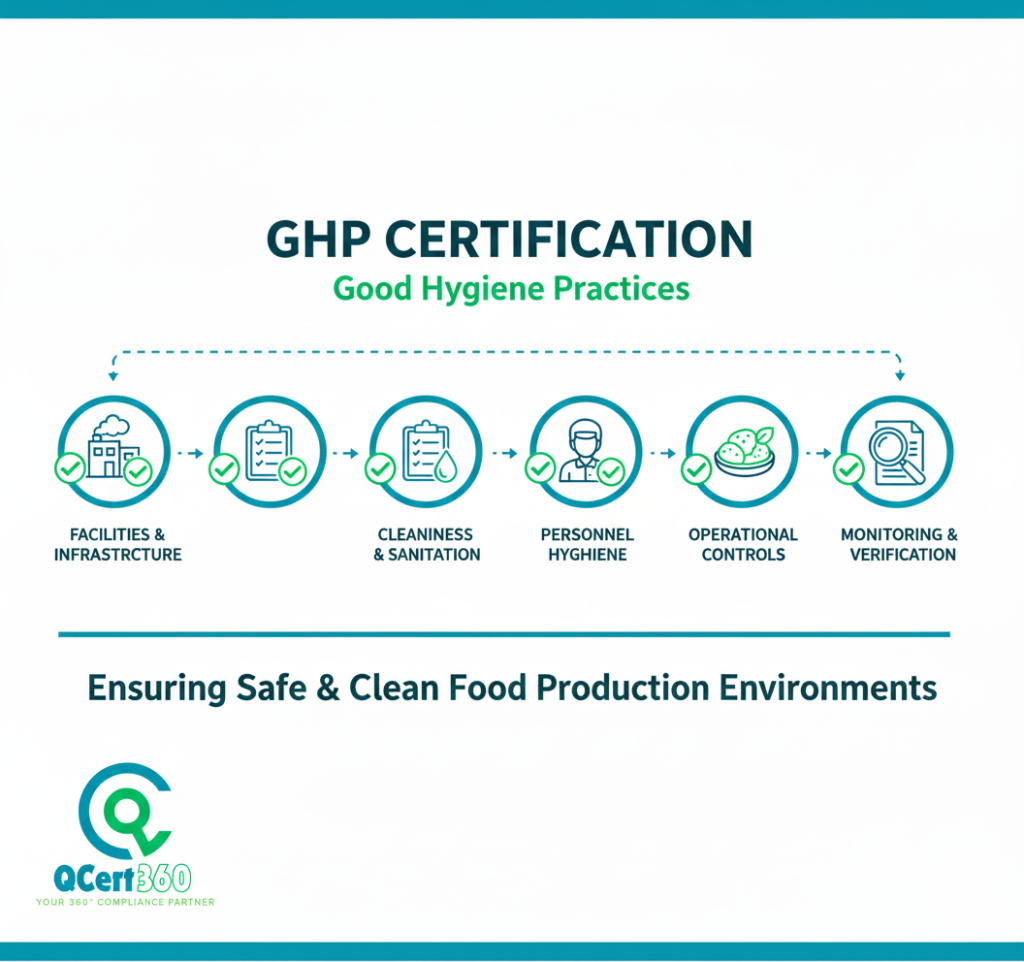
GHP (Good Hygiene Practice) Certification is a standard that ensures safe and hygienic practices in food handling, processing, and storage. It focuses on maintaining cleanliness, preventing contamination, and safeguarding consumer health throughout the food supply chain. The standard covers areas such as personal hygiene, facility sanitation, equipment maintenance, pest control, and staff training. GHP provides a foundation for implementing food safety systems like HACCP and ISO 22000. Certification demonstrates a company’s commitment to producing safe, high-quality food, complying with regulatory requirements, and protecting
contact@qcert360.com
For food producers, processors, retailers, and distributors, GHP (Good Hygiene Practices) certification is a globally recognized standard that ensures hygiene and safety throughout the food chain. It demonstrates that organizations follow systematic practices to prevent contamination, safeguard public health, and comply with food safety regulations. GHP certification is often a prerequisite for food safety schemes like HACCP and ISO 22000, making it a cornerstone of trusted food production.
GHP (Good Hygiene Practices) is a preventive food safety standard that focuses on maintaining hygiene and cleanliness during food handling, preparation, processing, storage, and distribution. It ensures organizations implement practices such as proper sanitation, pest control, waste management, and personal hygiene to reduce contamination risks. Certification confirms compliance with international food hygiene requirements, giving businesses credibility in both domestic and global markets.
Obtaining certification boosts brand visibility and credibility, making products and services more attractive to consumers and increasing market share in global markets.
Certification assure customers of consistent quality, safety, and reliability, fostering trust, increasing brand loyalty, and ensuring higher levels of customer satisfaction.
Certification ensure compliance with global standards and regulations, helping businesses avoid legal issues, penalties, and enabling smoother entry into diverse international markets.
Holding certification distinguishes a business from competitors, signaling superior quality and reliability, and positioning the company as an industry leader in the market.
Certification provide access to new international markets, demonstrating that a business meets global standards, which facilitates expansion and opens doors to new business opportunities worldwide.
Certifications help identify and mitigate risks, streamline operations, and reduce errors or defects, ensuring efficiency and consistency while safeguarding against operational disruptions.
Achieving GHP certification is not a one-time task—it requires continuous effort to maintain the standards that ensure food safety and hygiene. Businesses must stay committed to routine checks, corrective measures, and ongoing staff engagement.
Regular Inspections and Hygiene Audits – Certified facilities undergo scheduled audits to confirm ongoing compliance. These inspections help identify gaps early and keep hygiene practices consistently effective.
Staff Training on Sanitation, Hygiene, and Handling Practices – Food safety is only as strong as the people implementing it. Continuous training ensures that employees remain updated on hygiene protocols and can handle food responsibly.
Updating Processes with Evolving Food Safety Laws – Food safety regulations change with new scientific insights and global trade requirements. Organizations must revise their hygiene protocols to remain aligned with current legal and industry expectations.
Continuous Monitoring of Facilities, Suppliers, and Logistics – Maintaining hygiene extends beyond the facility walls. Regular checks on suppliers, storage conditions, and transportation practices are crucial to ensuring the entire supply chain upholds GHP standards.
Corrective Actions for Non-Compliance – When issues are found, swift corrective measures are necessary. Proactive problem-solving not only prevents risks but also demonstrates a company’s commitment to safe practices.
This continuous cycle of monitoring, training, and improvement ensures that GHP certification remains credible and valuable. It safeguards consumers, enhances brand reputation, and opens long-term business opportunities in both domestic and international markets.
Achieving GHP certification requires expert guidance, detailed documentation, and consistent process implementation. At Qcert360, we help organizations build robust hygiene systems, conduct gap assessments, and prepare for audits with confidence.
By partnering with Qcert360, businesses ensure compliance with global hygiene requirements, reduce risks of contamination, and gain trust from regulators and buyers. Our expertise helps companies not just achieve certification but also embed long-term hygienic practices that improve consumer safety and brand reputation. With Qcert360, you move beyond compliance to set a higher benchmark for safety, hygiene, and trust in the food industry.

Ryan Dias is a compliance and certification consultant at QCert360, specializing in ISO standards, SOC 1&2, HACCP, GDPR, PCI DSS, GMP, HIPAA, CE Marking, and international regulatory compliance solutions. He helps businesses across the globe strengthen compliance systems, improve operational efficiency, meet regulatory and buyer requirements, and achieve internationally recognized certifications & approvals that support sustainable growth, market credibility, and business expansion.
Trustindex verifies that the original source of the review is Google. They helped us with international standards consulting , which enabled us to expand globally with confidence.”Posted on GoogleTrustindex verifies that the original source of the review is Google. Their management consulting team provided us with actionable insights that transformed our business strategy.Posted on GoogleTrustindex verifies that the original source of the review is Google. We achieved RoHS compliance consulting with their expert help, ensuring we met environmental regulations.Posted on GoogleTrustindex verifies that the original source of the review is Google. Their ISO Certification Services are reliable, efficient, and tailored to our industry-specific needs.Posted on GoogleTrustindex verifies that the original source of the review is Google. They guided us through CCPA compliance consulting - very Professional and attentive to our needs.Posted on GoogleTrustindex verifies that the original source of the review is Google. The Team's support for HACCP certification was detailed & thorough, making the complex process manageable for our food Business.Posted on GoogleTrustindex verifies that the original source of the review is Google. I visited for PIPEDA Certification and it was seamless.Posted on GoogleTrustindex verifies that the original source of the review is Google. I recommend their international standards consulting.Posted on GoogleTrustindex verifies that the original source of the review is Google. Their management consulting firm gave us fresh insights.Posted on GoogleTrustindex verifies that the original source of the review is Google. Their SOC compliance services are excellent.Verified by TrustindexTrustindex verified badge is the Universal Symbol of Trust. Only the greatest companies can get the verified badge who has a review score above 4.5, based on customer reviews over the past 12 months. Read more

Qcert360 is a specialized solutions and services provider, focusing on ISO Certification, management consulting, training programs, assessments, & managed services.
Top Searched on QCERT360: ISO 9001 Certification | ISO 14001 Certification | ISO 45001 Certification | ISO 22000 Certification | ISO 27001 Certification | ISO 13485 Certification | ISO 17025 Certification | ISO 27701 Certification | ISO 20000-1 Certification | ISO 27032 Certification | ISO 22716 Certification | ISO 21001 Certification | ISO 28000 Certification | ISO 29993 Certification | ISO 27017 Certification | ISO 27018 Certification | ISO 50001 Certification | ISO 27014 Certification | ISO 29990 Certification | ISO 37001 Certification | ISO 41001 Certification | ISO 55001 Certification | ISO 22301 Certification | ISO 42001 Certification | ISO 22483 Certification | ISO 15189 Certification | GDP Certification | KOSHER Certification | HIPAA Certification | GLP Certification | SA 8000 Certification | HALAL Certification | FCC Certification | SOC 1 Certification | GMP Certification | FSSC 22000 Certification | Certificate of Conformity | CE Certification | ROHS Certification | BIFMA Certification | REACH Certification | SOC 2 Certification | NEMA Certification | HACCP Certification | GDPR Certification
Service providing Sectors: Manufacturing Industry | Electronics & Electrical Equipment Industry | Food & Beverage Processing Industry | Pharmaceuticals & Medical Devices Industry | Cosmetics & Personal Care Industry | Construction & Infrastructure Industry | Automotive & Auto Components Industry | Aerospace & Aviation Industry | Logistics & Supply Chain Industry | Warehousing & Storage Industry | Oil & Gas Industry | Renewable Energy Industry | Telecommunications Industry | Information Technology & IT Services Industry | Software, SaaS & Cloud Industry | E-Commerce & Online Retail Industry | Textiles & Apparel Manufacturing Industry | Chemical Manufacturing Industry | Plastics & Polymer Industry | Mining & Metals Industry | Agriculture & Agribusiness Industry | Food Farming & Processing Industry | Packaging, Materials & Printing Industry | Hospitality Industry | Healthcare Industry | Education & Training Institutions | Financial Services & Fintech | Banking & Insurance | Public Sector & Government Services | Real Estate & Facility Management Industry | Marine, Shipping & Port Operations | Power & Energy | Trading Companies | Transport Industry | Import & Export Businesses
Copyright © 2018-2026 Qcert360. All rights reserved. Developed by Qcert360.
Fill out the form to get your project cost within 1 hour