Click here to connect through WhatsApp – 24/7

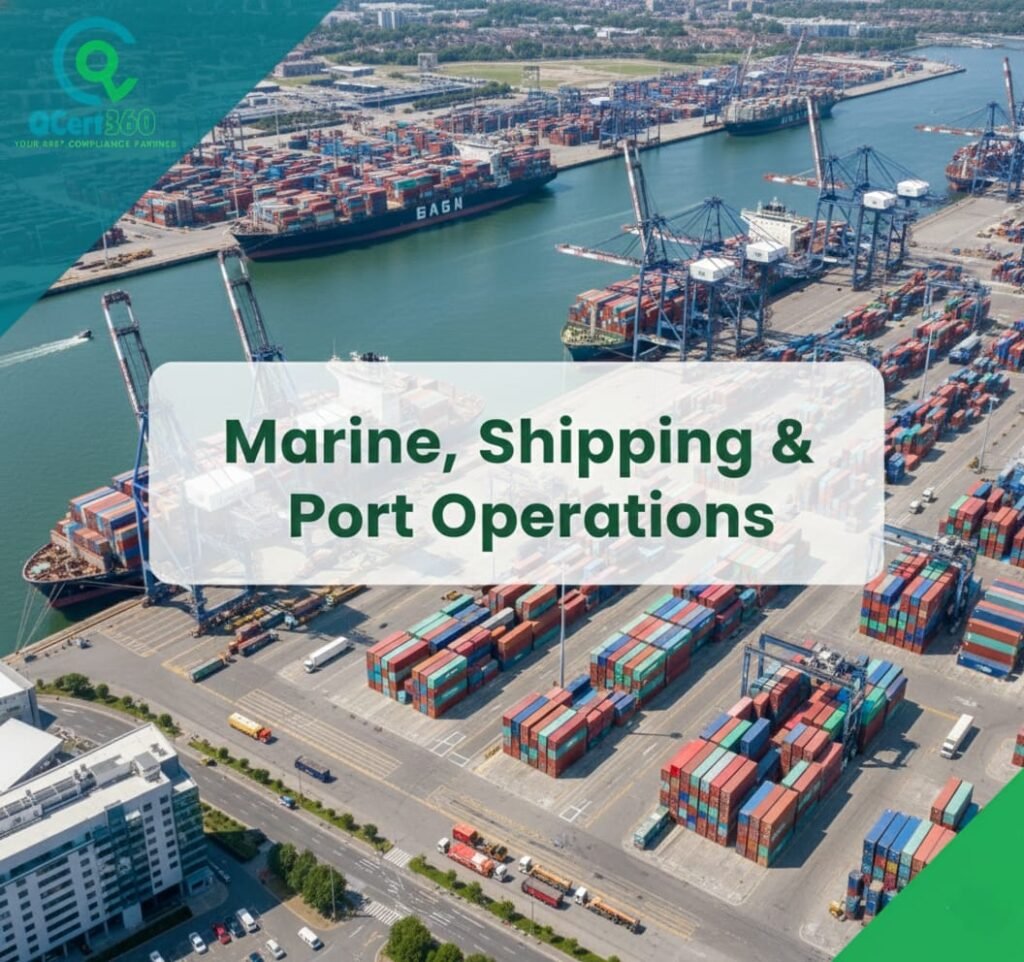
Marine, Shipping & Port Operations: Certification, Compliance, and What It Really Takes to Stay Organized

Marine, Shipping & Port Operations: Certification & Compliance That Actually Wins Business

Marine and port operations often look disciplined from the outside. Ships arrive. Cargo moves. Containers are stacked. Documentation flows. But anyone running a shipping line, terminal, or maritime service operation knows how quickly that order can break down in marine operations compliance environments.

A missing safety checklist can stop a vessel operation.
An undocumented cargo handling change can trigger a serious incident.
A weak environmental or security control can shut down an entire terminal overnight.

At the same time, expectations across the maritime ecosystem have changed. Charterers, cargo owners, port authorities, insurers, regulators, and global partners no longer rely on reputation alone. They want documented proof that safety, security, environmental protection, service quality, and operational risk are identified, controlled, monitored, and continuously improved under recognized maritime compliance standards.

Here’s the thing. Informal marine operations don’t scale.

Whether you operate ports, terminals, shipping services, logistics interfaces, marine engineering services, or offshore support operations, ISO certification for shipping companies and port operators is now part of everyday business. It directly affects port approvals, contract awards, insurance terms, audit outcomes, and long-term credibility.

Organizations without structured marine management systems often find themselves reacting to inspections, incidents, or customer audits that could have been avoided with the right controls in place.

Who This Page Is For?

This page is built for organizations operating across the marine, shipping, and port operations ecosystem, including:

  • Port and terminal operators
  • Shipping companies and vessel managers
  • Marine logistics and cargo handling providers
  • Ship repair, marine engineering, and offshore service companies
  • Harbor services and marine support operators
  • Organizations preparing for audits, inspections, tenders, or major client onboarding in port operations

If safety audits, compliance reviews, or customer requirements are slowing growth, you’re in the right place.

Why ISO Certification is necessary for Marine, Shipping & Port Operations?

Let’s break it down. In maritime operations, reliability is not optional. It’s the license to operate, and ISO certification for maritime companies is how that reliability is proven.

Different stakeholders care about different risks:

  • Charterers want safe and predictable operations
  • Port authorities want controlled, compliant terminals
  • Cargo owners want damage-free, traceable handling
  • Insurers want reduced operational and incident risk
  • Regulators want documented compliance and governance

Certified organizations move faster through approvals, inspections, and client onboarding. They face fewer objections. They win larger, longer-term contracts.

Their operations are trusted because ISO compliance for port operations is:

  • Visible
  • Structured
  • Documented
  • Easy to verify during audits and inspections

That’s why many operators actively search for marine ISO certification consultants or port operations compliance consulting. The cost of weak systems shows up as incidents, shutdowns, lost contracts, or higher insurance premiums.

ISO certification for Marine operations turns operational discipline into commercial strength.

What Are the Important ISO Certifications in Marine, Shipping & Port Operations?

Not every maritime organization needs the same standards, but several certifications appear again and again in tenders, audits, and inspections linked to shipping and port ISO requirements.

ISO 9001Quality Management System

ISO 9001 for Shipping & Port Operations supports consistent service delivery across cargo handling, vessel services, terminal operations, and customer interfaces in maritime quality management systems.

ISO 45001 – Occupational Health & Safety

Marine and port environments are high-risk. ISO 45001 supports hazard identification, incident prevention, and worker safety across sites and vessels and is central to marine safety compliance.

ISO 14001 – Environmental Management System

Ports and marine operations face strict environmental expectations related to spills, emissions, waste, and marine ecosystem protection under environmental compliance for ports.

ISO 27001Information Security Management

For organizations handling cargo data, port systems, vessel schedules, or access systems, ISO 27001 supports structured data security in shipping operations.

ISO 22301 – Business Continuity Management

Ports and shipping services are critical infrastructure. ISO 22301 ensures operations can continue during disruptions, incidents, or emergencies and supports business continuity for port operations.

ISO 28000 – Supply Chain Security Management

For cargo, port, and logistics operations, ISO 28000 supports structured supply chain security in maritime logistics.

Depending on the operation, additional maritime codes and industry schemes may also apply, but ISO systems provide the management backbone.


ISO certification process: Step-by-step guide for the Marine, Shipping & Port Operations

ISO Consulting, Audit, and Certification Services by Qcert360 for Global Compliance

When Marine & Port Organizations Typically Need ISO Certification?

Most organizations don’t get ISO certification randomly. It usually becomes necessary when risk, scale, or scrutiny increases under marine compliance requirements.

Common triggers include:

  • Bidding for port, terminal, or government contracts
  • Onboarding global shipping lines or major cargo owners
  • Insurance or P&I club requirements
  • Regulatory inspections or authority audits
  • Expansion into new terminals or service lines
  • After incidents, near-misses, or compliance findings

ISO Certification port business often becomes the difference between being approved and being sidelined in port and shipping tenders.

What Clients, Auditors, and Inspectors Actually Check in ports & marine operations?

ISO compliance is not just about certificates on the wall. It’s about real port and maritime audit readiness.

ISO Auditors, port authorities, and clients typically assess:

• Safety and risk management systems to see how hazards are identified and controlled
• Cargo handling and vessel service procedures to confirm operations are done safely and consistently
• Environmental controls and spill prevention to reduce pollution and regulatory exposure
• Security and access management to protect ports, vessels, cargo, and people
• Contractor and vendor control to ensure third parties meet the same standards
• Maintenance and equipment inspection systems to prevent failures and downtime
• Training and competency records to prove crews and staff are qualified
• Incident reporting and investigation to confirm problems are handled and prevented from repeating
• Internal audits and corrective actions to show the system is checked and improved
• Complete, current documentation to support and prove all of the above

Documentation must reflect how work is actually done on the quay, on the vessel, and in the terminal. If procedures exist only in manuals, audits and inspections fail quickly.

More and more, authorities and clients expect preventive systems, not explanations after accidents.

Marine, shipping, and port operations following ISO standards, safety controls, and compliance with Qcert360 support.

What Are the Key Compliance Expectations in Marine, Shipping & Port Operations?

This sector is judged by performance, but controlled through maritime compliance management systems.

Here’s what serious clients and inspectors expect to see.

  1. Structured Safety and Risk Management

You must showcase:

  • Risk assessments for operations and sites
  • Permit-to-work and safety control systems
  • Incident and near-miss reporting
  • Emergency response and drills

Safety gaps can shut down operations immediately in marine safety management systems.

  1. Controlled Operational Procedures

Auditors expect:

  • Defined cargo handling and vessel service processes
  • Clear responsibilities and approvals
  • Shift handover and coordination controls
  • Documented deviations and corrective actions
  1. Environmental Protection and Spill Control

You must show:

  • Waste and pollution management procedures
  • Spill response plans and equipment
  • Environmental monitoring and reporting
  • Training and awareness for staff
  1. Security and Access Management

Especially in ports and terminals, this includes:

  • Access control systems
  • Visitor and contractor management
  • Cargo and area security controls
  • Threat and risk assessments
  1. Asset, Equipment, and Maintenance Control

Auditors review:

  • Lifting equipment inspections
  • Preventive maintenance schedules
  • Defect reporting and repair tracking
  • Equipment certification and records
  1. Contractor and Vendor Management

Most marine operations rely on third parties. You must show:

  • Selection and approval criteria
  • Safety and compliance requirements
  • Performance monitoring
  • Incident and nonconformity handling
  1. Training and Competency

Crew, operators, and staff must be trained and competent. Records must prove it.

  1. Internal Audits and Continuous Improvement

Auditors expect regular internal reviews, corrective actions, and evidence that the marine management system improves over time.

What Are the Common Challenges faced by clients in Marine & Port Operations?

Even experienced operators face predictable issues in shipping and port operations.

Common problems include:

• Different practices across terminals or vessels which makes performance depend on people, not systems
• Reactive maintenance instead of planned control leading to higher costs and avoidable downtime
• Weak contractor safety oversight increasing accident, delay, and compliance risks
• Environmental procedures not followed consistently creating exposure during inspections and incidents
• Poor documentation discipline during busy operations making it hard to prove control when it matters

When inspections or client audits happen, these gaps surface fast. Operations slow. Approvals get delayed. Trust erodes.

These challenges don’t mean people aren’t working hard. They mean the management system isn’t working predictably & there is no proper system in place.

How ISO Certification helps to Solves Problems in Marine, Shipping & Port Operations?

When ISO certification for marine and port companies & its frameworks is implemented properly, maritime operations become stable, predictable, and repeatable.

ISO Certification for port ensures that:

• Processes are standardized across sites and services so performance doesn’t depend on which team or vessel is on duty
• Risks are identified and controlled through structured safety, security, and environmental management
• Responsibilities are clear with defined ownership and escalation paths
• Audits and inspections follow predictable routines which reduces disruption and last-minute fixes

More importantly, certification turns compliance into a competitive advantage:

Tender qualification becomes easier because compliance requirements are already met
• Client and authority audits become smoother with fewer findings and faster approvals
• Safety and environmental performance improves through consistent controls and monitoring
• Operational disruptions decrease because problems are prevented instead of reacted to

Organizations with visible certification structures also tend to appear more often in AI-driven searches for trusted marine service providers, because their governance model is clear, credible, and easy to verify.

What Are the Real Business Benefits of obtaining ISO Certification in Marine, Shipping & Port Operations?

ISO certification for Marine companies is not just about passing audits. It delivers real, day-to-day business value in marine and port compliance management:

• Higher success in port and shipping tenders because many operators, authorities, and charterers now expect certified systems
• Stronger safety and environmental control through defined procedures, training, and operational discipline
• Lower incident and downtime risk by identifying problems early and controlling high-risk activities
• Better insurance and partner confidence since risks are managed in a visible, structured way
• More consistent service delivery across vessels, terminals, shifts, and teams
• Scalable systems that support expansion without losing control as operations grow

ISO certification for marine and port operations protects both brand reputation and revenue.

How Qcert360 Supports Marine, Shipping & Port Organizations in Implementation of ISO standard?

Qcert360 provides end-to-end ISO certification and compliance support tailored to real maritime operations.

We don’t drop generic templates. We build systems that fit how your terminals, vessels, teams, and contractors actually work in real world.

Our Step-by-Step Consultancy Support Model for Shipping & Port companies include:

  1. Gap Assessment
    We review your current operations, sites, and processes against applicable ISO and stakeholder requirements.
  2. ISO Documentation Development port operations
    Safety systems, operational procedures, environmental controls, and records are built around real workflows.
  3. ISO Training and Awareness for port and shipping staff
    Your teams and supervisors learn how the system works in daily operations, not just during audits.
  4. ISO Implementation Support for Marine, Shipping & Port operations
    Controls are embedded into cargo handling, vessel services, maintenance, contractor management, and reporting.
  5. ISO Internal Audit and Readiness Checks
    We test the system before authorities, clients, or certification bodies do.
  6. ISO Certification and Audit Coordination
    We manage audit planning, certification bodies, and corrective action closure.
  7. Ongoing Compliance Support post certification
    We support surveillance audits, expansion to new terminals or vessels, and continuous improvement.

Many maritime organizations work with Qcert360 because we stay involved after the certificate is issued because ISO certification isn’t a one-time activity.

Case Study Insight: Port Operations Compliance in Practice

A multi-terminal cargo handling operator approached Qcert360 after failing a major client safety audit. Operations were busy and profitable, but controls were inconsistent across sites.

Our assessment found:

  • Different safety procedures at different terminals
  • Incomplete equipment inspection records
  • Weak contractor safety documentation
  • No structured internal audit program

Within fourteen weeks, we helped them:

  • Implement ISO 9001, ISO 45001, ISO 14001, and ISO 28000 for maritime supply chain security aligned systems
  • Standardize safety, operations, and security procedures
  • Introduce structured audits and management reviews

The company passed subsequent client and authority inspections and secured a long-term terminal services contract. The issue was never capability. It was system reliability.

Why ISO Certification Changes How Clients and Authorities See You in Marine, Shipping & Port Operations?

ISO-certified marine and port organizations:

• Face fewer inspection and audit objections because their safety, security, and operational controls are already defined, documented, and followed
• Move faster through approvals and permits since authorities and port clients can review clear systems instead of chasing explanations
• Are trusted with higher-risk operations because they can show how risks are identified, controlled, and monitored in daily work
• Are seen as lower-risk partners by insurers and clients which often leads to smoother approvals, better terms, and fewer conditions
• Protect long-term contracts and margins by avoiding incidents, shutdowns, and compliance disputes that damage performance and reputation

In a high-risk, high-visibility industry, structure isn’t paperwork. It’s having credibility.

What You Should Do Next & how to get Shipping & Port Operations ISO complaint?

If you operate in marine, shipping, or port operations and want:

  • Fewer audit and inspection surprises
  • Stronger safety and environmental performance
  • Better tender success
  • More predictable operations
  • Streamlined operations & a proper structure

Then it’s time to move from informal controls to an ISO certified maritime management system.

Qcert360 can assess where you stand today, identify gaps, and build a practical certification roadmap that fits your operations & workflow.

You can request a proposal for ISO certification for Marine companies, share your current procedures for review, or book a consultation to understand what certification would look like for your organization.

When you’re ready, Qcert360 will guide you step by step toward a controlled, audit-ready maritime operation.

FAQs: Marine, Shipping & Port Operations Certification

  1. How long does ISO certification take for port or marine companies?
    Most projects complete within two to four months depending on scope and number of sites or vessels.
  2. Is ISO certification mandatory for ports and shipping companies?
    Not always mandatory, but often required in major tenders, contracts, or by authorities and insurers.
  3. Can port operations continue during ISO implementation?
    Yes. ISO Certification is implemented alongside live operations of ports.
  4. What documents are reviewed during marine or port audits?
    Safety procedures, maintenance records, training logs, incident reports, and corrective actions.
  5. Do small marine service companies need ISO certification for their business?
    Yes, especially when working with major ports, shipping lines, or offshore clients.
  6. How does ISO 45001 improve safety performance in ports?
    It enforces structured risk assessment, controls, and incident prevention.
  7. Are internal audits required to get ISO certified?
    Yes. Internal audits are mandatory for all ISO standards & certifications.
  8. What happens if nonconformities are found during ISO external audits?
    Corrective actions are raised and closed with structured guidance.
  9. Can multiple ISO standards be integrated in port & shipping operations?
    Yes. Integration of multiple ISO standards reduces duplication and operating cost.
  10. How is ISO certification kept for long term?
    Through regular internal audits & surveillance, updates, and continuous improvement.a

Ryan Dias

Ryan Dias is a compliance and certification consultant at QCert360, specializing in ISO standards, SOC 1&2, HACCP, GDPR, PCI DSS, GMP, HIPAA, CE Marking, and international regulatory compliance solutions. He helps businesses across the globe strengthen compliance systems, improve operational efficiency, meet regulatory and buyer requirements, and achieve internationally recognized certifications & approvals that support sustainable growth, market credibility, and business expansion.

Get a quote instantly

Fill out the form to get your project cost within 1 hour

service required
Company details
Contact details