
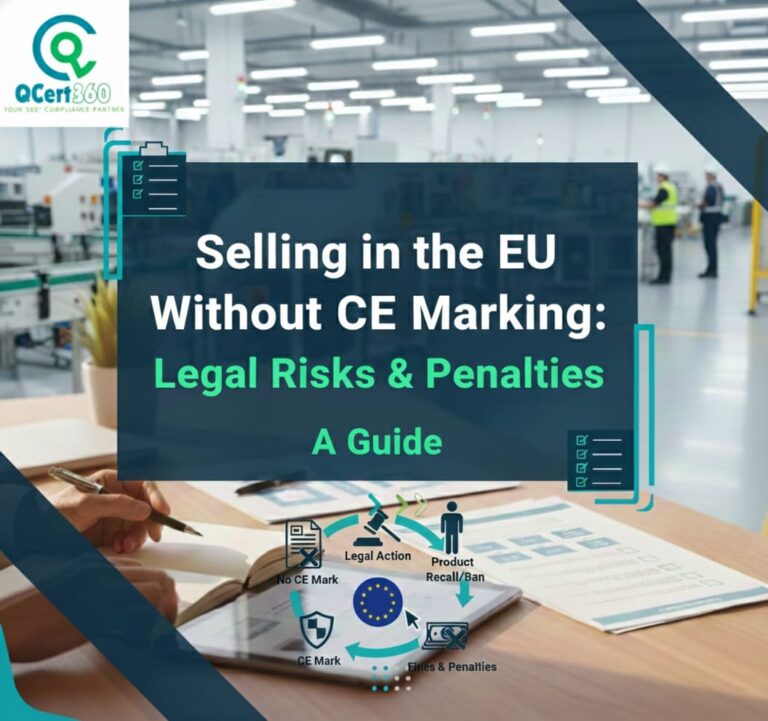
If you’re selling products into the European Union, CE marking is not optional. It’s not a logo. It’s not a marketing badge. It’s a legal requirement for market access. Yet every year, thousands of shipments are blocked, recalled, or banned because manufacturers and exporters either misunderstood CE marking or assumed they could “fix it later.”
Here’s the uncomfortable reality: selling in the EU without CE marking can lead to customs seizure, product bans, forced recalls, fines, and long-term commercial damage. And in many cases, the business impact is far worse than the legal penalty.
In this guide, we’ll break down exactly what happens if you place a non-compliant product on the EU market, who is legally responsible, how enforcement actually works, and how to fix the problem properly. We’ll also show how Qcert360 helps companies turn CE marking from a risk into a reliable market access system.
What happens if you sell in the EU without CE marking?
If a product that legally requires CE marking is sold in the EU without it, authorities can stop it at customs, remove it from the market, order a recall, impose fines, and in serious cases start legal proceedings. Enforcement is not theoretical. It is routine, coordinated across the EU, and increasingly strict due to safety and consumer protection policies.
In practice, this can mean:
- Shipments blocked or seized by EU customs
- Immediate sales ban in one or more EU countries
- Forced product recall from customers
- Public listing in Safety Gate (RAPEX)
- Financial penalties or legal actions
Once your product is flagged, you must prove compliance immediately. If you cannot, the product is treated as illegal.
Why CE marking is legally mandatory in the EU
CE marking is the legal declaration that your product complies with all applicable EU directives and regulations, such as the Machinery Regulation, EMC Directive, Low Voltage Directive, PPE Regulation, or Medical Device Regulation. It is not optional and not negotiable. Without it, your product has no legal right to be sold in the EU.
By affixing CE marking, you are declaring that:
- A proper conformity assessment has been completed
- A technical file exists and is complete
- A Declaration of Conformity (DoC) has been issued
- The product meets all essential health and safety requirements
CE marking is therefore a legal responsibility system, not a documentation exercise.
Who is legally responsible: manufacturer, importer, or distributor?
Under EU law, at least one economic operator in the supply chain must take full legal responsibility for CE compliance, and this can be the manufacturer, the EU importer, or even the distributor. If the manufacturer is outside the EU, the importer almost always becomes the legally responsible party.
In simple terms:
- EU manufacturer: always responsible
- Non-EU manufacturer: EU importer becomes legally responsible
- Distributor: must verify CE marking and documentation exist
This is why “my supplier said it’s CE compliant” is one of the most expensive assumptions in European trade.
What penalties and enforcement actions can authorities impose?
EU authorities can impose product bans, forced recalls, customs seizures, fines, and legal sanctions, often without going to court first, if they believe a product is non-compliant or unsafe. The goal is to protect users and the market, not to negotiate with exporters.
Typical consequences include:
- Customs blocking or seizure
- Market withdrawal orders
- Mandatory recalls from customers
- Prohibition of further sales
- Public safety warnings
- Financial penalties
- Legal action in severe cases
In many cases, the commercial damage and lost trust cost far more than the fines.
How EU market surveillance actually finds non-compliant products
EU enforcement is driven by customs controls, market surveillance inspections, competitor complaints, buyer audits, and online marketplace checks. It is systematic, not random, and increasingly data-driven across EU member states.
Common triggers:
- A shipment is flagged at customs
- A competitor files a complaint
- A customer reports a safety issue
- An online marketplace requests compliance proof
- Authorities run sector-wide inspection campaigns
Once flagged, authorities will typically request:
- Declaration of Conformity
- Technical documentation
- Test reports
- Risk assessment
- Notified Body certificates (if applicable)
If you cannot produce these quickly, your product is considered non-compliant.
Real-world case study: how a machinery exporter lost the EU market
A mid-sized machinery manufacturer outside the EU began exporting packaging machines through European distributors. The machines carried a CE logo, but no proper conformity assessment had been done.
What happened:
- A German market surveillance authority inspected one installation.
- They asked for the technical file and Declaration of Conformity.
- The importer could not provide them.
- The importer was held legally responsible.
The result:
- Immediate sales ban
- Recall of installed machines
- Public listing in Safety Gate (RAPEX)
- Two distributors terminated their contracts
The total loss was several million euros. Proper CE compliance would have cost a tiny fraction of that.
The most common CE marking mistakes that cause enforcement action
Most CE marking violations do not happen because companies want to break the law. They happen because CE is treated as paperwork instead of as a legal compliance system, or because companies copy competitors without understanding the rules. The intention is rarely bad. The execution usually is.
Typical mistakes include:
• Assuming test reports alone are enough even though CE requires a full legal and technical compliance system
• Using wrong or outdated directives or regulations which makes the entire Declaration of Conformity invalid
• Not performing a proper risk assessment as required by EU law
• Having an incomplete or missing technical file that cannot be shown to authorities
• Not appointing an EU-responsible economic operator when the manufacturer is outside the EU
• Using fake, misleading, or irrelevant certificates that have no legal value
• Not reassessing CE compliance after product changes and silently breaking conformity
CE marking must be defensible in front of authorities, not just decorative on the product or packaging.
What happens if your product is already on the EU market?
If authorities discover non-compliance after your product is already being sold, they can require corrective actions, suspend sales, or order recalls depending on the severity and safety risk. You do not get a free pass just because products are already in customers’ hands.
Possible outcomes:
- Minor issues → corrective action plan
- Serious documentation gaps → sales suspension
- Safety risk → recall and public warning
And yes, you bear the cost.
How to fix CE non-compliance properly?
Fixing CE non-compliance is not about patching documents or reusing old test reports. It means rebuilding compliance from the legal foundation up: identifying applicable regulations, performing proper risk assessment, applying the right harmonised standards, compiling a complete technical file, and issuing a correct Declaration of Conformity. There are no shortcuts that survive market surveillance or customs inspections.
The proper process includes:
- Identify applicable EU regulations and directives
You must first determine exactly which EU laws apply to your product, because this defines all legal obligations. - Perform a risk assessment
All safety and compliance risks must be identified, evaluated, and reduced using a structured and documented method. - Apply relevant harmonised standards
The correct standards must be selected and applied to demonstrate presumption of conformity with EU requirements. - Perform required testing
CE certficationTesting must confirm that the product actually meets the technical and safety requirements, not just on paper. - Compile technical documentation
A complete technical file must be built to prove compliance to authorities at any time. - Issue the Declaration of Conformity
This legal document formally declares that the product meets all applicable EU requirements. - Affix the CE marking correctly
Only after all compliance steps are completed can the CE marking be legally placed on the product.
This is exactly where Qcert360 supports manufacturers and exporters by building structured, defensible CE marking systems that stand up to audits, customs checks, and market surveillance.
When is a Notified Body required for CE Marking?
A Notified Body is required only for certain product categories and specific conformity assessment routes, such as some types of PPE, medical devices, pressure equipment, and high-risk machinery. Many products are placed on the market under self-declaration, but this does not reduce the manufacturer’s legal responsibility in any way.
Qcert360 helps clients determine:
• Whether a Notified Body is required for their specific product and regulation
• Which conformity assessment route applies under the relevant EU legislation
• How to manage the process efficiently and correctly to avoid delays, rework, and compliance risk
• Which Notified Body is appropriate and recognized for their product category
• How to prepare the technical file and evidence to pass the Notified Body review on the first attempt
The goal is the right conformity route, not the most expensive or complicated one.
CE marking, customs, and online marketplaces
Today, customs authorities and online marketplaces actively demand CE compliance proof before allowing products to enter or stay on the market. If you cannot provide documentation, your product will be blocked, seized, or delisted.
More and more CE issues are discovered through:
• Platform compliance checks (Amazon, Alibaba, and others now routinely ask for CE files)
• Logistics partner audits before accepting or forwarding shipments
• Buyer due diligence processes during supplier approval
• Market surveillance authority spot checks in the EU
• Competitor or consumer complaints that trigger regulatory investigations
No CE Marking certification documentation means no access to the market.
Why working with Qcert360 changes the outcome
The difference between guessing and doing CE properly is massive—and it often determines whether your product survives market scrutiny or gets stopped at the border.
Qcert360’s CE marking consultants helps you in:
• Identify applicable directives and regulations so your product is assessed against the correct legal requirements
• Build and structure your technical file so it is complete, consistent, and defensible
• Guide risk assessment and testing to ensure safety, EMC, RF, and performance risks are properly controlled
• Prepare the Declaration of Conformity so your legal declaration is accurate and valid
• Coordinate with Notified Bodies if required to manage approvals and avoid costly mistakes
• Create defensible, audit-proof CE compliance that stands up to market surveillance and customer reviews
In short, we turn CE marking from a risk into a controlled, reliable market access system.
Check your CE risk before authorities do
If you are selling or planning to sell in the EU, let Qcert360 review your CE compliance status before enforcement finds the gaps.
👉 Contact Qcert360 for a CE Compliance Review
Turn CE marking into reliable EU market access
CE marking done properly is not a cost. It is a growth enabler.
👉 Talk to Qcert360 about End-to-End CE Marking Support
Frequently Asked Questions (FAQs)
- Is it illegal to sell in the EU without CE marking?
Yes. If your product falls under a CE marking directive or regulation, selling it without CE marking is illegal and considered a regulatory violation. - Can customs seize my products without CE marking?
Yes. EU customs authorities can block, detain, or seize shipments that do not meet CE compliance requirements. - Who is responsible if the manufacturer is outside the EU?
The EU importer or authorized representative becomes legally responsible for compliance and documentation. - What fines apply for CE marking violations?
Fines vary by country, but market bans, recalls, and destroyed stock usually cost far more than any fine. - Can I fix CE compliance after selling?
Sometimes, but authorities may suspend sales, require recalls, or impose corrective actions before allowing continued market access. - Do I always need a Notified Body to obtain CE Mark?
No. A Notified Body is required only for certain product categories and conformity assessment routes defined in EU law. - Is CE marking a certificate?
No. CE marking is a legal declaration by the manufacturer, not a certificate issued by an authority. - What is the Declaration of Conformity?
It is the legal document in which the manufacturer declares that the product complies with all applicable EU requirements. - What is the technical file?
It is the complete set of technical and compliance evidence proving that the product meets EU regulations. - 10. How can Qcert360 help?
Qcert360 provides end-to-end CE marking and EU compliance support, including assessment, documentation, testing strategy, and regulatory guidance.
Our Services
ISO Standards
- ISO 9001 Certification
- ISO 14001 Certification
- ISO 45001 Certification
- ISO 22000 Certification
- ISO 17025 Certification
- ISO 27001 Certification
- ISO 13485 Certification
- ISO 20000-1 Certification
- ISO 41001 Certification
- ISO 22716 Certification
- ISO 50001 Certification
- ISO 22301 Certification
- ISO 29993 Certification
Product Certifications
Other international standards
- FSSC 22000 Certification
- HIPAA
- HACCP Certification
- SA 8000 Certification
- GMP Certification
- GDPR
- GDP Certification
- GLP Certification
- Certificate of Conformity
QCert360 provides a wide range of services including ISO certification, audit support, compliance consulting, and training. They specialize in helping businesses achieve global standards and certifications like ISO 9001, ISO 27001, ISO 14001, and many others. Their team ensures a seamless experience from consultation to certification, supporting clients at every stage.
The time it takes to achieve certification can vary depending on the complexity of the standard and the readiness of your organization. On average, it takes about 3 to 6 months. QCert360 works closely with clients to streamline the process, ensuring that all requirements are met efficiently and within a reasonable timeline.
QCert360 is a trusted partner with years of experience in helping businesses obtain international certifications. Their expert consultants provide tailored solutions, ensuring your organization not only meets but exceeds industry standards. With a customer-centric approach, they focus on offering end-to-end support to simplify the certification journey.
QCert360 serves a wide range of industries including manufacturing, healthcare, information technology, education, and services, among others. They customize their certification solutions to meet the unique requirements of each industry, ensuring relevance and compliance with global standards.
Yes, QCert360 provides ongoing support even after certification. They offer services like surveillance audits, recertification guidance, and consultancy to help maintain and improve your certification status. Their team ensures that your organization stays compliant and up-to-date with any changes in certification standards.
Getting started with QCert360 is simple. You can contact them via their website to request a consultation. Their team will assess your needs, discuss the best certification options for your business, and outline the steps involved. From there, they’ll guide you through the entire process, ensuring you’re prepared for certification.
QCert360 stands out due to its customer-focused approach, industry expertise, and comprehensive service offerings. Their team doesn’t just help you obtain certification but works to ensure your organization thrives in compliance with international standards. They also offer personalized consultation, making the process smoother and more efficient, ensuring long-term success for your business.
The cost of certification varies depending on factors such as the type of certification, the size and complexity of your organization, and the specific industry requirements. QCert360 offers competitive pricing and provides tailored quotes based on your unique needs. They ensure transparency and work with you to find the most cost-effective solution for your certification goals.
Yes, QCert360 offers internal audit services to help assess and improve your organization’s processes. Their expert auditors conduct thorough reviews of your systems and operations to ensure they meet required standards. They also provide actionable recommendations to help enhance efficiency and compliance, making sure you’re fully prepared for external audits.
If your organization doesn’t pass an audit or certification assessment, QCert360 works with you to understand the reasons for non-compliance and provides support to rectify the issues. They offer guidance on corrective actions and help you prepare for a re-assessment. Their goal is to ensure your organization meets the necessary standards for certification, and they will be by your side to make the process as smooth as possible.