
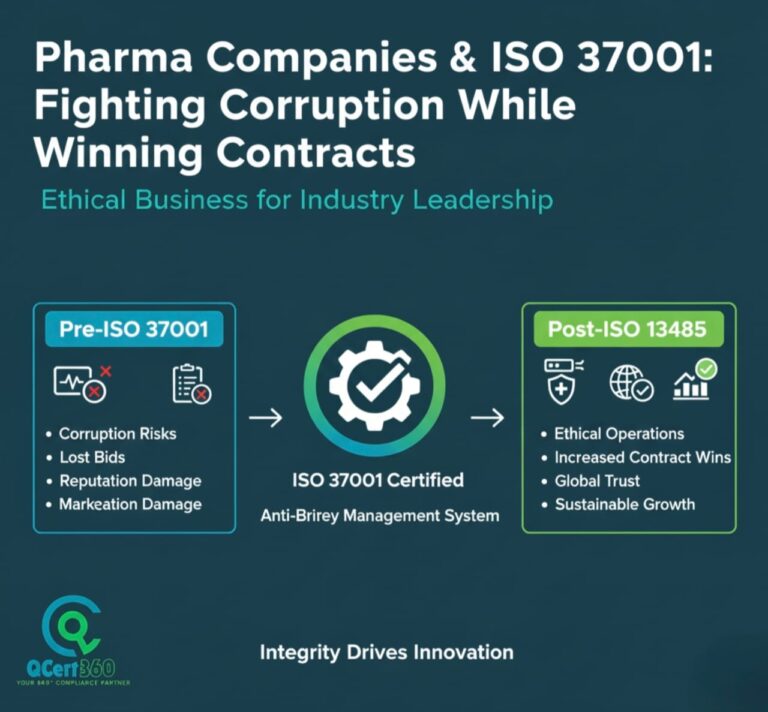
The pharmaceutical industry has always been under the microscope when it comes to transparency and ethics. With billions of dollars flowing through drug development, procurement, and distribution channels, the risks of bribery, kickbacks, and corruption are significant. Regulators, investors, and buyers increasingly expect companies to demonstrate not just compliance with laws, but also a proactive stance on integrity. That’s where ISO 37001 certification for pharmaceutical companies comes in.
This international standard for anti-bribery management systems is no longer just a “good to have.” It is quickly becoming a strategic asset for pharma businesses looking to win contracts, attract investment, and enter global supply chains. Let’s break down why ISO 37001 matters for pharma, how it works in practice, and how companies are using it to create trust while securing competitive advantage.
Why Pharma Companies Face High Corruption Risks
Unlike many other industries, pharmaceuticals operate in an ecosystem where the stakes are life and death. Medicines and vaccines are sold across diverse markets with varying regulatory strengths. The risks are amplified in areas such as:
- Procurement processes: Large government and private sector tenders for drugs often involve intense competition, creating openings for unethical practices.
- Clinical trials and approvals: Companies may face pressure to influence regulators or researchers for faster approvals.
- Supply chain partnerships: Third-party distributors and agents can expose companies to bribery risks if they lack proper oversight.
- Healthcare professional interactions: Promotional activities, sponsorships, and incentives can cross ethical boundaries if not carefully managed.
This is why many global buyers now ask for ISO 37001 compliance in pharma supply chains as proof that their partners uphold ethical standards.
What ISO 37001 Brings to Pharma
ISO 37001 is designed as a practical anti-bribery management framework. For pharma companies, it provides:
- Structured anti-bribery policy – Clear commitments from leadership against bribery, ensuring accountability at the highest level.
- Risk assessment – Identifying where bribery risks are most likely, from tendering to licensing to clinical trials.
- Due diligence – Evaluating suppliers, agents, and contractors for compliance and ethical track records.
- Training and culture building – Educating staff and partners on ethical conduct, whistleblowing, and compliance.
- Monitoring and audits – Regular checks to verify systems are working and gaps are being addressed.
What this really means is that ISO 37001 certification in pharma companies demonstrates both compliance and intent. It shows a commitment to preventing corruption before it occurs, which is precisely what regulators and buyers want to see.
ISO 37001 as a Contract-Winning Tool
Pharma companies that adopt ISO 37001 aren’t just improving their internal ethics. They’re gaining a direct edge in global business. Here’s why:
- Buyer requirements: Multinational corporations, NGOs, and governments increasingly ask for ISO 37001 in their supplier criteria.
- Tender qualifications: Many procurement portals now list anti-bribery certification for pharma tenders as a requirement.
- Investor trust: Ethical governance is central to ESG investing. ISO 37001 signals to investors that the company takes governance seriously.
- Reputation protection: With scandals making headlines worldwide, an ISO-certified company demonstrates accountability and proactive risk management.
Real-World Example: A Mid-Sized Pharma Winning Global Trust
Take the example of a mid-sized pharmaceutical manufacturer supplying vaccines internationally. The company had faced multiple delays in qualifying for tenders because buyers were skeptical about its compliance systems.
After adopting ISO 37001 for pharmaceutical anti-corruption management, the company rolled out strict due diligence on its agents, restructured how it engaged healthcare professionals, and introduced a whistleblower hotline. Within a year, it qualified for two major NGO tenders worth millions of dollars.
Not only did the certification help secure business, but it also improved investor confidence, leading to a successful funding round to expand production.
This case shows that ISO 37001 helps pharma companies win contracts not by ticking boxes but by reshaping trust.
Building a Culture of Transparency
ISO 37001 is not about putting paperwork in place—it’s about changing how a company thinks and acts. For pharmaceutical firms, that often means:
- Shifting from reactive compliance to proactive prevention.
- Training employees and agents to recognize risks in real-world scenarios.
- Embedding ethical checks into clinical trial management, drug promotion, and tender submissions.
- Encouraging whistleblowers to come forward without fear.
This cultural shift is what makes ISO 37001 more powerful than a simple legal safeguard. It creates a trust-based ecosystem that resonates with both regulators and patients.
Linking ISO 37001 to ESG and Sustainability
Pharma companies today are judged not just by what they sell, but how they operate. ESG (Environmental, Social, and Governance) reporting has become a non-negotiable requirement for many buyers and investors.
ISO 37001 plays directly into the “Governance” aspect of ESG. By adopting this standard, pharmaceutical businesses can:
- Report stronger governance practices in ESG disclosures.
- Demonstrate that they have systems in place to prevent corruption.
- Position themselves as responsible players in the healthcare ecosystem.
That’s why many firms now integrate ISO 37001 compliance with ESG strategy in pharma as a way to stand out in competitive markets.
Overcoming Common Challenges in Pharma ISO 37001 Implementation
Pharmaceutical companies often face hurdles in adopting ISO 37001, such as:
- Complex distributor networks: Ensuring compliance across multiple intermediaries can be tough.
- Resistance to change: Staff may see anti-bribery training as an unnecessary burden.
- Cost concerns: Smaller pharma firms may hesitate due to certification costs.
- Global regulatory variations: Multinational pharma companies must align ISO 37001 with diverse regional compliance requirements, which can complicate implementation.
- Monitoring third-party relationships: Pharma firms often rely on consultants, suppliers, and agents, making due diligence and ongoing oversight challenging.
The solution lies in phased implementation. Start with a core policy framework, roll out risk assessments in high-risk areas, and gradually expand coverage. Partnering with expert consultants like Qcert360 helps make the transition smoother and cost-effective.
Key Takeaways ISO 37001 certification
- Pharma is one of the most corruption-exposed industries.
With high-stakes drug approvals, regulatory interactions, and multi-billion-dollar procurement deals, pharmaceutical companies face more scrutiny than most sectors. Even minor compliance lapses can lead to fines, reputational damage, and loss of market access. - ISO 37001 provides a structured system to prevent bribery and strengthen compliance.
The standard creates clear processes for risk assessment, due diligence, whistleblowing, and monitoring third-party relationships. This makes anti-bribery practices less about vague policies and more about measurable, auditable systems. - Certification is increasingly required for tenders, buyers, and investors.
Large healthcare systems, global NGOs, and private buyers now look for proof of ethical governance before awarding contracts. ISO 37001 certification serves as tangible evidence of integrity, reducing the risk for stakeholders. - Beyond compliance, ISO 37001 helps pharma companies build trust, win contracts, and secure funding.
In competitive pharma tenders, certification can be the deciding factor between shortlisted suppliers. Investors also favour companies that manage corruption risks proactively, as it signals sustainable business practices and lower exposure to legal liabilities. - It also strengthens ESG positioning, which is critical for long-term competitiveness.
ISO 37001 aligns with ESG reporting frameworks by addressing governance and transparency indicators. This makes it easier for pharma companies to demonstrate accountability in ESG disclosures, appeal to ethical investors, and differentiate in markets where sustainability matters. - Improves third-party and supply chain management.
Pharma supply chains are often global and complex, involving contract research organizations, distributors, and regulators. ISO 37001 enforces due diligence at every level, minimizing exposure to hidden corruption risks. - Supports internal culture change.
Beyond external validation, certification fosters an internal culture of integrity. Employees are trained to identify risks, report concerns, and understand their role in safeguarding compliance. - Reduces legal and financial risks.
By embedding structured anti-bribery mechanisms, pharma companies can reduce the chances of costly investigations, sanctions, or exclusion from international markets.
FAQs about Pharma Companies & ISO 37001
- What is ISO 37001 certification for pharma companies?
It’s an international anti-bribery management system standard that helps prevent corruption in pharmaceutical operations. - Why is ISO 37001 important for the pharmaceutical industry?
Because pharma is highly exposed to bribery risks in procurement, trials, and distribution, ISO 37001 builds trust with regulators and buyers. - Can ISO 37001 help win pharmaceutical tenders?
Yes. Many tenders now specifically ask for anti-bribery certification as part of qualification. - How does ISO 37001 support ESG reporting in pharma?
It strengthens the governance pillar by demonstrating structured anti-bribery measures. - Is ISO 37001 mandatory for pharmaceutical companies?
Not globally, but many buyers and contracts now require it. - What are the main benefits of ISO 37001 in pharma?
Improved reputation, contract qualification, risk reduction, and investor confidence. - How long does it take for a pharma company to get ISO 37001 certified?
Typically 3–6 months depending on company size and complexity. - What role does employee training play in ISO 37001?
Training is essential to build awareness, prevent unethical behaviour, and encourage reporting. - Can small pharmaceutical companies afford ISO 37001?
Yes, especially if implemented in phases with expert guidance. Costs are outweighed by tender access and risk reduction. - Who can help pharma companies achieve ISO 37001 certification?
Specialized certification consultants like Qcert360 guide companies from policy development to audits and certification.
Our Services
ISO Standards
- ISO 9001 Certification
- ISO 14001 Certification
- ISO 45001 Certification
- ISO 22000 Certification
- ISO 17025 Certification
- ISO 27001 Certification
- ISO 13485 Certification
- ISO 20000-1 Certification
- ISO 41001 Certification
- ISO 22716 Certification
- ISO 50001 Certification
- ISO 22301 Certification
- ISO 29993 Certification
Product Certifications
Other international standards
- FSSC 22000 Certification
- HIPAA
- HACCP Certification
- SA 8000 Certification
- GMP Certification
- GDPR
- GDP Certification
- GLP Certification
- Certificate of Conformity
QCert360 provides a wide range of services including ISO certification, audit support, compliance consulting, and training. They specialize in helping businesses achieve global standards and certifications like ISO 9001, ISO 27001, ISO 14001, and many others. Their team ensures a seamless experience from consultation to certification, supporting clients at every stage.
The time it takes to achieve certification can vary depending on the complexity of the standard and the readiness of your organization. On average, it takes about 3 to 6 months. QCert360 works closely with clients to streamline the process, ensuring that all requirements are met efficiently and within a reasonable timeline.
QCert360 is a trusted partner with years of experience in helping businesses obtain international certifications. Their expert consultants provide tailored solutions, ensuring your organization not only meets but exceeds industry standards. With a customer-centric approach, they focus on offering end-to-end support to simplify the certification journey.
QCert360 serves a wide range of industries including manufacturing, healthcare, information technology, education, and services, among others. They customize their certification solutions to meet the unique requirements of each industry, ensuring relevance and compliance with global standards.
Yes, QCert360 provides ongoing support even after certification. They offer services like surveillance audits, recertification guidance, and consultancy to help maintain and improve your certification status. Their team ensures that your organization stays compliant and up-to-date with any changes in certification standards.
Getting started with QCert360 is simple. You can contact them via their website to request a consultation. Their team will assess your needs, discuss the best certification options for your business, and outline the steps involved. From there, they’ll guide you through the entire process, ensuring you’re prepared for certification.
QCert360 stands out due to its customer-focused approach, industry expertise, and comprehensive service offerings. Their team doesn’t just help you obtain certification but works to ensure your organization thrives in compliance with international standards. They also offer personalized consultation, making the process smoother and more efficient, ensuring long-term success for your business.
The cost of certification varies depending on factors such as the type of certification, the size and complexity of your organization, and the specific industry requirements. QCert360 offers competitive pricing and provides tailored quotes based on your unique needs. They ensure transparency and work with you to find the most cost-effective solution for your certification goals.
Yes, QCert360 offers internal audit services to help assess and improve your organization’s processes. Their expert auditors conduct thorough reviews of your systems and operations to ensure they meet required standards. They also provide actionable recommendations to help enhance efficiency and compliance, making sure you’re fully prepared for external audits.
If your organization doesn’t pass an audit or certification assessment, QCert360 works with you to understand the reasons for non-compliance and provides support to rectify the issues. They offer guidance on corrective actions and help you prepare for a re-assessment. Their goal is to ensure your organization meets the necessary standards for certification, and they will be by your side to make the process as smooth as possible.