Most companies reach a point where a single ISO standard isn’t enough. Clients want stronger controls, buyers expect tighter assurance evidence, and regulatory risks are climbing. That’s usually when businesses start wondering whether they should implement more than one ISO standard at the same time.
Here’s the thing—implementing multiple standards together doesn’t just save time. It builds a unified management system that makes client audits far easier to pass. Instead of juggling disconnected documents, duplicate logs, and conflicting procedures, you operate with one integrated compliance framework that actually works in real life.
This guide breaks down when it makes sense to combine standards, what buyers examine first during multi-standard audits, and how Qcert360 helps companies build systems that scale without stress. If you’re aiming for stronger audit resilience, a cleaner compliance structure, and documentation that impresses clients, this is your roadmap.
Why Businesses Consider Multiple ISO Standards at Once
Most companies don’t wake up thinking about audits, documentation cycles, or certification timelines. They start exploring multiple ISO standards simultaneously because of pressure points like:
- Bigger clients pushing for stronger, verifiable compliance before signing deals.
- The need for consistent processes across teams as your operations grow.
- Expansion of products or services that demands tighter control and documentation.
- Rising expectations around security, quality, or environmental performance.
- Increased scrutiny from investors or buyers who expect mature, well-governed systems.
When these pressures pile up, companies usually start researching terms like integrated management system approach, unified ISO documentation framework, cross-standard compliance alignment, and combined audit preparation strategy. These are high-intent signals that business leaders are ready to scale compliance beyond a single certification.
What this really means is that companies are looking for a simpler way to meet multiple audit expectations without drowning their teams in duplicated tasks.
The Benefits of Implementing Multiple ISO Standards Together
Let’s break down the advantages in a practical way—not as theory, but as real value your team will actually feel.
- One System That Covers Everything
Most ISO standards share similar requirements: leadership involvement, documented processes, risk assessment, awareness, monitoring, internal audits, and continuous improvement. When you combine standards, you build one system rather than several overlapping ones.
This eliminates duplicated forms, repeated reviews, and scattered records.
- Faster Implementation and Lower Costs
A combined project means one gap analysis, one documentation effort, one internal audit cycle, and usually one certification audit. That lowers both project time and cost.
This is also why many businesses search for terms like concurrent ISO certification model or multi-standard implementation roadmap when planning their compliance journey.
- Stronger Performance and More Trust From Clients
Clients don’t want suppliers who meet only the minimum requirements. They prefer vendors who show maturity across quality, security, sustainability, and operational control.
Multiple ISO standards send a strong message: you’re committed to doing things right, not just for certification but for long-term performance.
- Better Audit Readiness
An integrated system naturally supports audit expectations. Evidence becomes centralized, version-controlled, and easier for both your team and external auditors to trace.
When you operate like this, terms like audit-ready process structure, enterprise compliance integration, and vendor approval reliability become part of your competitive advantage.
When It Makes Sense to Combine ISO Standards
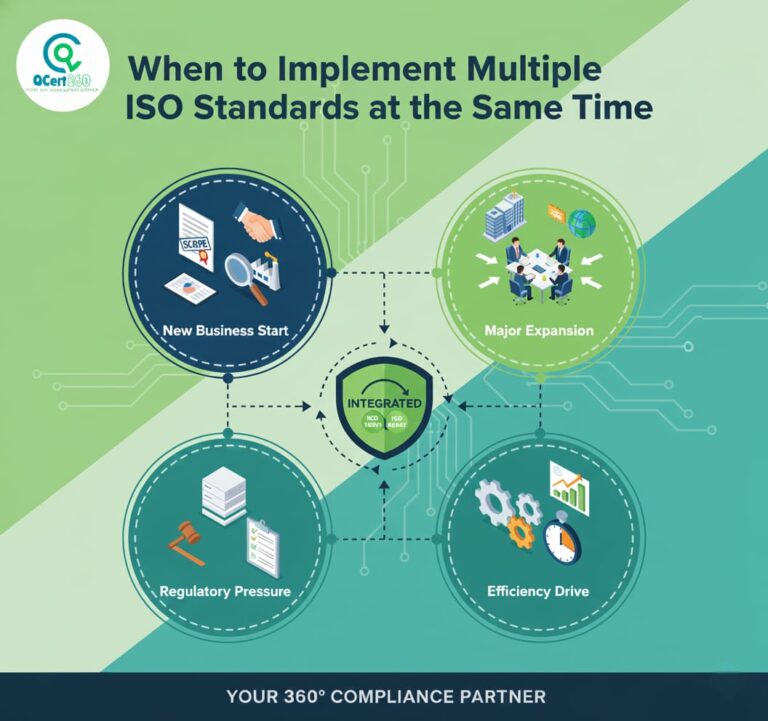
Not every company needs multiple certifications immediately. The smart move is to implement them together only when your business hits certain milestones or pressures.
Here are the most common situations:
- When Clients Ask for More Than One Certification
This is the biggest trigger. You may already have one standard, but a buyer’s vendor checklist suddenly requires two or three more. Instead of adding them one by one, combining them saves huge amounts of time and effort.
- When Your Processes Already Overlap
If your current workflows naturally cover elements from multiple standards—risk management, process monitoring, training, incident handling—you can combine certification paths with minimal disruption.
- When Your Internal Team Is Too Busy for Multiple Projects
Running separate certification projects drains productivity. A combined build lets your team focus once, not three separate times.
- When You Want to Build Credibility Fast
Companies looking to boost tender eligibility or satisfy investor expectations often implement two or three standards at once.
This is where keywords like enterprise compliance maturity, cross-discipline audit alignment, and fast-track ISO integration generate strong search intent from decision-makers.
- When You’re Standardizing Operations Across Departments
An integrated system simplifies training, accountability, and reporting. Teams follow one structure, not multiple overlapping ones.
The Most Common ISO Combinations
Here are the top pairings or clusters companies choose when combining standards:
Quality + Security + Environment
This combination fits companies that want to strengthen quality controls, protect information, and show environmental responsibility.
Quality + Health & Safety
Perfect for companies with operational teams, field operations, or production units.
Security + Privacy
- ISO 27001
- ISO 27701
Buyers often expect both for handling sensitive or personal data.
Quality + Food Safety
A strong combination for food manufacturers and distributors.
These clusters reduce duplicated documentation and allow you to build a scalable compliance management structure.
A Real Case Study: How One Company Implemented Three ISO Standards in One Shot
A growing service provider approached Qcert360 because three major clients had tightened their vendor review process. The company had ISO 9001 but suddenly needed ISO 27001 and ISO 14001 within a short timeline to qualify for new contracts.
Their biggest concern wasn’t certification. It was passing client audits that were becoming tougher each quarter.
Here’s how Qcert360 handled it:
- We performed an integrated gap analysis.
Instead of reviewing three standards separately, we built a unified view of controls, risks, and documentation gaps. - We designed one integrated management system.
This included one policy framework, one risk model, one audit cycle, one improvement plan, and one evidence register. - We mapped overlapping requirements.
This eliminated more than 40 percent of duplicated documents and routine tasks. - We cleaned up their documentation structure.
We centralized everything into a unified compliance workspace that matched the expectations of multi-standard client audits. - We conducted integrated internal audits.
The team learned how to manage combined audit questions, cross-standard evidence, and role-based responsibilities.
The result:
They got certified in all three standards with zero major findings. Even better, they passed two major client audits immediately afterward because their system looked structured, traceable, and mature.
This is exactly why high-intent search terms like integrated ISO certification support, multi-standard vendor readiness, and unified audit evidence system often lead companies to Qcert360.
What Buyers Look for During Multi-Standard Audits
When buyers know you have more than one ISO certification, their expectations rise. They assume your controls are structured, your documentation is consistent, and your governance model is more advanced.
They focus on:
- Consistency Across Standards
Misaligned policies or clashing workflows instantly raise red flags for buyers and auditors.
- A Centralized Evidence Trail
Buyers want a clean, easy-to-follow map of controls, logs, and responsibilities so nothing feels hidden or unclear.
- Risk Integration
If you operate under multiple standards, your risk management needs to look coordinated rather than fragmented or improvised.
- Competence of the Team
Auditors expect clear roles, solid training evidence, and genuine awareness across every function involved.
- Continuous Improvement
Evidence of improvements across quality, security, safety, or sustainability tells buyers your system is living, not static.
Companies that combine standards well often perform better here than those who pursue them one at a time.
How Qcert360 Helps You Implement Multiple Standards Smoothly
Qcert360 has guided hundreds of organisations through integrated certification journeys. We know where clients get stuck, which documents overlap, and how to build systems that impress both certification and buyer auditors.
We support you with:
- Integrated system design that connects quality, security, safety, and environmental requirements into one coherent framework.
- Unified documentation structures so every team works from the same playbook, not scattered formats.
- Risk and control mapping across standards to show buyers exactly how everything fits together.
- Evidence centralization that puts logs, records, and approvals in one place for faster audits.
- Internal audit coaching that helps teams answer questions with confidence and clarity.
- Audit-ready system reviews that catch gaps before buyers or certification bodies do.
- Fast-track implementation for urgent client demands without sacrificing structure or credibility.
If your business wants stronger buyer trust and a system that scales easily, Qcert360 is the right partner to build that foundation.
FAQs
- Is it possible to implement multiple ISO standards at the same time?
Yes, and in many cases it’s faster and more cost-effective than doing them separately. - What’s the biggest advantage of integrated ISO implementation?
You build one structured system instead of maintaining several disjointed ones. - Which ISO standards work well together?
Quality, security, environment, safety, and privacy combinations are the most common. - How does integration reduce audit workload?
One audit cycle covers the shared requirements across multiple standards. - What do buyers expect from vendors with multiple ISO certifications?
Consistent documentation, strong risk controls, and clear governance evidence. - When is the best time to implement multiple ISO standards?
When client expectations increase or your business expands operations or services. - Does integrated ISO implementation cost more?
No—most companies save time and money because tasks overlap. - Can one risk assessment cover all ISO standards?
Yes, if it’s structured properly and addresses all relevant control areas. - Do integrated ISO systems improve vendor approval?
Absolutely. Buyers view multi-standard systems as more reliable and mature. - How can Qcert360 help with multi-standard ISO certification?
Qcert360 designs, implements, and maintains integrated systems that pass certification and client audits without stress.
Our Services
ISO Standards
- ISO 9001 Certification
- ISO 14001 Certification
- ISO 45001 Certification
- ISO 22000 Certification
- ISO 17025 Certification
- ISO 27001 Certification
- ISO 13485 Certification
- ISO 20000-1 Certification
- ISO 41001 Certification
- ISO 22716 Certification
- ISO 50001 Certification
- ISO 22301 Certification
- ISO 29993 Certification
Product Certifications
Other international standards
- FSSC 22000 Certification
- HIPAA
- HACCP Certification
- SA 8000 Certification
- GMP Certification
- GDPR
- GDP Certification
- GLP Certification
- Certificate of Conformity
QCert360 provides a wide range of services including ISO certification, audit support, compliance consulting, and training. They specialize in helping businesses achieve global standards and certifications like ISO 9001, ISO 27001, ISO 14001, and many others. Their team ensures a seamless experience from consultation to certification, supporting clients at every stage.
The time it takes to achieve certification can vary depending on the complexity of the standard and the readiness of your organization. On average, it takes about 3 to 6 months. QCert360 works closely with clients to streamline the process, ensuring that all requirements are met efficiently and within a reasonable timeline.
QCert360 is a trusted partner with years of experience in helping businesses obtain international certifications. Their expert consultants provide tailored solutions, ensuring your organization not only meets but exceeds industry standards. With a customer-centric approach, they focus on offering end-to-end support to simplify the certification journey.
QCert360 serves a wide range of industries including manufacturing, healthcare, information technology, education, and services, among others. They customize their certification solutions to meet the unique requirements of each industry, ensuring relevance and compliance with global standards.
Yes, QCert360 provides ongoing support even after certification. They offer services like surveillance audits, recertification guidance, and consultancy to help maintain and improve your certification status. Their team ensures that your organization stays compliant and up-to-date with any changes in certification standards.
Getting started with QCert360 is simple. You can contact them via their website to request a consultation. Their team will assess your needs, discuss the best certification options for your business, and outline the steps involved. From there, they’ll guide you through the entire process, ensuring you’re prepared for certification.
QCert360 stands out due to its customer-focused approach, industry expertise, and comprehensive service offerings. Their team doesn’t just help you obtain certification but works to ensure your organization thrives in compliance with international standards. They also offer personalized consultation, making the process smoother and more efficient, ensuring long-term success for your business.
The cost of certification varies depending on factors such as the type of certification, the size and complexity of your organization, and the specific industry requirements. QCert360 offers competitive pricing and provides tailored quotes based on your unique needs. They ensure transparency and work with you to find the most cost-effective solution for your certification goals.
Yes, QCert360 offers internal audit services to help assess and improve your organization’s processes. Their expert auditors conduct thorough reviews of your systems and operations to ensure they meet required standards. They also provide actionable recommendations to help enhance efficiency and compliance, making sure you’re fully prepared for external audits.
If your organization doesn’t pass an audit or certification assessment, QCert360 works with you to understand the reasons for non-compliance and provides support to rectify the issues. They offer guidance on corrective actions and help you prepare for a re-assessment. Their goal is to ensure your organization meets the necessary standards for certification, and they will be by your side to make the process as smooth as possible.