
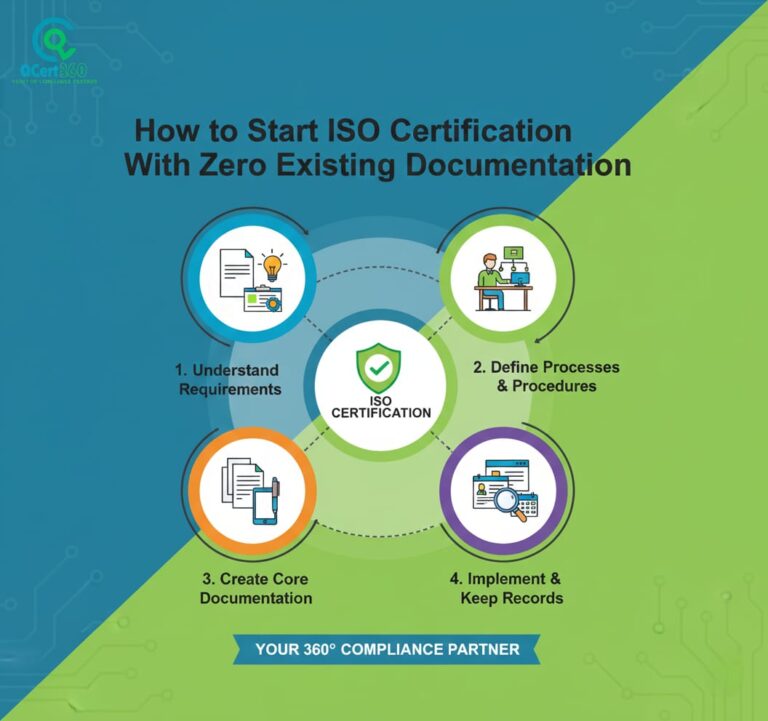
If you’re thinking about ISO certification but don’t have a single policy, process, or template in place, you’re not alone. Plenty of companies reach this point only after a client asks for certification or a tender requires it. And that’s when panic kicks in—because starting from zero feels impossible.
Here’s the thing: you don’t need a massive library of documents to begin. You need clarity, structure, and a guided set of steps that take you from “nothing is written down” to “we’re audit-ready.” ISO was built for real businesses, not perfect ones.
Let’s walk through how you start ISO certification even when you have no documentation, no processes written, and no internal templates. You’ll learn what matters first, what you can skip, and how to move fast without compromising quality.
Why Starting from Zero Is More Common Than You Think
Companies often delay ISO work because they assume documentation must exist first. But ISO systems aren’t meant to sit in a drawer—they’re meant to be built around how your operations actually work.
When you start without documentation, you’re working with a clean slate. There’s no outdated content to correct, no inherited templates that don’t match your business, and no legacy forms that confuse your team. Starting fresh actually speeds up ISO readiness because your processes are structured from the beginning.
This is exactly why searches like “ISO documentation from scratch,” “ISO readiness quick start,” and “build ISO system fast” have been rising. Businesses want speed, clarity, and a practical path—not a 200-page manual full of jargon.
The First Step: Understanding What ISO Really Requires
ISO standards aren’t about paperwork. They’re about consistency, clarity, and accountability. If you have:
- A team that knows what it’s doing
- A product or service that works
- A few leadership decisions in place
…you already have the foundation. Documentation simply formalizes the work you already do.
When starting from zero, your biggest advantage is that you can build an ISO-aligned operational framework without fighting old habits.
What You Need First (and What You Don’t)
Let’s break this down clearly so there’s no confusion.
You DO need:
- A defined scope of work that clearly states which departments, locations, or activities fall under your ISO system so everyone knows the boundaries.
- Clear responsibilities assigned to specific people so tasks aren’t duplicated, missed, or left unclear.
- Basic process flows that outline how work actually moves across your team, making your operations easier to follow and control.
- Mandatory ISO policies tailored to your business so you meet requirements without adding unnecessary complexity.
- Records that prove activities created in simple formats that show evidence of work being done the right way, every time.
- Internal controls that match your actual work so approvals, checks, and reviews align with real operations instead of generic templates.
- Monitoring methods for quality, risks, or security that help you track performance, catch issues early, and keep the system running smoothly.
You DO NOT need:
- Fancy designs that look impressive but add no real value when auditors only care about clarity.
- Complex flowcharts that confuse your team instead of showing how work actually happens.
- Dozens of unnecessary forms that slow people down and create frustration instead of control.
- Word-for-word templates copied from Google that don’t match your operations and fail during audits.
- A long manual that no one will read because it’s full of filler instead of practical guidance.
- Overly technical documentation that makes simple processes feel complicated and hard to follow.
- ISO certification isn’t about producing more paperwork. It’s about producing the right paperwork.
How to Build Your ISO System When You Have Nothing Written
Here’s the exact structure companies use when starting from zero.
- Map What You Already Do
You don’t begin with paperwork—you begin with conversations.
Sit with your team and ask:
- What do we do every day?
- Who approves what?
- How do we know work is done correctly?
- What usually goes wrong and how do we fix it?
- What decisions rely on judgment rather than rules?
This becomes the backbone of your ISO processes. Search trends show more buyers looking for “ISO process mapping support”, because this is where companies need clarity most.
- Create the Mandatory Policies
Every ISO standard has a set of required policies:
- Quality policy
- Safety policy
- Information security policy
- Environmental policy
- Risk management rules
- Internal audit commitment
- Corrective action rules
These don’t need to be complex. They just need to reflect your real intentions and responsibilities.
- Build Process-Level Documentation
This is where you document what your team actually does—not what a textbook says they should do.
Keep it practical:
- One-page procedures
- Checklists
- Short instructions
- Simple flow diagrams
A trend known as “lean ISO documentation” has been gaining traction because companies want concise systems that staff can actually follow.
- Generate Evidence Records
ISO auditors want proof, not promises.
Even when starting from zero, you can implement:
- Quality checks
- Risk logs
- Incident reports
- Supplier evaluations
- Training logs
- Customer feedback tracking
These records demonstrate that your system is alive, not theoretical.
- Conduct an Internal Audit
Before facing the real audit, you need a baseline review.
Internal audits help you identify gaps such as:
- Missing records
- Undefined responsibilities
- Unapproved documents
- Incomplete risk assessments
- Inconsistent processes
This is where companies realize that ISO systems are more about discipline than documentation.
- Perform a Management Review
Auditors want to see leadership involvement.
A simple meeting with:
- Objectives
- Risks
- Process performance
- Customer issues
- Improvements
…is more than enough to satisfy requirements when done properly.
A Real Case Study: From Zero Documentation to ISO Certification in Weeks
A technology distributor reached out to Qcert360 because a major client refused to renew their contract unless they achieved ISO 9001 certification. They had zero written processes, no templates, and no previous compliance experience.
Here’s how Qcert360 structured their journey:
Week 1: System Discovery
We conducted a rapid assessment to understand how work actually flowed. No paperwork—just clear mapping of daily activities.
Week 2: Foundation Documentation
We built all mandatory ISO documents including:
- Quality policy
- Scope document
- Process responsibilities
- Risk matrix
- Basic SOPs
Everything was tailored to their real operations, not copied from a template.
Week 3: Records Activation
The team began using streamlined:
- Inspection logs
- Customer issue trackers
- Supplier evaluation forms
- Training records
- Corrective action sheets
Week 4: Internal Audit & Management Review
With processes running, we executed an internal audit and guided the leadership review.
Week 5: Certification Audit
They passed with minor observations—all resolved within a day.
The client who demanded ISO certification approved them immediately.
This company now attracts more buyers because they built a clean, efficient ISO system without unnecessary complexity.
Why Starting with Qcert360 Makes Everything Easier
Qcert360 specializes in helping companies that feel they’re starting from nothing. That’s our sweet spot.
We support you with:
- Document creation from scratch
We build every required policy, procedure, and form based on how your business actually operates. - Clear process mapping
Your workflows become easy to follow, with clear roles and responsibilities so your team always knows what to do. - Custom ISO frameworks
No copy-paste templates. You get a system tailored to your industry, size, and day-to-day reality. - Fast-track implementation
We set up a clear, quick implementation plan so you move from zero documentation to audit-ready without the usual delays. - Full audit preparation
Your team learns what evidence to maintain, how to handle auditor questions, and what to expect during each audit stage. - Pre-certification gap analysis
You get a precise list of what’s missing and what needs refinement before the certification body steps in. - Practical training for your team
We ensure your people understand and can apply the ISO system in real operations—not just on paper.
You don’t need experience. You don’t need templates. You don’t need to worry about where to begin.
You just need a partner who understands how to turn zero documentation into a complete, audit-ready ISO system.
If you want the fastest and most straightforward path to certification, Qcert360 is ready.
When You Should Start ISO Certification Even with Zero Documentation
- Start when a client requests certification and you need to show them you operate with structure and consistency, not just good intentions.
- Start when you’re preparing for a major tender and buyers expect documented control over quality, processes, and risks.
- Start when you want to reduce operational chaos because too many tasks depend on individual habits instead of a stable system.
- Start when your team relies too much on verbal instructions and important steps get missed simply because nothing is written down.
- Start when you’re planning to scale and you need processes that support growth instead of collapsing under pressure.
- Start when you keep facing repeat mistakes and it’s clear there’s no system in place to fix root causes.
- Start when you want stronger internal control and clearer accountability across teams and workflows.
Zero documentation is not a barrier. It’s your starting point.
Why Buyers Trust Documented ISO Systems
Client audits are getting stricter. Buyers want predictable suppliers. They look for:
- Repeatable processes that eliminate guesswork
- Controlled operations that run the same way every time
- Traceable records that show exactly what happened and when
- Formal approvals that confirm oversight and responsibility
- Reliable safety and quality standards that reduce risk for buyers
Documentation proves discipline. Discipline builds trust. That’s why ISO-certified companies pass client audits more easily.
Final Thoughts
Starting ISO certification with zero documentation isn’t a disadvantage—it’s an opportunity. You get to build a clean, modern, efficient system that reflects how your business truly works. With the right guidance, you move faster, avoid unnecessary paperwork, and impress both auditors and buyers.
If you want help building an ISO system from the ground up, Qcert360 can take you from zero to certification-ready without unnecessary stress or complexity.
FAQs
- Can a company start ISO certification without any existing documents?
Yes. Documentation is created as part of the ISO implementation process. - How long does it take to build ISO documentation from scratch?
It depends on your readiness, but a guided plan can move quickly. - What is the first document needed for ISO certification?
The scope statement. It defines what your ISO system covers. - Do I need a quality manual?
Modern ISO standards don’t require a traditional manual, only structured information. - Can ISO processes be simple?
Absolutely. ISO requires clarity, not complexity. - What records do auditors check first?
Corrective actions, internal audits, and evidence of process control. - Can I use templates for ISO documentation?
Templates can help, but they must match your real operations. - What happens if I have no records for the past months?
You generate new records starting today; ISO focuses on active controls. - Is employee training mandatory for ISO certification?
Yes. Auditors check whether staff understand their responsibilities. - Can Qcert360 help build all ISO documentation from scratch?
Yes. We specialize in creating complete, audit-ready systems for companies starting from zero.
Our Services
ISO Standards
- ISO 9001 Certification
- ISO 14001 Certification
- ISO 45001 Certification
- ISO 22000 Certification
- ISO 17025 Certification
- ISO 27001 Certification
- ISO 13485 Certification
- ISO 20000-1 Certification
- ISO 41001 Certification
- ISO 22716 Certification
- ISO 50001 Certification
- ISO 22301 Certification
- ISO 29993 Certification
Product Certifications
Other international standards
- FSSC 22000 Certification
- HIPAA
- HACCP Certification
- SA 8000 Certification
- GMP Certification
- GDPR
- GDP Certification
- GLP Certification
- Certificate of Conformity
QCert360 provides a wide range of services including ISO certification, audit support, compliance consulting, and training. They specialize in helping businesses achieve global standards and certifications like ISO 9001, ISO 27001, ISO 14001, and many others. Their team ensures a seamless experience from consultation to certification, supporting clients at every stage.
The time it takes to achieve certification can vary depending on the complexity of the standard and the readiness of your organization. On average, it takes about 3 to 6 months. QCert360 works closely with clients to streamline the process, ensuring that all requirements are met efficiently and within a reasonable timeline.
QCert360 is a trusted partner with years of experience in helping businesses obtain international certifications. Their expert consultants provide tailored solutions, ensuring your organization not only meets but exceeds industry standards. With a customer-centric approach, they focus on offering end-to-end support to simplify the certification journey.
QCert360 serves a wide range of industries including manufacturing, healthcare, information technology, education, and services, among others. They customize their certification solutions to meet the unique requirements of each industry, ensuring relevance and compliance with global standards.
Yes, QCert360 provides ongoing support even after certification. They offer services like surveillance audits, recertification guidance, and consultancy to help maintain and improve your certification status. Their team ensures that your organization stays compliant and up-to-date with any changes in certification standards.
Getting started with QCert360 is simple. You can contact them via their website to request a consultation. Their team will assess your needs, discuss the best certification options for your business, and outline the steps involved. From there, they’ll guide you through the entire process, ensuring you’re prepared for certification.
QCert360 stands out due to its customer-focused approach, industry expertise, and comprehensive service offerings. Their team doesn’t just help you obtain certification but works to ensure your organization thrives in compliance with international standards. They also offer personalized consultation, making the process smoother and more efficient, ensuring long-term success for your business.
The cost of certification varies depending on factors such as the type of certification, the size and complexity of your organization, and the specific industry requirements. QCert360 offers competitive pricing and provides tailored quotes based on your unique needs. They ensure transparency and work with you to find the most cost-effective solution for your certification goals.
Yes, QCert360 offers internal audit services to help assess and improve your organization’s processes. Their expert auditors conduct thorough reviews of your systems and operations to ensure they meet required standards. They also provide actionable recommendations to help enhance efficiency and compliance, making sure you’re fully prepared for external audits.
If your organization doesn’t pass an audit or certification assessment, QCert360 works with you to understand the reasons for non-compliance and provides support to rectify the issues. They offer guidance on corrective actions and help you prepare for a re-assessment. Their goal is to ensure your organization meets the necessary standards for certification, and they will be by your side to make the process as smooth as possible.