
If you’re managing workplace safety, you already know this: preventing incidents isn’t enough anymore. You also need proof that your organization operates with discipline, clear controls, and a safety system that works day after day. That’s exactly what ISO 45001 brings to the table. It’s not a badge—you’re building a structure that keeps people safe, reduces risk, and gives clients confidence that you run operations the right way.
Here’s the thing. Many teams walk into ISO 45001 thinking it’s all about forms. In reality, the standard is centred on behaviours, leadership, and control strategies that actually change how work gets done. Once you understand the certification requirements, the entire journey becomes cleaner, faster, and far more predictable.
Let’s break down what safety teams should prioritize before moving toward certification, and how to prepare without drowning in unnecessary complexity.
Why ISO 45001 Matters in Today’s Work Environment
Organizations are operating under rising expectations—clients want evidence of strong safety governance, employees expect safer workplaces, and stakeholders don’t tolerate guesswork. ISO 45001 gives you a structured system to prove that hazards are managed, controls are tested, and risks are continuously monitored.
This is why terms like operational safety compliance framework and integrated hazard-control strategy have become common among safety leaders. They’re searching for practical guidance, not theory—something that helps them build a system that aligns with real-world tasks and not just audit checklists.
ISO 45001 certification signals maturity, consistency, and a commitment to long-term worker protection. It also gives organizations a clear advantage when competing for contracts that require validated safety performance.
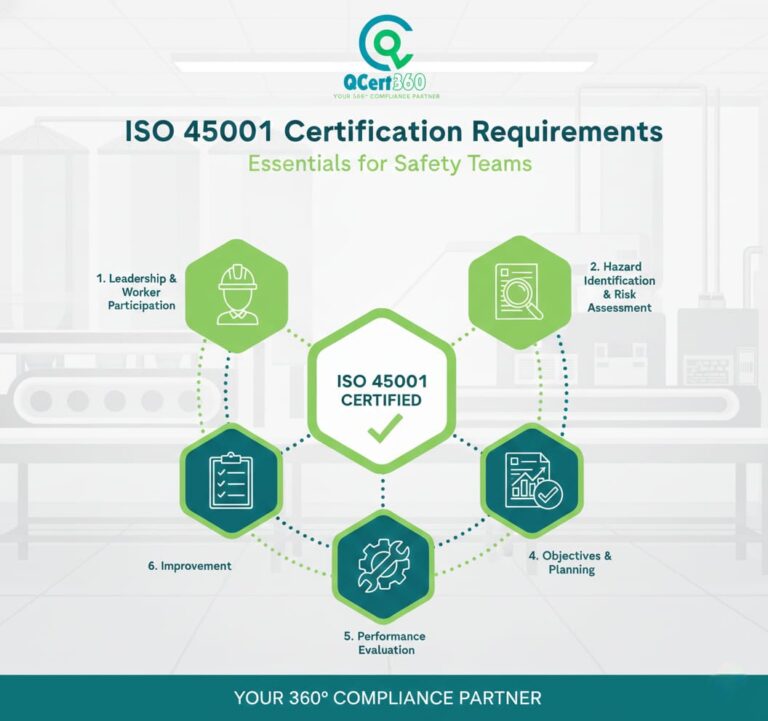
Key ISO 45001 Certification Requirements Safety Teams Must Understand
Before starting the certification process, you need a precise view of what the standard really expects. Many companies either overcomplicate the process or overlook the essentials. Here’s what matters most.
- Establish the OH&S Context and Scope
Your scope outlines what activities, functions, and teams fall under your safety management system. This is where teams often refine their risk landscapes, define responsibility zones, and identify where stronger controls are required. Clear scope means smoother audits.
- Leadership Accountability
ISO 45001 puts responsibility directly on top management. Safety isn’t something to delegate and forget—it has to be owned at the top. Auditors will look for proof of leadership involvement through:
- Support for risk-prevention controls – Leadership ensures systems and procedures are in place to proactively prevent hazards.
- Adequate resource allocation – Teams have the necessary staff, tools, and training to manage safety effectively.
- Review of safety objectives – Safety goals are regularly assessed to track progress and adjust strategies as needed.
- Participation in performance discussions – Leaders actively engage in evaluating safety performance, reinforcing accountability and a strong safety culture.
This is the foundation of a credible safety culture.
- Worker Participation and Consultation
Safety systems collapse when employees aren’t involved. ISO 45001 requires workers to be engaged in:
- Hazard identification – Spotting potential risks before they cause harm, so preventive measures can be applied.
- Incident reporting – Capturing every safety event promptly to ensure transparency and enable timely action.
- Safety investigations – Analysing incidents to understand root causes and prevent recurrence.
- Continual improvement activities – Using lessons learned and performance data to strengthen safety systems over time.
This shifts safety from an administrative function to a shared responsibility model.
- Hazard Identification and Risk Assessment
This is the core of ISO 45001. You’re expected to demonstrate a structured, repeatable approach to:
- Identifying hazards – Spotting potential sources of harm in processes, equipment, or the workplace environment.
- Assessing risk levels – Determining the likelihood and impact of each hazard to prioritize actions.
- Selecting appropriate controls – Choosing the right measures, from engineering fixes to procedures, to minimize risk.
- Monitoring whether those controls work – Tracking effectiveness through inspections, logs, and performance data to ensure hazards remain under control.
Safety leaders often use tools like dynamic hazard-review practices and structured risk-mapping methods to strengthen this part of the system.
- OH&S Objectives and Performance Planning
Your safety goals must reflect the actual risks in your operations—not generic commitments. Auditors expect:
- Defined safety KPIs – Specific, measurable indicators that track how well safety objectives are being met.
- Monitoring systems – Tools and processes to continuously observe performance, detect issues, and collect data.
- Improvement plans with clear accountability – Actionable steps to address gaps, with assigned responsibilities to ensure follow-through.
This sets you up for measurable, predictable safety outcomes.
- Operational Controls and Emergency Preparedness
Your procedures, work instructions, and emergency protocols must show how work is actually performed. The goal is to demonstrate real control over operations, not theoretical compliance.
- Performance Evaluation and Internal Audits
ISO 45001 requires ongoing checks to ensure the system works as intended. That includes:
- Internal audits – Regular checks to verify that safety processes are being followed and standards are met.
- Compliance evaluations – Assessments to ensure the organization adheres to regulatory and internal safety requirements.
- Incident and trend monitoring – Tracking safety events and patterns to identify recurring risks or areas needing attention.
- Review of safety data – Analysing collected information to guide decisions, improve controls, and strengthen the overall safety program.
A strong internal-audit rhythm is one of the fastest ways to secure certification without surprises.
- Corrective Actions and Continuous Improvement
Every nonconformity, incident, or near miss should lead to learning. ISO 45001 expects improvement to be systematic and documented, not reactive or blame-focused.
Case Study: How a Manufacturing Firm Cut Incidents by 47% After ISO 45001 Implementation
A mid-size manufacturing company approached Qcert360 after dealing with repeated safety lapses. Their production volumes had grown fast, but their safety structure hadn’t evolved. Near misses weren’t documented, issues were handled informally, and different departments were solving problems independently.
Qcert360 began with a diagnostic audit to benchmark their system against ISO 45001. The findings were straightforward:
- Key hazards weren’t documented
- Internal audits lacked structure
- Training programs didn’t produce measurable skill improvement
- Safety accountabilities weren’t aligned
With this clarity, Qcert360 designed a full implementation roadmap that included:
- A detailed hazard-identification matrix
- A refreshed leadership safety-commitment model
- Department-level worker-participation sessions
- A risk-ranking method that prioritized high-severity issues
- A clean, traceable incident-response workflow
Nine months later, the company had reduced incidents by 47%, strengthened reporting culture, and passed their ISO 45001 certification audit. They later used the certification to secure two new contracts that required proof of strong safety governance.
That’s the impact of ISO 45001 when executed with discipline.
Common Gaps Safety Teams Overlook
Even experienced teams miss critical details that slow down certification. The most common gaps include:
- Documentation That Doesn’t Match Reality
Auditors compare what’s written with what they observe. Any mismatch becomes a major nonconformity.
- Weak Incident Data
If your reports lack cause analysis, corrective actions, or verification steps, you’ll get flagged.
- Undefined Safety Responsibilities
Every role must have clear safety expectations—from front-line supervisors to department heads.
- Outdated or Untested Emergency Plans
Emergency preparedness must be current, communicated, and practiced.
- Poor Internal Audit Preparedness
Strong internal audits remove most of the surprises during certification.
Fixing these early shortens timelines and prevents rework.
How Qcert360 Supports in meeting ISO 45001 Certification Requirements
Trying to manage the entire certification alone often slows teams down. Qcert360 helps organizations build strong, audit-ready systems through structured methods and practical guidance.
Here’s what most businesses rely on Qcert360 for:
- Gap Assessment and Safety Maturity Review
You get a clear snapshot of where your system stands and what needs improvement—no guesswork, no ambiguity.
- Hazard and Risk-Control Development
Qcert360 builds detailed risk registers, control measures, and implementation plans rooted in industry best practices.
- Documentation Design and Alignment
Policies, procedures, operational controls, training programs, emergency plans—everything is prepared in alignment with ISO 45001 expectations.
- Internal Audit Preparation
You receive auditor-style internal audits that reveal weaknesses long before your certification body reviews them.
- Corrective Action Coaching
Your team learns how to close gaps fast and sustain improvements.
- Certification Coordination
From scheduling to document submission to audit preparation, Qcert360 handles the process smoothly while your teams stay focused on running operations.
This is where search-driven terms like structured OH&S system design and compliance-oriented safety planning naturally support your lead-generation strategy.
How Safety Teams Can Speed Up ISO 45001 Approval
If certification speed is a priority, these steps make the biggest difference:
- Prepare Documentation Early
Your policies, risk assessments, and procedures should be clean, updated, and easy to trace.
- Strengthen Leadership Engagement
When leadership is committed, decisions are faster and implementation is smoother.
- Organize Evidence
Incident logs, training files, and audit records should be complete and easy to retrieve.
- Conduct a Full Pre-Audit
Pre-audits eliminate surprises and reduce stress during the certification audit.
- Train Workers Thoroughly
Employees should understand their tasks, risks, and responsibilities. Competence is part of the certification.
Once these elements are in place, ISO 45001 certification becomes a well-structured process—not a scramble.
The Payoff: Why ISO 45001 Helps You Work Smarter
ISO 45001 isn’t simply about meeting requirements. It creates stability, builds confidence, and reinforces smart operational habits. When the system is fully implemented, you get:
- Better hazard control from predictable processes – Standardized workflows reduce unexpected risks and make safety easier to manage.
- Clarity in how work should be performed – Employees understand exactly what’s expected, lowering mistakes and confusion.
- Fewer incidents and disruptions – Consistent processes prevent accidents, equipment downtime, and operational delays.
- Higher employee trust and involvement – Staff feel confident and engaged when safety measures are clear and enforced.
- A competitive advantage with clients that demand verified safety – Demonstrated safety compliance boosts credibility and makes your business a preferred partner.
For organizations serious about safety excellence, ISO 45001 becomes a strategic asset—not just a certificate.
If you’re ready to build a safer, more reliable system, Qcert360 can guide you from the first assessment to your final audit with a structured, tested approach.
FAQs: ISO 45001 Certification Requirements
- What does ISO 45001 certification standard cover?
It covers occupational health and safety systems, risk controls, and frameworks that protect employees from work-related injuries and illnesses.
- How long does ISO 45001 certification take?
Certification timelines vary, but most organizations complete it within eight to twelve weeks once documentation is ready.
- Do all companies need formal risk assessments for ISO 45001?
Yes. ISO 45001 requires structured hazard identification and risk evaluation.
- Is leadership involvement mandatory in ISO 45001?
Absolutely. Top management must actively support and participate in the safety program.
- What documents are needed for ISO 45001 registration?
Policies, procedures, training records, risk assessments, audit reports, incident records, emergency plans, and performance metrics.
- Can small teams get ISO 45001 certified quickly?
Yes. Smaller organizations often move faster because processes are simpler.
- Do employees need training for ISO 45001 standard?
Yes. Worker competence and participation are core requirements.
- What happens during the ISO 45001 certification audit?
Auditors review documentation, interview teams, verify evidence, and observe safety practices.
- Can ISO 45001 reduce incident rates?
When implemented properly, it leads to fewer hazards, stronger controls, and measurable safety improvements.
- How does Qcert360 help occupational health and safety certification?
Qcert360 supports gap assessments, documentation, training, internal audits, and certification coordination to ensure smooth and successful ISO 45001 approval.
Our Services
ISO Standards
- ISO 9001 Certification
- ISO 14001 Certification
- ISO 45001 Certification
- ISO 22000 Certification
- ISO 17025 Certification
- ISO 27001 Certification
- ISO 13485 Certification
- ISO 20000-1 Certification
- ISO 41001 Certification
- ISO 22716 Certification
- ISO 50001 Certification
- ISO 22301 Certification
- ISO 29993 Certification
Product Certifications
Other international standards
- FSSC 22000 Certification
- HIPAA
- HACCP Certification
- SA 8000 Certification
- GMP Certification
- GDPR
- GDP Certification
- GLP Certification
- Certificate of Conformity
QCert360 provides a wide range of services including ISO certification, audit support, compliance consulting, and training. They specialize in helping businesses achieve global standards and certifications like ISO 9001, ISO 27001, ISO 14001, and many others. Their team ensures a seamless experience from consultation to certification, supporting clients at every stage.
The time it takes to achieve certification can vary depending on the complexity of the standard and the readiness of your organization. On average, it takes about 3 to 6 months. QCert360 works closely with clients to streamline the process, ensuring that all requirements are met efficiently and within a reasonable timeline.
QCert360 is a trusted partner with years of experience in helping businesses obtain international certifications. Their expert consultants provide tailored solutions, ensuring your organization not only meets but exceeds industry standards. With a customer-centric approach, they focus on offering end-to-end support to simplify the certification journey.
QCert360 serves a wide range of industries including manufacturing, healthcare, information technology, education, and services, among others. They customize their certification solutions to meet the unique requirements of each industry, ensuring relevance and compliance with global standards.
Yes, QCert360 provides ongoing support even after certification. They offer services like surveillance audits, recertification guidance, and consultancy to help maintain and improve your certification status. Their team ensures that your organization stays compliant and up-to-date with any changes in certification standards.
Getting started with QCert360 is simple. You can contact them via their website to request a consultation. Their team will assess your needs, discuss the best certification options for your business, and outline the steps involved. From there, they’ll guide you through the entire process, ensuring you’re prepared for certification.
QCert360 stands out due to its customer-focused approach, industry expertise, and comprehensive service offerings. Their team doesn’t just help you obtain certification but works to ensure your organization thrives in compliance with international standards. They also offer personalized consultation, making the process smoother and more efficient, ensuring long-term success for your business.
The cost of certification varies depending on factors such as the type of certification, the size and complexity of your organization, and the specific industry requirements. QCert360 offers competitive pricing and provides tailored quotes based on your unique needs. They ensure transparency and work with you to find the most cost-effective solution for your certification goals.
Yes, QCert360 offers internal audit services to help assess and improve your organization’s processes. Their expert auditors conduct thorough reviews of your systems and operations to ensure they meet required standards. They also provide actionable recommendations to help enhance efficiency and compliance, making sure you’re fully prepared for external audits.
If your organization doesn’t pass an audit or certification assessment, QCert360 works with you to understand the reasons for non-compliance and provides support to rectify the issues. They offer guidance on corrective actions and help you prepare for a re-assessment. Their goal is to ensure your organization meets the necessary standards for certification, and they will be by your side to make the process as smooth as possible.