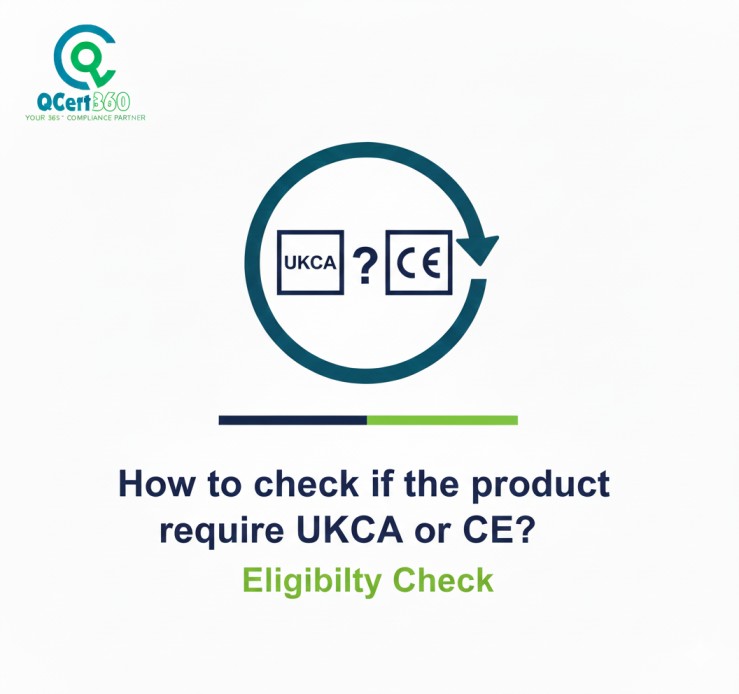
If you manufacture or supply products for regulated markets, you’ve probably wondered whether your product needs UKCA, CE, or both. Here’s the thing: you can’t guess this part. The wrong choice delays shipments, triggers buyer rejections, or forces you into retesting. A quick eligibility check helps you understand exactly which approval route your product falls under so you can plan fast and avoid compliance headaches.
Let’s break it down in a way that’s simple, practical, and genuinely useful for your next export discussion.
Why Knowing the Right Marking Matters while exporting the product
Most manufacturers assume that if a product looks “electronic” or “mechanical,” it automatically needs CE or UKCA. But the marking depends on scope, product category, function, risk, and the specific rules that apply. What this really means is that eligibility isn’t based on assumptions—it’s based on whether your product falls under a defined regulatory category.
Buyers check this quickly. They look for structural compliance, not surface-level claims. That’s why many manufacturers rely on a conformity-mapping approach early in their development cycle. It saves time, reduces retests, and gives your product a clean path to approval.
Step-by-Step guide to identify whether your Product Requires UKCA or CE certification
Step 1: Identify Your Product Category
Every product sits under a specific category defined by law. The category determines whether CE, UKCA, or both markings apply.
Start by looking at what your product does:
- Does it use electricity
• Does it create mechanical movement
• Does it emit radio signals
• Does it include pressure, heat, or chemical processes
• Is it a measuring instrument
• Does it include protective equipment
This early categorization helps you align your product with the right conformity path. Manufacturers who maintain a category-assessment routine often move through approvals much faster because they already know which rules apply.
Step 2: Check the Applicable Regulations
Once you know your category, you check the regulations. CE and UKCA have their own sets of rules, but many categories align closely.
Your product may fall under:
- Electrical safety requirements
• Electromagnetic compatibility rules
• Machinery safety expectations
• Radio device compliance
• Restriction of hazardous substances
• Toy safety standards
• Personal protective equipment controls
A simple rule of thumb: if your product impacts safety, energy, communication, or environmental factors, a regulated marking usually applies.
Many manufacturers build a regulation-mapping checklist to avoid missing categories that create unexpected approval barriers later.
Step 3: Determine Whether UKCA, CE, or Both Apply
This is where most people get confused. The quickest way to check is to ask two questions:
- Where will the product be placed on the market
- Which regulatory framework applies to that market
If your product enters markets that require the CE marking, you must follow the CE route. If your product enters markets requiring UKCA, you follow the UKCA route.
Some manufacturers adopt a dual-compliance approach to keep supply chains flexible. This approach relies on a structured product-compliance matrix that ensures UKCA and CE documentation remain synchronized without duplication.
Step 4: Look at the Risk Level of Your Product
Risk level plays a major role in whether a marking is required. Products with higher safety, electrical, or chemical risks nearly always need approval.
Ask these questions:
- Could the product harm the user if it fails
• Does it involve temperature, pressure, or motion
• Does it store or transmit data
• Does it interact with other devices
Products with higher risks undergo deeper evaluation, often requiring third-party review. Manufacturers who track risk early build a stronger conformity plan and reduce approval delays.
Step 5: Examine Your Product Features and Materials
Sometimes a small change makes a big difference. Features like sensors, batteries, motors, transmitters, and electronic circuits automatically trigger regulatory requirements.
Manufacturers often use a design-feature evaluation template that highlights when new product features shift eligibility from voluntary claims to mandatory marking.
Step 6: Review Your Documentation Expectations
If your product needs CE or UKCA, you must have a technical file. This file contains:
- Product specifications
• Risk assessments
• Material evidence
• Component details
• Verification results
• Labelling samples
• Test reports
A solid technical-file structure helps buyers verify your product quickly. It also protects you during inspections or supply-chain reviews.
Qcert360 helps companies build a compliance-ready product file that includes all required elements, making buyer checks faster and easier.
Step 7: Check If Your Product Requires Laboratory Testing
Testing is usually mandatory when your product involves:
- Electronics
• Mechanical hazards
• Radio transmission
• High energy output
• Chemical restrictions
A constructive testing plan saves manufacturers from repeat submissions and inconsistent results. Teams who build a test-scope planning model often avoid delays and secure approval faster.
Step 8: Confirm the Proper Marking for the Final Product
Once you understand the requirements, you apply the correct marking. Placing the wrong marking, or placing a marking without proof, creates serious compliance issues.
The marking must match:
- The category
• The test results
• The regulation
• The Declaration of Conformity
• The approval scope
A consistent marking strategy ensures you’re aligned with both regulatory expectations and buyer requirements.
Let’s quickly understand where UKCA & CE Mark certification is required
Let’s keep this straight and practical so you never second-guess it again.
Where CE Marking Is Required
You need CE marking when your product will be placed on the market in regions that legally follow the CE regulatory framework.
CE applies to:
- All European Union countries
- European Economic Area (EEA) members
- EFTA countries that accept CE
- Any importer or distributor selling into EU-regulated markets
If your buyers operate in these regions, CE marking is mandatory for products under regulated categories such as electronics, machinery, toys, medical devices, EMC equipment, and more.
Bottom line:
If your product is sold anywhere that falls under the EU regulatory umbrella, you need CE.
Where UKCA Marking Is Required
You need UKCA marking when your product enters the regulatory market of the United Kingdom.
UKCA applies to:
- England
- Scotland
- Wales
Northern Ireland follows a different system and typically uses CE under the NI protocol.
If you manufacture or supply products into these regions, your documentation, testing, and labeling must follow UKCA rules.
Bottom line:
If your product is placed on the market in Great Britain, UKCA is required.
When You Need Both
Some manufacturers need both CE and UKCA because their products are sold in markets covered by both regulatory systems.
If you want to serve both segments with one product range, you must build a dual-compliance conformity path:
- A CE technical file
- A UKCA technical file
- Declarations for each
- Markings for each market
- Testing aligned with both regulatory sets
In short:
If you supply multiple regions with different regulatory frameworks, you need two approval routes.
When You Don’t Need Either
Some products fall outside CE or UKCA scope completely.
These can include items with no regulated risk or non-technical goods that don’t fall under any directive category.
But here’s the catch:
If your product contains electrical functions, radio features, mechanical operation, sensory modules, protective components, or anything safety-related, chances are one or both markings apply.
Real-World Case Study: How One Manufacturer Fixed Their CE/UKCA Confusion
A manufacturing company approached Qcert360 because their product kept getting rejected by buyers. They believed the product only needed CE, but after a deeper look, we found that:
- The product fell under two regulated categories
• Their risk assessment was incomplete
• Required testing was missing
• The design changes were not evaluated
• Their marking was misaligned with approval scope
We rebuilt their conformity strategy:
- Created a complete eligibility map
• Ran a design-risk evaluation
• Coordinated testing through accredited partners
• Developed a synchronized technical file
• Prepared a clean Declaration of Conformity
• Structured a dual-marking compliance route
The result:
The manufacturer passed their next buyer review immediately and secured approval for all their planned product variations. They described the process as “the first-time compliance actually made sense.”
How Qcert360 Helps You Check CE or UKCA Eligibility Fast?
Manufacturers rely on Qcert360 because our team simplifies the entire eligibility process. We help you determine exactly what marking your product needs and how to prepare for it without wasting time.
Our support includes:
- Eligibility assessments – Confirm whether your product actually requires CE or UKCA, so you start on the right compliance path.
- Regulation mapping – Identify which directives and standards apply, removing all guesswork from the process.
- Documentation guidance – Help you create the manuals, labels, and technical evidence buyers and auditors expect.
- Testing coordination – Manage lab selection, sample preparation, and timelines to avoid delays and retests.
- Design-risk evaluation – Review your product early to catch non-compliant components or safety gaps before manufacturing.
- Technical-file structuring – Organize drawings, reports, risk assessments, and BOM data into a clean, audit-ready file.
- Declaration of Conformity support – Prepare a correct DoC with the right standards, models, and signatures.
- Buyer-readiness preparation – Ensure your documents, labels, and answers match what distributors and importers check before approving your product.
If you want clarity, speed, and a clean approval path, Qcert360 builds a complete compliance framework that makes decision-making easy.
What are the Benefits of Checking product certification Eligibility Early? CE Mark or UKCA?
Checking CE or UKCA eligibility early gives exporters a major advantage:
- Clear approval routes because you know exactly which directives and standards apply.
- Faster certification timelines with no last-minute surprises slowing down testing or documentation.
- Better buyer confidence since you can prove compliance planning from the start.
- Reduced testing costs by avoiding unnecessary tests or repeated lab cycles.
- Stronger design planning with safety and EMC requirements built into the product early.
- Predictable supply-chain movement because components and materials are selected with compliance in mind.
- Fewer redesigns and reworks as risks and non-compliant parts are caught before mass production.
Early eligibility checks prevent expensive mistakes and give you clarity long before the product reaches the market.
FAQs: How to Check if Your Product Requires UKCA or CE
- How do I know if my product needs CE or UKCA certification?
You check the product category, applicable regulations, risk level, and market destination. - Can a product require both CE and UKCA certification?
Yes. Many products need dual compliance when they serve multiple regulated regions. - Does every electronic product need CE Mark certification?
Not necessarily. Only products covered under regulated categories require CE. - Does UKCA replace CE?
It depends on the market your product enters. Each marking applies to its own regulatory framework. - What documents are needed for CE or UKCA certification approval?
A technical file, test reports, risk assessment, and a Declaration of Conformity. - Do all products require testing for obtaining the CE or UKCA certification?
Testing depends on product features, risk level, and regulatory scope. - What happens if I apply the wrong marking?
Shipments may be rejected, and you may need to redo testing and documentation. - Can Qcert360 check the product certification eligibility for me?
Yes. Qcert360 identifies your exact approval requirements and builds your compliance plan. - Does design change affect the product certification eligibility?
Yes. New features, components, or risks can shift your conformity requirements. - How fast can eligibility be checked?
With a clean product brief, Qcert360 provides clarity quickly and outlines the exact path to approval.
Our Services
ISO Standards
- ISO 9001 Certification
- ISO 14001 Certification
- ISO 45001 Certification
- ISO 22000 Certification
- ISO 17025 Certification
- ISO 27001 Certification
- ISO 13485 Certification
- ISO 20000-1 Certification
- ISO 41001 Certification
- ISO 22716 Certification
- ISO 50001 Certification
- ISO 22301 Certification
- ISO 29993 Certification
Product Certifications
Other international standards
- FSSC 22000 Certification
- HIPAA
- HACCP Certification
- SA 8000 Certification
- GMP Certification
- GDPR
- GDP Certification
- GLP Certification
- Certificate of Conformity
QCert360 provides a wide range of services including ISO certification, audit support, compliance consulting, and training. They specialize in helping businesses achieve global standards and certifications like ISO 9001, ISO 27001, ISO 14001, and many others. Their team ensures a seamless experience from consultation to certification, supporting clients at every stage.
The time it takes to achieve certification can vary depending on the complexity of the standard and the readiness of your organization. On average, it takes about 3 to 6 months. QCert360 works closely with clients to streamline the process, ensuring that all requirements are met efficiently and within a reasonable timeline.
QCert360 is a trusted partner with years of experience in helping businesses obtain international certifications. Their expert consultants provide tailored solutions, ensuring your organization not only meets but exceeds industry standards. With a customer-centric approach, they focus on offering end-to-end support to simplify the certification journey.
QCert360 serves a wide range of industries including manufacturing, healthcare, information technology, education, and services, among others. They customize their certification solutions to meet the unique requirements of each industry, ensuring relevance and compliance with global standards.
Yes, QCert360 provides ongoing support even after certification. They offer services like surveillance audits, recertification guidance, and consultancy to help maintain and improve your certification status. Their team ensures that your organization stays compliant and up-to-date with any changes in certification standards.
Getting started with QCert360 is simple. You can contact them via their website to request a consultation. Their team will assess your needs, discuss the best certification options for your business, and outline the steps involved. From there, they’ll guide you through the entire process, ensuring you’re prepared for certification.
QCert360 stands out due to its customer-focused approach, industry expertise, and comprehensive service offerings. Their team doesn’t just help you obtain certification but works to ensure your organization thrives in compliance with international standards. They also offer personalized consultation, making the process smoother and more efficient, ensuring long-term success for your business.
The cost of certification varies depending on factors such as the type of certification, the size and complexity of your organization, and the specific industry requirements. QCert360 offers competitive pricing and provides tailored quotes based on your unique needs. They ensure transparency and work with you to find the most cost-effective solution for your certification goals.
Yes, QCert360 offers internal audit services to help assess and improve your organization’s processes. Their expert auditors conduct thorough reviews of your systems and operations to ensure they meet required standards. They also provide actionable recommendations to help enhance efficiency and compliance, making sure you’re fully prepared for external audits.
If your organization doesn’t pass an audit or certification assessment, QCert360 works with you to understand the reasons for non-compliance and provides support to rectify the issues. They offer guidance on corrective actions and help you prepare for a re-assessment. Their goal is to ensure your organization meets the necessary standards for certification, and they will be by your side to make the process as smooth as possible.