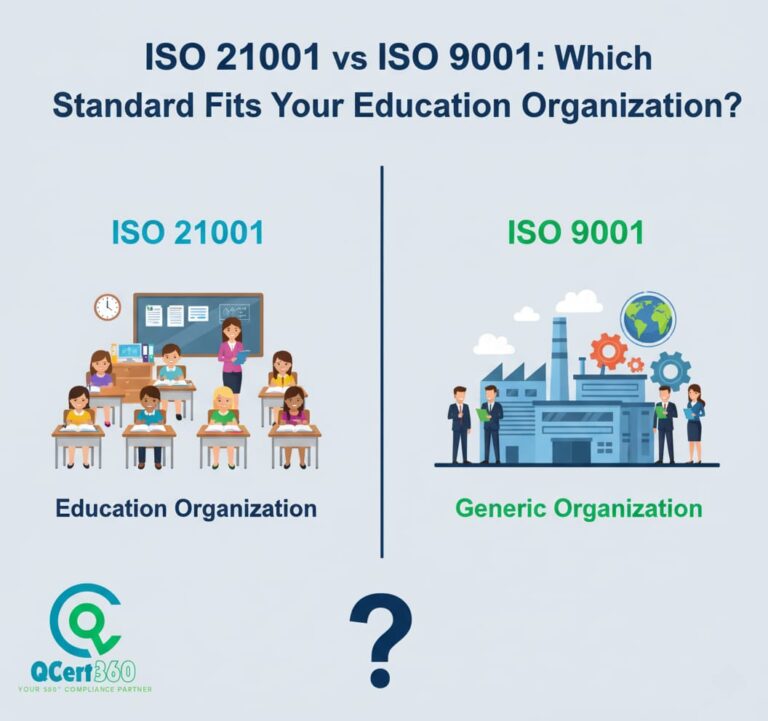
If you run an education or training organization, you’ve probably heard both ISO 21001 and ISO 9001 mentioned in conversations about quality, global credibility, and student trust. On paper, they seem similar. Both talk about processes, leadership, and continuous improvement. But once you dig in, you realize they’re built for two very different worlds.
Here’s the thing: ISO 9001 works beautifully for general business operations, but education isn’t just another business. You aren’t producing widgets. You’re shaping learners. That’s where ISO 21001 comes in—it’s purpose-built for education providers who want a structured, globally respected framework for improving learning outcomes.
So let’s break it down in a practical way: What’s the real difference? Which standard fits your organization? And how do you choose the one that gives you the strongest return on investment?
Why Education Organisations Need a Clear Quality Framework
Education today is under pressure. Learners expect better experiences, global recognition, transparent processes, and proof that what you teach is delivered in a professional, credible environment. Whether you’re a university, vocational training centre, corporate training provider, or an EdTech platform, your audience wants more than marketing—they want evidence.
That’s why certification matters. It signals maturity, consistency, and reliability. The question is which ISO standard makes more sense for you.
ISO 21001: Built Exclusively for the Education Sector
ISO 21001 is the Educational Organizations Management System (EOMS). It focuses on how institutions help learners succeed. Everything in this standard revolves around learning experience, teaching effectiveness, stakeholder engagement, accessibility, and measurable outcomes.
If you’re offering education or training, ISO 21001 aligns directly with your mission. It’s designed for:
- Universities and colleges
- Schools
- Training and coaching institutes
- Vocational and skill-development centers
- EdTech platforms
- E-learning providers
- Corporate training departments
What this really means is: if learning is your core product, ISO 21001 meets you where you are.
ISO 9001: A Strong General Quality Framework
ISO 9001 focuses on quality management for any industry. Manufacturers, logistics companies, IT firms, and consulting businesses all use it. It’s about consistent delivery, customer satisfaction, leadership, and risk management.
Can an education provider get ISO 9001 certified? Absolutely. Many do.
But let’s be honest—ISO 9001 doesn’t address the deeper reality of learning environments:
classroom delivery, curriculum design, assessment methods, learner needs, and educational outcomes.
It will help you run operations better, but it won’t strengthen your teaching framework in the way ISO 21001 can.
Key Differences: ISO 21001 vs ISO 9001
Nice—here’s a simple, slightly expanded version of each point so it reads like practical guidance.
- Purpose
• ISO 21001 — Designed around learners: it ties together learning design, delivery, assessment and the environment so education actually produces the intended competencies and outcomes.
• ISO 9001 — Designed around customers and processes: it creates predictable, repeatable operations that reduce errors and improve satisfaction across any service or product. - Core audience
• ISO 21001 — Education providers: schools, universities, training centres, distance-learning organisations and anybody that designs or delivers learning.
• ISO 9001 — Any organisation: manufacturers, service firms, non-profits, and yes, education providers who want a generic quality-management backbone. - Core requirements
ISO 21001 adds education-specific layers that 9001 doesn’t cover, for example:
• Curriculum planning — formal requirements for how learning objectives, teaching activities and assessments are designed and reviewed.
• Learner feedback and engagement — structured channels to capture what learners experience and use that input to improve courses.
• Accessibility and inclusivity — measures to make learning usable by diverse learners and to remove barriers to participation.
• Learning improvement processes — mechanisms focused on improving learning effectiveness, not just fixing administrative glitches.
• Teaching methodologies — expectations around instructor competence, teaching guides and consistency of delivery.
• Educational support services — targeted student support (advice, counselling, learning resources) tied into the quality system. - Outcome expectation
• ISO 21001 — You should see better learner achievement, higher completion rates, clearer competencies and stronger evidence that learning led to capability.
• ISO 9001 — You should see smoother operations, fewer administrative errors, faster turnaround on processes, and improved stakeholder confidence in how you run the organisation. - International perception
Here’s the thing: across Asia, the EU, the Middle East and Africa, ISO 21001 is gaining traction as a recognized benchmark for education quality. Governments, ministries and international training partners increasingly view it as useful evidence during procurement or partnership checks — so having 21001 can make you a stronger contender in cross-border bids and formal collaborations.
Want this tightened into a single-line comparison for a slide or a one-sentence decision rule you can drop into proposals? I’ll write it.
Which ISO Standard Should You Choose for Educational Organizations?
Let’s break it down based on your goals.
Nice—here’s a tight, human-friendly lift on each point, just a touch more detail so they read like quick, practical decisions.
Choose ISO 21001 if you want to:
- Strengthen learning outcomes — tighten curriculum design and assessment so learners actually meet the intended competences, not just attend classes.
- Improve teaching consistency — put common teaching frameworks and instructor guidance in place so students get a similar quality of instruction across courses and cohorts.
- Attract international learners — signal that your learning delivery meets globally recognised education quality expectations, making cross-border students more confident to enroll.
- Align with global education frameworks — map your programs to international competency and qualification frameworks, easing credit transfer and recognition.
- Build credibility with academic partners — show partner universities and training providers you follow accepted education management practices, making collaboration smoother.
- Compete in government or cross-border training contracts — meet procurement expectations that favour formally managed education systems, improving bid competitiveness.
- Demonstrate a learner-centric approach — shift focus from institutional convenience to learner needs, feedback and continuous improvement in learning experiences.
Choose ISO 9001 if you want to:
- Improve overall operational processes — standardise workflows across the organisation so routine tasks are predictable and fewer things fall through the cracks.
- Enhance administrative efficiency — reduce rework and delays in enrolment, finance, procurement and HR by applying process controls and metrics.
- Standardize support functions — bring consistency to non-teaching areas (IT, facilities, student services) so they reliably support the core education mission.
- Build general business credibility — provide stakeholders and customers a familiar mark of quality management that applies beyond education-specific claims.
Choose both (ISO 21001 + ISO 9001) if:
- You want a complete quality system—academically and operationally — cover both the pedagogy and the business processes so nothing important is left unmanaged.
- You have both education units and non-education functions — ensure classrooms and corporate services each follow fit-for-purpose quality controls.
- You are scaling internationally and need multi-standard recognition — combine the sector-specific education credibility of 21001 with the broad, cross-industry trust of 9001 to win partners and contracts in multiple markets.
Want these converted into a one-paragraph elevator pitch for your website or a short slide for a bid? I can do that next.
Many successful institutions pair both standards because they complement each other. ISO 21001 shapes the educational experience, while ISO 9001 strengthens the organizational engine that runs behind it.
A Real-World Case Study: How a Training Institute Chose the Right Standard
A vocational training institute in the Middle East approached Qcert360 with a challenge: they were losing out on regional contracts because buyers saw them as “unstructured.” Internally, they felt they were doing a good job. Externally, they had no proof.
The team initially believed ISO 9001 would solve their problem. After a gap analysis, we saw a deeper issue: the problem wasn’t general quality—it was learning quality.
Their learners had inconsistent outcomes. Trainers followed different methods. Feedback from trainees was getting lost. They had no structured way to measure training effectiveness.
Implementing ISO 21001 changed the entire culture.
Here’s what happened within six months:
- Teaching methods were standardized
- Learner feedback became a measurable part of improvement
- Training materials followed a controlled, repeatable structure
- Accessibility and transparency improved
- Assessment criteria became clear and consistent
- Their acceptance rate for international training contracts jumped significantly
What convinced their buyers wasn’t just the certificate—it was the structured, learner-focused system behind it.
This is a common pattern. Education organizations often think they need ISO 9001, but their actual bottleneck is learner experience, which only ISO 21001 fully addresses.
Why Qcert360 Is the Right Partner for Your ISO 21001 Journey
Implementing ISO 21001 or ISO 9001 is more than drafting documents and doing audits. Education institutions need a partner who understands how learning systems work, not just checklists.
Qcert360 brings hands-on experience working with:
- Universities
- Skill-development centers
- Online training organizations
- Corporate L&D units
- Coaching and certification bodies
- TVET and vocational academies
Here’s how we help:
- Practical, learner-focused implementation
- Simplified documentation that teams can actually use
- Trainer and staff awareness programs
- Internal audit support
- Full certification readiness
- Accreditation-recognized certification
Our team specializes in aligning your processes with international requirements without dragging your staff through unnecessary complexity.
If your goal is to improve credibility, win more international partnerships, or offer a world-class learner experience, Qcert360 is the partner that gets you there smoothly.
So… Which ISO Standard Fits Educational Organizations the best?
If education is your core mission, ISO 21001 is the smarter, more strategic fit. If you want broad operational consistency, ISO 9001 gives you that foundation. If you want to become a top-tier, globally recognized institution, combining both standards gives you unmatched strength.
And if you’re unsure, Qcert360 can do a quick assessment and guide you to the best path—without overselling or complicating things.
Ready to explore certification? Reach out to Qcert360 and we’ll help you choose the right standard, implement it the right way, and position your institution for global trust.
FAQ
- What is the main difference between ISO 21001 and ISO 9001 for education?
ISO 21001 focuses on learning quality and educational outcomes, while ISO 9001 targets general business processes and consistency. - Is ISO 21001 mandatory for education providers?
It’s not mandatory, but many global education partners and government bodies prefer or require it during qualification. - Can a school or training center get both ISO 21001 and ISO 9001?
Yes, many institutions choose both to strengthen educational quality and overall operations. - Who benefits the most from ISO 21001 certification?
Training centers, universities, e-learning platforms, and vocational institutions benefit the most because the standard aligns with learner needs. - How long does ISO 21001 certification take?
The timeline depends on readiness, but most education organizations complete it within 6–12 weeks. - Does ISO 21001 help improve teaching quality?
Yes, it brings structure to teaching methods, lesson planning, assessments, and feedback systems. - Is ISO 9001 enough for education providers?
It helps operations, but it doesn’t improve learning outcomes. ISO 21001 fills that gap. - Does ISO 21001 help with student recruitment?
Yes. It boosts credibility and international trust, which attracts learners and partners. - Are ISO 21001 audits strict?
They’re structured but practical. The focus is on how you support learners, not on unnecessary bureaucracy. - How can Qcert360 help with ISO 21001 certification?
Qcert360 provides implementation, training, documentation, internal audits, and accredited certification support tailored for education organizations.
Our Services
ISO Standards
- ISO 9001 Certification
- ISO 14001 Certification
- ISO 45001 Certification
- ISO 22000 Certification
- ISO 17025 Certification
- ISO 27001 Certification
- ISO 13485 Certification
- ISO 20000-1 Certification
- ISO 41001 Certification
- ISO 22716 Certification
- ISO 50001 Certification
- ISO 22301 Certification
- ISO 29993 Certification
Product Certifications
Other international standards
- FSSC 22000 Certification
- HIPAA
- HACCP Certification
- SA 8000 Certification
- GMP Certification
- GDPR
- GDP Certification
- GLP Certification
- Certificate of Conformity
QCert360 provides a wide range of services including ISO certification, audit support, compliance consulting, and training. They specialize in helping businesses achieve global standards and certifications like ISO 9001, ISO 27001, ISO 14001, and many others. Their team ensures a seamless experience from consultation to certification, supporting clients at every stage.
The time it takes to achieve certification can vary depending on the complexity of the standard and the readiness of your organization. On average, it takes about 3 to 6 months. QCert360 works closely with clients to streamline the process, ensuring that all requirements are met efficiently and within a reasonable timeline.
QCert360 is a trusted partner with years of experience in helping businesses obtain international certifications. Their expert consultants provide tailored solutions, ensuring your organization not only meets but exceeds industry standards. With a customer-centric approach, they focus on offering end-to-end support to simplify the certification journey.
QCert360 serves a wide range of industries including manufacturing, healthcare, information technology, education, and services, among others. They customize their certification solutions to meet the unique requirements of each industry, ensuring relevance and compliance with global standards.
Yes, QCert360 provides ongoing support even after certification. They offer services like surveillance audits, recertification guidance, and consultancy to help maintain and improve your certification status. Their team ensures that your organization stays compliant and up-to-date with any changes in certification standards.
Getting started with QCert360 is simple. You can contact them via their website to request a consultation. Their team will assess your needs, discuss the best certification options for your business, and outline the steps involved. From there, they’ll guide you through the entire process, ensuring you’re prepared for certification.
QCert360 stands out due to its customer-focused approach, industry expertise, and comprehensive service offerings. Their team doesn’t just help you obtain certification but works to ensure your organization thrives in compliance with international standards. They also offer personalized consultation, making the process smoother and more efficient, ensuring long-term success for your business.
The cost of certification varies depending on factors such as the type of certification, the size and complexity of your organization, and the specific industry requirements. QCert360 offers competitive pricing and provides tailored quotes based on your unique needs. They ensure transparency and work with you to find the most cost-effective solution for your certification goals.
Yes, QCert360 offers internal audit services to help assess and improve your organization’s processes. Their expert auditors conduct thorough reviews of your systems and operations to ensure they meet required standards. They also provide actionable recommendations to help enhance efficiency and compliance, making sure you’re fully prepared for external audits.
If your organization doesn’t pass an audit or certification assessment, QCert360 works with you to understand the reasons for non-compliance and provides support to rectify the issues. They offer guidance on corrective actions and help you prepare for a re-assessment. Their goal is to ensure your organization meets the necessary standards for certification, and they will be by your side to make the process as smooth as possible.