
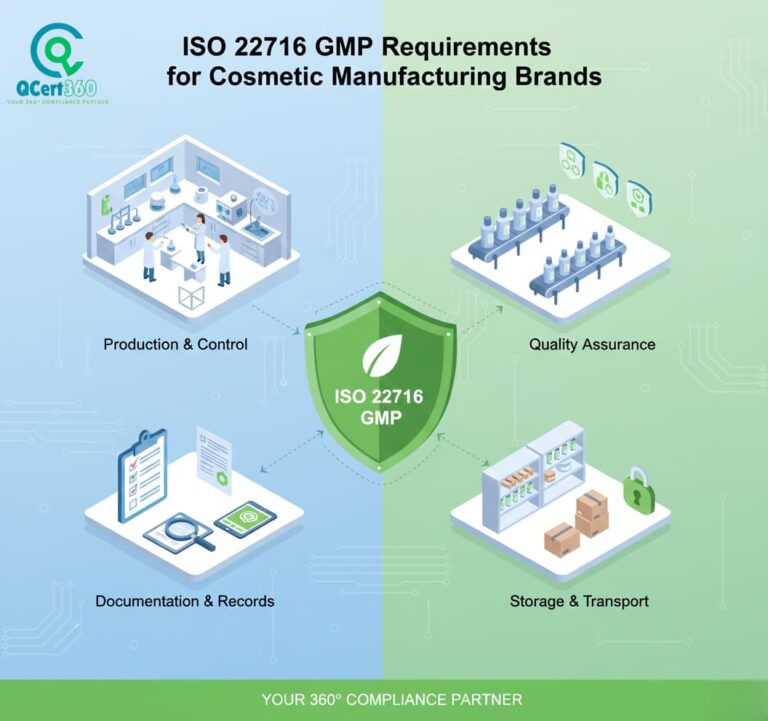
If you manufacture cosmetics, you already know how demanding this space has become. Customers expect clean formulas, stable products, and consistent quality every single time. Buyers expect structured manufacturing controls. And global retailers won’t even look at suppliers who can’t prove their production environment is safe, traceable, and well-managed.
That’s where ISO 22716 comes in. It’s the global benchmark for Good Manufacturing Practices in cosmetics, and it spells out exactly how brands should control every part of production—from raw material handling to filling, packaging, testing, storage, and shipment.
Think of it as the backbone of a responsible, scalable cosmetics operation. When you get it right, everything else falls into place: compliance, buyer trust, product quality, brand reputation, and export readiness.
Let’s break down what ISO 22716 actually requires, how cosmetics companies use it to strengthen operations, and how Qcert360 helps you get certified without turning it into a long, painful project.
Why ISO 22716 GMP Matters for Every Cosmetics Manufacturer
Here’s the thing: ISO 22716 isn’t just about compliance. It’s about building a controlled production environment where mistakes are prevented instead of fixed later. The standard covers the entire product lifecycle and how your team handles it day to day.
Modern buyers expect this because the industry is crowded, regulations keep tightening, and recalls can destroy trust overnight. This is why search interest for terms like GMP certification for cosmetics, quality control in cosmetics manufacturing, and cosmetic safety compliance has grown sharply.
Brands and contract manufacturers who follow ISO 22716 position themselves as safe, reliable, and ready for scrutiny. Those who don’t risk being replaced.
What ISO 22716 GMP Actually Covers
Unlike some quality standards that stay high-level, ISO 22716 dives straight into operational details. It explains exactly how manufacturers should control hygiene, traceability, documentation, equipment, raw materials, and storage conditions.
- Personnel and Training
Your people must know what they’re doing and why it matters. ISO 22716 requires:
- proper training on production tasks
- hygiene rules for staff
- documented responsibilities
- controlled access to production areas
Well-trained personnel are the foundation of GMP.
- Premises and Environment
Manufacturing areas must support consistent quality. The standard looks at:
- layout that prevents cross-contamination
- cleanable surfaces
- controlled airflow
- defined zones for raw materials, finished goods, and waste
This creates a safe and predictable environment for production.
- Equipment Management
Every piece of equipment affects product quality, so GMP requires:
- planned maintenance
- calibration schedules
- cleaning records
- validated critical machines
The goal is simple—no surprises during production.
- Raw Materials and Packaging Controls
ISO 22716 expects you to treat materials with the same care as the final product. That means:
- approved suppliers
- incoming inspections
- batch traceability
- controlled storage conditions
This prevents contamination and quality variability.
- Production and Filling Operations
This is where consistency matters. GMP requires clear instructions, defined process parameters, batch records, line clearance, and cleanliness protocols.
- Laboratory Controls
Testing isn’t optional. ISO 22716 calls for documented methods, qualified technicians, validated equipment, and proper sample retention.
- Handling of Non-Conformities
If something goes wrong, there must be a structured response. GMP requires corrective actions, root-cause analysis, and documentation.
- Storage and Distribution
Even the best product can be ruined by poor handling. The standard defines storage conditions, inventory rotation, and shipment controls.
- Documentation and Record-Keeping
This is where many manufacturers struggle, but it’s essential for GMP. ISO 22716 expects clear SOPs, batch records, logs, test reports, and change-control documents.
These requirements work together to create a factory that buyers trust—not because you say it’s safe, but because your system proves it.
How ISO 22716 GMP Helps Cosmetics Manufacturers Stay Competitive
Cosmetics companies often think GMP is something they have to do. The truth is, it’s one of the strongest competitive advantages you can build.
Here’s what the most successful manufacturers achieve with ISO 22716:
- cleaner, safer production lines that run without constant interventions
- fewer rejects and reworks because teams follow the same controlled steps
- stronger supplier relationships built on predictable quality
- better product consistency across every batch
- higher buyer confidence during evaluations and shelf-readiness checks
- clear batch traceability that simplifies investigations
- faster approvals from retailers who see a disciplined GMP system
Search intent for terms like GMP audit readiness, cosmetic quality system requirements, and ISO 22716 certification process keeps climbing because companies see GMP as a direct advantage—not an obligation.
Case Study: How One Cosmetics Brand Reduced Defects by 47% with ISO 22716
A mid-size personal care manufacturer was struggling with batch inconsistencies. Customers were flagging issues like separation in creams, fragrance variations, and unstable emulsions. Internally, the manufacturer knew the problem wasn’t the formula—it was the lack of structured processes around handling, filling, and environmental control.
A major retail buyer insisted on ISO 22716 certification for vendor approval. The company had no choice but to rethink its operations.
They partnered with Qcert360 for a complete GMP transformation.
Qcert360:
- mapped their manufacturing workflow to see where controls were missing
- identified contamination risks in filling areas that were quietly hurting batch quality
- redesigned SOPs for storage and batch preparation so teams followed the same steps every time
- implemented traceability logs for raw materials to tighten oversight
- trained operators on hygiene and documentation so habits matched GMP expectations
- prepared the company for a third-party ISO 22716 audit with no last-minute panic
Within four months, the company achieved certification. The real impact showed up right after:
- batch inconsistencies dropped
- customer complaints fell by nearly half
- production downtime reduced
- the retail buyer approved them as a long-term supplier
ISO 22716 wasn’t just a requirement—it became the foundation for operational stability and credibility.
Why Cosmetics Companies Choose Qcert360 for ISO 22716 Certification
ISO 22716 can feel overwhelming when you’re new to GMP requirements. There are dozens of processes, hundreds of documents, and daily practices that need consistent execution.
Qcert360 makes this easy.
You get:
- a clear roadmap from assessment to certification that shows your team what to do and when
- SOPs, forms, and checklists tailored to cosmetics operations so daily tasks stay structured
- practical GMP training for your staff to build confidence and consistency on the shop floor
- real-world templates for batch records and hygiene logs that speed up documentation
- step-by-step support during audit preparation to remove guesswork and avoid surprises
- access to accredited bodies for certification so you can complete the process without delays
Instead of trying to build everything from scratch, your team gets a ready-to-use GMP system designed to pass audits and support growth.
Companies also appreciate the way Qcert360 helps them optimise processes rather than loading them with unnecessary complexity. You get a clean, lean, efficient system that feels natural to follow.
If you want to strengthen your operations, impress buyers, and improve product consistency, ISO 22716 is the right place to start—and Qcert360 is the partner that gets you there faster.
How ISO 22716 Supports Brand Reputation and Risk Control
Cosmetics markets move fast. New ingredients, new packaging formats, and new formulations are everywhere. With so much experimentation, the risk of contamination, instability, or misuse increases.
ISO 22716 reduces those risks by giving you a structured, discipline-driven production environment:
- clear separation of clean and dirty zones so workflows stay safe and contamination-free
- monitored environmental conditions that keep every process within the right quality limits
- controlled filling lines to avoid variation and maintain stable product integrity
- documented cleaning operations that show traceability and accountability at every step
- reliable materials management that reduces mistakes and keeps inventory under control
- cross-checked production records to verify each batch meets requirements before release
The result is a brand that operates with confidence—even during audits.
That’s why search terms like cosmetic GMP compliance, manufacturing hygiene standards, and ISO 22716 production control keep gaining traction. Companies are actively looking for ways to build manufacturing maturity, not just avoid regulatory issues.
Why Implementing ISO 22716 Early Creates Long-Term Advantages
Most companies wait until a buyer demands certification. But the smartest manufacturers implement GMP before they’re forced to. That way, they enter buyers’ lists with confidence and secure approvals faster.
Early ISO 22716 adoption leads to:
- Stronger supplier credibility because partners see you follow disciplined, traceable GMP practices.
- Smoother production scale-ups since processes are already stable, controlled, and well-documented.
- Fewer root-cause investigations because deviations drop and issues become easier to trace.
- Better control during NPD as new formulas enter a structured, compliant development workflow.
- Easier onboarding of new personnel thanks to clear SOPs and predictable routines.
- Predictable batch performance because every stage—from raw materials to filling—is consistently managed.
Plus, your system grows with you instead of collapsing under pressure when demand increases.
FAQs
- What is the purpose of ISO 22716 registration?
It provides Good Manufacturing Practices for cosmetics to ensure safety, quality, and controlled production. - Is ISO 22716 mandatory for cosmetics companies?
It becomes required when customers, retailers, or regulators demand documented GMP compliance. - What areas does ISO 22716 standard cover?
It covers personnel, hygiene, equipment, raw materials, production, testing, storage, documentation, and distribution. - How long does ISO 22716 GMP certification take?
Timelines vary, but companies working with Qcert360 often achieve certification within weeks or a few months. - Does ISO 22716 include lab testing requirements?
Yes. It requires structured methods, validated equipment, and controlled testing processes. - What documents are needed for ISO 22716 certification?
SOPs, batch records, training logs, supplier approvals, cleaning logs, and traceability documents. - Can contract manufacturers get ISO 22716 GMP certified?
Absolutely. It’s essential for contract manufacturing operations. - Is staff training included in ISO 22716 compliance requirements?
Yes. Personnel must be trained on hygiene, production tasks, and GMP responsibilities. - Do small cosmetics brands need ISO 22716 GMP compliance?
If they manufacture in-house or work with buyers who expect GMP, it becomes essential. - How can Qcert360 help with ISO 22716 GMP implementation?
Qcert360 offers consulting, documentation support, training, audit preparation, and certification guidance.
Our Services
ISO Standards
- ISO 9001 Certification
- ISO 14001 Certification
- ISO 45001 Certification
- ISO 22000 Certification
- ISO 17025 Certification
- ISO 27001 Certification
- ISO 13485 Certification
- ISO 20000-1 Certification
- ISO 41001 Certification
- ISO 22716 Certification
- ISO 50001 Certification
- ISO 22301 Certification
- ISO 29993 Certification
Product Certifications
Other international standards
- FSSC 22000 Certification
- HIPAA
- HACCP Certification
- SA 8000 Certification
- GMP Certification
- GDPR
- GDP Certification
- GLP Certification
- Certificate of Conformity
QCert360 provides a wide range of services including ISO certification, audit support, compliance consulting, and training. They specialize in helping businesses achieve global standards and certifications like ISO 9001, ISO 27001, ISO 14001, and many others. Their team ensures a seamless experience from consultation to certification, supporting clients at every stage.
The time it takes to achieve certification can vary depending on the complexity of the standard and the readiness of your organization. On average, it takes about 3 to 6 months. QCert360 works closely with clients to streamline the process, ensuring that all requirements are met efficiently and within a reasonable timeline.
QCert360 is a trusted partner with years of experience in helping businesses obtain international certifications. Their expert consultants provide tailored solutions, ensuring your organization not only meets but exceeds industry standards. With a customer-centric approach, they focus on offering end-to-end support to simplify the certification journey.
QCert360 serves a wide range of industries including manufacturing, healthcare, information technology, education, and services, among others. They customize their certification solutions to meet the unique requirements of each industry, ensuring relevance and compliance with global standards.
Yes, QCert360 provides ongoing support even after certification. They offer services like surveillance audits, recertification guidance, and consultancy to help maintain and improve your certification status. Their team ensures that your organization stays compliant and up-to-date with any changes in certification standards.
Getting started with QCert360 is simple. You can contact them via their website to request a consultation. Their team will assess your needs, discuss the best certification options for your business, and outline the steps involved. From there, they’ll guide you through the entire process, ensuring you’re prepared for certification.
QCert360 stands out due to its customer-focused approach, industry expertise, and comprehensive service offerings. Their team doesn’t just help you obtain certification but works to ensure your organization thrives in compliance with international standards. They also offer personalized consultation, making the process smoother and more efficient, ensuring long-term success for your business.
The cost of certification varies depending on factors such as the type of certification, the size and complexity of your organization, and the specific industry requirements. QCert360 offers competitive pricing and provides tailored quotes based on your unique needs. They ensure transparency and work with you to find the most cost-effective solution for your certification goals.
Yes, QCert360 offers internal audit services to help assess and improve your organization’s processes. Their expert auditors conduct thorough reviews of your systems and operations to ensure they meet required standards. They also provide actionable recommendations to help enhance efficiency and compliance, making sure you’re fully prepared for external audits.
If your organization doesn’t pass an audit or certification assessment, QCert360 works with you to understand the reasons for non-compliance and provides support to rectify the issues. They offer guidance on corrective actions and help you prepare for a re-assessment. Their goal is to ensure your organization meets the necessary standards for certification, and they will be by your side to make the process as smooth as possible.