
If you’ve already been through ISO 9001 certification once, you know the drill. The planning. The documentation. The internal audits. The management review. And then the relief when you finally get that certificate in hand. But here’s the thing many companies don’t realize until renewal time comes around: ISO 9001 recertification isn’t a repeat of your initial journey—it’s a maturity check.
Think of it like a fitness test. Your certification body wants to see whether you’ve actually been applying the system or whether everything slipped back into “business as usual.” And because ISO 9001 is a three-year cycle, the recertification audit becomes a moment of truth.
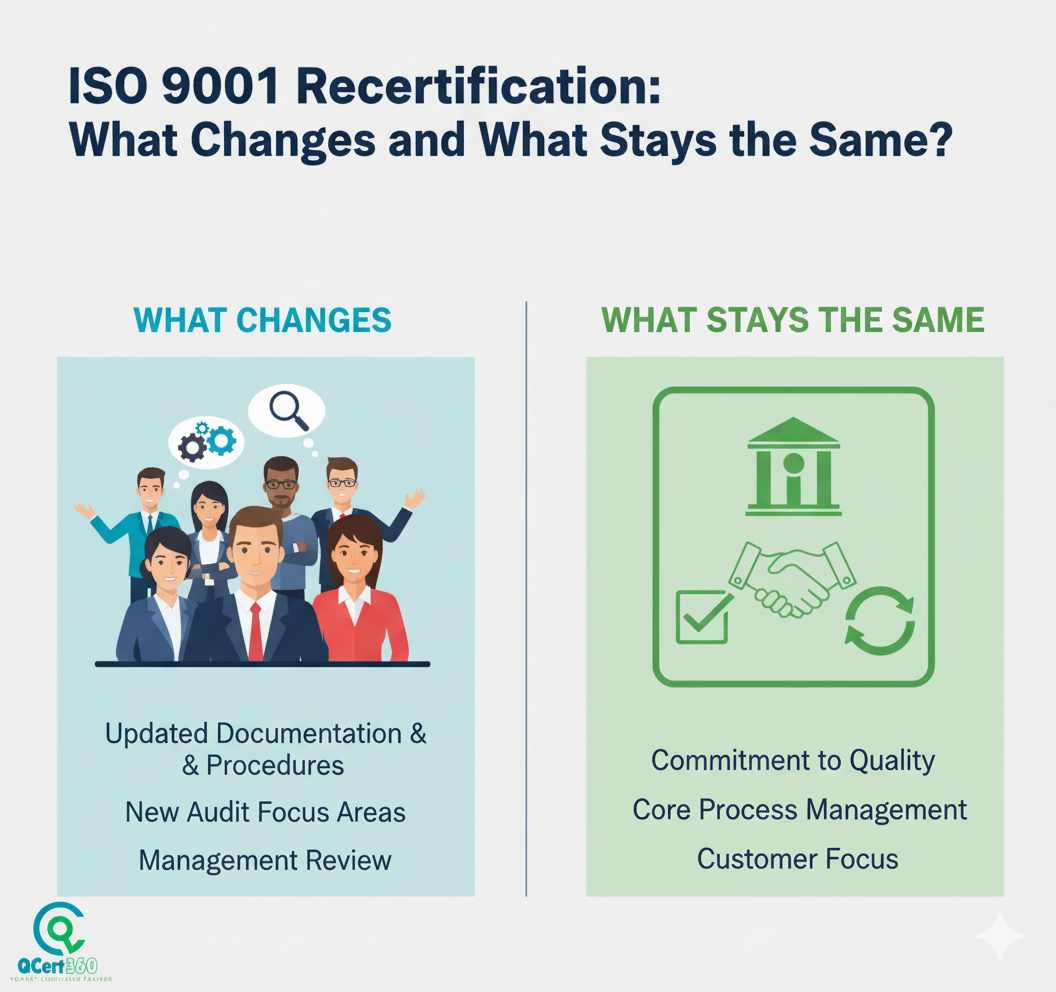
So let’s break it down clearly. What stays the same? What actually changes? And what should you do to stay ready without scrambling at the last minute?
Why ISO 9001 Recertification Matters More Than You Think
A lot of companies assume that once they’re certified, they’re set for good. But if you want to stay competitive—especially in supply chains where customers expect consistent quality—your certificate must stay valid and up to date. Many buyers now view expired or lapsed certificates as a red flag.
ISO 9001 recertification shows you’re not just following a quality management system on paper. You’ve embedded it into your operations, from risk-based thinking to process monitoring to customer satisfaction tracking. And because the ISO 9001:2015 standard emphasizes continual improvement, auditors expect to see meaningful progress, not just maintenance.
This is where companies either shine—or get stuck.
What Stays the Same During ISO 9001 Recertification?
Let’s start with the familiar parts, because there’s a lot that carries over from your initial certification.
- The Core Requirements Don’t Change
ISO 9001:2015 hasn’t undergone major revisions since its release. This means every clause you complied with before—context, leadership, planning, support, operation, performance evaluation, improvement—still applies.
Your processes don’t need reinvention. They need reinforcement.
- The Documentation Structure Remains Consistent
You still need:
- Quality Manual (if you use one)
- Policies and procedures
- Risk assessments
- SOPs
- Forms and records
- Monitoring and measurement data
Auditors don’t expect shiny new documents. They expect living documents—used, updated, and aligned with your actual operations.
- Internal Audits and Management Reviews Are Still Mandatory
These two haven’t changed at all. But during recertification, they hold more weight. Auditors look closely at:
- How effectively you audit your own processes
- Whether management reviews reflect strategic decisions
- How you’ve addressed previous nonconformities
If these two activities look weak, the recertification audit becomes tougher.
- Competence and Training Evidence Still Matter
Your team’s competence records, onboarding, skill assessments, and job-specific training requirements are still part of the audit. No surprises here.
- Customer Feedback and Corrective Actions Still Drive the System
Nonconformities, complaints, and improvement actions continue to be central indicators of how well your quality management system performs.
So far, nothing dramatic. But this is where many companies underestimate what has evolved.
What Actually Changes During ISO 9001 Recertification?
Now let’s look at the areas that shift as you move from first certification to renewal.
- Auditors Expect Maturity, Not Just Compliance
During the initial certification, auditors mainly want to see whether you understand the system. During recertification, they want proof that your system is:
- Being used
- Being improved
- Adding value
- Influencing decisions
Your quality management system has to show life—not just labels and binders.
- Performance Trends Matter Much More
Auditors don’t just check whether you monitor KPIs—they look at the trend of your KPIs over the last three years.
Examples:
- Improvement in on-time delivery — fewer missed deadlines, smoother schedules.
- Drop in customer complaints — fewer repeat issues and quicker resolutions.
- Reduced scrap or rework — less waste and lower corrective costs.
- Better supplier performance — more reliable deliveries and fewer quality gaps.
- Higher customer satisfaction scores — clearer positive feedback and stronger retention.
Flat or declining trends raise questions.
- Your Risk-Based Thinking Must Evolve
Initial risk assessments are often basic. By recertification, they should show:
- Updated risks
- Emerging risks
- Opportunities identified
- Evidence of actions taken
If your risk register looks three years old, expect a nonconformity.
- Evidence of Continual Improvement Becomes Critical
ISO 9001 expects you to evolve—processes, training, operational controls, technology, and customer engagement.
Auditors want to know:
- What has improved since your last cycle?
- Why did you improve it?
- What evidence supports the improvement?
Improvement for show no longer works.
- Surveillance Audit Findings Must Be Closed
Every finding from your year 1 and year 2 surveillance audits must be fully closed, with strong corrective actions. Weak or incomplete closures delay recertification.
- Scope Revalidation Happens
Your scope may shift due to:
- New products
- Expanded markets
- New branches
- Strategic changes
Recertification is the moment to align your certificate with your current business
A Real-World Case Study: How ISO 9001 Recertification Changed a Manufacturing Firm’s Trajectory
A mid-sized manufacturer in Europe contacted Qcert360 three months before their ISO 9001 certificate was set to expire. They assumed recertification would be simple. But when we ran a quick gap assessment, a few issues surfaced:
- Their documentation hadn’t been updated in two years — procedures described past ways of working, so records didn’t match daily practice and auditors found inconsistencies.
- KPIs were tracked but not analyzed — numbers existed, but no one dug into trends or causes, so opportunities for improvement stayed hidden.
- Customer complaints were logged but not categorized — every complaint looked the same, making it impossible to spot recurring issues or prioritise fixes.
- Management reviews were happening, but with no real strategic discussion — meetings checked boxes instead of using data to make decisions about risks, resources and growth.
- Internal audits were done “just to complete the requirement” — audits became a formality instead of a diagnostic tool, so root causes weren’t explored and real change stalled.
This company wasn’t doing anything wrong—they had simply shifted focus to growth and neglected their quality system.
Here’s what we did:
- Updated their documentation based on real operational data — we replaced generic procedures with records and SOPs that reflect how the team actually works, so evidence matches practice.
- Created trend-based KPI dashboards — visual trackers show performance over time, making problems and improvements obvious instead of hidden in spreadsheets.
- Redesigned their complaint handling system — we made it faster to capture, investigate and close complaints, and ensured corrective actions feed back into process changes.
- Revamped their internal audit process to make it meaningful — audits shifted from box-checking to targeted reviews that uncover root causes and trigger useful improvements.
- Guided leadership on integrating quality with strategy — we helped managers use QMS data to set priorities, allocate resources and measure impact on business goals.
- Strengthened evidence for continual improvement — we tied actions to measurable results so every improvement has traceable evidence and clear outcomes.
Three weeks later, they underwent recertification—and passed with zero major findings.
Better yet, their new dashboards and risk controls helped reduce rework by 11% over the next six months.
This is the kind of shift that recertification can bring when it’s done right.
How Qcert360 Makes ISO 9001 Recertification Easier and More Strategic
Qcert360 helps companies stay audit-ready Recertification shouldn’t feel like a last-minute scramble.
- Gap Assessment
We look at how your business has evolved since your last cycle and point out the areas that need attention, giving you a clear path forward. - Updated Documentation
We streamline and update your QMS so it reflects the way you actually operate today, not the outdated procedures sitting in old manuals. - Internal Audit Support
Our auditors walk through your processes with the same mindset as a certification body, helping you spot issues early and fix them before they become findings. - Corrective Action Planning
We help you build actions that address root causes, drive real improvements and leave auditors confident in your system. - Management Review Guidance
We guide leadership to use QMS insights for smarter decisions, linking quality, performance and business growth in a practical way. - Recertification Audit Preparation
We organise your evidence, coach your teams and tighten loose ends so the external audit feels predictable instead of overwhelming. - Accredited Certification
Qcert360 provides ISO 9001 certification recognised across Asia, Europe, the Middle East and Africa—credibility your clients can trust.
If your certificate is close to expiring or you want a stronger, cleaner QMS, Qcert360 is the partner that keeps everything practical, clear and aligned with real business goals.
Final Thoughts
ISO 9001 recertification isn’t just a renewal. It’s a chance to prove that quality has truly become part of your culture. What stays the same are the fundamental requirements. What changes are the expectations—your system should be more mature, more refined, and more connected to business performance.
If you want a smoother, smarter recertification experience, Qcert360 is ready to guide you every step of the way.
FAQs
- What is ISO 9001 recertification?
It’s the process of renewing your ISO 9001 certification every three years to confirm continued compliance. - How long does ISO 9001 recertification take?
Most businesses complete it within 2–4 weeks, depending on readiness. - What happens if my ISO 9001 certificate expires?
You lose certified status and may need a full initial certification again. - What do auditors check during ISO recertification?
Performance trends, continual improvement, document updates, internal audits, and system maturity. - Are ISO recertification audits harder than initial audits?
They’re more detailed because auditors expect growth, not basic compliance. - Can I change my certification body during ISO recertification?
Yes, any accredited certification body like Qcert360 can take over the process. - Do I need to update my ISO 9001 documentation for recertification?
Yes. Documents must reflect current processes, risks, and improvements. - How can Qcert360 help with ISO 9001 recertification?
We support gap analysis, documentation, internal audits, training, and accredited certification. - What improvements should I show during ISO recertification?
Better KPIs, stronger controls, fewer complaints, and evidence of continual improvement. - Is ISO recertification required for tender eligibility?
Yes. Many buyers require a valid, up-to-date ISO 9001 certificate to qualify.
Our Services
ISO Standards
- ISO 9001 Certification
- ISO 14001 Certification
- ISO 45001 Certification
- ISO 22000 Certification
- ISO 17025 Certification
- ISO 27001 Certification
- ISO 13485 Certification
- ISO 20000-1 Certification
- ISO 41001 Certification
- ISO 22716 Certification
- ISO 50001 Certification
- ISO 22301 Certification
- ISO 29993 Certification
Product Certifications
Other international standards
- FSSC 22000 Certification
- HIPAA
- HACCP Certification
- SA 8000 Certification
- GMP Certification
- GDPR
- GDP Certification
- GLP Certification
- Certificate of Conformity
QCert360 provides a wide range of services including ISO certification, audit support, compliance consulting, and training. They specialize in helping businesses achieve global standards and certifications like ISO 9001, ISO 27001, ISO 14001, and many others. Their team ensures a seamless experience from consultation to certification, supporting clients at every stage.
The time it takes to achieve certification can vary depending on the complexity of the standard and the readiness of your organization. On average, it takes about 3 to 6 months. QCert360 works closely with clients to streamline the process, ensuring that all requirements are met efficiently and within a reasonable timeline.
QCert360 is a trusted partner with years of experience in helping businesses obtain international certifications. Their expert consultants provide tailored solutions, ensuring your organization not only meets but exceeds industry standards. With a customer-centric approach, they focus on offering end-to-end support to simplify the certification journey.
QCert360 serves a wide range of industries including manufacturing, healthcare, information technology, education, and services, among others. They customize their certification solutions to meet the unique requirements of each industry, ensuring relevance and compliance with global standards.
Yes, QCert360 provides ongoing support even after certification. They offer services like surveillance audits, recertification guidance, and consultancy to help maintain and improve your certification status. Their team ensures that your organization stays compliant and up-to-date with any changes in certification standards.
Getting started with QCert360 is simple. You can contact them via their website to request a consultation. Their team will assess your needs, discuss the best certification options for your business, and outline the steps involved. From there, they’ll guide you through the entire process, ensuring you’re prepared for certification.
QCert360 stands out due to its customer-focused approach, industry expertise, and comprehensive service offerings. Their team doesn’t just help you obtain certification but works to ensure your organization thrives in compliance with international standards. They also offer personalized consultation, making the process smoother and more efficient, ensuring long-term success for your business.
The cost of certification varies depending on factors such as the type of certification, the size and complexity of your organization, and the specific industry requirements. QCert360 offers competitive pricing and provides tailored quotes based on your unique needs. They ensure transparency and work with you to find the most cost-effective solution for your certification goals.
Yes, QCert360 offers internal audit services to help assess and improve your organization’s processes. Their expert auditors conduct thorough reviews of your systems and operations to ensure they meet required standards. They also provide actionable recommendations to help enhance efficiency and compliance, making sure you’re fully prepared for external audits.
If your organization doesn’t pass an audit or certification assessment, QCert360 works with you to understand the reasons for non-compliance and provides support to rectify the issues. They offer guidance on corrective actions and help you prepare for a re-assessment. Their goal is to ensure your organization meets the necessary standards for certification, and they will be by your side to make the process as smooth as possible.