
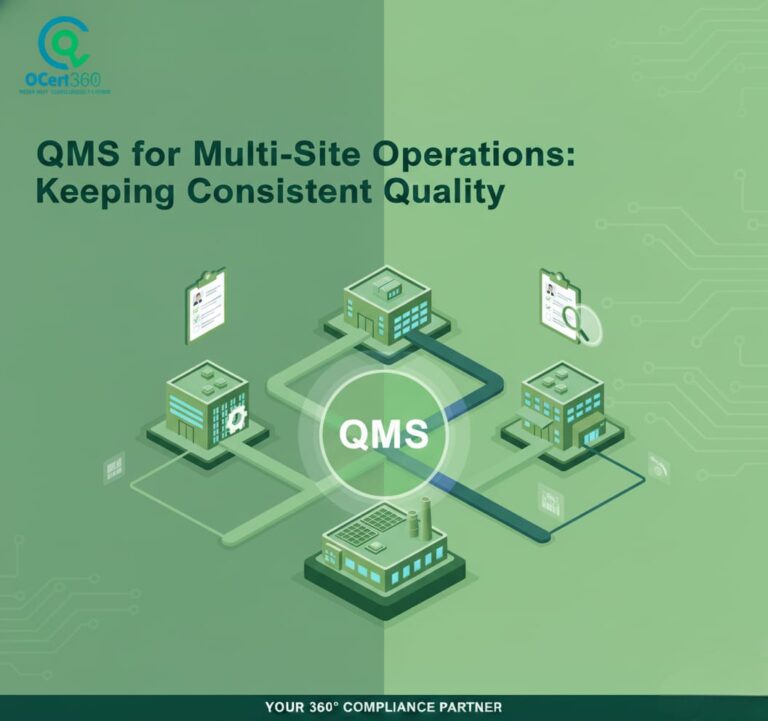
Running operations across multiple sites sounds like a sign of growth, but anyone who has managed more than one facility knows the real story. One site performs flawlessly, another runs into recurring customer issues, and the third has its own way of doing things that doesn’t match the corporate playbook.
Here’s the thing: without a unified Quality Management System that works across all locations, the entire operation turns into a patchwork of methods, interpretations, and inconsistent results. And inconsistency is the fastest way to lose buyers, stretch delivery timelines, and damage your reputation.
This is where a well-designed multi-site QMS built around ISO 9001 certification becomes a real competitive advantage. It gives your teams a shared language, a shared set of rules, and a shared way to measure performance—no matter where your facilities are located.
Let’s break down what it takes to keep quality consistent across multiple sites, how leading companies do it, and why working with a partner like Qcert360 gives you a smoother, faster, and audit-ready implementation.
Why Multi-Site Operations Struggle With Consistency
When your business operates in more than one location, quality challenges multiply quickly:
- Different supervisors interpret processes differently, which creates inconsistency across daily operations.
- Teams build their own templates, checklists, or documentation, leading to uneven quality and missing controls.
- Training varies from site to site, so people don’t follow the same level of understanding or skill.
- Corrective actions fix isolated issues instead of tackling the deeper system-level causes.
- Procurement, customer service, and logistics follow different standards, making alignment and audit readiness difficult.
The result? A steady stream of variation that impacts customer satisfaction, product quality, and operational efficiency.
A unified multi-site quality management system fixes this by centralizing expectations while still giving local teams the flexibility they need to operate smoothly. Think of it as a single high-performing system that scales across addresses, geographies, and teams.
Why ISO 9001 Certification Is Essential for Multi-Site Operations
ISO 9001 remains the global benchmark for operational discipline and quality assurance. For multi-site organizations, it unlocks benefits you simply can’t achieve with scattered, local procedures:
- One set of documented processes across all locations creates consistency and removes confusion about how work should be done.
- Harmonized KPIs and performance metrics help every site report, measure, and improve in the same direction.
- Shared risk-based thinking and structured internal audits ensure issues are caught early and handled systematically.
- Stronger customer trust, especially with buyers in Europe, the UAE, and South Africa, comes from proving your operations follow recognized standards.
- Lower cost of compliance through multi-site certification audits reduces duplicated effort and saves both time and money.
- Reduced operational waste and fewer recurring errors result from everyone following aligned procedures and continuous improvement routines.
When implemented correctly, a multi-site ISO 9001 QMS becomes the backbone of business continuity, supplier confidence, and long-term customer relationships.
How a Multi-Site QMS Actually Works
A multi-site QMS is more than copying the same manual across facilities. It is a system built around controlled standardization. Here’s the structure most successful organizations follow:
- A Central Quality Framework
Your head office controls the core QMS documentation, process flows, procedures, and strategic KPIs. This ensures every site follows the same foundation.
- Local Tailoring Where Necessary
Some processes require local interpretation—especially where regulations, operational environments, or customer expectations differ. Multi-site QMS allows controlled customization without losing consistency.
- Performance Monitoring Across Sites
This is where many companies fall short. With a proper QMS, quality becomes measurable. You see trends such as:
- Customer complaints by region reveal where service issues are concentrated and which markets need attention.
- Defect rates by facility help you pinpoint plants or lines that require stronger controls.
- On-time delivery performance shows how reliably each site meets customer commitments.
- Effectiveness of corrective actions indicates whether fixes actually prevent issues from recurring.
- This data holds every location accountable.
- Cross-Site Internal Audits
Internal audits become more powerful in a multi-site environment. You identify good practices in one location and replicate them across the network. You also catch risks early before they grow.
- Multi-Site Certification Audits
ISO certification bodies conduct combined audits, reducing certification cost and strengthening system-level assurance.
This model drives uniformity without suffocating local autonomy. It also signals to international buyers that your entire organization—not just one plant—operates under proven quality controls.
A Real-World Case Study: How a Multi-Site QMS Transformed a Growing Manufacturer
A mid-sized electronics manufacturer operating facility in Eastern Europe and the Middle East reached out to Qcert360 because their quality results were all over the place. One site delivered top-notch output. Another struggled with returning customers due to inconsistent product testing. A third site faced repeated supplier non-conformance issues.
The leadership wanted ISO 9001 multi-site certification but had no idea how to unify their systems without disrupting ongoing work.
Here’s how the project unfolded:
The Challenge
- Each location had its own documentation formats, which made consistency and audit alignment difficult.
- No shared training system meant employees learned processes differently depending on the site.
- Supplier qualification varied widely, leading to uneven quality and unpredictable risks.
- Different criteria for approving final products created confusion and inconsistent output across facilities.
- Customer complaints were logged differently in each site, making trends hard to track and compare.
Qcert360’s Approach
Our team stepped in with a structured multi-site QMS implementation plan:
- Conducted a cross-site gap analysis to see exactly where processes differed and where alignment was needed.
- Standardized the entire documentation structure so every site followed the same formats and controls.
- Built a central digital QMS portal accessible to all sites, making documents and records easy to find and update.
- Established shared KPIs and dashboards to track performance consistently across the whole group.
- Introduced a unified supplier evaluation method to ensure all vendors met the same quality expectations.
- Implemented consistent CAPA processes so issues were addressed in the same structured way everywhere.
- Trained 30+ internal auditors across all facilities to strengthen oversight and maintain system integrity.
- Coordinated a multi-site certification audit with an accredited body to achieve group-wide compliance in one go.
The Result
Within four months:
- All sites aligned under a single QMS, creating consistent processes and expectations across the organization.
- Customer complaints dropped by 35 percent as issues were addressed more systematically.
- Rework reduced significantly across two facilities thanks to clearer controls and fewer recurring errors.
- New buyers from Germany and the Netherlands approved them as suppliers due to stronger process credibility.
- They achieved ISO 9001 multi-site certification on the first attempt, validating the success of the transformation.
This transformation gave the company a stronger supply chain presence and a more predictable quality output across every operation.
Why Qcert360 Is the Right Partner for Multi-Site QMS Certification
If you’ve managed multi-location quality challenges, you already know it’s not just about writing documents. It’s about creating a system your entire business believes in—and follows.
Qcert360 offers:
- End-to-End Implementation Support
From policies to SOPs to internal audit training, we help you build a clean, modern, and audit-ready QMS.
- Multi-Site Audit Expertise
We coordinate with accredited certification bodies to structure certification for maximum efficiency and cost savings.
- Industry-Specific QMS Knowledge
Whether you’re in manufacturing, logistics, engineering, services, or electronics, our consultants understand how multi-site quality works in real settings.
- Remote and On-Site Support
We combine remote documentation sessions with on-site audits when required, making the process smooth and predictable.
- Faster Certification Without Cutting Corners
We streamline your QMS—no clutter, no outdated formats, no redundant procedures.
If you want operations that perform consistently, deliver predictably, and pass audits confidently, Qcert360 simplifies the journey.
The Bottom Line
Multi-site operations don’t get better by chance. They get better by design. A unified QMS built around ISO 9001 gives your organization:
- control
- clarity
- consistency
- credibility
And when you elevate all your locations to a single, disciplined quality standard, you win more trust, more contracts, and more long-term business.
If you want to build a multi-site QMS that actually works—and get certified without stress—Qcert360 is ready to support you.
FAQs
- What is a multi-site QMS in ISO 9001?
It’s a single quality management system used across several company locations, governed by a central quality framework.
- Why is ISO 9001 important for multi-site operations?
It creates consistent processes, improves customer confidence, and supports cross-site performance monitoring.
- Can all company locations be ISO 9001 QMS certified together?
Yes. ISO 9001 supports multi-site certification under one audit program when processes are centrally controlled.
- How does a multi-site QMS reduce operational risks?
It eliminates process variation, strengthens internal audits, and ensures every site follows the same quality standards.
- What documentation is required for multi-site ISO 9001 certification?
Central policies, SOPs, quality objectives, risk assessments, process maps, and site-specific operational records.
- Does a multi-site QMS lower certification cost?
Yes. Combined audits reduce overall certification and surveillance audit expenses.
- How does QMS help with supplier quality management?
It standardizes supplier evaluation, approval, monitoring, and corrective actions across all locations.
- Can a multi-site QMS improve customer satisfaction?
Absolutely. It reduces inconsistencies that cause complaints and strengthens service quality.
- How long does multi-site ISO 9001 certification take?
Most organizations complete it within 8–16 weeks depending on complexity and number of locations.
- How can Qcert360 help with multi-site QMS implementation?
We support documentation, training, internal audits, and coordinate multi-site certification with accredited bodies.
Our Services
ISO Standards
- ISO 9001 Certification
- ISO 14001 Certification
- ISO 45001 Certification
- ISO 22000 Certification
- ISO 17025 Certification
- ISO 27001 Certification
- ISO 13485 Certification
- ISO 20000-1 Certification
- ISO 41001 Certification
- ISO 22716 Certification
- ISO 50001 Certification
- ISO 22301 Certification
- ISO 29993 Certification
Product Certifications
Other international standards
- FSSC 22000 Certification
- HIPAA
- HACCP Certification
- SA 8000 Certification
- GMP Certification
- GDPR
- GDP Certification
- GLP Certification
- Certificate of Conformity
QCert360 provides a wide range of services including ISO certification, audit support, compliance consulting, and training. They specialize in helping businesses achieve global standards and certifications like ISO 9001, ISO 27001, ISO 14001, and many others. Their team ensures a seamless experience from consultation to certification, supporting clients at every stage.
The time it takes to achieve certification can vary depending on the complexity of the standard and the readiness of your organization. On average, it takes about 3 to 6 months. QCert360 works closely with clients to streamline the process, ensuring that all requirements are met efficiently and within a reasonable timeline.
QCert360 is a trusted partner with years of experience in helping businesses obtain international certifications. Their expert consultants provide tailored solutions, ensuring your organization not only meets but exceeds industry standards. With a customer-centric approach, they focus on offering end-to-end support to simplify the certification journey.
QCert360 serves a wide range of industries including manufacturing, healthcare, information technology, education, and services, among others. They customize their certification solutions to meet the unique requirements of each industry, ensuring relevance and compliance with global standards.
Yes, QCert360 provides ongoing support even after certification. They offer services like surveillance audits, recertification guidance, and consultancy to help maintain and improve your certification status. Their team ensures that your organization stays compliant and up-to-date with any changes in certification standards.
Getting started with QCert360 is simple. You can contact them via their website to request a consultation. Their team will assess your needs, discuss the best certification options for your business, and outline the steps involved. From there, they’ll guide you through the entire process, ensuring you’re prepared for certification.
QCert360 stands out due to its customer-focused approach, industry expertise, and comprehensive service offerings. Their team doesn’t just help you obtain certification but works to ensure your organization thrives in compliance with international standards. They also offer personalized consultation, making the process smoother and more efficient, ensuring long-term success for your business.
The cost of certification varies depending on factors such as the type of certification, the size and complexity of your organization, and the specific industry requirements. QCert360 offers competitive pricing and provides tailored quotes based on your unique needs. They ensure transparency and work with you to find the most cost-effective solution for your certification goals.
Yes, QCert360 offers internal audit services to help assess and improve your organization’s processes. Their expert auditors conduct thorough reviews of your systems and operations to ensure they meet required standards. They also provide actionable recommendations to help enhance efficiency and compliance, making sure you’re fully prepared for external audits.
If your organization doesn’t pass an audit or certification assessment, QCert360 works with you to understand the reasons for non-compliance and provides support to rectify the issues. They offer guidance on corrective actions and help you prepare for a re-assessment. Their goal is to ensure your organization meets the necessary standards for certification, and they will be by your side to make the process as smooth as possible.