When a potential client asks for your ISO documents, what they’re really checking is simple: can they trust you with their business?
Here’s the thing—most companies don’t lose deals because they lack ISO certification. They lose deals because their ISO documentation looks incomplete, outdated, or disconnected from how the business actually works. Buyers today expect proof of operational control, risk awareness, and continuous improvement. They don’t want a folder full of generic templates. They want evidence that your management system is real.
So let’s break down what buyers look for first, why these checks matter, and how a strong system helps you pass client audits smoothly with ISO requirements aligned to real expectations.
This guide walks you through the areas where companies slip, the quick wins that boost buyer confidence, and how Qcert360 helps organisations close gaps fast—without complicating their operations.
Why Buyers Scrutinise ISO Documentation More Closely Than Ever
Client auditors have changed. They’re sharper, more risk-aware, and far more focused on supplier resilience. Many now use advanced vendor risk frameworks that push them to look beyond certificates and evaluate your system end-to-end.
This shift is why terms like supplier assurance evidence, audit readiness review, compliance verification pack, and ISO governance maturity have become high-intent search topics. Buyers want more transparency, and they want it upfront.
They’re usually scanning for three things:
- Authenticity – Does your documentation reflect real processes, or does it feel like a downloaded template?
- Consistency – Do your policies, procedures, and records align with each other?
- Traceability – Can you show how decisions are made, monitored, and improved?
Companies that nail these three areas pass audits with ease. Those that don’t often get stuck in multiple rounds of clarifications, follow-up evidence, or—worse—a rejection.
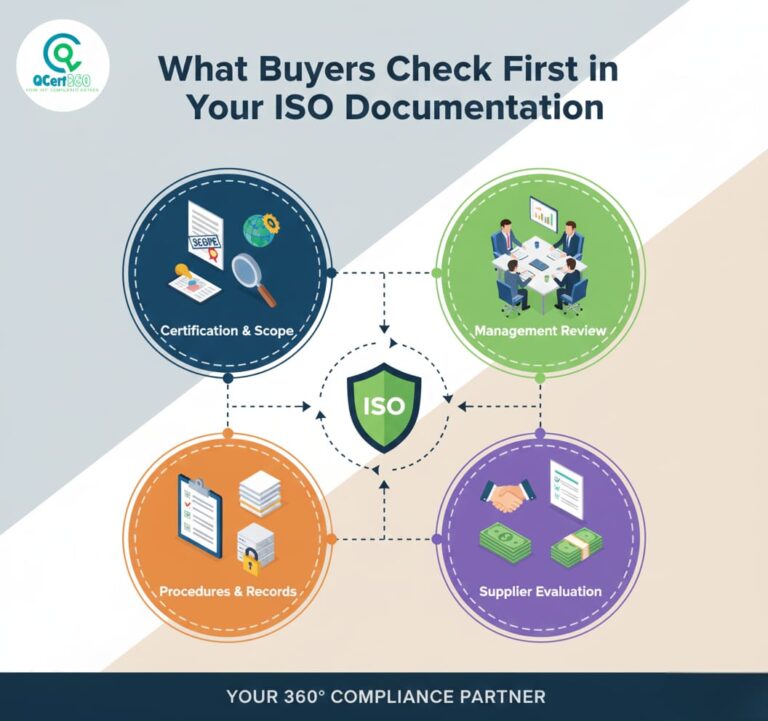
The First ISO Documents Buyers Always Check
Let’s walk through the documents client auditors always ask for first. These are the items that shape their impression within minutes, and they heavily influence whether they trust the rest of your system.
- Your ISO Policy (Quality, Information Security, Environment, or Safety)
Buyers read your policy differently from how certification auditors do. They’re looking for alignment with their own values and risk expectations. A vague, template-style policy signals weak internal governance.
A strong policy highlights:
- Clear leadership commitments that show decision-makers are genuinely backing the system, not just signing a policy because it’s required.
- Measurable objectives that actually track progress, help teams stay focused, and give auditors something concrete to assess.
- Relevance to your industry and services so the goals aren’t generic statements but real targets that reflect how your business operates.
- Real risk-aware thinking woven into daily decisions, helping teams spot issues early and prioritize what could genuinely impact quality, delivery, or compliance.
This is also where keywords like internal quality controls, audit-ready management system, and compliance leadership framework naturally carry weight, because this document is the backbone of your system.
- Your Scope of Certification
Client auditors check whether your scope truly covers the products, services, or processes they are buying from you. If there’s even a slight mismatch, it raises doubts immediately.
A precise scope shows credibility and reduces back-and-forth during the audit.
- Your Process Maps or Workflow Diagrams
This is where many audits succeed or fail. Buyers want a clear picture of how you operate, not long paragraphs or ambiguous descriptions.
They want to see:
- Where risks are identified in the workflow so nothing important is overlooked.
- Where controls sit, making it obvious how processes stay stable and compliant.
- How quality is embedded in day-to-day tasks instead of sitting in a manual no one reads.
- Who approves what, giving you clear accountability and faster decision-making.
A well-built workflow supports high-intent terms like operational risk control map, supplier compliance audit pack, and ISO process transparency that buyers actively search for when evaluating vendors.
- Risk Assessment Records
Buyers look at how you identify and treat risks that could impact them—delivery delay, data exposure, defect rate, or service failure.
They want:
- A structured evaluation approach that reviews what’s working, what’s slipping, and what needs immediate attention.
- Clear ownership so every action, control, and follow-up has a responsible person—not a vague team label.
- Monitoring cycles that keep the system alive through regular checks, reviews, and performance tracking.
- Improvement actions that close gaps quickly, prevent repeat issues, and keep your management system moving forward instead of standing still.
If your risk assessment matches your policy and process map, you instantly gain credibility.
- Corrective Actions and Improvement Logs
Nothing builds trust like proof of learning.
Buyers check:
- What incidents or issues you’ve logged so buyers can see you track problems instead of ignoring them.
- How quickly you resolved them, showing your ability to react, recover, and keep operations stable.
- Who handled them, making it clear that responsibilities are defined and your team knows how to respond.
- What preventive measures you added so clients see that every incident leads to stronger controls, not repeated mistakes.
This is where a documented continuous improvement cycle shows real maturity—not theory.
- Training and Competency Evidence
Buyers don’t just want to see a training matrix. They want proof that the right people know what they’re doing.
This includes:
- Role-based training so every person learns exactly what applies to their job, not generic theory.
- Induction processes that set expectations from day one and help new staff follow your controls correctly.
- Refresher cycles that keep people sharp and prevent old habits from creeping back in.
- Competency tests or evaluations that prove your team understands the system and can apply it in real work.
A strong competency file reduces buyer risk instantly.
- Monitoring and Measurement Records
Client auditors check:
- KPIs that show whether your controls are actually working, not just documented.
- Service level monitoring that highlights delays, gaps, or inconsistencies before a client points them out.
- Internal audit findings that reveal what needs fixing and where the system is slipping.
- Management review decisions that turn all this data into clear priorities, resources, and improvement actions.
This tells them whether your system works day-to-day, not just on paper.
A Real-World Case Study: How One Company Turned Audit Stress into a Strength
A mid-sized technology services company approached Qcert360 after failing a major client audit. The buyer had flagged issues like inconsistent policy wording, outdated logs, missing approval trails, and unclear workflows. The vendor had ISO certification, but their documentation didn’t reflect their actual operations.
Here’s how we helped them turn things around:
- We mapped their real workflows
This helped us remove unnecessary steps, align responsibilities, and bring clarity to how services flowed internally. - We rebuilt their risk assessment model
We introduced structured risk categories, defined owners, and added measurable controls. - We redesigned their policy framework
Their old documents sounded generic. We rewrote them to reflect leadership intent, operational needs, and audit-ready governance. - We cleaned up their records and logs
We created a central compliance evidence register that simplified audits and reduced duplication. - We trained the team for buyer-style audits
Most staff were prepared for certification audits, not vendor audits. We coached them on answering questions related to real-world operational risks.
Within six weeks, the company passed the client audit with zero major findings. The buyer described their new system as “clear, transparent, and aligned with modern compliance expectations.”
This transformation made the company far more competitive. They started using terms like vendor compliance confidence, audit-ready documentation pack, ISO verification insights, and supplier reliability evaluation across their proposals, which significantly boosted win rates.
Where Most Companies Fail Buyer Audits (And How You Avoid It)
Let’s be honest—most vendors don’t fail because they lack effort. They fail because they focus on certification, not real-world expectations.
Here are the most common gaps buyers spot immediately:
- Policies That Don’t Match Practice
If your policy promises robust review cycles but your records show nothing for 18 months, auditors catch it instantly.
- Obsolete or Conflicting Documents
Buyers quickly notice mismatched dates, inconsistent templates, and missing version controls.
- Risk Assessments That Look Theoretical
If your risk assessment feels disconnected from daily operations, it’s a red flag.
- Records Without Ownership
Buyers expect accountability. Empty signatures or missing approval trails signal weak governance.
- Incomplete Training Evidence
Saying “staff are trained” without proof is one of the biggest audit failures.
- KPIs That You Don’t Actually Track
Buyers check whether you monitor what you claim to measure.
Once you fix these gaps, your documentation naturally becomes audit-ready.
How Qcert360 Helps You Pass Client Audits Without Stress
Qcert360 supports organisations not just in getting certified but in building systems that stand up to tough buyer audits. Our approach blends practical implementation with audit-ready evidence building.
We help you:
- Align documentation with real operations so what’s written actually matches the way your teams work day to day, not an idealized version no one follows.
- Build process maps buyers can understand quickly, giving them a clear view of how you control quality, security, or compliance without forcing them to decode complex flowcharts.
- Design risk models that reflect business reality, focusing on the threats that genuinely affect your operations instead of generic templates that add no value.
- Clean up records and close documentation gaps so every audit trail is complete, accurate, and easy to present during assessments.
- Prepare teams for client-style audit questioning, helping them answer confidently, stick to facts, and avoid oversharing during high-stakes evaluations.
- Maintain documentation through structured review cycles that keep policies, procedures, and evidence current—so nothing becomes outdated right before a client audit.
This is what turns your system into a selling point—not just a compliance requirement.
If you need your ISO documentation to impress buyers, not intimidate your team, Qcert360 is your best partner.
FAQs What Buyers Check First in Your ISO Documentation: A Guide
- What do buyers look for first in ISO documentation?
They start with your policy, scope, and process maps because these reveal how your system operates in real life. - How do I make my ISO documents audit-ready?
Ensure consistency, clear version control, updated evidence, and traceable processes. - Why do vendor audits feel stricter than certification audits?
Buyers focus on risk exposure, operational reliability, and supplier assurance, not just compliance. - What causes vendors to fail client audits?
Most failures stem from outdated documents, missing records, and mismatched policies. - How often should ISO documents be reviewed?
A structured six- or twelve-month cycle keeps your evidence fresh and audit-ready. - Do buyers check training records during audits?
Absolutely. They want to see competency proof for all operational roles. - What is the most important ISO document for client auditors?
Your process map—it shows how work flows and where controls exist. - How does risk assessment affect vendor approval?
Strong risk controls build confidence, while weak models raise doubts. - Can Qcert360 help fix incomplete ISO documentation?
Yes. Qcert360 specialises in rebuilding systems that pass buyer-level scrutiny. - How do I prepare my team for buyer audits?
Train them on role-based responsibilities, risk awareness, and evidence verification.
Our Services
ISO Standards
- ISO 9001 Certification
- ISO 14001 Certification
- ISO 45001 Certification
- ISO 22000 Certification
- ISO 17025 Certification
- ISO 27001 Certification
- ISO 13485 Certification
- ISO 20000-1 Certification
- ISO 41001 Certification
- ISO 22716 Certification
- ISO 50001 Certification
- ISO 22301 Certification
- ISO 29993 Certification
Product Certifications
Other international standards
- FSSC 22000 Certification
- HIPAA
- HACCP Certification
- SA 8000 Certification
- GMP Certification
- GDPR
- GDP Certification
- GLP Certification
- Certificate of Conformity
QCert360 provides a wide range of services including ISO certification, audit support, compliance consulting, and training. They specialize in helping businesses achieve global standards and certifications like ISO 9001, ISO 27001, ISO 14001, and many others. Their team ensures a seamless experience from consultation to certification, supporting clients at every stage.
The time it takes to achieve certification can vary depending on the complexity of the standard and the readiness of your organization. On average, it takes about 3 to 6 months. QCert360 works closely with clients to streamline the process, ensuring that all requirements are met efficiently and within a reasonable timeline.
QCert360 is a trusted partner with years of experience in helping businesses obtain international certifications. Their expert consultants provide tailored solutions, ensuring your organization not only meets but exceeds industry standards. With a customer-centric approach, they focus on offering end-to-end support to simplify the certification journey.
QCert360 serves a wide range of industries including manufacturing, healthcare, information technology, education, and services, among others. They customize their certification solutions to meet the unique requirements of each industry, ensuring relevance and compliance with global standards.
Yes, QCert360 provides ongoing support even after certification. They offer services like surveillance audits, recertification guidance, and consultancy to help maintain and improve your certification status. Their team ensures that your organization stays compliant and up-to-date with any changes in certification standards.
Getting started with QCert360 is simple. You can contact them via their website to request a consultation. Their team will assess your needs, discuss the best certification options for your business, and outline the steps involved. From there, they’ll guide you through the entire process, ensuring you’re prepared for certification.
QCert360 stands out due to its customer-focused approach, industry expertise, and comprehensive service offerings. Their team doesn’t just help you obtain certification but works to ensure your organization thrives in compliance with international standards. They also offer personalized consultation, making the process smoother and more efficient, ensuring long-term success for your business.
The cost of certification varies depending on factors such as the type of certification, the size and complexity of your organization, and the specific industry requirements. QCert360 offers competitive pricing and provides tailored quotes based on your unique needs. They ensure transparency and work with you to find the most cost-effective solution for your certification goals.
Yes, QCert360 offers internal audit services to help assess and improve your organization’s processes. Their expert auditors conduct thorough reviews of your systems and operations to ensure they meet required standards. They also provide actionable recommendations to help enhance efficiency and compliance, making sure you’re fully prepared for external audits.
If your organization doesn’t pass an audit or certification assessment, QCert360 works with you to understand the reasons for non-compliance and provides support to rectify the issues. They offer guidance on corrective actions and help you prepare for a re-assessment. Their goal is to ensure your organization meets the necessary standards for certification, and they will be by your side to make the process as smooth as possible.