If you’re launching a new business, you already know how many moving parts you’re juggling. Here’s the thing—ISO certification often feels like something you should “get later when the company grows.” But that mindset slows growth instead of supporting it. What founders are realizing now is that getting ISO-ready early gives you a sharper competitive edge and lowers long-term compliance costs.
Let’s break down what you actually need in place before you begin the ISO certification process and how a new business—even with minimal structure—can set up a strong compliance foundation.
Why New Businesses Shouldn’t Wait to Start ISO Preparation
You don’t need a large team or years of operations to begin. What matters is clarity. Auditors look for consistency, traceability, and defined processes—not decades of history. When you build your systems from day one, you avoid retrofitting policies later, which usually costs more and takes longer.
A smart founder treats ISO as part of the business blueprint, not a fix-it-later project. That’s why many new companies start with an ISO readiness assessment even before hiring their first manager. It gives them a realistic view of documentation gaps, compliance risks, and the exact depth of work needed.
And here’s what surprises most teams: starting early speeds up certification, because everything is designed correctly from the beginning.
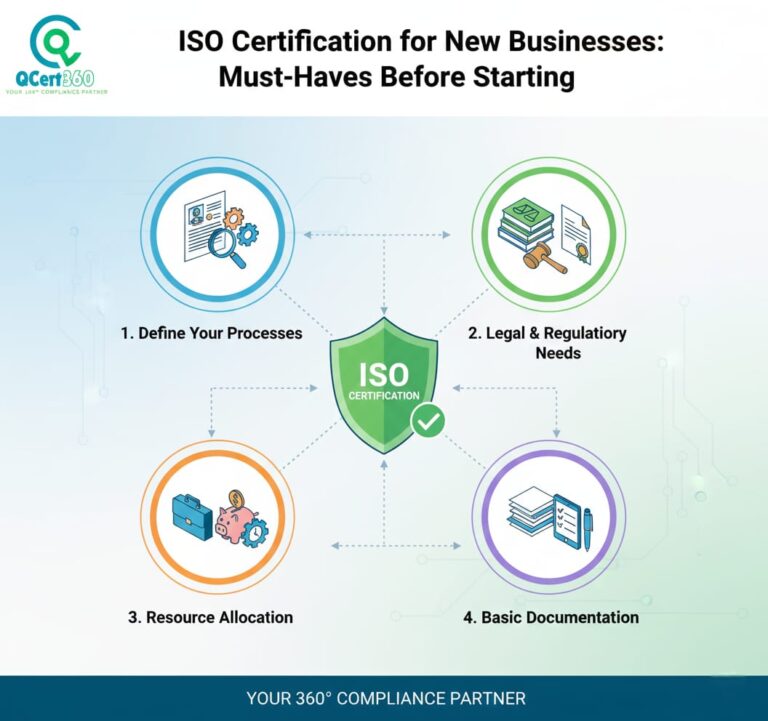
The Must-Haves Before You Start the ISO Certification for New Businesses
- A Clear Business Model and Defined Responsibilities
Auditors don’t need a huge hierarchy. They need clarity. Document who does what, who approves what, and who is responsible for each area. Even if one person handles multiple responsibilities, that’s fine.
This early clarity supports your process maturity evaluation, making certification smoother and faster.
- A Basic Set of Core Processes
You don’t need 50 procedures. You need only the ones that keep your business consistent. Think of your workflows like a set of instructions someone else should be able to follow without confusion.
Typical early processes include:
- Project or service delivery
- Customer communication
- Quality checks
- Corrective actions
- Supplier selection
These are the building blocks of a founder-driven quality system, something auditors appreciate because it shows commitment from leadership.
- Initial Documentation Structure
You don’t need every document finalized before you start. You just need a framework:
- Policy drafts
- Basic procedures
- Key records you’ll maintain
- Templates for logs
- Process flow diagrams
This is where documentation readiness checks help. A consultant reviews what you already have, shows you what’s missing, and organizes your documents into an audit-friendly structure.
It’s not about quantity; it’s about alignment.
- Early-Stage Risk Assessment
Risk management is at the heart of ISO standards. A simple business risk mapping session helps you identify:
- Operational risks
- Data or system risks
- Supplier risks
- Quality risks
- Customer delivery risks
When done early, this becomes your foundation for many mandatory ISO controls.
- Baseline Performance Metrics
You don’t need five years of data. You need a few meaningful metrics that reflect how you measure success.
Examples:
- Error rates
- Customer feedback trends
- Delivery consistency
- Response times
These metrics strengthen your pre-audit preparedness steps because they show you’re monitoring performance and improving it.
How Qcert360 Helps obtain ISO Certification for New Businesses with ease
New businesses often assume ISO is too complex or expensive early on. Qcert360 was built to remove that barrier by offering a certification planning framework tailored for startups and first-time founders.
Here’s how Qcert360 supports you:
- Gap analysis designed for companies with minimal or zero documentation
This gives you a clear picture of what’s missing and what needs to be built, without overwhelming your team. - Step-by-step ISO onboarding roadmap that keeps the process lightweight
You get a simple, structured path so everyone knows what to do next and nothing feels complicated. - Drafting essential policies and procedures
We create the core documents your system needs, written in a way your team can actually follow. - Guidance on building simple but effective internal controls
You learn how to set up controls that protect quality and reduce risk without adding unnecessary paperwork. - Mock audits to ensure you’re audit-ready
We run practice audits that mirror real auditor questions, so there are no surprises on certification day. - Continuous support until certification
You’re guided through every stage—documentation, implementation, internal audits, and final approval—until the certificate is in your hands.
Instead of overwhelming you with templates and jargon, Qcert360 focuses on building a quality structure that grows with your business.
Real-World Case Study: How a New Digital Products Company Got ISO-Ready from Scratch
A young digital products company approached Qcert360 with the same concern most founders have: “We don’t have documentation yet—can we even start ISO certification?” They had a team of four, no structured workflows, and no existing policies.
Here’s what happened.
Qcert360 kicked off with a simple ISO readiness assessment. The team learned two things immediately:
- They didn’t need a full rewrite of their operations.
- They needed structure, not complexity.
Using a personalized ISO onboarding roadmap, Qcert360 helped them:
- Create their first set of procedures
- Map their risks and controls through targeted process maturity evaluation
- Build an internal quality system without slowing their existing work
- Train the team on audit expectations
- Run a pre-audit review to fix gaps early
The result?
They passed their Stage 1 audit with zero nonconformities. By Stage 2, only minor adjustments remained—and they achieved certification in under 90 days.
Today, their ISO certification is a core part of their sales pitch, helping them win new clients who demand structured quality processes.
The Most Common Mistake New Businesses Make
Most new businesses think they need to wait until they have more data, more staff, or more clients. The truth? Waiting only makes certification heavier and more expensive. Starting early ensures ISO becomes part of your culture, not a burden.
When you set up a quality control alignment early, your processes mature naturally over time—making future audits much easier to manage.
The Step-By-Step Path to ISO Certification for New Businesses
Here’s the straightforward flow many new businesses follow:
Step 1: Run a Gap Review
This is your starting point. It shows what’s already in place—maybe a few workflows, approvals, or tracking methods—and what’s missing. A consultant can map this quickly so you know exactly what to build instead of guessing.
Step 2: Build Core Policies
Your Quality Policy, objectives, risk procedure, and operational rules become the backbone of the entire system. These documents set direction, clarify expectations, and anchor every process you create next.
Step 3: Create Simple, Practical Procedures
This is where things get real. You define how tasks happen, who approves them, and how evidence is kept. The goal is clarity. If your team can’t follow it, it won’t help you pass an audit.
Step 4: Implement and Collect Evidence
Once the procedures go live, your team starts generating proof—records, logs, checklists, approvals, meeting notes. This evidence shows the system works in daily operations, not just on paper.
Step 5: Conduct an Internal Audit
An internal auditor reviews your processes, interviews the team, and tests your records. Any gap is identified here so you can fix it before facing a certification body.
Step 6: Hold a Management Review
This meeting reviews performance, risks, customer issues, audit findings, improvements, and resource needs. It shows leadership is actively directing and improving the system.
Step 7: Certification Audit
Stage 1 confirms your documentation is complete and aligned with the standard.
Stage 2 verifies that your team follows the system consistently.
If both go well, you’re certified.
With the right support, this entire journey becomes structured and predictable—no chaos, no guesswork, and no wasted effort.
Why Early Certification Attracts Clients and Partners
Businesses increasingly want to work with partners who operate with structure and credibility. When you’re ISO-certified early, it sends a strong message:
- You take quality seriously. It shows you’re not improvising but running your operations with intention and structure.
- You manage risk professionally. Clients see that you understand your weak spots and have controls in place to prevent failures.
- You can scale safely. Strong systems mean growth won’t create chaos or break your service consistency.
- You meet compliance expectations even as a new company. Buyers know you can deliver reliably from day one, not “figure it out later.”
These are traits buyers look for, which is why early adoption leads to faster client trust and stronger sales conversations.
Ready to Start ISO Certification? Qcert360 Can Guide You from Zero to Certification
If you’re a new business and want to start ISO certification without drowning in paperwork, Qcert360 removes the complexity, speeds up the entire journey, and sets you up with a system that grows with your company.
You get expert guidance, documentation support, audit preparation, and a clear roadmap—so you can move confidently from uncertainty to certification.
If you want to explore your options or request a quote, reach out anytime.
FAQs
- Can a new business start ISO certification without documents?
Yes. You only need clarity, not finished documents. A consultant helps you create what’s required.
- How long does ISO certification take for new businesses?
With proper structure, most new companies complete certification within a few months.
- Do auditors expect years of records?
No. They expect consistency. Even recent records are acceptable.
- What’s the first step for ISO certification process?
A gap review or readiness assessment gives you a clear starting point.
- Is ISO expensive for new businesses?
Costs depend on scope and audit time. Starting early reduces long-term costs.
- Can one person manage ISO certification project?
Yes. Many new businesses have one owner acting as Quality Manager initially.
- What documents are mandatory for ISO certification?
Policies, procedures, risk assessments, records, and audit evidence.
- What if my processes are still evolving?
That’s normal. ISO systems are designed to adapt as you grow.
- Do we need specialized software?
No. Simple templates and structured folders work perfectly at the beginning.
- How can Qcert360 help in ISO compliance registration?
Through readiness assessments, documentation support, audit preparation, and a step-by-step roadmap built specifically for new businesses.
Our Services
ISO Standards
- ISO 9001 Certification
- ISO 14001 Certification
- ISO 45001 Certification
- ISO 22000 Certification
- ISO 17025 Certification
- ISO 27001 Certification
- ISO 13485 Certification
- ISO 20000-1 Certification
- ISO 41001 Certification
- ISO 22716 Certification
- ISO 50001 Certification
- ISO 22301 Certification
- ISO 29993 Certification
Product Certifications
Other international standards
- FSSC 22000 Certification
- HIPAA
- HACCP Certification
- SA 8000 Certification
- GMP Certification
- GDPR
- GDP Certification
- GLP Certification
- Certificate of Conformity
QCert360 provides a wide range of services including ISO certification, audit support, compliance consulting, and training. They specialize in helping businesses achieve global standards and certifications like ISO 9001, ISO 27001, ISO 14001, and many others. Their team ensures a seamless experience from consultation to certification, supporting clients at every stage.
The time it takes to achieve certification can vary depending on the complexity of the standard and the readiness of your organization. On average, it takes about 3 to 6 months. QCert360 works closely with clients to streamline the process, ensuring that all requirements are met efficiently and within a reasonable timeline.
QCert360 is a trusted partner with years of experience in helping businesses obtain international certifications. Their expert consultants provide tailored solutions, ensuring your organization not only meets but exceeds industry standards. With a customer-centric approach, they focus on offering end-to-end support to simplify the certification journey.
QCert360 serves a wide range of industries including manufacturing, healthcare, information technology, education, and services, among others. They customize their certification solutions to meet the unique requirements of each industry, ensuring relevance and compliance with global standards.
Yes, QCert360 provides ongoing support even after certification. They offer services like surveillance audits, recertification guidance, and consultancy to help maintain and improve your certification status. Their team ensures that your organization stays compliant and up-to-date with any changes in certification standards.
Getting started with QCert360 is simple. You can contact them via their website to request a consultation. Their team will assess your needs, discuss the best certification options for your business, and outline the steps involved. From there, they’ll guide you through the entire process, ensuring you’re prepared for certification.
QCert360 stands out due to its customer-focused approach, industry expertise, and comprehensive service offerings. Their team doesn’t just help you obtain certification but works to ensure your organization thrives in compliance with international standards. They also offer personalized consultation, making the process smoother and more efficient, ensuring long-term success for your business.
The cost of certification varies depending on factors such as the type of certification, the size and complexity of your organization, and the specific industry requirements. QCert360 offers competitive pricing and provides tailored quotes based on your unique needs. They ensure transparency and work with you to find the most cost-effective solution for your certification goals.
Yes, QCert360 offers internal audit services to help assess and improve your organization’s processes. Their expert auditors conduct thorough reviews of your systems and operations to ensure they meet required standards. They also provide actionable recommendations to help enhance efficiency and compliance, making sure you’re fully prepared for external audits.
If your organization doesn’t pass an audit or certification assessment, QCert360 works with you to understand the reasons for non-compliance and provides support to rectify the issues. They offer guidance on corrective actions and help you prepare for a re-assessment. Their goal is to ensure your organization meets the necessary standards for certification, and they will be by your side to make the process as smooth as possible.