
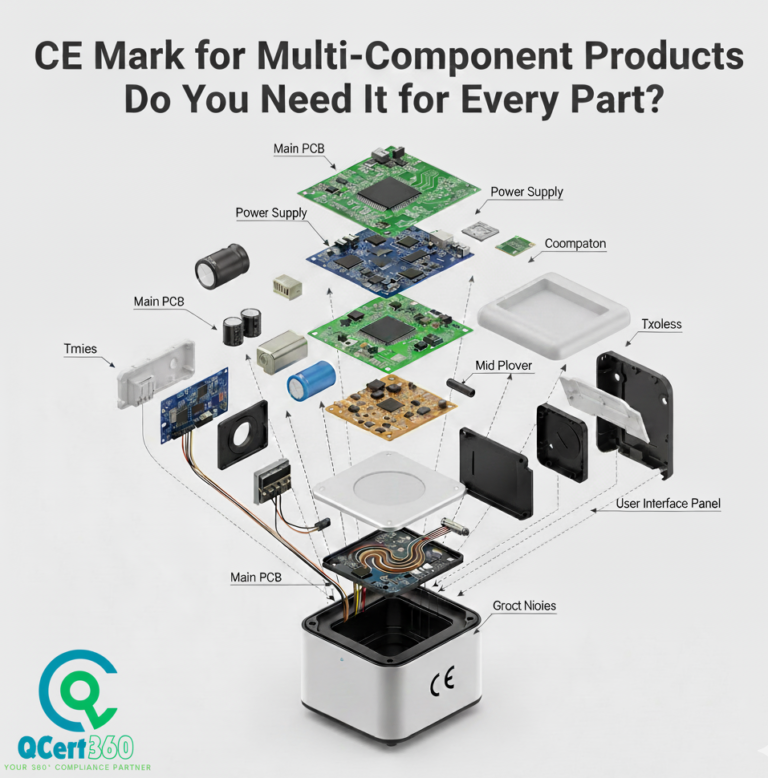
When it comes to CE marking, one of the most common points of confusion is this: if your product has multiple components—say electronics, mechanical parts, and software—does each part need its own CE mark, or is the whole system enough? The answer isn’t always straightforward. Let’s break it down with practical examples, regulatory insights, and compliance essentials that manufacturers need to keep in mind.
What CE Marking Really Represents
CE marking is not a “quality mark” but a compliance passport. It shows that a product meets the relevant EU directives and regulations, from safety and health to environmental protection. For multi-component products, CE marking applies to the final assembled product—but only if it falls within the scope of applicable directives.
Think of a smart washing machine: the CE mark covers the entire machine, but that doesn’t mean each internal screw needs its own CE symbol. However, certain critical parts—like a power supply unit or wireless module—may already come with their own CE marking, showing independent conformity.
Understanding Multi-Component Product Compliance
Manufacturers of multi-component products must determine whether the assembled unit, its parts, or both need CE marking. Here’s where many businesses get it wrong.
- Entire product compliance: If you’re selling a finished good (like a laptop), the CE mark on the laptop covers its compliance across directives like Low Voltage Directive (LVD), Electromagnetic Compatibility (EMC), and RoHS. Importantly, testing must confirm that all components, when combined, do not create new risks or interfere with performance.
- Critical component compliance: Certain modules—such as radio transmitters, lithium-ion batteries, or pressure vessels—fall under specific regulations that require their own CE mark before integration. Using CE-marked components simplifies the conformity process but doesn’t replace the need for final product testing. Manufacturers must also verify supplier documentation to avoid counterfeit certificates.
- In-house components: If you manufacture and assemble your own parts that are not sold separately, they don’t need a CE mark individually, as long as the final product meets all applicable directives. However, records of internal testing, safety evaluations, and risk assessments should still be maintained in the technical documentation to prove due diligence.
- Software-driven components: Increasingly, integrated products rely on software that affects safety or performance. While software itself doesn’t carry a CE mark, it falls under assessment requirements, especially when it controls critical functions like wireless communication, battery charging, or machinery operation.
- Aftermarket or replaceable components: If a part, such as a charger or medical device accessory, is marketed independently for replacement or resale, it must carry its own CE marking and compliance evidence.
This layered approach helps manufacturers balance efficiency with compliance, ensuring that both individual modules and the final assembly align with regulatory expectations.
Case Study: CE Marking for Smart Home Devices
A company manufacturing smart thermostats faced a compliance dilemma. The device combined a touchscreen, Wi-Fi module, rechargeable battery, and housing. Here’s how it played out:
- Wi-Fi module: Already CE marked by the supplier under the Radio Equipment Directive.
- Battery: Required compliance with UN 38.3 (transport safety) and RoHS, but not standalone CE marking since it wasn’t marketed separately.
- Touchscreen: No CE marking required individually, but had to comply with safety tests within the final device.
- Final product: The thermostat required CE marking under EMC, LVD, RED, and RoHS.
This example shows that while not every part need CE marking, the overall product must prove conformity through proper technical documentation, testing, and a Declaration of Conformity (DoC).
How to Determine Which Parts Require CE Marking
To avoid over- or under-compliance, follow this logical approach:
- Identify applicable directives – Does your component or finished product fall under LVD, EMC, Machinery Directive, Medical Devices Regulation, or others?
- Assess standalone functionality – If the component is sold independently (like a charger), it may need its own CE marking.
- Check supplier declarations – Many critical modules come pre-marked, reducing your burden. Always request test reports and DoCs.
- Perform risk assessments – Even if a part doesn’t need CE marking, it must not compromise the safety of the final product.
- Compile technical files – Keep testing records, supplier certificates, and conformity statements ready for audits.
CE Marking and Supply Chain Trust
Here’s the thing: supply chain integrity plays a huge role. If you’re sourcing pre-marked components, verify their authenticity. Counterfeit CE marks are a growing problem, and if your final product fails compliance checks, you’re liable—not your supplier. That means the burden of proof sits with the manufacturer or importer, no matter how many certifications are presented upstream.
Global buyers and regulatory bodies now expect full traceability. This isn’t just about storing certificates—it’s about maintaining contracts, supplier declarations, and detailed testing records in order. Many businesses now include periodic supplier audits or third-party verification to strengthen their compliance assurance.
Digital tools, like blockchain traceability systems, are increasingly being used to confirm part compliance across the supply chain. These technologies provide immutable proof that each component met required safety and quality standards at every step, reducing the risk of disputes during inspections or recalls.
Additionally, building trust in your supply chain enhances brand value. Retailers and distributors are more willing to carry products from manufacturers who can prove robust compliance management, while insurers often view verified supply chains as lower risk, which can even reduce liability premiums.
Common Misconceptions About CE Marking Components
- Myth 1: Every part must carry CE marking.
Not true. Only components covered by specific directives require it. - Myth 2: CE marking on a component guarantees my final product is compliant.
False. You must still test the integrated product as a whole. - Myth 3: CE marking is optional for low-risk items.
Incorrect. If a directive applies, compliance is mandatory regardless of risk level.
Compliance Challenges in CE Mark for Multi-Component Products
Manufacturers often face hurdles like:
- Conflicting standards between components and final products, which can lead to delays in certification or even rejection if compatibility isn’t demonstrated.
- Documentation gaps from suppliers, especially when smaller vendors fail to provide complete test reports, declarations of conformity, or material safety data sheets.
- High costs of retesting integrated products, since even minor modifications in one component can trigger the need for full system evaluation.
- Rapid regulatory updates, especially in sectors like electronics and medical devices, making it difficult to maintain compliance across multiple markets.
- Supply chain complexity, where different tiers of suppliers may operate under varying regulatory frameworks, increasing the risk of non-compliance.
- Unclear responsibility allocation, as disputes can arise over whether the component manufacturer or the final product assembler is accountable for meeting certain requirements.
Forward-looking companies address these challenges through proactive testing, early supplier engagement, and regulatory intelligence platforms that track changing requirements. They also invest in supplier training and establish clear compliance ownership at every stage of the product lifecycle, which reduces delays and avoids costly recalls.
Case Study: Machinery with Integrated Subsystems
A mid-sized machinery manufacturer built automated conveyor systems. Their machines used:
- Electric motors (CE marked under the Machinery Directive).
- Control panels with radio frequency modules (CE marked under RED).
- In-house mechanical frames (not CE marked individually).
The entire conveyor system required CE marking as a finished product. By leveraging the CE-marked subsystems and conducting additional EMC testing on the integrated unit, the company successfully reduced compliance costs and avoided duplication.
CE Marking Pitfalls That Cost Manufacturers Time and Money
A surprising number of companies lose weeks — sometimes months — in the CE certification process because of avoidable mistakes. Common pitfalls include:
- Late identification of applicable directives: Teams often assume only one directive applies, missing others like EMC or RoHS.
- Incomplete technical documentation: Missing test reports or poorly structured files trigger repeat audits.
- Relying on outdated harmonised standards: Using an expired version of a standard can invalidate an entire conformity assessment.
- Supplier data gaps: Without declarations of conformity from upstream suppliers, manufacturers end up stuck in back-and-forth checks.
- Skipping pre-compliance testing: Waiting until the final product stage for testing leads to costly redesigns.
By spotting and addressing these early, manufacturers save both compliance costs and market launch delays.
The Future of CE Marking for Multi-Component Products
Looking ahead, CE marking will become even more rigorous. With the rise of smart devices, AI-driven equipment, and renewable energy products, manufacturers can expect broader directives and tighter enforcement. Sustainability requirements, like eco-design and recyclability, will also integrate into conformity assessments.
For multi-component products, this means more scrutiny of both parts and final systems. Companies that invest early in compliance culture, digital monitoring, and reliable supplier partnerships will have a competitive edge in global markets.
Why Choose Qcert360 for CE Marking Multi-Component Products?
Navigating CE marking for multi-component products can get tricky—do you certify the whole system, or each part separately? That’s where Qcert360 steps in. Our experts simplify the process by analysing your product’s structure, intended use, and applicable EU directives to determine the exact compliance route. We help you avoid unnecessary costs while ensuring every required component meets European safety and performance standards. From gap analysis to final CE declaration, Qcert360 provides end-to-end support so your products are approved without delays, giving you confidence to sell across Europe.
FAQs: CE Marking for Multi-Component Products
- Does every component need CE marking?
No, only components under specific directives require it. The final product must always be CE marked if within scope. - What happens if my supplier provides a fake CE mark?
You’re still responsible. Always verify supplier certificates and test reports. - Can I sell a product in the EU without CE marking if it’s safe?
No, safety alone is not enough—compliance with directives is mandatory. - Do in-house parts need CE marking?
Not if they’re only used in your own final product. - How do I know which CE directives apply to my product?
Check the EU “Blue Guide” or consult compliance experts. - Can CE and UKCA marks coexist on a product?
Yes, for now. Dual marking is allowed if both requirements are met. - Do I need to retest if I integrate CE-marked components?
Yes, the final product still requires system-level testing. - How long must I keep CE technical documentation?
At least 10 years after the product is placed on the market. - What role do notified bodies play?
They conduct third-party assessments when required by directives. - Is CE marking recognized outside Europe?
It’s primarily for the EU/EEA but often valued as a sign of compliance internationally.
Our Services
ISO Standards
- ISO 9001 Certification
- ISO 14001 Certification
- ISO 45001 Certification
- ISO 22000 Certification
- ISO 17025 Certification
- ISO 27001 Certification
- ISO 13485 Certification
- ISO 20000-1 Certification
- ISO 41001 Certification
- ISO 22716 Certification
- ISO 50001 Certification
- ISO 22301 Certification
- ISO 29993 Certification
Product Certifications
Other international standards
- FSSC 22000 Certification
- HIPAA
- HACCP Certification
- SA 8000 Certification
- GMP Certification
- GDPR
- GDP Certification
- GLP Certification
- Certificate of Conformity
QCert360 provides a wide range of services including ISO certification, audit support, compliance consulting, and training. They specialize in helping businesses achieve global standards and certifications like ISO 9001, ISO 27001, ISO 14001, and many others. Their team ensures a seamless experience from consultation to certification, supporting clients at every stage.
The time it takes to achieve certification can vary depending on the complexity of the standard and the readiness of your organization. On average, it takes about 3 to 6 months. QCert360 works closely with clients to streamline the process, ensuring that all requirements are met efficiently and within a reasonable timeline.
QCert360 is a trusted partner with years of experience in helping businesses obtain international certifications. Their expert consultants provide tailored solutions, ensuring your organization not only meets but exceeds industry standards. With a customer-centric approach, they focus on offering end-to-end support to simplify the certification journey.
QCert360 serves a wide range of industries including manufacturing, healthcare, information technology, education, and services, among others. They customize their certification solutions to meet the unique requirements of each industry, ensuring relevance and compliance with global standards.
Yes, QCert360 provides ongoing support even after certification. They offer services like surveillance audits, recertification guidance, and consultancy to help maintain and improve your certification status. Their team ensures that your organization stays compliant and up-to-date with any changes in certification standards.
Getting started with QCert360 is simple. You can contact them via their website to request a consultation. Their team will assess your needs, discuss the best certification options for your business, and outline the steps involved. From there, they’ll guide you through the entire process, ensuring you’re prepared for certification.
QCert360 stands out due to its customer-focused approach, industry expertise, and comprehensive service offerings. Their team doesn’t just help you obtain certification but works to ensure your organization thrives in compliance with international standards. They also offer personalized consultation, making the process smoother and more efficient, ensuring long-term success for your business.
The cost of certification varies depending on factors such as the type of certification, the size and complexity of your organization, and the specific industry requirements. QCert360 offers competitive pricing and provides tailored quotes based on your unique needs. They ensure transparency and work with you to find the most cost-effective solution for your certification goals.
Yes, QCert360 offers internal audit services to help assess and improve your organization’s processes. Their expert auditors conduct thorough reviews of your systems and operations to ensure they meet required standards. They also provide actionable recommendations to help enhance efficiency and compliance, making sure you’re fully prepared for external audits.
If your organization doesn’t pass an audit or certification assessment, QCert360 works with you to understand the reasons for non-compliance and provides support to rectify the issues. They offer guidance on corrective actions and help you prepare for a re-assessment. Their goal is to ensure your organization meets the necessary standards for certification, and they will be by your side to make the process as smooth as possible.