
The oil and gas industry are unlike any other. High risks, massive investments, and unforgiving operating conditions mean that quality management isn’t just about efficiency—it’s about survival. Many companies already hold ISO 9001 certification, the world’s most widely recognized quality management standard. But here’s the reality: for oil and gas suppliers, ISO 9001 alone isn’t enough.
That’s where ISO 29001 steps in. Built specifically for the petroleum, petrochemical, and natural gas sectors, it addresses the gaps ISO 9001 leaves behind. If you’re supplying equipment, services, or technology to oil and gas operators, understanding the difference between these two certifications could make the difference between winning contracts and being sidelined.
Why Quality Management in Oil & Gas Is Different
Before diving into the standards, let’s clarify why the oil and gas supply chain is so demanding:
- High stakes – Failures often result in catastrophic safety incidents, environmental disasters, and multi-million-dollar lawsuits. The margin for error is nearly zero, which makes preventive systems more valuable than corrective actions.
- Complex supply chains – A single project may involve hundreds of contractors and subcontractors spread across multiple countries. Any weak link can compromise the entire operation.
- Strict regulations – Compliance is heavily monitored by both governments and operators, with penalties that can include shutdowns, fines, and blacklisting from future contracts.
- Long-term operations – Projects like offshore drilling rigs or LNG plants run for decades, demanding long-term reliability and robust maintenance frameworks.
- High-cost downtime – Every hour of disruption translates into massive financial losses, putting enormous pressure on suppliers to deliver consistent, defect-free performance.
- Global scrutiny – Investors, regulators, and the public watch the sector closely, meaning suppliers must prove not just compliance but also sustainability and transparency.
These conditions create pressure for suppliers to prove not just general quality control but industry-specific reliability, risk management, and traceability—qualities that go far beyond what standard frameworks can cover.
ISO 9001: The Foundation of Quality
ISO 9001 is the baseline for quality management across industries. It focuses on:
- Customer satisfaction
- Process efficiency
- Risk-based thinking
- Continuous improvement
- Documented management systems
For manufacturers and service providers, ISO 9001 certification signals a commitment to structured processes and consistent results. It’s globally recognized and often a prerequisite for entering new markets, giving organizations a clear framework to demonstrate reliability and accountability.
However, in the oil and gas sector, the stakes are far higher. While ISO 9001 establishes discipline and consistency, it doesn’t go deep enough into the realities of high-risk environments. Critical aspects like equipment integrity, operational safety, supply chain failures, and contractor oversight can cost billions if mismanaged. That’s why oil and gas suppliers need more than just general quality assurance—they need a standard tailored to the sector’s complexity and hazards.
ISO 29001: Industry-Specific Precision
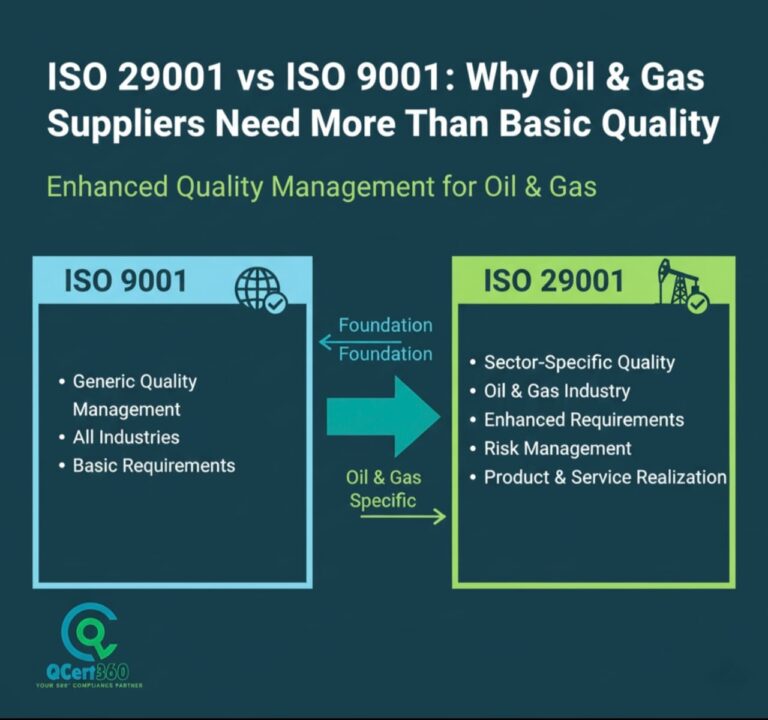
ISO 29001 was developed jointly by ISO and the international oil and gas industry. Think of it as ISO 9001 plus oil and gas DNA. It integrates the principles of ISO 9001 but adds requirements tailored to industry realities.
Key focus areas include:
- Defect prevention – Not just fixing problems, but avoiding them from the start.
- Supply chain resilience – Standards for subcontractor performance, traceability, and quality assurance.
- Operational risk management – Addressing hazards unique to oil and gas.
- Standardized conformity – Ensuring suppliers across regions meet the same benchmarks.
- Customer–supplier relationships – Strengthening communication and collaboration between operators and contractors.
Where ISO 9001 builds a foundation, ISO 29001 raises the bar for oil and gas reliability.
Why Oil & Gas Suppliers Need ISO 29001
Let’s break it down. Oil and gas operators expect their suppliers to minimize risk at every stage. Having ISO 9001 might prove you have a quality system, but it doesn’t prove you’re ready for high-risk industry environments.
Here’s why ISO 29001 is becoming a non-negotiable standard:
- Contract eligibility – Many oil majors and EPC (engineering, procurement, construction) firms require ISO 29001 certification from suppliers.
- Reduced liability – Certification demonstrates proactive risk management, lowering exposure to legal and financial claims.
- Stronger global competitiveness – It shows you can meet the same standards as leading international suppliers.
- Operational efficiency – Reduces rework, defects, and supply delays by enforcing stringent quality checks.
- Reputation advantage – Operators want trusted partners. ISO 29001 signals you’re serious about safety and reliability.
Case Study: Valve Manufacturer Winning Global Contracts
A mid-sized valve manufacturer was ISO 9001 certified for over a decade. They supplied general industries successfully but struggled to secure oil and gas contracts. Clients demanded evidence of industry-specific controls.
After upgrading to ISO 29001:
- They revised supplier audits to align with oil and gas risk management.
- Introduced defect-prevention tools in design and production.
- Adopted traceability measures across raw materials and finished goods.
Result? Within 18 months, the company won contracts from two international oil majors. Certification not only opened new markets but also boosted confidence among existing customers.
Case Study: Service Provider Reducing Project Delays
An engineering services firm specialized in pipeline inspections. Despite ISO 9001, they faced client complaints about inconsistent reporting and delays.
By adopting ISO 29001, they:
- Standardized procedures for inspections.
- Improved subcontractor oversight.
- Established defect-prevention mechanisms.
- Introduced performance monitoring dashboards to track progress in real time.
- Enhanced communication protocols with clients and contractors to avoid misalignment.
Within a year, client satisfaction scores improved, and the firm reported a 25% reduction in project delays. They also secured new long-term contracts because customers saw evidence of reduced risks and greater operational reliability.
This demonstrates how ISO 29001 goes beyond compliance—it directly impacts service quality, profitability, and long-term client trust.
Key Differences Between ISO 9001 and ISO 29001
Aspect | ISO 9001 | ISO 29001 |
Scope | General industries | Petroleum, petrochemical, and natural gas |
Focus | Process quality & customer satisfaction | Risk, defect prevention, supply chain integrity |
Supply chain | Basic supplier management | Comprehensive supplier and subcontractor control |
Safety & risk | General risk management | Industry-specific operational risks |
Contracts | Baseline requirement | Often mandatory for oil & gas projects |
How to Transition from ISO 9001 to ISO 29001
If you already have ISO 9001, moving to ISO 29001 isn’t a complete overhaul—it’s an upgrade. Steps include:
- Gap analysis – Identify where current systems fall short of ISO 29001, particularly in areas like supply chain traceability and defect-prevention practices.
- Supplier engagement – Extend compliance requirements down the supply chain, ensuring subcontractors and vendors follow the same quality framework.
- Risk mapping – Incorporate oil and gas-specific hazards into management systems, including operational safety, equipment failures, and environmental risks.
- Defect-prevention systems – Move from reactive corrections to proactive design and process checks, supported by real-time monitoring tools.
- Certification audit – Work with an accredited body familiar with oil and gas standards to validate compliance.
- Employee training – Equip staff with sector-specific knowledge, so quality isn’t just a policy but a practiced habit.
- Continuous monitoring – Use KPIs and audit reviews to ensure improvements don’t stall after certification.
By following these steps, companies transform ISO 9001’s general framework into an oil and gas-focused system that reduces risks, improves reliability, and builds stronger client trust.
How to Transition from ISO 9001 to ISO 29001
The energy industry is under increasing scrutiny—environmental, safety, and operational. As global demand for accountability rises, ISO 29001 is becoming the industry’s gold standard. Expect:
- Wider adoption across new energy sectors like LNG and hydrogen, where supply chain risks and safety concerns mirror traditional oil and gas.
- Stronger integration with digital compliance systems, using AI and blockchain for traceability and real-time audits.
- Growing use of certification in global trade agreements and tenders, making ISO 29001 a competitive necessity.
- Closer alignment with ESG reporting frameworks, ensuring companies demonstrate not just compliance but sustainability leadership.
- Increased investor pressure, as financial institutions increasingly demand ISO-certified risk management before financing large-scale projects.
Companies that adopt it early aren’t just compliant—they’re future-proofing their position in an industry where quality and trust drive long-term survival.
Why Qcert360 is the Best Partner for ISO 29001 vs ISO 9001 in Oil & Gas
Oil and gas suppliers can’t afford to rely on just basic quality management. While ISO 9001 sets a strong foundation, ISO 29001 goes further, addressing sector-specific risks, supply chain reliability, and regulatory compliance. Qcert360 stands out because we understand both standards in depth and guide companies in choosing and integrating the right one for maximum impact. Our team ensures certification isn’t just a checkbox, but a business advantage that improves tender eligibility, client trust, and risk control. With Qcert360, suppliers move beyond compliance to real competitive edge.
FAQs ISO 29001 vs ISO 9001: Why Oil & Gas Suppliers Need More Than Basic Quality
- Is ISO 9001 enough for oil and gas suppliers?
Not usually. ISO 9001 is a foundation, but most operators require ISO 29001 for industry-specific assurance. - How does ISO 29001 improve supply chain management?
It enforces stricter controls, traceability, and defect-prevention practices across subcontractors. - Can a company hold both ISO 9001 and ISO 29001?
Yes. In fact, ISO 29001 builds on ISO 9001, so companies usually maintain both. - Does ISO 29001 apply only to manufacturers?
No, it applies to service providers, contractors, and technology suppliers in oil and gas. - How long does ISO 29001 certification take?
Timelines vary but typically range from 2 to 4 months depending on readiness. - What happens if suppliers don’t adopt ISO 29001?
They risk losing tenders, contracts, and market opportunities to competitors with certification. - Is ISO 29001 recognized outside oil and gas?
While industry-specific, many principles like risk and defect prevention apply across sectors. - What is the main difference between ISO 9001 and ISO 29001?
ISO 9001 is general quality management, while ISO 29001 focuses on oil and gas-specific risks and requirements. - Do small suppliers need ISO 29001?
Yes, even SMEs must prove reliability to secure oil and gas contracts, and certification can be a differentiator. - How does ISO 29001 affect safety?
It integrates safety-focused risk management, reducing accidents and operational hazards in high-risk environments.
Our Services
ISO Standards
- ISO 9001 Certification
- ISO 14001 Certification
- ISO 45001 Certification
- ISO 22000 Certification
- ISO 17025 Certification
- ISO 27001 Certification
- ISO 13485 Certification
- ISO 20000-1 Certification
- ISO 41001 Certification
- ISO 22716 Certification
- ISO 50001 Certification
- ISO 22301 Certification
- ISO 29993 Certification
Product Certifications
Other international standards
- FSSC 22000 Certification
- HIPAA
- HACCP Certification
- SA 8000 Certification
- GMP Certification
- GDPR
- GDP Certification
- GLP Certification
- Certificate of Conformity
QCert360 provides a wide range of services including ISO certification, audit support, compliance consulting, and training. They specialize in helping businesses achieve global standards and certifications like ISO 9001, ISO 27001, ISO 14001, and many others. Their team ensures a seamless experience from consultation to certification, supporting clients at every stage.
The time it takes to achieve certification can vary depending on the complexity of the standard and the readiness of your organization. On average, it takes about 3 to 6 months. QCert360 works closely with clients to streamline the process, ensuring that all requirements are met efficiently and within a reasonable timeline.
QCert360 is a trusted partner with years of experience in helping businesses obtain international certifications. Their expert consultants provide tailored solutions, ensuring your organization not only meets but exceeds industry standards. With a customer-centric approach, they focus on offering end-to-end support to simplify the certification journey.
QCert360 serves a wide range of industries including manufacturing, healthcare, information technology, education, and services, among others. They customize their certification solutions to meet the unique requirements of each industry, ensuring relevance and compliance with global standards.
Yes, QCert360 provides ongoing support even after certification. They offer services like surveillance audits, recertification guidance, and consultancy to help maintain and improve your certification status. Their team ensures that your organization stays compliant and up-to-date with any changes in certification standards.
Getting started with QCert360 is simple. You can contact them via their website to request a consultation. Their team will assess your needs, discuss the best certification options for your business, and outline the steps involved. From there, they’ll guide you through the entire process, ensuring you’re prepared for certification.
QCert360 stands out due to its customer-focused approach, industry expertise, and comprehensive service offerings. Their team doesn’t just help you obtain certification but works to ensure your organization thrives in compliance with international standards. They also offer personalized consultation, making the process smoother and more efficient, ensuring long-term success for your business.
The cost of certification varies depending on factors such as the type of certification, the size and complexity of your organization, and the specific industry requirements. QCert360 offers competitive pricing and provides tailored quotes based on your unique needs. They ensure transparency and work with you to find the most cost-effective solution for your certification goals.
Yes, QCert360 offers internal audit services to help assess and improve your organization’s processes. Their expert auditors conduct thorough reviews of your systems and operations to ensure they meet required standards. They also provide actionable recommendations to help enhance efficiency and compliance, making sure you’re fully prepared for external audits.
If your organization doesn’t pass an audit or certification assessment, QCert360 works with you to understand the reasons for non-compliance and provides support to rectify the issues. They offer guidance on corrective actions and help you prepare for a re-assessment. Their goal is to ensure your organization meets the necessary standards for certification, and they will be by your side to make the process as smooth as possible.