
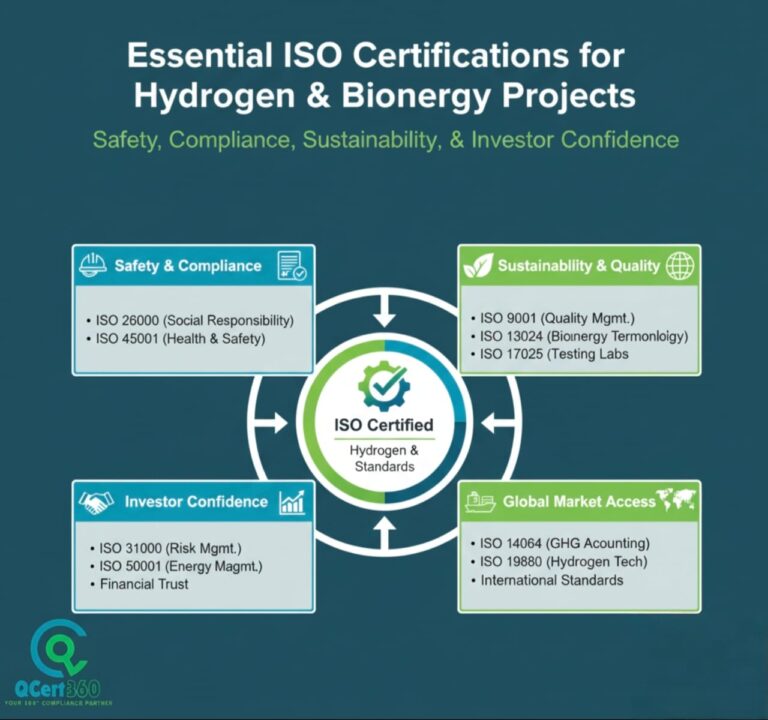
Hydrogen and bioenergy are no longer niche technologies. They are central to the world’s clean energy transition. But here’s the challenge: building trust in these projects requires more than technical innovation—it requires clear, verifiable proof of safety, quality, and sustainability. That’s where ISO certification steps in.
Unlike traditional fossil energy projects, hydrogen and bioenergy carry unique risks and stakeholder expectations. ISO standards provide the framework for ensuring everything from safe production to transparent reporting. Let’s unpack what certifications matter most, how companies are using them, and why the right compliance strategy can make or break a project’s success
Why Certification Matters in Hydrogen and Bioenergy
In energy markets, credibility is currency. Investors, regulators, and consumers demand assurance that projects meet international benchmarks. For hydrogen and bioenergy, this is even more critical because:
- Safety risks are higher (hydrogen’s volatility and biomass storage hazards).
- Sustainability claims face heavy scrutiny, as stakeholders expect transparent proof of environmental performance.
- Global supply chains make traceability essential, especially when raw materials or components come from multiple jurisdictions.
- Government incentives often require proof of compliance, making certification a gateway to financial viability.
- Cross-border trade becomes smoother with ISO certification, since many countries mirror or recognize these standards.
- Technology adoption accelerates, as partners and customers trust ISO-certified processes more readily.
Without recognized certifications, projects risk delays, funding challenges, or outright rejection in competitive markets. ISO certification solves this by aligning operations with globally recognized frameworks, reducing uncertainty, and demonstrating accountability to every stakeholder involved.
Core ISO Standards for Hydrogen and Bioenergy Projects
Different stages of hydrogen and bioenergy projects—from design to operation—require different certifications. The most relevant include:
- ISO 9001: Quality Management Systems
Guarantees that processes are consistent and customer-focused. For hydrogen and bioenergy, it covers equipment design, fuel handling, and operational workflows.
- ISO 14001: Environmental Management Systems
Bioenergy projects face intense scrutiny on lifecycle emissions. Hydrogen projects must show reduced environmental impacts compared to fossil alternatives. ISO 14001 helps build credibility around these claims.
- ISO 45001: Occupational Health and Safety
Hydrogen leakage, high-pressure systems, and biomass handling all carry risks. This certification ensures projects minimize accidents and safeguard workers.
- ISO 50001: Energy Management Systems
Vital for optimizing plant efficiency, tracking energy use, and proving sustainability performance in renewable energy portfolios.
- ISO/TS 19880: Hydrogen Fuelling Stations
A technical specification tailored specifically for hydrogen refuelling infrastructure. It sets safety and performance requirements for storage, compression, and dispensing systems.
Traceability matters in bioenergy—particularly for feedstock sourcing. This standard supports transparent supply chains, reassuring regulators and customers that sustainability claims are real.
Case Study: Hydrogen Fuelling Network Adoption
A renewable energy company launched hydrogen fuelling stations for public transport fleets. Instead of just focusing on the hardware, they adopted:
- ISO 9001 for quality assurance in equipment design, ensuring every station met consistent performance benchmarks.
- ISO 45001 to ensure worker safety during station operation, minimizing risks in handling high-pressure hydrogen.
- ISO/TS 19880 to meet global standards for hydrogen refuelling, aligning with international expectations for safety and interoperability.
The outcome? Their network achieved recognition by international fleet operators, opening partnerships that would have been impossible without ISO certification. Beyond that, the company was able to reduce liability risks, shorten approval times with local regulators, and attract investment from global energy funds. By embedding ISO standards early, they positioned themselves not only as infrastructure providers but as trusted partners in the wider hydrogen mobility ecosystem.
Risk Landscape Without ISO Certification
Skipping certification in hydrogen and bioenergy is more than a compliance risk—it’s a business risk. Companies often face:
- Regulatory penalties if local authorities demand recognized standards and the organization fails to demonstrate alignment.
- Lost funding opportunities, as investors often make ISO certification a pre-condition for financing large-scale clean energy projects.
- Market access barriers, since many international tenders and government-backed contracts require ISO-aligned proof of compliance.
- Operational hazards, leading to accidents, downtime, or lawsuits if safety and quality systems are not benchmarked against global standards.
- Insurance complications, as insurers increasingly require certified management systems before underwriting high-risk energy projects.
- Erosion of stakeholder trust, where communities, partners, and regulators may view uncertified projects as unsafe or unsustainable.
For an industry where reputation can swing investor confidence overnight, the cost of non-compliance is always higher than certification. In fact, without ISO certification, companies risk falling behind competitors who demonstrate reliability and transparency through recognized standards.
Linking ISO Standards with ESG Reporting
Here’s the thing: ESG reporting and ISO certification now go hand in hand. Hydrogen and bioenergy projects must prove they align with sustainability frameworks, carbon reduction goals, and social accountability. ISO certifications like 14001 (environment) and 50001 (energy) feed directly into ESG metrics, providing reliable data for stakeholders.
Forward-looking companies are already embedding ISO-driven metrics into their annual sustainability reports. This not only satisfies regulators but also builds investor confidence
Emerging ISO Standards for Clean Energy
ISO committees are actively developing new standards for renewable energy. For hydrogen and bioenergy, some of the upcoming frameworks include:
- ISO 14687:2025: Hydrogen fuel quality standards, ensuring purity levels meet safety and efficiency requirements for fuel cells and transportation applications.
- ISO 19884: Safety requirements for hydrogen storage, covering pressure vessels, refuelling infrastructure, and leak detection to prevent accidents.
- ISO 13065:2016 : Sustainability criteria for bioenergy, providing a framework for evaluating greenhouse gas savings, biodiversity impacts, and lifecycle emissions.
Adopting these early gives companies a competitive edge, showing regulators and partners that they’re not just compliant but proactive. It also builds confidence among investors who see early alignment with global benchmarks as a sign of risk mitigation. Additionally, early adoption reduces the cost of retroactive compliance once standards become mandatory and strengthens eligibility for international funding and green certification programs.
Case Study: Bioenergy Plant Securing International Funding
A biomass-to-energy project sought international financing. Their challenge wasn’t technology but proving sustainability credentials. By adopting:
- ISO 14001 for environmental impact management, ensuring emissions, waste, and land-use practices met global expectations.
- ISO 22095 for feedstock traceability, which gave transparency into the origin, quality, and sustainability of biomass supply chains.
- ISO 50001 for energy efficiency tracking, helping optimize plant performance and reduce operational costs.
They were able to present a strong compliance package to investors. The project not only secured funding but also negotiated better financing terms because risks were demonstrably lower. Beyond financing, certification also improved community acceptance, as local stakeholders trusted the project’s sustainability claims. Additionally, compliance with international ISO standards positioned the plant as a model for replicating bioenergy projects in other regions, giving it a first-mover advantage in expansion opportunities.
Compliance Strategy for Hydrogen and Bioenergy Projects
Certification isn’t a box-ticking exercise. Companies succeeding in this space approach it strategically:
- Gap Assessment – Identify which standards apply to your operations and evaluate existing practices against ISO requirements before scaling projects.
- Supplier Engagement – Ensure feedstock providers, equipment manufacturers, and contractors comply with relevant standards, since weak links in the supply chain can undermine overall certification.
- Integrated Management Systems – Combine quality, safety, and environmental certifications to avoid duplication and reduce audit fatigue across departments.
- Digital Documentation – Store technical files and audit records in cloud-based systems for easier compliance checks and faster responses to regulator or investor queries.
- Continuous Monitoring – Use IoT sensors and data analytics to track performance against ISO benchmarks and detect deviations early.
- Risk Management Alignment – Integrate ISO-based risk assessments with operational planning, especially for hydrogen safety, bioenergy logistics, and emissions control.
- Stakeholder Transparency – Publish sustainability and compliance data in ESG reports to build investor confidence and strengthen public trust.
This approach ensures certification isn’t just about compliance—it becomes a tool to drive efficiency, safety, resilience, and long-term trust in hydrogen and bioenergy projects.
Misconceptions About ISO in Renewable Energy
- “Certification is only for large corporations.” Wrong. Smaller firms often gain the most because certification boosts credibility.
- “ISO slows down project timelines.” Not true—structured processes often accelerate approvals.
- “Hydrogen projects only need sector-specific standards.” False. General management systems like ISO 9001, 14001, and 45001 remain critical.
- “Bioenergy doesn’t need chain-of-custody standards.” Incorrect. Traceability is a top regulatory and market demand.
Future Outlook: ISO and the Energy Transition
Hydrogen and bioenergy will play central roles in meeting net-zero goals. As demand rises, so will scrutiny. Expect:
- Stricter alignment between ISO standards and government incentive programs, as funding bodies increasingly require ISO-backed compliance for eligibility.
- Increased use of digital compliance tools for audits, including AI-driven monitoring systems that flag potential gaps in real time.
- Growing reliance on certifications in international trade agreements, making ISO compliance a prerequisite for cross-border energy partnerships.
- Integration of ISO standards with carbon credit systems, where verified sustainability certifications directly influence eligibility for carbon markets.
- Expansion of sector-specific ISO standards, particularly around hydrogen storage, distribution, and bioenergy lifecycle assessments.
Companies that adopt ISO now are positioning themselves not just as compliant operators but as leaders in the future energy economy, ready to capture opportunities as global regulatory frameworks tighten.
Why Qcert360 is the Top ISO certification consultant for hydrogen and bioenergy projects?
Qcert360 is the trusted partner for ISO certification in hydrogen and bioenergy projects because we understand the unique challenges of renewable energy sectors. From ISO 9001 for quality, ISO 14001 for environmental management, ISO 45001 for worker safety, to ISO 50001 for energy efficiency, our experts guide you through every step of compliance. We simplify complex regulatory requirements, prepare you for global tender opportunities, and ensure certifications are achieved without delays. With proven expertise across energy projects worldwide, Qcert360 helps you build credibility, meet buyer expectations, and gain a competitive edge in the fast-growing green energy market.
FAQs on ISO Certification for Hydrogen and Bioenergy
- Do all hydrogen projects need ISO/TS 19880 certification?
Not all, but any project involving refuelling stations must comply. - Can ISO 50001 replace sustainability reporting?
No, but it provides verified data that strengthens ESG reports. - How long does ISO certification take for energy projects?
Depending on scope, anywhere from 3 months to 6 months. - Is certification mandatory for bioenergy feedstock suppliers?
Not always, but it’s highly recommended for traceability. - Can one project hold multiple ISO standard certifications?
Yes, integrated management systems allow overlap across standards. - What happens if a project doesn’t get ISO certified?
Risk of penalties, funding rejections, and market access limitations. - Are ISO standards recognized outside the EU?
Yes, ISO is international and widely accepted in global trade. - Do ISO certifications expire?
Yes, typically every three years, with annual surveillance audits. - How costly is ISO certification for renewable projects?
Costs vary, but they are always lower than compliance failures. - What’s the first step to start ISO certification?
Conduct a gap analysis with experts to identify applicable standards.
Our Services
ISO Standards
- ISO 9001 Certification
- ISO 14001 Certification
- ISO 45001 Certification
- ISO 22000 Certification
- ISO 17025 Certification
- ISO 27001 Certification
- ISO 13485 Certification
- ISO 20000-1 Certification
- ISO 41001 Certification
- ISO 22716 Certification
- ISO 50001 Certification
- ISO 22301 Certification
- ISO 29993 Certification
Product Certifications
Other international standards
- FSSC 22000 Certification
- HIPAA
- HACCP Certification
- SA 8000 Certification
- GMP Certification
- GDPR
- GDP Certification
- GLP Certification
- Certificate of Conformity
QCert360 provides a wide range of services including ISO certification, audit support, compliance consulting, and training. They specialize in helping businesses achieve global standards and certifications like ISO 9001, ISO 27001, ISO 14001, and many others. Their team ensures a seamless experience from consultation to certification, supporting clients at every stage.
The time it takes to achieve certification can vary depending on the complexity of the standard and the readiness of your organization. On average, it takes about 3 to 6 months. QCert360 works closely with clients to streamline the process, ensuring that all requirements are met efficiently and within a reasonable timeline.
QCert360 is a trusted partner with years of experience in helping businesses obtain international certifications. Their expert consultants provide tailored solutions, ensuring your organization not only meets but exceeds industry standards. With a customer-centric approach, they focus on offering end-to-end support to simplify the certification journey.
QCert360 serves a wide range of industries including manufacturing, healthcare, information technology, education, and services, among others. They customize their certification solutions to meet the unique requirements of each industry, ensuring relevance and compliance with global standards.
Yes, QCert360 provides ongoing support even after certification. They offer services like surveillance audits, recertification guidance, and consultancy to help maintain and improve your certification status. Their team ensures that your organization stays compliant and up-to-date with any changes in certification standards.
Getting started with QCert360 is simple. You can contact them via their website to request a consultation. Their team will assess your needs, discuss the best certification options for your business, and outline the steps involved. From there, they’ll guide you through the entire process, ensuring you’re prepared for certification.
QCert360 stands out due to its customer-focused approach, industry expertise, and comprehensive service offerings. Their team doesn’t just help you obtain certification but works to ensure your organization thrives in compliance with international standards. They also offer personalized consultation, making the process smoother and more efficient, ensuring long-term success for your business.
The cost of certification varies depending on factors such as the type of certification, the size and complexity of your organization, and the specific industry requirements. QCert360 offers competitive pricing and provides tailored quotes based on your unique needs. They ensure transparency and work with you to find the most cost-effective solution for your certification goals.
Yes, QCert360 offers internal audit services to help assess and improve your organization’s processes. Their expert auditors conduct thorough reviews of your systems and operations to ensure they meet required standards. They also provide actionable recommendations to help enhance efficiency and compliance, making sure you’re fully prepared for external audits.
If your organization doesn’t pass an audit or certification assessment, QCert360 works with you to understand the reasons for non-compliance and provides support to rectify the issues. They offer guidance on corrective actions and help you prepare for a re-assessment. Their goal is to ensure your organization meets the necessary standards for certification, and they will be by your side to make the process as smooth as possible.