
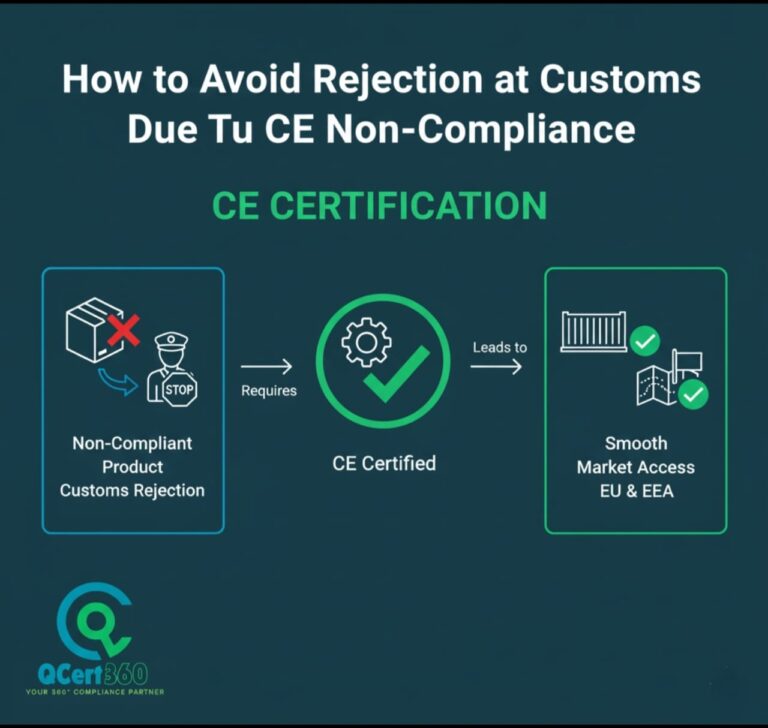
When products cross borders, compliance isn’t just a box to tick—it’s the difference between smooth entry and a shipment being detained, delayed, or even destroyed. Customs authorities in the European Union are stricter than ever on CE marking, and non-compliance can cost businesses thousands in fees, lost contracts, and reputational damage.
The good news? With the right preparation, you can drastically reduce your risk. Let’s unpack how to avoid rejection at customs due to CE non-compliance and what steps every manufacturer, importer, and exporter should take.
Why Customs Rejection Happens in the First Place
Products are stopped at customs for a handful of predictable reasons:
- Missing CE mark on the product, packaging, or documentation. Even if the product is compliant, the absence of a visible CE mark signals non-conformity to customs officers.
- Incorrect CE marking (e.g., logo sizing or misleading placement). The CE logo has strict design rules, and even small errors can trigger suspicion of counterfeit or improper use.
- Incomplete technical files that fail to prove conformity. Without test reports, risk assessments, and the Declaration of Conformity, authorities have no way of validating compliance.
- Unverified supplier claims, especially in multi-component products. Relying on verbal assurances or partial certificates is a common reason for rejection.
- False assumptions around exemptions from CE marking directives. Many companies mistakenly believe their products don’t require CE marking when in fact, several overlapping directives may apply.
Here’s the thing: customs officers aren’t guessing. They use strict checklists, regulatory training, and databases of past non-compliance cases to spot red flags quickly. If your documentation doesn’t align with the regulations or if your CE mark looks suspicious, rejection is almost guaranteed—and repeat violations can place your company under increased regulatory enforcement for future shipments.
Compliance Starts Before Shipping
Many companies think customs is the place where compliance begins. In reality, compliance starts back at the design and manufacturing stage. By the time a product reaches the port, it’s too late to fix missing documents or failed testing.
Key steps for early compliance:
- Design with directives in mind: From machinery safety to EMC emissions, directives should guide your product engineering.
- Perform a conformity assessment: This may involve self-declaration or working with a Notified Body, depending on your product category.
- Compile a technical file: Include design drawings, risk assessments, and testing reports. Customs doesn’t always ask for it, but you must have it ready.
- Prepare the Declaration of Conformity (DoC): This is your legal statement that the product meets all applicable EU regulations.
Case Study: Electronics Manufacturer Blocked at Customs
An electronics company shipped a batch of smart home devices to Europe. Each device carried the CE mark, but customs flagged the shipment. Why? The Declaration of Conformity referenced only the EMC Directive but left out the Radio Equipment Directive (RED). Since the devices had wireless modules, they fell under RED too.
The outcome: The entire shipment was held for six weeks, clients cancelled orders, and the company paid additional testing and re-shipping fees.
Lesson: Partial compliance is still non-compliance. Every applicable directive must be covered in your documentation.
Avoiding Common Pitfalls in Customs Clearance
Here’s where many exporters trip up:
- Relying on supplier promises – If your supplier says a component is CE compliant, always verify with certificates and test reports.
- Incorrect CE mark usage – The CE logo must follow exact proportions; using a fake or altered mark can trigger rejection.
- Incomplete compliance documentation – Customs may ask for the DoC or test reports, and failure to provide them quickly raises suspicion.
- Ignoring importer obligations – Importers are legally responsible for ensuring compliance, not just the overseas manufacturer.
- Outdated conformity assessments – Regulations evolve. A certificate from five years ago may no longer hold.
The Role of Importers and Distributors
Customs doesn’t just look at manufacturers. Importers and distributors also face legal responsibilities because they act as gatekeepers for products entering the market. If you’re importing, you must:
- Verify that the manufacturer has carried out conformity assessment properly, which means reviewing certificates, testing reports, and ensuring the product meets all relevant EU directives.
- Keep copies of the Declaration of Conformity (DoC) and technical documentation for authorities to request at any time, often for up to 10 years after the product is placed on the market.
- Ensure the product bears the CE mark correctly, including proper sizing, visibility, and placement, since even design errors can be flagged during inspections.
- Respond to regulatory enforcement requests from authorities, which may involve submitting documentation quickly or arranging product recalls if compliance fails.
Neglecting these steps doesn’t just risk rejection—it puts your business directly on the hook for fines, product seizures, and potential bans from future imports. In fact, regulators often hold importers and distributors to the same standard as manufacturers, since they play a direct role in ensuring only safe and compliant products reach consumers. Proactive due diligence, supplier audits, and digital compliance tracking are now common practices among forward-thinking distributors to avoid costly mistakes.
Building a Trade Compliance Strategy
Compliance isn’t a one-time effort—it’s an ongoing trade compliance strategy. Companies that succeed at avoiding customs rejections usually do the following:
- Invest in regulatory intelligence: Track updates to directives that impact your industry.
- Adopt digital compliance tools: Cloud systems for storing documentation speed up customs checks.
- Train staff across departments: Compliance isn’t just legal’s job—it involves engineering, supply chain, and logistics.
- Audit suppliers regularly: Don’t wait until shipment to discover that a part wasn’t tested properly.
- Plan for export readiness early: Compliance should be built into your product development cycle.
Case Study: Medical Device Exporter Gets It Right
A medical device company exporting diagnostic equipment faced some of the toughest compliance challenges. Unlike consumer products, medical devices fall under highly specific directives with stricter safety requirements. Instead of waiting for customs to raise issues, the company took a compliance assurance system approach that focused on prevention rather than damage control.
- They mapped every applicable directive to their product line, ensuring nothing was overlooked—from general CE requirements to sector-specific medical device rules.
- They partnered with a Notified Body for conformity assessment, gaining not only certification but also expert guidance on emerging regulatory changes.
- They stored their technical files digitally for rapid customs submission, which meant that whenever customs authorities requested documentation, it could be provided instantly.
- They conducted supplier audits to verify part-level compliance, ensuring that every component—from electronic chips to sterile packaging—met CE obligations.
- They also introduced internal compliance training for staff, making sure their entire team understood the importance of CE documentation and customs readiness.
- Finally, they built a routine pre-shipment compliance checklist, allowing them to catch and correct small issues before goods ever left the warehouse.
The result? Zero customs rejections over three years and a faster customs clearance process, which not only reduced costs but also gave them a competitive edge in international tenders where compliance speed can be a deciding factor. Their story shows that proactive CE compliance isn’t just about avoiding problems—it can be a genuine business advantage.
Risk of Penalties and Business Impact
Customs rejection isn’t just an inconvenience—it carries real costs that can quickly spiral beyond the shipment in question.
- Storage fees while goods sit at the port. Delays at customs mean your products may be held for days or weeks, with mounting demurrage and warehousing charges that eat into your margins.
- Fines for false or incomplete documentation. Even minor errors in CE certification paperwork can be treated as serious violations, leading to significant penalties that could have been avoided with proper compliance.
- Lost contracts due to late delivery. Buyers and distributors often work on strict timelines. A single rejected shipment can cause them to cancel purchase orders, switch to competitors, or blacklist your company.
- Damaged reputation with buyers and distributors. In industries where reliability is everything, word travels fast. One compliance failure can make partners hesitant to trust you with larger or long-term contracts.
- Repeat scrutiny on future shipments from the same company. Once flagged, customs authorities often treat subsequent imports from your business as high-risk, leading to more frequent checks, longer clearance times, and recurring costs.
When compared to the cost of proper CE certification and documentation, non-compliance is always more expensive. The upfront investment in getting certified correctly protects not only your shipments but also your long-term business relationships and growth opportunities.
Risk of Penalties and Business Impact
Even outside the EU, CE marking is widely recognized. Many countries treat it as a trusted proof of conformity. By ensuring CE compliance, businesses not only guarantee market access requirements in Europe but also simplify entry into other regions.
Think of CE marking attestation as your global passport for products. Without it, you’re not just risking rejection at customs—you’re shutting the door on entire markets.
Final Thoughts
Avoiding rejection at customs due to CE non-compliance comes down to preparation, verification, and proactive risk management. Manufacturers, importers, and distributors must treat CE marking as a core part of their trade compliance strategy, not as an afterthought.
If you want smooth customs clearance, protect your brand from penalties, and build long-term trust with global buyers, compliance isn’t optional—it’s your strongest asset.
Why Qcert360 is the Right Partner to Avoid CE Non-Compliance Issues
When it comes to CE conformity of compliance, a small mistake can mean delayed shipments, rejected consignments, or even financial penalties. This is where Qcert360 makes the difference. Our team specializes in guiding manufacturers, exporters, and distributors through every step of CE marking, from identifying applicable EU directives to preparing technical documentation and ensuring testing meets European standards.
What sets us apart is our proactive approach—we don’t just certify your products; we help you anticipate potential compliance risks before your goods ever reach customs. With Qcert360, you can be confident your shipments will clear borders smoothly, protecting your reputation and bottom line.
FAQs on How to Avoid Rejection at Customs Due to CE Non-Compliance
- Can customs officers stop a shipment even if the CE mark is visible?
Yes, if documentation is missing or the mark appears suspicious. - Who is legally responsible for CE compliance—the manufacturer or the importer?
Both. Importers must verify documentation before placing products on the EU market. - What happens if my product fails conformity assessment after shipment?
The shipment can be rejected, recalled, or destroyed at your expense. - Is self-declaration enough for all products?
No. High-risk categories like medical devices and PPE often require Notified Body involvement. - Can I use a supplier’s CE certificate without further checks?
No, you must verify authenticity with testing reports and declarations & get CE under your own brand name. - How often should CE compliance documentation be updated?
Every time directives change or new versions of standards apply. - Do CE marking rules apply to used or refurbished products?
Yes, if they’re being placed on the EU market for the first time. - Can CE compliance reduce customs clearance delays?
Absolutely. Complete, verified documentation speeds up customs checks significantly. - What are the risks of counterfeit CE marks?
Counterfeit marks can result in confiscation, fines, and long-term loss of trust with authorities. - Does CE marking guarantee approval in non-EU countries?
Not always, but many countries recognize CE as proof of compliance, easing entry requirements.
Our Services
ISO Standards
- ISO 9001 Certification
- ISO 14001 Certification
- ISO 45001 Certification
- ISO 22000 Certification
- ISO 17025 Certification
- ISO 27001 Certification
- ISO 13485 Certification
- ISO 20000-1 Certification
- ISO 41001 Certification
- ISO 22716 Certification
- ISO 50001 Certification
- ISO 22301 Certification
- ISO 29993 Certification
Product Certifications
Other international standards
- FSSC 22000 Certification
- HIPAA
- HACCP Certification
- SA 8000 Certification
- GMP Certification
- GDPR
- GDP Certification
- GLP Certification
- Certificate of Conformity
QCert360 provides a wide range of services including ISO certification, audit support, compliance consulting, and training. They specialize in helping businesses achieve global standards and certifications like ISO 9001, ISO 27001, ISO 14001, and many others. Their team ensures a seamless experience from consultation to certification, supporting clients at every stage.
The time it takes to achieve certification can vary depending on the complexity of the standard and the readiness of your organization. On average, it takes about 3 to 6 months. QCert360 works closely with clients to streamline the process, ensuring that all requirements are met efficiently and within a reasonable timeline.
QCert360 is a trusted partner with years of experience in helping businesses obtain international certifications. Their expert consultants provide tailored solutions, ensuring your organization not only meets but exceeds industry standards. With a customer-centric approach, they focus on offering end-to-end support to simplify the certification journey.
QCert360 serves a wide range of industries including manufacturing, healthcare, information technology, education, and services, among others. They customize their certification solutions to meet the unique requirements of each industry, ensuring relevance and compliance with global standards.
Yes, QCert360 provides ongoing support even after certification. They offer services like surveillance audits, recertification guidance, and consultancy to help maintain and improve your certification status. Their team ensures that your organization stays compliant and up-to-date with any changes in certification standards.
Getting started with QCert360 is simple. You can contact them via their website to request a consultation. Their team will assess your needs, discuss the best certification options for your business, and outline the steps involved. From there, they’ll guide you through the entire process, ensuring you’re prepared for certification.
QCert360 stands out due to its customer-focused approach, industry expertise, and comprehensive service offerings. Their team doesn’t just help you obtain certification but works to ensure your organization thrives in compliance with international standards. They also offer personalized consultation, making the process smoother and more efficient, ensuring long-term success for your business.
The cost of certification varies depending on factors such as the type of certification, the size and complexity of your organization, and the specific industry requirements. QCert360 offers competitive pricing and provides tailored quotes based on your unique needs. They ensure transparency and work with you to find the most cost-effective solution for your certification goals.
Yes, QCert360 offers internal audit services to help assess and improve your organization’s processes. Their expert auditors conduct thorough reviews of your systems and operations to ensure they meet required standards. They also provide actionable recommendations to help enhance efficiency and compliance, making sure you’re fully prepared for external audits.
If your organization doesn’t pass an audit or certification assessment, QCert360 works with you to understand the reasons for non-compliance and provides support to rectify the issues. They offer guidance on corrective actions and help you prepare for a re-assessment. Their goal is to ensure your organization meets the necessary standards for certification, and they will be by your side to make the process as smooth as possible.