
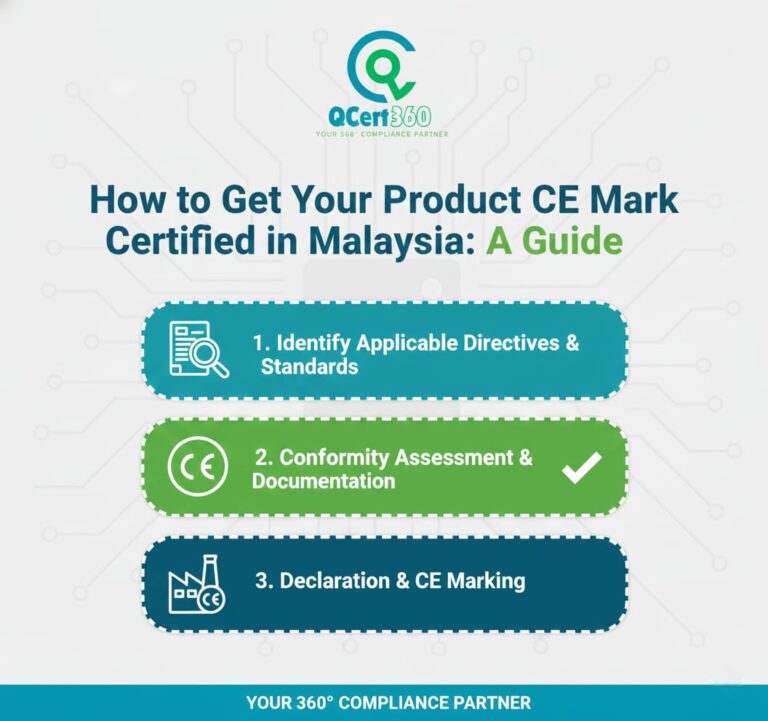
If you’re planning to export a product that needs CE marking, here’s the thing you need to know upfront: CE certification isn’t a bureaucratic hurdle—it’s a passport to the European market. Whether you’re dealing with electronics, machinery, medical devices, toys, or any regulated product, the CE mark shows that your product meets essential European safety, health, and environmental standards.
But here’s where many Malaysian manufacturers get stuck. The rules look complicated, the documentation feels endless, and the entire process seems tailored for companies with full-time compliance teams. The good news? It doesn’t need to be overwhelming, and with the right guidance, getting CE certified becomes a structured, predictable process.
Let’s break down exactly how to get your product CE Mark certified, how to prepare for the technical requirements, and how Qcert360 can streamline the entire journey for you.
What CE Marking Actually Means for Your Product
CE marking might look like a small symbol, but it carries big implications. It tells European regulators that your product meets essential safety and performance standards. When buyers see it, they know the product has gone through conformity assessments, safety evaluations, and proper technical documentation.
For manufacturers, CE compliance isn’t just about passing an inspection—it’s about building a product that meets clear regulatory expectations. That’s why phrases like product conformity roadmap, CE compliance readiness, and technical documentation audit have become common search terms for businesses preparing for exports.
Think of CE marking as a structured quality assurance framework rather than a last-minute checklist.
Step 1: Identify the Correct CE Directive
Every product fall under one or more CE directives. These directives define what you must comply with before placing your product on the market.
A few examples include:
- Machinery Directive
- EMC Directive
- Low Voltage Directive
- Radio Equipment Directive
- Toy Safety Directive
- Medical Device Regulation
Getting the directive wrong leads to delays, repeat testing, and rejected documentation. This is why many companies start by running a directive identification review to clarify the exact compliance path for their product.
Step 2: Determine Product Requirements
Once you know the directive, the next step is understanding which standards apply to your specific product. These standards influence:
- Safety testing
- Electrical compliance
- Chemical restrictions
- Mechanical performance
- Environmental impact
Manufacturers often underestimate how detailed these standards can get. For instance, if you’re building electronics, you might need electromagnetic shielding tests, thermal stress assessments, and material safety verification. And if you’re dealing with connected products, added cybersecurity compliance can come into play.
This is where high-intent keywords like harmonized standards assessment and CE safety test preparation fit naturally into the picture—because they reflect real tasks safety teams face.
Step 3: Conduct a Product Gap Assessment
Before you jump into testing, you need to know where your product currently stands. A gap assessment compares your product against the required standards.
This includes reviewing:
- Component compliance
- Design documentation
- Materials used
- Electrical safety features
- Labelling and warnings
- User manuals
Many Malaysian manufacturers discover significant documentation gaps at this stage. Missing test reports, incomplete drawings, or unverified supplier declarations can delay certification by months. A structured CE compliance gap mapping helps you avoid unnecessary back-and-forth during the conformity phase.
Step 4: Perform the Required Product Testing
Testing is at the core of CE certification. You may need:
- Electrical safety tests
- EMC and EMI tests
- Mechanical durability tests
- Environmental exposure tests
- Chemical and material analyses
- RF and wireless tests
Depending on the directive, testing can be done internally or through a Notified Body. For complex products, the third-party CE assessment route is often mandatory.
Testing is where many companies lose time because they don’t understand the sequencing. If the product is not test-ready—missing shielding, poor insulation, incomplete labelling—you’ll face retests, extra costs, and delays.
A structured test-ready compliance plan ensures that your product meets all pre-test requirements before entering the lab.
Step 5: Compile the Technical Documentation
This is the part most manufacturers overlook.
Technical documentation must be:
- Complete
- Accurate
- Aligned with the directive
- Available at all times for market surveillance authorities
Your documentation must include:
- Product description
- Design drawings
- Bill of materials
- Risk assessments
- Test reports
- QC and inspection records
- Labelling samples
- User manuals
- Compliance evidence
Auditors will check whether the documentation matches the actual product. A mismatch—even a small one—can lead to a compliance failure. That’s why companies often run a technical file validation review before moving forward.
Step 6: Draft and Sign the Declaration of Conformity (DoC)
Once testing is done and documentation is ready, you create the Declaration of Conformity. This legal document states that your product meets all relevant EU directives and harmonized standards.
It must include:
- Manufacturer details
- Directives and standards applied
- Test report references
- Product model identifiers
- Authorized signatory details
Signing a DoC without proper compliance exposes your company to legal and financial risks, including product recalls and import bans.
This is where expert guidance matters. A DoC that’s drafted correctly helps ensure smooth customs clearance and market entry.
Step 7: Affix the CE Mark Correctly
Only after completing all steps can you place the CE mark on your product. Placement rules must be followed, covering:
- Minimum size
- Visibility
- Permanence
- Proportions
Incorrect marking can lead to penalties, so most companies perform a labeling compliance verification before printing packaging or finalizing engravings.
A Real Case Study: How a Penang Electronics Firm Achieved CE Marking
A mid-sized electronics manufacturer based in Penang reached out to Qcert360 for help exporting their smart LED controller to Europe. They had strong engineering talent but limited exposure to CE rules. Their technical file was incomplete, test reports were outdated, and their risk assessment followed a local template that didn’t align with EU expectations.
Here’s how we helped:
- Directive Mapping
We identified the EMC Directive, Low Voltage Directive, and RoHS requirements as applicable. This immediately clarified the exact standards the team needed. - Testing Plan
We coordinated testing with an accredited EU lab, ensuring faster approval rather than running multiple rounds locally. - Documentation Upgrade
We rebuilt their technical file using a clean EU conformity documentation structure that met buyer expectations. - Risk Assessment Rewrite
We implemented an upgraded hazard control validation system aligned with EU requirements. - Declaration of Conformity Guidance
Once everything was verified, we guided the team through issuing the DoC and affixing the CE Mark legally.
Result?
They secured two EU distributors within three months and expanded their export pipeline. Their CEO later shared that implementing CE standards directly strengthened their internal quality processes.
Why Malaysian Companies Choose Qcert360 to get CE Mark Certified in Malaysia
CE Marking involves more than testing. It demands interpretation, documentation, and strategic decision-making. Malaysian companies across Kuala Lumpur, Selangor, and Melaka often turn to Qcert360 because we simplify the process, reduce uncertainty, and support teams through every technical and regulatory challenge.
What Qcert360 brings:
- Hands-on guidance in choosing the right directives – Helping you understand exactly which EU laws apply to your product so you don’t waste time on irrelevant requirements.
• Full documentation development support – Building every file you need, from technical documentation to user instructions, in a clear and audit-ready format.
• Testing coordination – Managing communication with accredited labs, aligning test plans, and ensuring prototypes are prepared correctly.
• Compliance gap audits – Reviewing your current product and documentation to pinpoint what’s missing before you face an official evaluation.
• Risk assessment enhancements – Strengthening your hazard analysis so it meets EU expectations and reduces approval delays.
• CE Mark training for internal teams – Giving your staff the practical knowledge needed to maintain compliance long after certification.
• Fast-track certification support where applicable – Streamlining the process for products that qualify for quicker CE pathways.
If your goal is EU market entry, our experts help you avoid delays, rework, and costly compliance mistakes.
Preparing for European Buyers and Distributors
Once you have CE Marking, the next step is aligning with buyer expectations. Many EU distributors now ask for:
- Updated test reports – Current, standard-aligned reports that prove the product meets safety and performance requirements.
- Risk assessments – Clear documentation showing you’ve identified hazards, evaluated risks, and applied the right controls.
- Traceability details – Records that link components, batches, and suppliers so reviewers can verify every step of the supply chain.
- Packaging compliance – Labelling, symbols, and safety information that follow EU packaging and marking rules.
- RoHS evidence – Material declarations, supplier certificates, and test data confirming restricted substances are within legal limits.
- User manuals that match EU language rules – Instructions written in the correct local languages with accurate warnings, safe-use guidance, and essential markings.
This is why more Malaysian exporters are investing in end-to-end CE compliance support early in the product cycle. It gives them a competitive edge during negotiations.
Common Mistakes Malaysian Exporters Make
Here’s what we often see when reviewing client files:
- Recycling old test reports – Many brands try reusing past reports, but most expire or don’t align with the latest harmonized standards, which makes them unusable for compliance.
- Weak risk assessments – EU buyers notice shallow or copy-paste assessments instantly, and it signals that the product hasn’t been engineered with real safety thinking.
- Outdated manuals – Manuals need accurate safety instructions, pictograms, warnings, and compliant terminology. Anything outdated raises red flags during conformity checks.
- Incomplete technical files – Missing drawings, test plans, manufacturing controls, or declarations slows down the entire approval cycle because reviewers can’t verify conformity.
- Late testing – Teams that test only after finalizing production often face costly redesigns and delays. Early testing avoids unnecessary rework and keeps timelines predictable.
Avoiding these issues can save months.
Ready to Get CE Certified in Malaysia? Qcert360 Can Help
If you’re manufacturing in Kuala Lumpur, Johor Bahru, Penang, Selangor, Melaka, Kedah, or anywhere across Malaysia’s rapidly growing industrial hubs, the fastest path to Europe starts with a clear CE strategy — and the right partner.
Qcert360 provides a complete, done-for-you CE certification service in Malaysia. Whether you’re building electronics, machinery, toys, medical devices, or consumer products, we’ll help you meet EU standards with confidence, speed, and clarity.
If you’re ready, reach out. The sooner CE compliance starts, the smoother your export journey becomes.
FAQs
- How much time does it take to get CE certification in Malaysia?
It depends on your product type and testing needs, but most projects take 2–6 weeks. - Do all products need Notified Body approval?
Only certain high-risk items require third-party involvement. Many products follow a self-declaration route. - Is CE Marking mandatory in Malaysia to enter the EU?
Yes. Without CE Marking, products cannot legally be sold in the European market. - What documents are needed for obtaining CE Marking in Malaysia?
You need a technical file, test reports, risk assessment, user manual, and a Declaration of Conformity. - Can Malaysian labs issue CE test reports?
Some can test to EU standards, but not all are accepted by Notified Bodies. Qcert360 helps you choose the right pathway. - Does CE Marking expire?
The mark itself doesn’t expire, but test reports and standards must stay up to date and the certification must be renewed every 3 years - What’s the most expensive part of CE Marking certification in Malaysia?
Usually testing, especially for electronics or high-risk products. - Can small manufacturers get CE certified in Malaysia easily?
Yes. With proper guidance, even small production units can meet EU requirements. - What happens if a product fails CE Mark testing?
It must be corrected and retested. A proper assessment initially helps avoid repeated failures. - How does Qcert360 support Malaysian product manufacturers?
We handle documentation, testing, directives, risk review, and complete CE project management for smooth EU approval.
Our Services
ISO Standards
- ISO 9001 Certification
- ISO 14001 Certification
- ISO 45001 Certification
- ISO 22000 Certification
- ISO 17025 Certification
- ISO 27001 Certification
- ISO 13485 Certification
- ISO 20000-1 Certification
- ISO 41001 Certification
- ISO 22716 Certification
- ISO 50001 Certification
- ISO 22301 Certification
- ISO 29993 Certification
Product Certifications
Other international standards
- FSSC 22000 Certification
- HIPAA
- HACCP Certification
- SA 8000 Certification
- GMP Certification
- GDPR
- GDP Certification
- GLP Certification
- Certificate of Conformity
QCert360 provides a wide range of services including ISO certification, audit support, compliance consulting, and training. They specialize in helping businesses achieve global standards and certifications like ISO 9001, ISO 27001, ISO 14001, and many others. Their team ensures a seamless experience from consultation to certification, supporting clients at every stage.
The time it takes to achieve certification can vary depending on the complexity of the standard and the readiness of your organization. On average, it takes about 3 to 6 months. QCert360 works closely with clients to streamline the process, ensuring that all requirements are met efficiently and within a reasonable timeline.
QCert360 is a trusted partner with years of experience in helping businesses obtain international certifications. Their expert consultants provide tailored solutions, ensuring your organization not only meets but exceeds industry standards. With a customer-centric approach, they focus on offering end-to-end support to simplify the certification journey.
QCert360 serves a wide range of industries including manufacturing, healthcare, information technology, education, and services, among others. They customize their certification solutions to meet the unique requirements of each industry, ensuring relevance and compliance with global standards.
Yes, QCert360 provides ongoing support even after certification. They offer services like surveillance audits, recertification guidance, and consultancy to help maintain and improve your certification status. Their team ensures that your organization stays compliant and up-to-date with any changes in certification standards.
Getting started with QCert360 is simple. You can contact them via their website to request a consultation. Their team will assess your needs, discuss the best certification options for your business, and outline the steps involved. From there, they’ll guide you through the entire process, ensuring you’re prepared for certification.
QCert360 stands out due to its customer-focused approach, industry expertise, and comprehensive service offerings. Their team doesn’t just help you obtain certification but works to ensure your organization thrives in compliance with international standards. They also offer personalized consultation, making the process smoother and more efficient, ensuring long-term success for your business.
The cost of certification varies depending on factors such as the type of certification, the size and complexity of your organization, and the specific industry requirements. QCert360 offers competitive pricing and provides tailored quotes based on your unique needs. They ensure transparency and work with you to find the most cost-effective solution for your certification goals.
Yes, QCert360 offers internal audit services to help assess and improve your organization’s processes. Their expert auditors conduct thorough reviews of your systems and operations to ensure they meet required standards. They also provide actionable recommendations to help enhance efficiency and compliance, making sure you’re fully prepared for external audits.
If your organization doesn’t pass an audit or certification assessment, QCert360 works with you to understand the reasons for non-compliance and provides support to rectify the issues. They offer guidance on corrective actions and help you prepare for a re-assessment. Their goal is to ensure your organization meets the necessary standards for certification, and they will be by your side to make the process as smooth as possible.