
If you’ve been exploring ISO certification for your company, one question usually shows up early: How long will the implementation actually take? It’s a fair question. Businesses need realistic timelines to plan budgets, align teams, and meet client or tender deadlines. But here’s the thing—ISO implementation isn’t an off-the-shelf process. It’s shaped by your size, your sector, your risks, and how mature your internal controls are today.
Let’s break this down clearly so you can see what your timeline might look like and what you can do to speed it up.
Why Do ISO Implementation Timelines Vary So Much?
The short answer: because businesses themselves vary wildly. A small service company with straightforward processes won’t require the same level of documentation, internal audits, or risk controls as a manufacturing plant or logistics provider.
Some of the biggest timeline influences include:
- How structured your processes are today
- Whether the company has existing documentation
- The complexity of your operations
- The ISO standard you’re targeting
- The level of leadership involvement
- The number of sites or departments
- The experience of the internal team
This is why you’ll see more companies searching for terms like ISO certification timeline, ISO readiness review, faster ISO implementation, and ISO compliance roadmap. Businesses want clarity—and they want to move quickly without compromising quality.
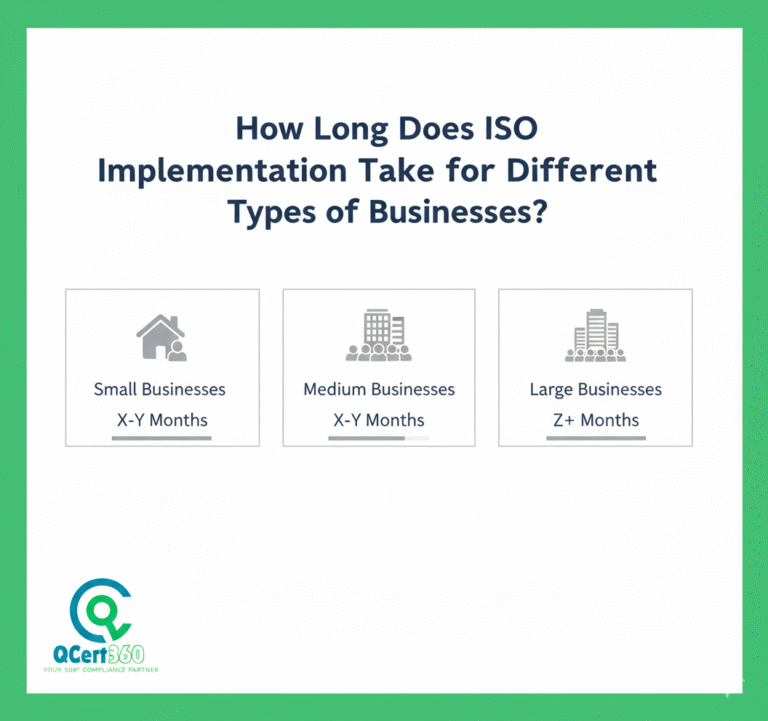
Typical ISO Implementation Timelines by Business Size
Here’s a simple way to view it:
- Micro Businesses (1–10 employees)
Average: 4–6 weeks
These companies usually have limited documentation but very simple operations. With focused support, they move fast. If the goal is something like ISO 9001, ISO 27001, or ISO 14001, the biggest task tends to be setting up repeatable processes and training.
A short ISO readiness gap analysis at the start helps spot what’s missing and prevents surprises during audit.
- Small Businesses (10–50 employees)
Average: 6–10 weeks
Small companies typically have partially defined workflows, but nothing standardized across the board. They need more time for documentation, internal audits, and corrective actions.
Here, a structured ISO gap review and process mapping workshop often cut down delays. For businesses exporting to the EU, UAE, or African markets, this stage helps align systems with compliance demands.
- Medium Enterprises (50–250 employees)
Average: 3–4 months
At this level, things get more layered:
- Multiple departments
- Cross-functional approvals
- Higher operational risks
- More stakeholders
Whether they’re implementing ISO 45001 for workplace safety or ISO 27001 for information security, the timeline expands because training, documentation, and internal audits require deeper involvement.
Medium companies benefit the most from a phased ISO implementation roadmap, especially when they’re chasing tender opportunities or regional regulatory compliance.
- Large Enterprises (250+ employees)
Average: 6–8 months
The timeline grows because:
- Documentation is extensive
- Compliance needs are strict
- Internal audits take longer
- Multi-site operations complicate things
Large companies often combine standards—say ISO 9001, ISO 14001, and ISO 45001 under an Integrated Management System—which extends the timeframe but increases efficiency long-term.
International buyers often use ISO compliance verification as a requirement at this level, so doing it right the first-time matters.
How Long Does ISO Implementation Take for Small Businesses?
Small businesses usually move faster because they have fewer departments, simpler workflows, and quicker decision-making. If they’re implementing something like ISO 9001 or ISO 14001, most can wrap up the work in 6 to 10 weeks with professional guidance.
A compact ISO readiness gap analysis early in the process helps identify what’s missing and prevents delays later. For fast-moving companies, this step alone can shave days or even weeks off the certification timeline.
Businesses of this size often achieve the fastest results when documentation templates, training, and internal audits are managed by an external partner. That reduces guesswork and accelerates implementation.
How Long Does ISO Implementation Take for Micro Enterprises?
Micro enterprises—teams of up to 10—often achieve ISO certification in 4 to 6 weeks. Their operations tend to be agile, and they can align quickly when leaders are directly involved.
The biggest challenge for micro companies is usually documentation. They rely heavily on informal communication and routine familiarity. When moving toward ISO, this needs to be formalized, but the actual processes are simple enough that the shift is fast.
This is where guided documentation support and process-mapping sessions make a noticeable difference.
How Long Does ISO Implementation Take for Medium-Sized Companies?
Medium enterprises sit in the sweet spot where they’re big enough to have layered operations, but small enough to adopt new structures quickly. Their timeline lands around 3 to 4 months depending on the standard.
Why longer?
Because here you’re dealing with:
- Multiple departments
- Cross-functional approvals
- More risk areas
- Larger volumes of documentation
- Formal internal audits
- Broader training requirements
If the company is targeting standards like ISO 45001 or ISO 27001, the timeline expands because these involve deeper risk assessments and structured controls.
A solid ISO implementation roadmap is essential at this stage. Without one, projects drift, and the timeline doubles.
How Long Does ISO Implementation Take for Large Enterprises?
Large companies typically need 6 to 8 months for full implementation. And depending on the number of sites, the standard, and the level of operational complexity, some may take even longer.
The biggest time consumers here include:
- Multi-site audits
- High volumes of documentation
- Coordinating training for hundreds of employees
- Aligning global or regional processes
- Ensuring evidence of consistent compliance
When large companies opt for an Integrated Management System, combining ISO 9001, ISO 14001, and ISO 45001 in a single framework, the upfront timeline extends—but the long-term efficiency is massive.
Many global buyers prefer suppliers with multi-standard compliance, which is why large enterprises treat this as a strategic move rather than a checklist item.
Does the ISO Standard You Choose Affect the Timeline?
Yes—and significantly.
Here’s a practical way to think about it:
- ISO 9001: Usually, the fastest because it focuses on quality processes you already use daily.
- ISO 14001: Adds environmental controls, so expect a few extra weeks.
- ISO 45001: Involves risk assessments and health & safety controls.
- ISO 27001: One of the most time-intensive due to information security measures.
- ISO 22000 / HACCP: Timelines depend heavily on supply chain risk.
- ISO 22301: Needs detailed continuity and resilience planning, so requires more time.
The more risk-heavy the standard, the more time you’ll invest in creating controls, documentation, training, and evidence.
A structured pre-audit compliance review is one of the fastest ways to shorten the timeline across all standards.
A Real-World Case Study: How One Company Cut Their ISO Timeline by Half
A mid-size machinery distributor needed ISO 9001 quickly to meet supplier requirements and qualify for high-value contracts. Their operations were strong, but documentation was minimal, and they had never navigated ISO before.
They approached Qcert360 with a tight deadline: eight weeks.
Here’s how the timeline played out:
Week 1–2: Gap Analysis and Process Mapping
We ran a detailed ISO gap review and mapped their workflows. This revealed inconsistent documentation and a few process bottlenecks that were slowing down operations anyway.
Week 3–5: Documentation and Training
Using Qcert360’s documentation framework, we created all required policies, SOPs, risk assessments, and forms. Staff training sessions helped align teams with ISO requirements and remove uncertainty.
Week 6–7: Internal Audit and Corrections
We conducted the internal audit, identified necessary corrections, and helped the team close them within days.
Week 8: Certification Audit
The auditor passed them with no major non-conformities.
Not only did they meet the deadline—they entered the certification audit with confidence because the system was structured around real operations, not theoretical templates.
This is exactly what companies want when they search for fast and reliable ISO implementation support.
What Mistakes Slow Down ISO Implementation the Most?
If you want to keep your timeline under control, watch out for these pitfalls:
- Treating ISO like a paperwork exercise
- Not assigning process owners
- Waiting too long to finalize documentation
- Skipping internal audits
- Poor cross-department communication
- Delayed management decisions
Most delays don’t come from the standard—they come from unclear responsibilities inside the business. Once roles are defined, ISO moves quickly and smoothly.
How Can Qcert360 Help You Speed Up ISO Implementation?
Qcert360 has supported companies across multiple sectors with fast, structured, and internationally recognized ISO implementation. Our method focuses on making the process smooth and stress-free.
You get:
- A full ISO implementation roadmap
- Documentation templates aligned with the latest standards
- Hands-on consulting from certified auditors
- Process mapping and training sessions
- Internal audits
- Support until you’re fully certified
Whether you’re a startup, a growing SME, or a multi-site enterprise, we help you achieve global ISO compliance without the usual delays.
If you’re planning for tender submissions, supplier onboarding, or new market entry, a fast and clean ISO implementation can make the difference between winning and losing opportunities.
If you want to shorten your certification timeline, let Qcert360 guide the process from start to finish.
10 FAQs: ISO Implementation Timelines
- How long does ISO implementation usually take?
Anywhere from 4 weeks to 12 months depending on the size and complexity of your business. - Do smaller companies complete ISO faster?
Yes. Micro and small businesses often complete the process in 4–10 weeks. - What causes ISO certification delays?
Poor documentation, unclear responsibilities, and slow decision-making. - Which ISO standard takes the longest to implement?
ISO 27001 typically takes longer due to security controls and risk assessments. - Can multiple ISO standards be implemented together?
Yes, and many companies choose an Integrated Management System to save time. - How much time should be allocated for internal audits?
Most companies need 1–2 weeks depending on the number of departments. - Can ISO certification be fast-tracked?
Yes. With expert support, many organizations cut their timeline by 30–50%. - What if a company has no documentation?
It’s still manageable. Most SMEs start with minimal documentation and finish within weeks. - Does employee training affect the timeline?
Absolutely. Well-trained teams speed up implementation significantly. - How can Qcert360 help me get ISO certified faster?
By providing structured guidance, ready-to-use documentation, internal audits, and end-to-end implementation support.
Our Services
ISO Standards
- ISO 9001 Certification
- ISO 14001 Certification
- ISO 45001 Certification
- ISO 22000 Certification
- ISO 17025 Certification
- ISO 27001 Certification
- ISO 13485 Certification
- ISO 20000-1 Certification
- ISO 41001 Certification
- ISO 22716 Certification
- ISO 50001 Certification
- ISO 22301 Certification
- ISO 29993 Certification
Product Certifications
Other international standards
- FSSC 22000 Certification
- HIPAA
- HACCP Certification
- SA 8000 Certification
- GMP Certification
- GDPR
- GDP Certification
- GLP Certification
- Certificate of Conformity
QCert360 provides a wide range of services including ISO certification, audit support, compliance consulting, and training. They specialize in helping businesses achieve global standards and certifications like ISO 9001, ISO 27001, ISO 14001, and many others. Their team ensures a seamless experience from consultation to certification, supporting clients at every stage.
The time it takes to achieve certification can vary depending on the complexity of the standard and the readiness of your organization. On average, it takes about 3 to 6 months. QCert360 works closely with clients to streamline the process, ensuring that all requirements are met efficiently and within a reasonable timeline.
QCert360 is a trusted partner with years of experience in helping businesses obtain international certifications. Their expert consultants provide tailored solutions, ensuring your organization not only meets but exceeds industry standards. With a customer-centric approach, they focus on offering end-to-end support to simplify the certification journey.
QCert360 serves a wide range of industries including manufacturing, healthcare, information technology, education, and services, among others. They customize their certification solutions to meet the unique requirements of each industry, ensuring relevance and compliance with global standards.
Yes, QCert360 provides ongoing support even after certification. They offer services like surveillance audits, recertification guidance, and consultancy to help maintain and improve your certification status. Their team ensures that your organization stays compliant and up-to-date with any changes in certification standards.
Getting started with QCert360 is simple. You can contact them via their website to request a consultation. Their team will assess your needs, discuss the best certification options for your business, and outline the steps involved. From there, they’ll guide you through the entire process, ensuring you’re prepared for certification.
QCert360 stands out due to its customer-focused approach, industry expertise, and comprehensive service offerings. Their team doesn’t just help you obtain certification but works to ensure your organization thrives in compliance with international standards. They also offer personalized consultation, making the process smoother and more efficient, ensuring long-term success for your business.
The cost of certification varies depending on factors such as the type of certification, the size and complexity of your organization, and the specific industry requirements. QCert360 offers competitive pricing and provides tailored quotes based on your unique needs. They ensure transparency and work with you to find the most cost-effective solution for your certification goals.
Yes, QCert360 offers internal audit services to help assess and improve your organization’s processes. Their expert auditors conduct thorough reviews of your systems and operations to ensure they meet required standards. They also provide actionable recommendations to help enhance efficiency and compliance, making sure you’re fully prepared for external audits.
If your organization doesn’t pass an audit or certification assessment, QCert360 works with you to understand the reasons for non-compliance and provides support to rectify the issues. They offer guidance on corrective actions and help you prepare for a re-assessment. Their goal is to ensure your organization meets the necessary standards for certification, and they will be by your side to make the process as smooth as possible.