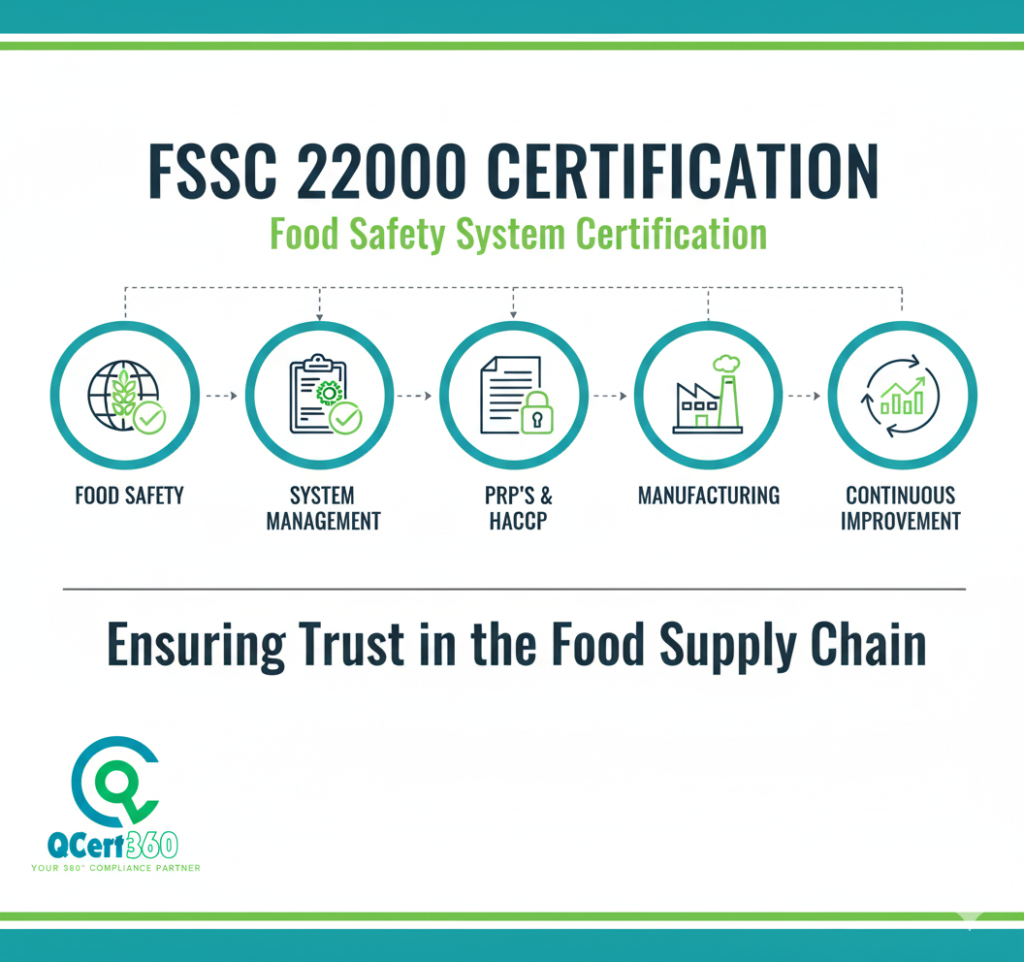
FSSC 22000 Certification

FSSC 22000 (Food Safety System Certification) is a globally recognized standard for food safety management systems. It builds on ISO 22000 and integrates sector-specific Pre-Requisite Programs (PRPs) to ensure safe food production, processing, packaging, and distribution. The standard focuses on hazard prevention, risk management, traceability, and regulatory compliance throughout the food supply chain. FSSC 22000 is recognized by the Global Food Safety Initiative (GFSI), making it widely accepted by retailers and regulators worldwide. Certification demonstrates an organization’s commitment to delivering safe, high-quality food products, strengthening consumer trust, and supporting global market access. It applies to companies of all sizes in the food industry.

Click here to connect through WhatsApp – 24/7

Request a Call Back

Get Free Consultation

Have any Questions?

Mail us Today!

contact@qcert360.com

FSSC 22000 Certification – Ensuring Global Food Safety and Compliance

For food manufacturers, processors, packaging companies, and distributors, FSSC 22000 certification is a globally recognized mark of food safety and compliance. It demonstrates that organizations have robust systems in place to control food safety risks, meet international standards, and ensure consumer protection. Achieving FSSC 22000 is more than just regulatory compliance—it reflects a strong commitment to quality, transparency, and global market access.

What is FSSC 22000 Certification?

FSSC 22000 (Food Safety System Certification) is a globally recognized food safety certification scheme acknowledged by the Global Food Safety Initiative (GFSI). It integrates ISO 22000 requirements with industry-specific prerequisite programs (PRPs) and additional FSSC criteria, creating a comprehensive framework for managing food safety risks. Covering the entire supply chain—from farming and raw material processing to packaging, storage, and distribution—FSSC 22000 ensures consistent safety and quality at every stage. By achieving this certification, organizations demonstrate their commitment to consumer protection, regulatory compliance, and international market access, while strengthening trust with buyers, retailers, and stakeholders worldwide.

Why FSSC 22000 Certification Matters

  • Market Access – Many international retailers, food service providers, and regulatory authorities require suppliers to hold FSSC 22000 certification. Without it, businesses may be excluded from high-value markets.
  • Consumer Confidence – Certification signals that food products are safe, hygienic, and consistently produced under globally accepted standards, giving consumers peace of mind.
  • Regulatory Compliance – FSSC 22000 aligns with worldwide food safety laws, including EU regulations, FDA standards, and Codex Alimentarius, reducing the risk of legal penalties.
  • Risk Management – The framework helps organizations proactively identify, assess, and control food safety hazards, minimizing risks of contamination and costly recalls.
  • Business Credibility – Certification builds stronger trust with buyers, investors, and stakeholders, demonstrating that food safety is a priority and a long-term commitment.
FSSC 22000 certification for food safety and compliance with international standards

Benefits:

Enhanced Marketability:

Obtaining certification boosts brand visibility and credibility, making products and services more attractive to consumers and increasing market share in global markets.

Consumer Trust & Satisfaction:

Certification assure customers of consistent quality, safety, and reliability, fostering trust, increasing brand loyalty, and ensuring higher levels of customer satisfaction.

Regulatory Compliance

Certification ensure compliance with global standards and regulations, helping businesses avoid legal issues, penalties, and enabling smoother entry into diverse international markets.

Competitive Advantage

Holding certification distinguishes a business from competitors, signaling superior quality and reliability, and positioning the company as an industry leader in the market.

Global Expansion

Certification provide access to new international markets, demonstrating that a business meets global standards, which facilitates expansion and opens doors to new business opportunities worldwide.

Risk Mitigation & Efficiency

Certifications help identify and mitigate risks, streamline operations, and reduce errors or defects, ensuring efficiency and consistency while safeguarding against operational disruptions.

Core Components of FSSC 22000 Certification

  • Hazard Analysis and Risk Control – Organizations must systematically identify biological, chemical, and physical hazards at every stage of production. Risks are analyzed, preventive controls are established, and monitoring systems are put in place to ensure food remains safe from farm to table.
  • Prerequisite Programs (PRPs) – These include hygiene practices, sanitation protocols, pest management, allergen control, and environmental monitoring. PRPs form the foundation of a safe production environment, reducing the chance of contamination before it reaches the final product.
  • Traceability and Recall Systems – Businesses must implement robust traceability to track ingredients and finished products across the supply chain. This ensures swift recalls in case of a safety issue, protecting both consumers and brand reputation.
  • Management Commitment – Leadership plays a critical role by allocating resources, fostering a food safety culture, and actively supporting continuous improvements in the system.
  • Documentation and Records – Detailed documentation—covering processes, procedures, monitoring, and corrective actions—provides proof of compliance during audits and demonstrates a structured approach to ongoing food safety improvement.

Benefits of FSSC 22000 Certification

  • Entry into Global Food Supply Chains – Many multinational retailers, manufacturers, and distributors require GFSI-recognized certification as a prerequisite. FSSC 22000 certification unlocks access to these markets, helping businesses participate in high-value supply chains worldwide.
  • Enhanced Consumer Trust and Brand Loyalty – Certification signals that an organization prioritizes food safety and quality. This assurance builds confidence among consumers, strengthens loyalty, and differentiates the brand in competitive markets.
  • Reduced Risks of Recalls, Contamination, and Penalties – By systematically managing hazards, companies can prevent costly recalls, foodborne illness outbreaks, and legal repercussions. This proactive risk management protects both consumers and business continuity.
  • Streamlined Compliance with International Buyers and Trade Requirements – FSSC 22000 aligns with global food safety regulations, reducing the complexity of meeting multiple country-specific standards and easing cross-border trade.
  • Competitive Advantage – Certification not only positions businesses ahead of uncertified competitors but also strengthens credibility during audits, tenders, and negotiations with key stakeholders.

Who Needs FSSC 22000 Certification?

  • Food and Beverage Manufacturers – This includes producers of packaged foods, dairy, meat, poultry, seafood, frozen products, beverages, and ready-to-eat items. Certification assures buyers that their processes meet internationally recognized food safety standards.
  • Packaging Companies – Manufacturers of food-contact packaging such as plastics, glass, metals, and paper must demonstrate that their materials do not compromise food safety. FSSC 22000 certification builds trust with food producers and global buyers.
  • Storage and Distribution Providers – Warehousing, cold storage, and logistics companies play a critical role in maintaining food integrity. Certification ensures they manage hygiene, temperature control, and handling practices effectively.
  • Animal Feed Producers – Feed quality directly impacts the safety of meat, dairy, and aquaculture products. Certification ensures feed producers follow strict controls, supporting overall supply chain safety.
  • Catering and Retail Organizations – Restaurants, food service providers, and retailers serving end consumers benefit from certification by showcasing their commitment to safe, hygienic, and compliant practices.
  • Ingredient and Additive Suppliers – Producers of flavors, colors, preservatives, and other additives also require certification, as their inputs influence the safety of final food products.

Ongoing Compliance Under FSSC 22000

Achieving FSSC 22000 certification is only the beginning—maintaining it requires continuous effort and vigilance. Organizations must commit to:

  • Regular audits and inspections – Internal and external audits help verify that food safety systems remain effective and compliant with certification requirements. These checks also highlight areas for improvement.
  • Ongoing staff training – Employees need consistent training in hygiene, handling practices, food safety protocols, and emergency response to ensure awareness and accountability at every stage of the supply chain.
  • Updating processes when changes occur – Introducing new ingredients, working with different suppliers, or adjusting production processes can introduce new risks. Companies must reassess controls and documentation to remain compliant.
  • Monitoring regulatory and GFSI updates – Food safety regulations evolve constantly, and organizations must stay aligned with the latest requirements to maintain global acceptance.
  • Continuous improvement initiatives – Beyond compliance, businesses are expected to drive ongoing enhancements to their food safety systems, demonstrating a proactive culture of risk management and consumer protection.

By embedding these practices, companies not only preserve certification but also strengthen resilience, reduce operational risks, and safeguard consumer trust.

Conclusion: Qcert360 Expertise in FSSC 22000 Certification

Achieving FSSC 22000 certification requires more than just meeting regulatory checklists—it demands a comprehensive understanding of food safety hazards, industry-specific prerequisite programs (PRPs), and meticulous documentation across all stages of the food supply chain. At Qcert360, we provide end-to-end guidance to help organizations navigate this complex process with confidence. Our services include conducting gap assessments, implementing robust food safety management systems, coordinating audits, preparing technical documentation, and ensuring audit readiness.

Partnering with Qcert360 means businesses gain more than certification—they gain a trusted advisor who ensures systems are not only compliant but also optimized for operational efficiency and risk mitigation. We work closely with management and staff to embed a culture of food safety, continuous improvement, and regulatory awareness throughout the organization.

With our support, companies can confidently enter global supply chains, meet the expectations of retailers, regulators, and buyers, and demonstrate their commitment to food safety and quality. FSSC 22000 certification with Qcert360 strengthens your brand credibility, builds consumer trust, reduces operational risks, and provides a competitive edge in the increasingly stringent global food industry, ensuring long-term business growth and sustainability.

Sectors & Industries we serve
Energy Industry
Qcert360 offers ISO certification services for the energy sector, enhancing quality, safety, sustainability, and efficiency with ISO 9001, ISO 14001, ISO 45001, and ISO 50001.
Click Here
Information Technology
Qcert360 offers ISO certification services for the Information Technology sector, improving quality, security, and efficiency with ISO 9001, ISO 27001, ISO 20000, ISO 22301, SOC,GDPR,HIPAA
Click Here
Health Care
Qcert360 provides ISO certification services for the healthcare sector, improving quality, patient safety, and efficiency with ISO 9001, ISO 13485, ISO 45001, and ISO 14001,ISO 10002, HIPAA, ISO 15189 & GMP
Click Here
Finance and Banking
Qcert360 offers ISO certification services for the finance and banking sector, enhancing operational efficiency, security, and customer satisfaction with ISO 9001, ISO 27001, ISO 20000-1, and ISO 22301.
Click Here
Retail and Ecommerce
Qcert360 provides ISO certification services for the retail and e-commerce sector, enhancing customer satisfaction, efficiency, and security with ISO 9001, ISO 27001, ISO 14001, and ISO 45001
Click Here
Construction and Real Estate
Qcert360 offers ISO certification services for the construction and real estate sector, improving project quality, safety, and sustainability with ISO 9001, ISO 14001, ISO 45001, and ISO 50001.
Click Here
Logistics
Qcert360 provides ISO certification services for the transportation and logistics sector, enhancing efficiency, safety, and sustainability with ISO 9001, ISO 14001, ISO 45001, and ISO 28000.
Click Here
Agriculture and Food Production
Qcert360 offers ISO certification services for the agriculture and food production sector, ensuring quality, safety with ISO, 22000 HACCP, GAP, GMP,
Click Here
Manufacturing
Qcert360 provides ISO certification services for the manufacturing sector, enhancing product quality, efficiency, and safety with ISO 9001, ISO 14001, ISO 45001, and ISO 50001,CE mark, RoHS, FCC
Click Here
Telecommunications
Qcert360 offers ISO certification services for the telecommunications sector, improving service quality, security, and efficiency with ISO 9001, ISO 27001, ISO 20000, and ISO 45001.
Click Here
Get a quote instantly

Fill out the form to get your project cost within 1 hour

service required
Company details
Contact details