
ISO 13485 Certification for Medical Device Manufacturers in Ghana – Get Expert MDQMS Certification Support with QCert360
ISO 13485 Certification for Medical Device Manufacturers in Ghana– Expert Consultants for MDQMS Implementation & Certification services
Medical devices carry a level of responsibility that few other products match. When a surgical instrument, diagnostic kit, monitoring device, or healthcare consumable fails — or is manufactured without adequate quality controls — patients pay the price.
For medical device manufacturers in Ghana, ISO 13485 certification is the internationally recognised proof that your Quality Management System meets the rigorous standards that the global healthcare industry demands. It is not just a credential for export. It is the foundation of credible, safe, and market-ready medical device manufacturing.
This guide covers everything Ghana medical device manufacturers need to know about ISO 13485 certification — what it is, why you need it, how it differs from ISO 9001, what the process involves, how long it takes, what it costs, and how to get it done efficiently with the right consulting support.
What is ISO 13485 Certification for Medical Device Manufacturers in Ghana?
ISO 13485 helps medical device manufacturers in Ghana establish a structured quality management system that controls the processes affecting product quality and safety. It brings together key areas such as medical device quality assurance, medical device quality control, risk management, traceability, complaint handling, corrective actions, and regulatory compliance.
For manufacturers, this means quality is managed throughout the medical device lifecycle, from design and production to distribution and post-market activities. The system also helps organisations demonstrate compliance with applicable medical device manufacturing standards, regulatory requirements, and international medical device quality standards.
A properly implemented ISO 13485 quality management system can therefore support medical device manufacturing compliance and medical device regulatory compliance, while providing a documented framework for consistent manufacturing and quality control. It can also support medical device compliance certification for medical device manufacturers in Ghana when certification is performed against the applicable ISO 13485 requirements.
The medical device quality management system in Ghana, also known as a medical device QMS for medical device manufacturers in Ghana, provides the foundation for organisations seeking medical device manufacturers ISO certification in Ghana and preparing their quality systems for international healthcare markets.
For Ghana medical device manufacturers, ISO 13485 certification demonstrates to international buyers, hospital procurement bodies, export market regulators, and development partners that:
- Your design and manufacturing processes are systematically controlled
- Product traceability is maintained from raw materials through to market
- Risk management is embedded in product design and production
- Customer complaints and adverse event reporting are systematically managed
- Your QMS meets the baseline requirements that most international medical device markets require for market access
ISO 13485 is also the foundational certification that enables Ghana medical device manufacturers to pursue CE marking for European market access and to satisfy the quality system requirements of the EU Medical Device Regulation (EU MDR).
ISO 13485 medical device compliance for medical device manufacturers in Ghana — covering medical device manufacturing compliance, medical device regulatory compliance, medical device quality assurance, medical device quality control, and medical device manufacturing standards for medical device manufacturers in Ghana — is what ISO 13485 delivers through a single, internationally recognised management system certification. It establishes the ISO 13485 quality management system for medical device manufacturers in Ghana — also known as ISO 13485 compliance for medical device manufacturers in Ghana — that satisfies international medical device quality standards and the ISO 13485 regulatory requirements that global markets impose.
The medical device quality management system in Ghana that ISO 13485 certification establishes — also referred to as the medical device QMS for medical device manufacturers in Ghana — is the foundational requirement for medical device manufacturers ISO certification in Ghana seeking to access international healthcare markets. It addresses the full spectrum of medical device compliance certification for medical device manufacturers in Ghana, from design control through manufacturing, post-market surveillance, and corrective action management.
What is the Difference Between ISO 13485 and ISO 9001 for Medical Device Companies in Ghana?
This is one of the most important questions medical device manufacturers ask when planning their certification strategy. While both standards address quality management, ISO 13485 is specifically designed for the medical device industry.
ISO 9001:2015
ISO 9001 is a general quality management standard applicable to organisations across different industries. It focuses on meeting customer requirements, controlling processes, improving performance, and maintaining consistent quality.
ISO 13485:2016
ISO 13485 is a medical device-specific quality management standard. It is designed for organisations involved in the design, development, production, installation, and servicing of medical devices. It includes additional requirements related to regulatory compliance, risk management, traceability, and product safety.
Here are the main differences:
Area | ISO 9001 | ISO 13485 |
Industry focus | General, applicable to any industry | Specifically designed for medical device organisations |
Risk management | General risk-based thinking | Medical device risk management aligned with ISO 14971 for medical device manufacturers in Ghana |
Regulatory requirements | Focuses mainly on customer and applicable organisational requirements | Places greater emphasis on applicable ISO 13485 regulatory requirements |
Product safety | General quality and process controls | Specific controls for medical device safety, quality, and regulatory compliance |
Traceability | Requirements depend on the organisation and product | More detailed traceability requirements for medical devices and components |
Sterile devices | No medical-device-specific requirements | Includes specific requirements applicable to sterile medical device manufacturing |
Post-market activities | General customer feedback processes | More specific requirements for complaints, feedback, and post-market activities |
Quality objectives | Emphasis on continual improvement | Greater emphasis on maintaining an effective and compliant QMS |
Documentation | Documentation based on organisational needs and standard requirements | More extensive documentation and records related to medical device processes |
Which Standard Should a Medical Device Manufacturer in Ghana Choose?
For organisations that manufacture, assemble, or supply medical devices, ISO 13485 is generally the more appropriate quality management standard because it addresses medical device-specific quality, regulatory, traceability, and risk management requirements.
ISO 9001 can still be useful as a general quality management framework, but it does not replace the medical device-specific requirements addressed by ISO 13485.
This is why medical device manufacturing standards often include ISO 13485 as the primary quality management standard, alongside standards such as ISO 14971 for medical device manufacturers in Ghana for risk management and ISO 11135 for sterilisation where applicable.
The Bottom Line for Ghana Medical Device Manufacturers
The key difference is simple: ISO 9001 is a general quality management standard, while ISO 13485 is specifically designed for medical device organisations.
For Ghana medical device manufacturers seeking stronger medical device manufacturing compliance, medical device regulatory compliance, medical device quality assurance, medical device quality control, and access to international medical device quality standards, ISO 13485 provides a more relevant framework.
It establishes the quality management system for medical device manufacturers, supporting controlled manufacturing, risk management, traceability, regulatory compliance, and product quality. For manufacturers targeting international markets, ISO 13485 can also support broader medical device compliance certification for medical device manufacturers in Ghana, depending on the requirements of the target market.
Why Do Medical Device Manufacturers in Ghana Need ISO 13485 Certification?
The reasons Ghana medical device manufacturers need ISO 13485 certification are both commercial and ethical.
Market access requirements:
- Export market access — European, North American, Middle Eastern, and Asian medical device markets require ISO 13485 certification or an equivalent QMS as a prerequisite for market entry. Without it, your devices cannot legally enter these markets
- ISO 13485 and CE marking — CE marking — the conformity marking required for medical devices sold in the European Economic Area — requires the manufacturer to hold ISO 13485 certification as part of the conformity assessment process
- ISO 13485 and EU MDR — The EU Medical Device Regulation (EU MDR) requires device manufacturers to have a compliant QMS in place. ISO 13485 is the recognised standard for demonstrating EU MDR QMS compliance
- Procurement requirements — Hospital networks, healthcare NGOs, and institutional medical device buyers require ISO 13485 certification from their suppliers as evidence of quality management system compliance
Commercial benefits:
- Buyer trust — ISO 13485 certification provides healthcare buyers with independently verified assurance that your manufacturing processes meet internationally recognised medical device quality standards
- Competitive advantage — In World’s growing medical device market, ISO 13485 certified manufacturers consistently differentiate themselves from uncertified competitors in procurement evaluations
- Investment readiness — Medical device investors and development finance partners use ISO 13485 certification as a due diligence indicator of manufacturing maturity
Operational benefits:
- Reduced product failures — A well-implemented medical device QMS systematically identifies and addresses the process failures and design weaknesses that lead to product non-conformances and field failures
- Systematic complaint and adverse event management — ISO 13485 requires formal complaint handling and adverse event reporting processes that protect patients and reduce the manufacturer’s liability exposure
- Continuous quality improvement — The QMS framework drives structured, evidence-based improvement across all manufacturing and quality assurance processes
ISO 13485 Requirements for Medical Device Manufacturers in Ghana
ISO 13485 requires manufacturers to establish a quality management system covering risk management, regulatory compliance, traceability, production controls, documentation, complaints, CAPA and post-market activities:
Quality Management System scope and planning — Define what the QMS covers: which medical device types, manufacturing processes, facilities, and business functions are included. Document the QMS scope and identify all applicable regulatory requirements.
Leadership and quality policy — Senior management must define a quality policy appropriate for a medical device manufacturer, establish quality objectives, and demonstrate active commitment to the QMS. This is not a compliance team activity — ISO 13485 requires visible leadership accountability for product quality.
Resource management — Ensure adequate infrastructure, work environment controls, and competent personnel for medical device manufacturing. This includes controlling contamination, maintaining cleanroom environments where required, and managing equipment calibration and maintenance.
Product realisation — Document and control all processes involved in translating customer and regulatory requirements into manufactured medical devices — covering design and development (where applicable), purchasing controls, production and service controls, and sterilisation validation.
Risk management — Embed risk management throughout the product lifecycle, from design through manufacturing and post-market surveillance. ISO 14971 for medical device manufacturers in Ghana provides the recognised framework for medical device risk management that ISO 13485 references.
Measurement, analysis, and improvement — Implement processes for monitoring product quality, measuring process performance, managing non-conforming products, investigating complaints, reporting adverse events, and driving corrective and preventive actions.
Traceability — Maintain complete traceability of medical devices and their components from raw material receipt through finished product distribution. For implantable devices, traceability requirements are even more stringent.
Post-market surveillance — Collect and analyse data from the market regarding device performance, customer feedback, and adverse events. Use this data to update risk assessments and QMS processes as required.
ISO 13485 Documentation for Medical Device Manufacturers in Ghana
ISO 13485 has more extensive documentation requirements than most other management system standards, reflecting the critical importance of controlled, traceable records in medical device manufacturing.
Core mandatory documented information:
- Medical Device Quality manual — documenting the MDQMS scope, processes, and their interactions
- Medical Device Quality policy and quality objectives
- MDQMS scope statement with justification for any exclusions
- Risk management procedure (aligned to ISO 14971)
- Design and development procedure (if your organisation performs design activities)
- Purchasing procedure and approved supplier list
- Production and service control procedures
- Equipment calibration and maintenance records
- Sterilisation validation records (if applicable)
- Product labelling and packaging procedures
- Product traceability records — device history records (DHRs) and device master records (DMRs)
- Non-conforming product procedure and records
- Customer complaint handling procedure and records
- Adverse event reporting procedure
- Corrective and preventive action (CAPA) procedure and records
- Internal audit programme, audit records, and audit reports
- Management review records
- ISO 13485 Training and competency records for all personnel in quality-critical roles
- Regulatory requirements register — documenting applicable requirements in each target market
ISO 13485 documentation for medical device manufacturers in Ghana must be more detailed and more rigorously controlled than typical ISO 9001 documentation — reflecting the higher consequence of errors in medical device manufacturing. QCert360 develops complete, audit-ready documentation packages for medical device manufacturer clients tailored to their specific device types, manufacturing processes, and target markets.
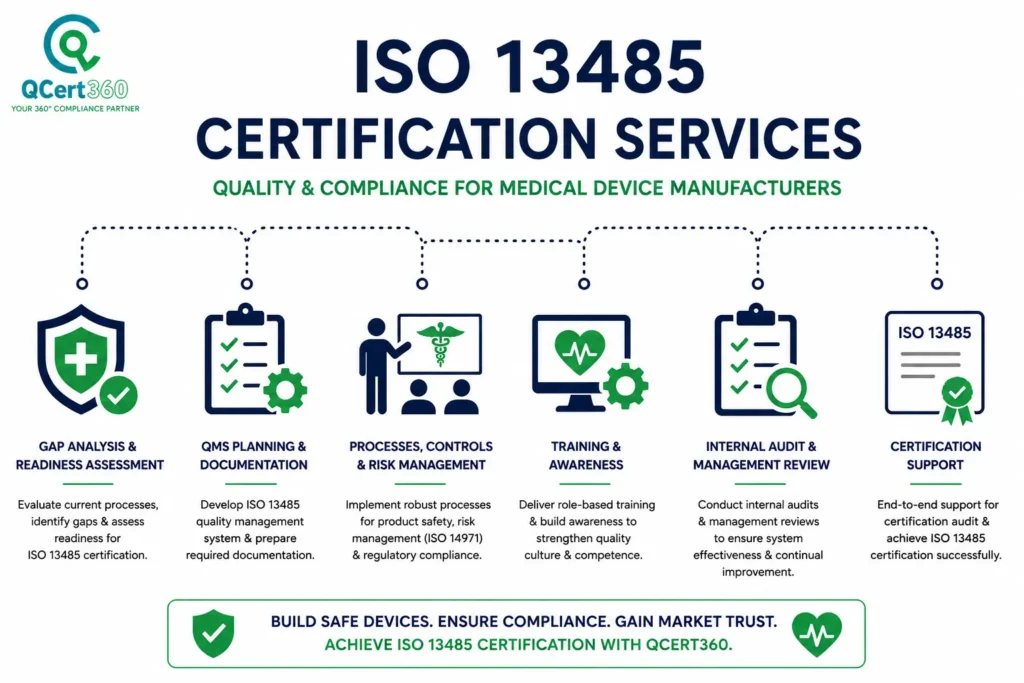
ISO 13485 Certification Process for Medical Device Manufacturers in Ghana
How to implement ISO 13485 for medical device manufacturers in Ghana follows this structured process. QCert360’s ISO 13485 implementation consultant for medical device manufacturers in Ghana manages every stage — from gap analysis through ISO 13485 audit requirements for medical device manufacturers in Ghana and certification audit coordination.
Step 1 — Gap Analysis
A qualified ISO 13485 consultant assesses your current quality management practices against the full ISO 13485 requirements. The gap analysis identifies what you have in place, what needs to be built, and what the implementation scope requires. This is the foundation for your implementation plan and cost estimate.
Step 2 — QMS Scope and Regulatory Requirements Identification
Define the certification scope — which medical devices, manufacturing processes, and facilities are included. Identify all applicable regulatory requirements for your target markets. For manufacturers pursuing CE marking or EU MDR compliance, this step includes mapping ISO 13485 requirements to EU MDR obligations.
Step 3 — Risk Management System Development
Develop or enhance your risk management process aligned to ISO 14971. Conduct product-level risk analyses for all in-scope devices, documenting hazard identification, risk estimation, risk evaluation, and risk control measures.
Step 4 — QMS Documentation Development
Build the complete ISO 13485 documentation set — quality manual, procedures, work instructions, forms, and record templates. ISO 13485 documentation for medical device manufacturers in Ghana must be comprehensive, controlled, and reflect actual manufacturing and quality processes.
Step 5 — Implementation
Roll out the QMS across your manufacturing operations. Train all relevant staff — production operators, quality assurance personnel, procurement staff, and management. Begin generating controlled records — production batch records, calibration records, non-conformance records, and CAPA records.
Step 6 — ISO 13485 Audit Preparation for Medical Device Manufacturers in Ghana
Conduct a pre-certification readiness assessment confirming all documentation is complete, all processes are operational and evidenced, and all staff are trained and competent. QCert360 conducts comprehensive ISO 13485 audit preparation for medical device manufacturers in Ghana before engaging the certification body.
Step 7 — Internal Audit
Complete a full internal audit of the implemented QMS against ISO 13485 requirements. Identify and resolve all non-conformities before the formal certification audit.
Step 8 — Management Review
Senior management formally reviews QMS performance — audit results, complaint data, CAPA status, quality objectives achievement, and resource adequacy.
Step 9 — Stage 1 Certification Audit
The accredited certification body reviews your QMS documentation, confirming the system is complete and ready for the on-site Stage 2 assessment.
Step 10 — Stage 2 Certification Audit
The certification body conducts an on-site assessment of your manufacturing facility, interviewing staff, reviewing records, and verifying that the documented QMS is genuinely implemented and effective.
Step 11 — ISO 13485 Certificate Issuance and Registration
Your ISO 13485 certificate is issued and registered — publicly verifiable by buyers, regulators, and market access authorities. ISO 13485 registration for medical device manufacturers in Ghana completes the process.
How Long Does It Take to Get ISO 13485 Certification for Medical Device Manufacturers in Ghana?
For most medical device manufacturers, the realistic timeline is 3 to 6 months from initial gap analysis through to certificate issuance.
ISO 13485 takes longer to implement than general quality management standards because of the depth of documentation required, the complexity of risk management processes, the need for validation records for key manufacturing and sterilisation processes, and the stricter audit expectations of medical device certification bodies.
Factors that affect the timeline:
- Medical device complexity — A single-product manufacturer of a simple device type certifies faster than a multi-product manufacturer covering Class II or Class III devices
- Existing QMS maturity — Manufacturers with existing ISO 9001 certification, documented procedures, or prior quality system experience move significantly faster
- Design activities — Manufacturers performing their own medical device design and development face additional documentation requirements that extend the timeline
- Sterilisation — Products requiring sterilisation validation add significant time due to the validation studies required
- Target markets — Manufacturers pursuing CE marking or EU MDR compliance alongside ISO 13485 certification face additional regulatory alignment requirements
- Certification body scheduling — Medical device certification audits are more specialised and may require longer scheduling lead times
For small manufacturers and startups: ISO 13485 certification for small medical device manufacturers and startups in Ghana can be achieved within the lower end of this range — 3 to 6 months — for simple device types with focused scope and dedicated consultant support.
ISO 13485 Certification Cost for Medical Device Manufacturers in Ghana
ISO 13485 certification cost for medical device manufacturers in Ghana varies based on the scope and complexity of the QMS, the number and type of medical devices in scope, the current state of existing quality documentation, the regulatory requirements of target markets, and the certification body engaged.
Key cost factors:
- Device complexity and risk class — Higher-risk devices (Class II and III) have more extensive documentation, validation, and audit requirements, increasing both consulting and certification body costs
- Number of device types — Certifying a portfolio of multiple device types requires more extensive risk management and design documentation than a single-device scope
- Existing QMS documentation — Manufacturers with existing documented procedures, batch records, and quality system elements require less documentation development, reducing consulting costs
- Design and development inclusion — Including design and development activities in the certification scope adds significant documentation requirements
- Sterilisation — Sterile device validation studies and process controls add cost and time
- Target market regulatory alignment — Aligning ISO 13485 implementation with EU MDR or other market-specific regulatory requirements adds scope and cost
- Certification body fees — Medical device certification body fees are typically higher than general ISO certification fees, reflecting the specialised medical device auditor expertise required
QCert360 provides transparent, fully scoped pricing for ISO 13485 certification for medical device manufacturers in Ghana. You receive a detailed cost breakdown before any engagement begins.
Contact QCert360 for a free ISO 13485 certification cost estimate tailored to your medical device manufacturing business.
ISO 13485 and CE Marking / EU MDR
For Ghana medical device manufacturers targeting European markets, ISO 13485 and CE marking are directly linked. CE marking — the conformity marking required for medical devices sold in the European Economic Area — requires manufacturers to operate a Quality Management System compliant with the EU MDR. ISO 13485 certification is the primary mechanism for demonstrating EU MDR QMS compliance.
ISO 13485 and EU MDR alignment means Ghana manufacturers pursuing European market access need to ensure their QMS meets both the ISO 13485 standard requirements and the additional QMS requirements specified in the EU MDR. QCert360 implements ISO 13485 QMS systems for Ghana medical device manufacturers with explicit EU MDR alignment, supporting both ISO 13485 certification and the CE marking application process.
Medical device CE marking, combined with ISO 13485 certification, provides Ghana manufacturers with the credentials needed to supply medical devices into European hospitals, distributors, and healthcare procurement networks.
ISO 14971 for medical device manufacturers in Ghana is the international standard for medical device risk management. It is directly referenced within ISO 13485 and provides the systematic framework for identifying hazards associated with medical devices, estimating and evaluating risks, implementing risk controls, and monitoring risk management effectiveness throughout the device lifecycle.
A robust, ISO 14971-compliant risk management process is one of the most technically demanding elements of ISO 13485 implementation — and one of the areas where experienced medical device QMS consultants add the most value. QCert360’s ISO 13485 implementation services include complete ISO 14971 risk management process development for all in-scope medical devices.
ISO 13485 Certification Renewal for Medical Device Manufacturers in Ghana
ISO 13485 certification renewal for medical device manufacturers in Ghana follows the same three-year certificate cycle as other ISO management standards:
- Annual surveillance audits — Conducted in Years 2 and 3 to confirm continued QMS effectiveness and compliance
- Three-year recertification — Full QMS reassessment at the end of each three-year cycle to renew the certificate
- Continual improvement — Demonstrated QMS improvement through CAPA, updated risk assessments, and objective achievement
During the certificate cycle, medical device manufacturers must maintain QMS records, conduct internal audits, manage CAPAs, handle complaints, report adverse events, and keep regulatory requirements registers updated. QCert360 provides ongoing ISO 13485 compliance support to help manufacturers maintain certification readiness between surveillance audits.
Why Choose QCert360 for ISO 13485 Consulting for Medical Device Manufacturers in Ghana?
QCert360 provides specialist ISO 13485 implementation services for medical device manufacturers in Ghana — combining medical device QMS expertise, risk management technical depth, and accredited certification body relationships to deliver ISO 13485 certification efficiently and with direct commercial value.
Why Ghana medical device manufacturers choose QCert360:
- Medical device sector expertise — Deep understanding of medical device manufacturing processes, risk management requirements, regulatory compliance obligations, and the specific documentation standards that medical device certification auditors assess
- ISO 13485 consultants for medical device manufacturers in Ghana — Qualified QMS consultants with direct medical device ISO 13485 implementation experience — not generalists adapting manufacturing templates for medical device use
- End-to-end implementation consulting — Gap analysis, QMS documentation development, risk management system implementation, staff training, internal audit, ISO 13485 audit preparation, and certification body coordination — all under one engagement
- ISO 14971 risk management expertise — Complete ISO 14971-compliant risk management process development for all in-scope medical device types
- EU MDR alignment capability — For manufacturers targeting European markets, QCert360 aligns ISO 13485 implementation with EU MDR QMS requirements, supporting both certification and CE marking
- ISO 13485 certification body for medical device manufacturers in Ghana — QCert360 partners with multiple internationally accredited certification bodies with specific medical device certification expertise, ensuring your ISO 13485 certificate is recognised by global markets and buyers
- ISO 13485 accreditation for medical device manufacturers in Ghana — All certification is through properly accredited bodies — ensuring certificates are recognised by medical device market access authorities, procurement bodies, and international buyers
- Small manufacturer and startup focus — QCert360 offers ISO 13485 implementation programmes specifically structured for small medical device manufacturers and startups in Ghana, with proportionate scope, documentation, and cost
Contact QCert360 today for a free consultation on ISO 13485 certification for your medical device manufacturing business in Ghana.
Reach out now and let QCert360 build your Medical Device Quality Management System.
Benefits of ISO 13485 Certification for Medical Device Manufacturers in Ghana
The benefits of ISO 13485 certification for medical device manufacturers in Ghana go well beyond market access compliance:
- International market access — ISO 13485 opens doors to European, American, Middle Eastern, and Asian medical device markets that require certified QMS as a market entry condition
- CE marking pathway — ISO 13485 certification is a prerequisite for CE marking, unlocking European market access for Ghana-manufactured medical devices
- Procurement qualification — Hospital networks, NGO medical buyers, and government health procurement bodies require ISO 13485 certification from medical device suppliers
- Patient safety — A rigorously implemented medical device QMS systematically identifies and eliminates the process failures and design weaknesses that lead to device failures and patient harm
- Reduced liability — Documented QMS evidence of controlled, compliant manufacturing processes reduces manufacturer liability exposure in the event of a product quality issue
- Operational improvement — The medical device QMS framework drives systematic improvement in production consistency, complaint rates, and non-conformance reduction
- Investor and partner confidence — ISO 13485 certification signals manufacturing maturity to medical device investors and development partners
Get Medical device manufacturers ISO 13485 Certified in Ghana with QCert360
Medical device manufacturing demands the highest level of quality management discipline of any industry. The patients who depend on your devices deserve no less. ISO 13485 certification gives your manufacturing business the internationally recognised Quality Management System that proves your commitment to quality, safety, and continuous improvement — and that opens the global medical device markets your business is ready to serve.
QCert360 has the medical device sector expertise, the ISO 13485 technical depth, the ISO 14971 risk management capability, and the accredited certification body relationships to guide your medical device manufacturing business through ISO 13485 certification efficiently, credibly, and with direct commercial return.
Contact QCert360 today: If you’re wondering how to get ISO 13485 certification for medical device business in Ghana, start with a free consultation. Our medical device QMS consultants can assess your current system, explain the requirements, and provide a clear implementation timeline and cost estimate.
Don’t let missing medical device certification close the doors to the markets your devices are ready for. Let QCert360 get your medical device manufacturing business ISO 13485 certified.
Frequently Asked Questions (FAQs)
- Why is ISO 13485 certification important for medical device manufacturers in Ghana?
ISO 13485 certification for medical device manufacturers in Ghana helps demonstrate that your quality management system meets international medical device quality requirements. - What are the ISO 13485 requirements for medical device manufacturers in Ghana?
Key ISO 13485 requirements include quality management, risk management, traceability, design controls, supplier control, CAPA, complaint handling, and regulatory compliance. - How does ISO 13485 implementation help medical device manufacturers in Ghana?
ISO 13485 implementation helps establish controlled processes, improve product quality, manage risks, and prepare the organisation for certification audits. - What does ISO 13485 consulting for medical device manufacturers in Ghana include?
ISO 13485 consulting typically includes gap assessment, QMS documentation, risk management support, employee training, implementation guidance, and audit preparation. - What is involved in an ISO 13485 audit process for medical device manufacturers in Ghana?
An ISO 13485 audit reviews your QMS, manufacturing processes, documentation, risk controls, records, and compliance with applicable requirements. - How can ISO 13485 compliance benefit medical device manufacturers in Ghana?
ISO 13485 compliance improves process control, product quality, traceability, risk management, and confidence among customers and regulatory stakeholders. - What is MDQMS certification for medical device manufacturers in Ghana?
MDQMS certification refers to certification of a Medical Device Quality Management System, commonly based on ISO 13485 requirements. - Can ISO 13485 certification support medical device exports from Ghana?
Yes. ISO 13485 certification can strengthen your quality credentials and support access to international markets, subject to applicable regulatory and market requirements. - How much does ISO 13485 implementation cost for medical device manufacturers in Ghana?
The cost depends on company size, device complexity, scope, QMS maturity, and certification audit requirements. A gap assessment can help determine the expected cost. - Can QCert360 provide ISO 13485 certification consulting support for medical device manufacturers in Ghana?
Yes. QCert360 provides ISO 13485 implementation and consulting support for medical device manufacturers in Ghana, including QMS development, training, and audit preparation. - How to choose an ISO 13485 consulting company in Ghana
Choose an ISO 13485 consulting company in Ghana based on its medical device QMS experience, ISO 14971 expertise, implementation experience, audit preparation capability, and certification track record.
Our Services
ISO Standards
- ISO 9001 Certification
- ISO 14001 Certification
- ISO 45001 Certification
- ISO 22000 Certification
- ISO 17025 Certification
- ISO 27001 Certification
- ISO 13485 Certification
- ISO 20000-1 Certification
- ISO 41001 Certification
- ISO 22716 Certification
- ISO 50001 Certification
- ISO 22301 Certification
- ISO 29993 Certification
Product Certifications
Other international standards
- FSSC 22000 Certification
- HIPAA
- HACCP Certification
- SA 8000 Certification
- GMP Certification
- GDPR
- GDP Certification
- GLP Certification
- Certificate of Conformity