
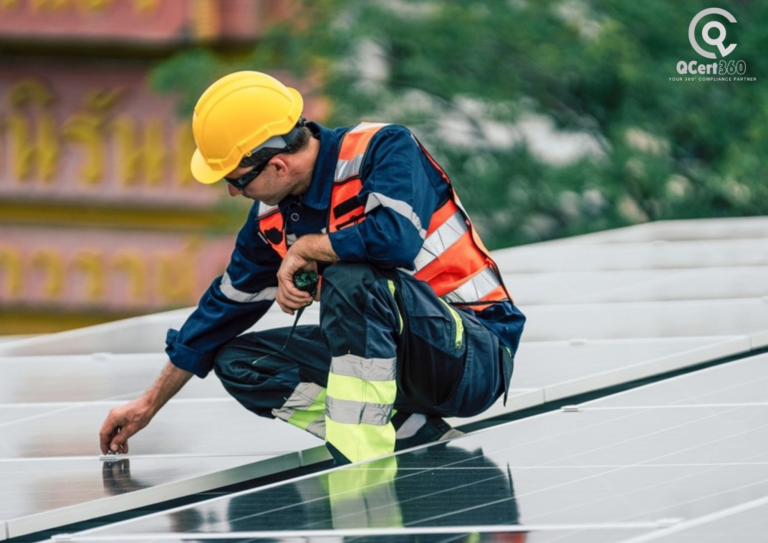
If you’re in the business of building solar panels, inverters, or full photovoltaic systems, you already know the competition is fierce. Utilities and EPC (Engineering, Procurement, and Construction) contractors have hundreds of suppliers to choose from, but they don’t take chances. They want partners who can prove, not just claim, that their products meet the highest energy performance and compliance standards.
That’s where ISO 50001 certification for solar manufacturers and CE Marking solar equipment compliance come in. Together, these two certifications can open the door to multi-million-dollar contracts—and keep you ahead in a market that rewards trust and technical proof.
Let’s break down how each works, why they matter, and how combining them could become your most powerful sales tool.
Why Utilities and EPCs Care About ISO 50001 & CE Marking Certifications
When a utility or EPC contractor is evaluating suppliers, price is only one factor. They’re also looking at:
- Proven quality and compliance
- Energy efficiency performance
- Risk of delays from failed inspections or rework
- Ability to meet regional and international market requirements
If your solar manufacturing business can demonstrate energy management ISO 50001 for solar production and CE compliance for solar panel makers, you’re essentially saying, “We don’t just meet the standards—we build them into our DNA.” That message carries weight with procurement teams who are accountable for performance and regulatory adherence.
Part 1: Understanding ISO 50001 for Solar Manufacturers
ISO 50001 is the global standard for energy management systems (EnMS). For a solar manufacturer, it’s more than a nice badge—it’s proof that you have a structured, measurable approach to reducing energy consumption, cutting costs, and improving sustainability in production.
What It Means for Your Factory
Whether you produce PV modules, solar inverters, or mounting systems, an ISO 50001 solar factory certification process involves:
- Monitoring and analysing your plant’s energy usage
- Identifying and acting on efficiency improvements
- Training staff to follow energy-saving best practices
- Continuously improving your energy performance
This can lead to reduced production costs, better margins, and a greener brand image—all attractive to clients.
Benefits Beyond Compliance
Here’s the thing—many solar manufacturers see ISO 50001 training for solar manufacturing as an operational cost. In reality, it’s a sales asset. Being able to show an EPC partner your documented energy performance improvements can be the deciding factor in beating a competitor’s bid.
For example, one PV module plant reduced energy consumption per unit by 12% after ISO 50001 implementation for PV module production. That improvement not only lowered operating costs but also strengthened their sustainability credentials in bids.
Part 2: CE Marking for Solar Equipment
While ISO 50001 is about how you run your factory, CE Marking is about proving that the products coming out of it are safe, reliable, and compliant with EU regulatory requirements. Even if you’re not directly targeting the EU, many buyers worldwide see CE as a benchmark for quality.
What CE Marking Covers for Solar Products
For solar manufacturers, getting a CE Mark for photovoltaic modules or related components typically involves compliance with:
- Electrical safety standards
- EMC (Electromagnetic Compatibility)
- Environmental directives such as RoHS
- Specific product performance and durability tests
If you manufacture inverters, understanding CE Marking requirements for solar inverters is crucial, as these devices must pass stringent safety and electromagnetic interference tests before approval.
The CE Documentation Process
To apply CE Mark to a solar assembly line, you need:
- A complete technical file with design, testing, and quality control records
- Product test reports from accredited laboratories
- A declaration of conformity signed by an authorized person in your company
Working with an expert partner like Qcert360 can help you avoid common pitfalls in CE Mark documentation for solar components—from incomplete testing scopes to outdated harmonized standards.
Part 3: The Power of Dual Certification
Individually, ISO 50001 and CE Marking each bring strong benefits. Together, they create a trust package that speaks directly to what utilities and EPCs want:
- Proof of efficient, sustainable manufacturing (ISO 50001)
- Proof of product safety and compliance (CE Marking)
When a buyer sees you’ve invested in both, they know you’re not just chasing minimum requirements—you’re building for long-term quality and performance.
Case Example: Closing the Deal with Dual Certification
A mid-sized solar panel manufacturer competing for a 50 MW utility project had solid pricing but was up against two larger players. They’d recently completed energy management ISO 50001 for solar production and updated all products to meet CE compliance for solar panel makers.
During the technical evaluation, they highlighted:
- A documented 10% reduction in factory energy consumption
- CE Mark certification covering their PV modules and inverters
- A streamlined process for getting CE Mark for photovoltaic modules in future product lines
The result? They won the contract—not because they were the cheapest, but because their certifications reduced the buyer’s risk.
Part 4: How to Get Started
Step 1: Gap Assessment
Review your current energy management practices and product compliance processes. Identify what’s already in place and where the gaps are.
Step 2: Plan ISO 50001 Implementation
Map out your ISO 50001 solar factory certification process. This will include baseline energy data collection, staff training, and process optimization.
Step 3: Prepare for CE Marking
Gather existing product test reports, then align them with CE Marking requirements for solar inverters and PV modules. If reports are missing or outdated, schedule accredited testing.
Step 4: Integrate Both
Where possible, run the two projects in parallel. For instance, equipment upgrades to improve energy efficiency under ISO 50001 can also be selected to meet CE compliance requirements.
Part 5: Why Work with an Expert Partner
While it’s possible to navigate these certifications internally, the complexity of both processes means many manufacturers lose time or money through trial and error. A partner like Qcert360 can:
- Conduct a readiness audit
- Guide ISO 50001 implementation for PV module production
- Manage CE Mark documentation for solar components
- Ensure testing and audits are completed on schedule
The faster you complete the certifications, the sooner you can start using them in bids.
The Bottom Line
In the solar manufacturing world, contracts are won by more than just competitive pricing. They’re secured by proving you can deliver quality, efficiency, and compliance—consistently. ISO 50001 certification for solar manufacturers shows you run a tight, sustainable operation. CE Marking solar equipment compliance proves your products are ready for global markets.
Put them together, and you have a business case that’s hard for utilities and EPCs to ignore.
Qcert360’s Expertise in ISO 50001 and CE Marking for Solar Manufacturers
At Qcert360, we’ve worked with solar manufacturers of all sizes—from emerging PV startups to large-scale panel and inverter factories—helping them navigate ISO 50001 certification for solar manufacturers and CE Marking solar equipment compliance without costly delays.
Our strength lies in combining technical compliance expertise with a market-entry mindset. We don’t just tick certification boxes; we position your business so that certifications actively strengthen your bids for utility and EPC projects.
Here’s what sets us apart:
- End-to-end project management – from gap assessments to final audits.
- Integrated approach – running ISO 50001 solar factory certification process and CE compliance in parallel to save time.
- Global test lab network – ensuring your CE Mark documentation for solar components meets all current standards.
- Industry-specific know-how – understanding the technical, procurement, and regulatory nuances of solar manufacturing.
With Qcert360, you get more than certification—you get a competitive advantage built into every step.
Case Study: How a Mid-Tier Solar Manufacturer Secured a Major Utility Contract with Qcert360
The Challenge:
A mid-tier solar module manufacturer was competing for a 75 MW EPC project. While their pricing was competitive, they lacked formal energy management certification and their CE Marking was incomplete for new inverter models. Procurement teams flagged these gaps as potential risks, putting the contract in jeopardy.
Our Approach:
Qcert360 carried out a rapid gap assessment to identify missing requirements for both ISO 50001 implementation for PV module production and CE Marking requirements for solar inverters.
- We initiated a fast-track ISO 50001 training for solar manufacturing program, enabling process improvements that reduced factory energy use by 9% in under six months.
- Simultaneously, we coordinated accredited testing to secure getting CE Mark for photovoltaic modules and inverters, completing the CE Mark documentation for solar components ahead of the bid deadline.
The Outcome:
The manufacturer submitted their tender with dual certification in place, supported by hard data on energy efficiency improvements and compliance. This significantly boosted their technical score and reduced perceived procurement risk.
Result: They won the EPC contract, expanding their annual revenue by 27% and establishing a stronger market position for future bids.
Call to Action:
If you’re ready to strengthen your bids and win higher-value contracts, Qcert360 can guide you through both ISO 50001 and CE Marking from start to finish. Contact us today to discuss your project and certification roadmap.
FAQs
- What is ISO 50001 certification for solar manufacturers?
ISO 50001 is the international standard for energy management systems. For solar manufacturers, it proves you have a structured approach to monitoring and improving energy efficiency in your production processes. - How does ISO 50001 benefit a solar manufacturing business?
It reduces production costs, improves sustainability performance, and strengthens your credibility in tenders by showing measurable energy efficiency improvements. - What is CE Marking for solar equipment?
CE Marking is proof that your solar products—such as PV modules, inverters, and components—comply with safety, performance, and environmental standards required in many markets. - Do I need both ISO 50001 and CE compliance for solar panel makers?
While not always legally required together, having both certifications demonstrates you meet high operational and product quality standards, which can give you a competitive edge in utility and EPC bids. - What is the process for getting a CE Mark for photovoltaic modules?
You’ll need to test your product against relevant standards, compile technical documentation, and issue a declaration of conformity before applying the CE Mark. - How long does the ISO 50001 solar factory certification process take?
Depending on your readiness, it typically takes 6–12 months, including energy audits, staff training, and process adjustments. - What are CE Marking requirements for solar inverters?
Inverters must pass electrical safety tests, electromagnetic compatibility (EMC) assessments, and meet environmental directives like RoHS. - Can ISO 50001 and CE Marking be implemented together?
Yes. Running them in parallel can save time, as some process improvements for ISO 50001 can also support CE compliance documentation. - What is included in CE Mark documentation for solar components?
It includes design files, test reports, quality control records, and a declaration of conformity, all kept in a technical file. - Why work with a certification partner like Qcert360?
Qcert360 manages the full journey—from gap assessments to final audits—ensuring you achieve both certifications efficiently and in a way that strengthens your market position.