
ISO 27001 Implementation Services in Estonia – Get End-to-End ISMS Implementation Support with Qcert360
ISO 27001 Implementation Services in Estonia – Expert Consultants for ISMS Implementation & Certification
Every business in Estonia that handles sensitive data — customer records, financial information, employee data, health records, or intellectual property — carries information security risk. The question is not whether your business faces cyber threats. It is whether your business has a structured, documented, and independently verified system for managing them.
ISO 27001 implementation in Estonia is how you build that system.
ISO 27001 is the international standard for Information Security Management Systems (ISMS). Implementing it means systematically identifying your information security risks, putting controls in place to manage them, and creating the documented management framework that keeps your information assets protected — and keeps that protection verifiable by clients, government buyers, and international partners.
This guide covers everything Estonia businesses need to know about ISO 27001 ISMS implementation in Estonia — what it involves, who needs it, how the process works including the ISO 27001 implementation steps in Estonia, how long it takes, what it costs, and how to choose the right consultant to guide you through it.
What is ISO 27001 Implementation in Estonia?
ISO 27001 implementation is the process of building, documenting, and rolling out an Information Security Management System (ISMS) that meets the requirements of ISO/IEC 27001. It provides a structured framework for managing an organisation’s information security programme, including risk assessment, security controls, policies, employee responsibilities, incident management, continual improvement and ISMS operationalisation.
A fully implemented ISO 27001 ISMS covers:
- How your organisation identifies and classifies its information assets
- How information security risks are assessed and treated
- Which security controls are applied and why
- How staff are trained and made aware of their security responsibilities
- How security incidents are detected, reported, and resolved
- How the system is internally audited and reviewed by senior management
- How continuous improvement is demonstrated over time
ISO 27001 implementation and certification in Estonia go hand in hand — implementation is what you do to get your ISMS ready; certification is the independent audit that confirms it meets the standard. You cannot achieve ISO 27001 certification without first completing a thorough implementation.
What Type of Companies Need to Implement ISO 27001 in Estonia?
Any business that handles sensitive data, provides IT or digital services, or wants to demonstrate information security credibility to clients and buyers benefits from ISO 27001 implementation. The standard is particularly critical for:
IT Companies and Software Developers
ISO 27001 implementation for IT companies in Estonia demonstrates to corporate and government clients that information security is embedded in how you develop, deploy, and support technology — not bolted on as an afterthought. Government ICT tenders and large enterprise contracts increasingly specify ISO 27001 as a mandatory supplier requirement.
Software and SaaS Companies
ISO 27001 implementation for software companies in Estonia and ISO 27001 implementation for SaaS companies in Estonia addresses the information security expectations of enterprise clients who share sensitive business data with your platform. SaaS businesses need to demonstrate that client data is protected across multi-tenant environments, access controls are robust, and data breaches are managed and disclosed appropriately.
FinTech Companies
ISO 27001 implementation for FinTech companies in Estonia is increasingly a baseline requirement from banking partners, payment processors, and institutional investors. FinTech businesses handle high volumes of personally identifiable financial data — and the security management expectations from clients, regulators, and investors reflect that sensitivity.
Healthcare Organisations
ISO 27001 implementation for healthcare companies in Estonia addresses the heightened information security requirements of patient data management, electronic health records, telemedicine platforms, and health insurance data processing. Healthcare information security failures carry severe reputational and patient safety consequences.
Financial Services
ISO 27001 implementation for financial services in Estonia covers banks, insurance companies, microfinance institutions, investment firms, and payment service providers whose client data management obligations demand internationally recognised security management credentials.
Cloud Service Providers
ISO 27001 implementation for cloud service providers in Estonia demonstrates that hosted environments, data storage infrastructure, and cloud platforms are managed with robust information security controls — a critical requirement for enterprise and government cloud clients.
AI Companies
How can AI companies implement ISO 27001 in Estonia? AI businesses handling training data, model outputs, and client data integration need to demonstrate that their data governance, access controls, and model security practices meet internationally recognised standards. ISO 27001 provides the management system framework for AI companies to govern information security across data pipelines, development environments, and deployed AI systems.
ISO 27001 Implementation Requirements in Estonia
The standard’s requirements apply consistently regardless of geography — ISO 27001 is an international standard. Here are the core requirements your ISMS must satisfy:
Leadership commitment — Senior management must define an information security policy, assign roles and responsibilities, and demonstrate active ownership of the ISMS. ISO 27001 is not a technical team’s project — it requires visible boardroom-level commitment.
ISMS scope definition — You must clearly define what the ISMS covers: which systems, locations, processes, information types, and business units fall within the certification boundary.
Context and stakeholder analysis — Identify internal and external factors that affect information security. Understand what your clients, partners, and other stakeholders expect from your information security management.
ISO 27001 Implementation Risk Assessment in Estonia — Conduct a formal information security risk assessment identifying threats (hacking, insider threats, physical breaches, system failures), vulnerabilities (weak access controls, unpatched systems, poor staff practices), and their potential impact on your business. This is the technical core of ISO 27001 implementation.
Risk treatment plan — For each identified risk, decide how to treat it: implement controls to reduce it, accept it, transfer it (through insurance or contracts), or avoid it. Document these decisions in a risk treatment plan.
Statement of Applicability (SoA) — List all 93 controls in ISO 27001 Annex A and document which controls you have implemented, which you have excluded, and why. The SoA is a critical audit document.
Control implementation — Implement the selected security controls across technical, organisational, physical, and people security domains. This includes access management, encryption, network security, logging, vulnerability management, supplier security, business continuity, and incident response.
Training and awareness — All staff must receive information security awareness training relevant to their roles. The ISMS is only as strong as the humans who operate within it.
Internal audit — Conduct planned internal audits to verify the ISMS is functioning as documented and meeting ISO 27001 requirements.
Management review — Senior management formally reviews ISMS performance at planned intervals, assessing audit results, security incidents, objective achievement, and improvement priorities.
Continual improvement — Demonstrate ongoing ISMS improvement through corrective actions, updated risk assessments, and evolving security controls.
What is the ISO 27001 Implementation Process in Estonia?
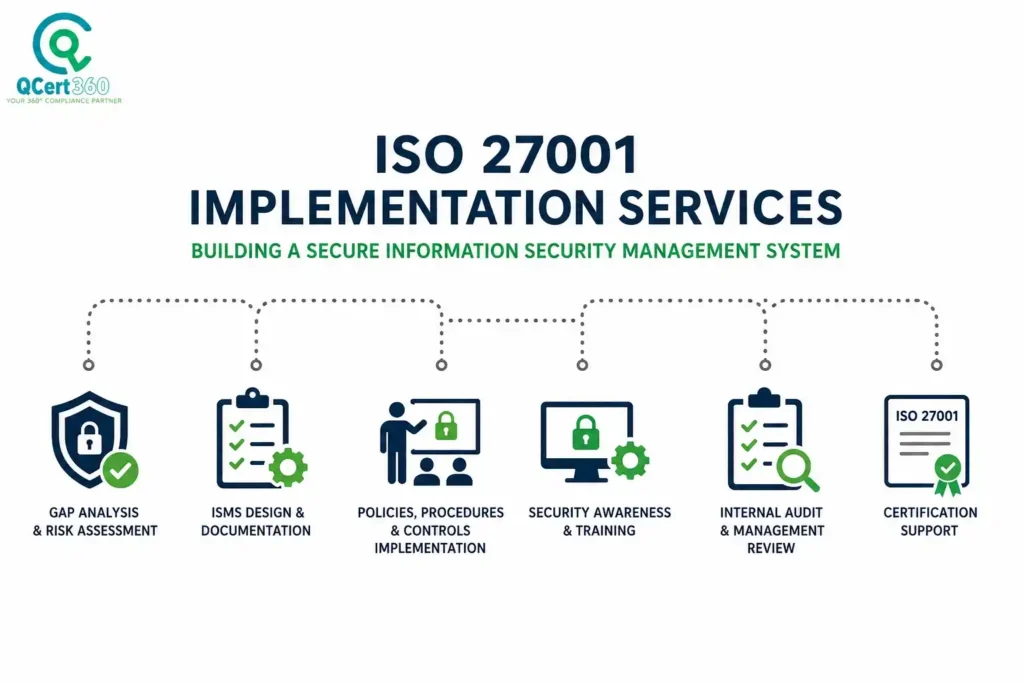
Implementation follows a structured pathway from initial assessment through to a fully operational ISMS ready for certification. Here is the step-by-step ISO 27001 implementation roadmap in Estonia that QCert360 follows with clients:
Step 1 — ISO 27001 Implementation Gap Analysis in Estonia
What is an ISO 27001 gap analysis in Estonia? A gap analysis is a structured assessment of your current information security practices against ISO 27001 requirements. It identifies what you already have in place, what is partially in place, and what is missing entirely. The gap analysis produces a prioritised remediation plan and forms the foundation for your implementation timeline and cost estimate.
A gap analysis is a practical starting point for ISO 27001 implementation because it identifies existing controls, gaps, priorities, and resources needed to build the ISMS.
Step 2 — ISO 27001 Implementation Readiness Assessment in Estonia
An ISO 27001 implementation readiness assessment in Estonia goes a step further than the gap analysis — assessing your organisation’s readiness to implement an ISMS. This includes evaluating management commitment, available internal resources, staff security awareness baseline, existing IT infrastructure and controls, and your organisation’s capacity to sustain the implementation programme alongside normal business operations.
Step 3 — ISMS Scope and Context Definition
Define precisely what your ISMS covers. For most Estonia businesses, this means identifying which systems, data types, physical locations, and business processes are within scope. Scope definition is a strategic decision — it affects the complexity of the implementation, the audit duration, and the commercial value of the resulting certificate.
Step 4 — ISO 27001 Implementation Risk Assessment in Estonia
What is an ISO 27001 risk assessment in Estonia? It is the formal process of identifying all information assets within the ISMS scope, identifying the threats and vulnerabilities that could compromise those assets, assessing the likelihood and impact of each risk, and deciding how each risk will be treated.
The risk assessment is the technical centrepiece of ISO 27001. It must be documented using a consistent methodology and updated whenever significant changes occur to your information environment or threat landscape.
Step 5 — Risk Treatment and Statement of Applicability
Develop the risk treatment plan — documenting how each identified risk will be controlled. Select controls from ISO 27001 Annex A and from any other sources appropriate to your risk environment. Compile the Statement of Applicability documenting all 93 Annex A controls with inclusion/exclusion justification for each.
Step 6 — ISO 27001 Implementation Documentation Services in Estonia
ISO 27001 requires a substantial set of documented information. This is where ISO 27001 implementation documentation services in Estonia add the most consultant value — building a complete, audit-ready document set that reflects your actual operations rather than generic templates.
What documents are required for ISO 27001 implementation in Estonia? The core set includes:
- Information security policy
- ISMS scope statement
- Risk assessment methodology document
- Risk register and risk assessment records
- Risk treatment plan
- Statement of Applicability
- Information security objectives
- Asset inventory
- Roles and responsibilities documentation
- Operational security procedures — access management, change management, incident response, business continuity, supplier security, patch management, backup management
- Training and awareness records
- Internal audit programme and audit records
- Management review records
- Incident and corrective action records
QCert360 develops all required documentation for clients using sector-specific templates tailored to each business’s technology environment, team structure, and client profile.
Step 7 — Security Controls Implementation
Implement the selected security controls across your organisation. This is the operational phase of ISO 27001 implementation — putting actual security measures in place, not just documenting plans for them. Controls cover technical security (access management, encryption, network security, logging, vulnerability scanning), organisational security (policies, supplier agreements, staff vetting), physical security (server room access, clean desk, visitor management), and people security (staff training, background checks, security responsibilities).
Step 8 — ISO 27001 Implementation Plan in Estonia
A detailed ISO 27001 implementation plan in Estonia documents all implementation activities, responsible owners, timelines, and milestones. The implementation plan ensures the programme stays on track, resources are allocated efficiently, and nothing falls through the gaps between technical and organisational workstreams. QCert360 builds and manages the implementation plan for every client engagement.
Step 9 — Staff Training and Security Awareness
All relevant staff complete security awareness training covering phishing, password management, data handling, incident reporting, physical security, and their specific ISMS responsibilities. Training records are maintained as documented ISMS evidence.
Step 10 — Internal Audit
A structured internal audit assesses the implemented ISMS against ISO 27001 requirements. Non-conformities are identified and corrected before the formal certification audit. This is the final quality gate before engaging the certification body.
Step 11 — Management Review
Senior management formally reviews ISMS performance — audit results, security incidents, risk treatment status, objective achievement, and resource adequacy. The management review record is a critical certification audit document.
Step 12 — ISO 27001 Implementation Audit Preparation in Estonia
ISO 27001 implementation audit preparation in Estonia is the final pre-certification phase — confirming that all documentation is complete, all controls are operational and evidenced, all staff have completed required training, and the ISMS is ready for the certification body’s Stage 1 and Stage 2 audits. QCert360 conducts a comprehensive pre-certification readiness review for every client before the formal certification audit is scheduled.
ISO 27001 Implementation Timeline in Estonia
The ISO 27001 implementation timeline in Estonia for most organisations ranges from 2 to 4 months from initial gap analysis through to a certification-ready ISMS, depending on organisational size, technical complexity, existing security maturity, and the number of staff involved.
Factors that affect the ISO 27001 implementation timeline:
- Existing security controls and documentation — Organisations with existing security policies, IT procedures, and access management systems move significantly faster than those starting from scratch
- Organisational size and complexity — A 20-person software company implements faster than a 500-person financial services business with multiple systems, offices, and client environments
- ISMS scope — Narrow, focused scopes certify faster than broad, organisation-wide implementations
- Management availability — ISO 27001 requires senior management input at multiple stages; delayed decisions slow the programme
- Staff engagement — Implementation pace depends on how quickly staff complete training and adopt new security procedures
- Internal resource availability — Dedicated internal security champions accelerate implementation compared to relying entirely on consultant resources
For small businesses: ISO 27001 implementation for small businesses in Estonia can be achieved in as little as 10 to 14 weeks for focused-scope implementations with a committed internal champion and dedicated consultant support.
Benefits of ISO 27001 Implementation in Estonia
- Customer trust: Demonstrates that your organisation manages sensitive information through a structured and recognised security framework.
- Supplier qualification: Helps businesses meet information security expectations when qualifying as a supplier or service provider.
- Enterprise procurement: Supports procurement requirements from large organisations that expect formal information security management.
- Contract requirements: Helps meet contractual security requirements from customers, partners, and business clients.
- Security assurance: Provides a structured approach to managing information security risks, controls, incidents, and responsibilities.
- Third-party risk management: Helps organisations identify and manage information security risks associated with suppliers and external service providers.
- Business resilience: Strengthens preparedness for security incidents and disruptions by establishing defined processes and responsibilities.
- Information asset protection: Helps protect sensitive business information through risk-based controls, access management, monitoring, and security procedures.
- Competitive differentiation: Demonstrates a stronger information security commitment and can help distinguish your organisation from competitors.
- International client requirements: Helps businesses showcase recognised information security practices when working with international customers and partners.
ISO 27001 Implementation Cost in Estonia
How much does ISO 27001 implementation cost in Estonia? ISO 27001 implementation cost in Estonia varies based on organisational size, scope complexity, existing security maturity, and the consulting support model engaged.
Key cost factors for ISO 27001 implementation:
- Organisation size — More employees, systems, and data environments mean more risk assessment work, more documentation, and longer audit duration
- ISMS scope — Narrow product or service-specific scopes cost less than broad organisational scopes covering all business units and locations
- Existing security maturity — Organisations with mature security controls and existing documentation need less consulting time to reach certification readiness
- Consulting model — Full-service implementation management costs more than advisory support for internally-resourced implementations, but delivers faster, lower-risk outcomes
- ISO 27001 implementation consultant cost in Estonia — This varies between providers. QCert360 offers transparent, scoped pricing with a detailed cost breakdown before any engagement begins
- ISO 27001 Certification body fees in Estonia — Separate from consulting fees; these depend on company size and audit duration
- Ongoing surveillance costs — Annual surveillance audit fees over the three-year certificate cycle should be factored into total investment planning
ISO 27001 implementation cost for small businesses in Estonia is typically lower than for large enterprises, as the smaller scope, fewer staff, and simpler technology environments require less consulting time and shorter certification audits.
ISO 27001 implementation services cost in Estonia at QCert360 is fully scoped and transparently priced before any work begins. Contact QCert360 for a free, no-obligation implementation cost estimate tailored to your specific organisation.
ISO 27001 Implementation Checklist in Estonia
An ISO 27001 implementation checklist in Estonia covers the key deliverables your organisation must complete before the ISMS is ready for certification audit. Here is the core checklist:
Foundational elements:
- ISMS scope defined and documented
- Information security policy approved by senior management
- Roles and responsibilities assigned and communicated
- Interested parties and their requirements identified
Risk management:
- Risk assessment methodology documented
- Information asset inventory complete
- Risk assessment conducted and documented
- Risk treatment plan approved
- Statement of Applicability completed and approved
Documentation:
- All required documented information developed and controlled
- Operational security procedures in place for all in-scope processes
- Training and awareness records maintained
Implementation:
- All selected security controls implemented and operational
- Technical controls evidenced (access logs, encryption, patch records, backup records)
- Supplier security agreements in place
- Incident response procedure tested
Monitoring and improvement:
- Internal audit conducted and non-conformities resolved
- Management review conducted and recorded
- Corrective actions documented and closed
This checklist forms the basis of QCert360’s pre-certification readiness assessment for every ISO 27001 implementation client.
How to Implement ISO 27001 in Estonia
The ISMS implementation begins engaging an experienced ISO 27001 implementation consultant, complete a gap analysis and readiness assessment, define your ISMS scope, conduct a risk assessment, build your documentation, implement security controls, train your staff, conduct an internal audit, and prepare for the certification body’s assessment.
How do I choose an ISO 27001 implementation consultant in Estonia? Look for:
- Relevant sector experience — A consultant who has implemented ISO 27001 for businesses in your industry understands the specific threats, controls, and documentation requirements relevant to your environment
- Certification body relationships — Consultants with established relationships with accredited certification bodies can facilitate smoother audit scheduling and pre-audit communication
- Implementation track record — Ask about previous implementations — industries covered, timelines achieved, and certification success rates
- Transparent pricing — A trustworthy consultant provides a detailed scoped quote before any engagement begins, not a vague estimate that expands during the project
- End-to-end capability — The best consultants manage the full implementation journey, from gap analysis through documentation, training, internal audit, and certification audit support — not just one phase
Implementation builds the ISMS that certification auditors will assess. Without complete implementation, certification is not achievable — the certification body’s Stage 1 and Stage 2 audits verify that the ISMS is fully documented, fully implemented, and generating real operational records.
Specifically, implementation prepares your organisation for certification by:
- Building the complete documentation set that Stage 1 auditors review
- Generating the operational records (access logs, training records, incident reports, audit records) that Stage 2 auditors sample as implementation evidence
- Completing the internal audit that identifies and resolves non-conformities before the certification body finds them
- Completing the management review that demonstrates senior management’s active ISMS ownership
- Training staff so they can answer auditor questions confidently and accurately
ISO 27001 certification implementation services in Estonia from QCert360 are designed specifically to ensure that by the time the certification body arrives, your organisation is genuinely ready — not just theoretically compliant.
What is the difference between ISO 27001 Implementation vs Certification?
ISO 27001 implementation and certification are connected, but they are not the same. Implementation is the process of building and operating an Information Security Management System (ISMS), while certification is the independent assessment that verifies whether the ISMS meets ISO 27001 requirements.
Factor | ISO 27001 Implementation | ISO 27001 Certification |
Purpose | Build and operate the ISMS | Independently assess the ISMS |
Who performs it? | Organisation, with consultant support if required | Independent certification body |
Main activities | Gap analysis, risk assessment, documentation, controls, training and internal audit | Stage 1 and Stage 2 certification audits |
Focus | Establishing and operating information security processes | Verifying conformity with ISO 27001 |
Result | Certification-ready ISMS | ISO 27001 certificate if requirements are met |
Responsibility | Organisation and implementation team | Certification body |
How Implementation Leads to Certification
ISO 27001 implementation normally follows a structured sequence: gap analysis, ISMS scope definition, risk assessment, risk treatment, documentation, security control implementation, staff training, internal audit, management review and certification preparation.
During implementation, the organisation establishes its ISMS and generates evidence showing that information security processes are operating effectively. This may include risk records, training records, internal audit results, management review records and operational security evidence.
Once the ISMS is ready, an independent certification body conducts the certification audit. Stage 1 generally reviews the organisation’s documented management system and readiness, while Stage 2 evaluates implementation and operational effectiveness.
Can You Get ISO Certification Without Implementation?
No. An organisation must first establish and operate its ISMS before certification can be achieved. Simply creating policies or using ISO 27001 templates does not demonstrate effective implementation.
For businesses seeking ISO 27001 compliance in Estonia, the distinction is important: implementation builds the ISMS, while certification independently verifies it. A consultant can support implementation, but the certification decision must remain with the independent certification body.
Can Small Businesses Implement ISO 27001 in Estonia?
Can small businesses implement ISO 27001 in Estonia? Yes, absolutely. ISO 27001 is scalable to organisations of any size. The ISMS scope, risk assessment depth, and control set are all calibrated to the actual complexity and risk profile of each organisation.
For small businesses, ISO 27001 implementation typically involves:
- A focused, narrowly defined ISMS scope covering specific products, services, or business units
- A proportionate risk assessment targeting the highest-impact information security threats relevant to a smaller business
- Streamlined documentation that is complete but right-sized — not overengineered for a 10-person company
- Training delivered efficiently across a small team
- A faster implementation timeline reflecting the lower complexity of the organisation
QCert360 offers ISO 27001 implementation for small businesses in Estonia with programmes specifically structured and priced for smaller organisations — making internationally recognised information security management accessible without the enterprise-scale resource investment.
Why Choose QCert360 for ISO 27001 Implementation Services in Estonia?
QCert360 is a specialist ISO 27001 implementation company in Estonia, providing end-to-end ISMS implementation support for IT companies, software businesses, SaaS providers, FinTech companies, healthcare organisations, financial services firms, AI businesses, and cloud service providers.
Why Estonia businesses choose QCert360 for ISO 27001 implementation:
- ISO 27001 implementation consulting in Estonia — Qualified information security consultants with direct ISO 27001 ISMS implementation experience across Estonia’s technology and financial services sectors
- Sector-specific expertise — Deep understanding of the specific information security risks, control environments, and client expectations across IT, FinTech, healthcare, financial services, and AI sectors
- ISO 27001 Implementation Service Provider in Estonia — Gap analysis, readiness assessment, risk assessment, documentation development, controls implementation support, staff training, internal audit, pre-certification assessment, and certification audit coordination — all under one engagement
- ISO 27001 implementation support in Estonia — Dedicated project management and consultant support throughout the implementation programme, ensuring the project stays on track and on budget
- ISO 27001 ISMS implementation services in Estonia — Purpose-built ISMS documentation frameworks tailored to each client’s technology environment, business model, and client profile
- Accredited certification body partnerships — QCert360 works with multiple internationally accredited certification bodies, ensuring your ISO 27001 certificate is recognised by government buyers, international clients, and enterprise procurement functions
- Transparent pricing — Detailed, scoped cost estimates before any engagement begins — no hidden costs, no scope creep surprises
- ISO 27001 implementation for small businesses in Estonia — Proportionate, affordable implementation programmes for smaller organisations that need ISO 27001 credentials without enterprise-scale complexity or cost
Contact QCert360 today for a free ISO 27001 implementation gap analysis and cost estimate.
Reach out now and let QCert360 build your ISO 27001 ISMS from the ground up.
Frequently Asked Questions (FAQs)
- What is ISO 27001 implementation in Estonia?
ISO 27001 implementation in Estonia is the process of building, documenting, and operationalising an Information Security Management System (ISMS) that meets ISO/IEC 27001 requirements. It covers risk assessment, control implementation, documentation, staff training, internal audit, and management review. - How to implement ISO 27001 standard for a company in Estonia?
To implement ISO 27001 in Estonia, complete a gap analysis and risk assessment, define the ISMS scope, prepare documentation, implement security controls, train staff, conduct an internal audit, and prepare for Stage 1 and Stage 2 assessments. QCert360 manages every step. - How long does ISO 27001 implementation take in Estonia?
ISO 27001 implementation typically takes 2 to 4 months, depending on organisation size, scope complexity, and security maturity. Small businesses with a focused scope may complete it in 10 to 14 weeks with dedicated consultant support. - How much does ISO 27001 implementation cost in Estonia?
ISO 27001 implementation costs vary based on organisation size, scope, security maturity, and consulting model. QCert360 provides transparent, fully scoped pricing before engagement. Contact us for a free cost estimate. - What is an ISO 27001 gap analysis in Estonia?
An ISO 27001 gap analysis in Estonia assesses current information security practices against ISO 27001 requirements. It identifies what exists, what is incomplete, and what is missing, forming the basis of the implementation plan and cost estimate. - What is an ISO 27001 risk assessment in Estonia?
An ISO 27001 risk assessment in Estonia identifies information assets, threats, and vulnerabilities, then evaluates risk likelihood and impact and determines how risks should be treated. It is central to ISO 27001 implementation and guides control selection. - What documents are required for ISO 27001 implementation in Estonia?
Core documents include the information security policy, ISMS scope statement, risk assessment and treatment records, Statement of Applicability, asset inventory, security procedures, training records, internal audit records, management review records, and corrective action records. - Can small businesses implement ISO 27001 in Estonia?
Yes. ISO 27001 is scalable to organisations of any size. QCert360 offers ISO 27001 implementation programmes for small businesses in Estonia, with proportionate scope, documentation, and cost. - How does ISO 27001 implementation prepare a company for certification?
ISO 27001 implementation builds the complete ISMS that certification auditors assess, including documentation, operational records, internal audit findings, and management review records. Full implementation is required for certification. - How do I choose an ISO 27001 implementation consulting company in Estonia?
Choose an ISO 27001 implementation consultant with sector-relevant experience, certification body relationships, a proven track record, transparent pricing, and end-to-end service capability. QCert360 provides these capabilities for ISO 27001 implementation in Estonia.
Start Your ISO 27001 Implementation program in Estonia Today
Information security is not optional for businesses operating in Estonia’s digital economy — it is the foundation of client trust, enterprise contract eligibility, and responsible data management. ISO 27001 implementation gives your business the structured, internationally recognised management system that demonstrates your information security commitment goes beyond good intentions.
QCert360 has the expertise, the documentation capability, the sector knowledge, and the accredited certification body relationships to guide your organisation through ISO 27001 ISMS implementation efficiently, practically, and with a direct commercial return.
Contact QCert360 today for a free ISO 27001 implementation gap analysis and cost estimate. Our consultants will assess your current security posture, define your implementation scope, and give you a clear roadmap and honest timeline — with no obligation to proceed.
Don’t wait for a security incident or a lost tender to prompt action. Let QCert360 get your ISO 27001 ISMS implemented and your organisation information security certified in Estonia.
Our Services
ISO Standards
- ISO 9001 Certification
- ISO 14001 Certification
- ISO 45001 Certification
- ISO 22000 Certification
- ISO 17025 Certification
- ISO 27001 Certification
- ISO 13485 Certification
- ISO 20000-1 Certification
- ISO 41001 Certification
- ISO 22716 Certification
- ISO 50001 Certification
- ISO 22301 Certification
- ISO 29993 Certification
Product Certifications
Other international standards
- FSSC 22000 Certification
- HIPAA
- HACCP Certification
- SA 8000 Certification
- GMP Certification
- GDPR
- GDP Certification
- GLP Certification
- Certificate of Conformity