ISO 27701 Certification in Taiwan – Get Expert Certification Support for Your Data Privacy Management System (PIMS) & Business Compliance
ISO 27701 Certification in Taiwan: Expert Privacy Compliance & Certification Support for Businesses
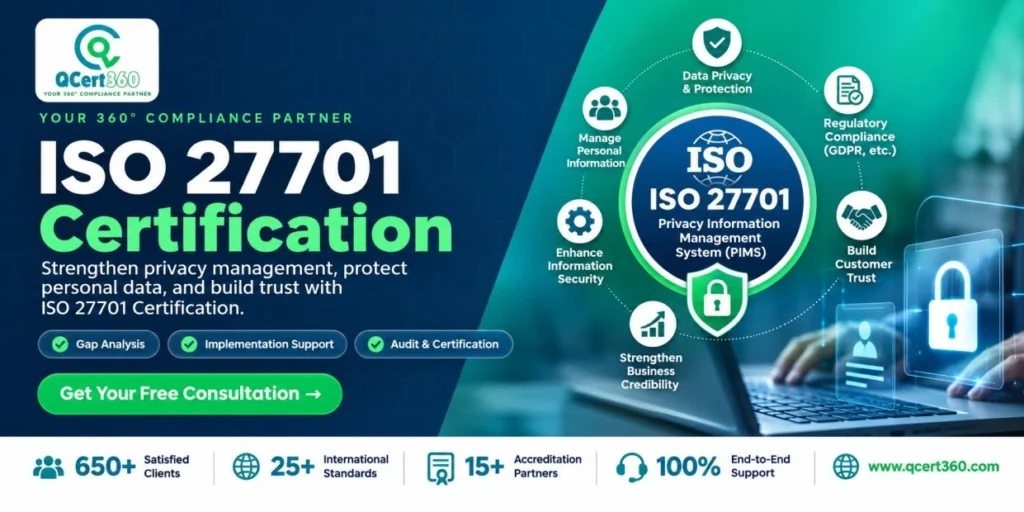
ISO 27701 Certification in Taiwan shows customers, partners, and regulators that your organization manages personal data under a proven framework. QCert360 provides ISO 27701 certification services in Taiwan, from the first gap review to audit support. Our ISO 27701 consultants in Taiwan, including ISO 27701 certification consultants and PIMS consultants, build the system, train your team, and prepare you for an independent audit. As an ISO 27701 certification company in Taiwan, we focus on practical results rather than paperwork.
This guide covers the 2025 edition, requirements, process, documents, cost, and sector needs. Read the sections that match your stage, then request a quotation.
ISO 27701 Certification in Taiwan: Overview, Scope and Business Benefits
ISO 27701 certification confirms that an organization runs a Privacy Information Management System that protects personal data and meets recognized privacy requirements. It covers how you collect, use, store, share, and delete personal information. An independent certification body audits the system and issues the certificate. QCert360 supports ISO 27701 implementation in Taiwan from planning through audit readiness.
The scope can cover your whole organization or a defined business unit, product, or service. Many companies start with the services that handle the most sensitive data and expand later. ISO 27701 compliance services in Taiwan help you define a scope that is realistic, defensible, and commercially useful.
Current market trends explain the rising demand:
- Customer due diligence: Enterprise buyers now ask suppliers for privacy evidence, not just security evidence.
- Standalone privacy certification: The 2025 edition lets organizations certify privacy management without first certifying information security.
- Privacy by design: Product teams now embed privacy controls during design, not after launch.
- Vendor risk programs: Large organizations assess third-party privacy risk in every contract.
- AI and analytics growth: More data processing activities mean more privacy risk to manage.
- Cross-border operations: Data moves across systems, clouds, and partners, so governance matters more.
- Integrated management systems: Companies align privacy, security, and quality systems to cut duplicate effort.
What Are the Benefits of ISO 27701 Certification for Taiwan Companies?
- Builds Customer Trust: Demonstrates a commitment to protecting personal data and maintaining customer privacy.
- Improves Regulatory Compliance: Supports stronger privacy management practices aligned with Taiwan’s Data Protection Act
- Reduces Privacy Risks: Helps identify and manage risks related to data breaches, unauthorized access, and personal data misuse.
- Speeds Up Vendor Approvals: Strengthens credibility during supplier evaluations, vendor onboarding, and international business partnerships.
- Improves Data Management: Establishes clear procedures for collecting, processing, storing, and sharing personal information.
- Creates Competitive Advantage: Helps Taiwan companies attract international clients and win business opportunities where data privacy is a key requirement.
Who Needs ISO 27701 Certification in Taiwan?
- IT and Technology Companies: Organizations handling customer information, cloud data, and digital services.
- Banks and Financial Institutions: Businesses processing personal and financial information.
- Healthcare Providers: Hospitals, clinics, laboratories, and medical service providers managing patient records.
- Telecommunications Companies: Mobile network operators and service providers handling subscriber data.
- E-commerce and Retail Businesses: Online stores and retailers collecting customer details and payment-related information.
- Data Controllers and Processors: Organizations responsible for collecting, storing, processing, or managing personal data on behalf of clients.
What Is ISO 27701:2025 and Why Is Privacy Management Important for Taiwan Businesses?
ISO/IEC 27701:2025 is the international standard for privacy information management systems. It sets requirements for establishing, running, and improving a privacy management system that protects personal data. The 2025 edition, published in October 2025, replaced the 2019 edition and works as a standalone, certifiable standard.
Privacy management matters because personal data now sits at the center of products, marketing, payments, and operations. A single breach or misuse can damage trust faster than almost any other failure. A structured privacy management framework helps you control risk before it turns into an incident.
What Is a Privacy Information Management System?
A Privacy Information Management System, or PIMS, is the set of policies, processes, roles, and controls that govern how an organization handles personal information. It defines who is accountable, how risks are assessed, which controls apply, and how performance is reviewed. Privacy governance sits at its core.
What Is the Difference Between ISO 27701:2019 and ISO 27701:2025?
The 2019 edition worked as an extension to ISO 27001 and ISO 27002, so organizations needed an information security system first. The 2025 edition stands alone, with its own management system requirements and control sets. Organizations certified to ISO 27701:2019 must move to the new edition within the published transition period, which public guidance places at about three years from publication.
Comparison Area | ISO 27701:2019 | ISO 27701:2025 |
Management System | Extension of ISO 27001 and ISO 27002. | Standalone Privacy Information Management System (PIMS). |
ISO 27001 Requirement | Required an existing ISO 27001-based ISMS. | Can be implemented independently without ISO 27001 certification. |
Structure | Followed the structure of ISO 27001:2013. | Follows the harmonized management system structure. |
Implementation | Privacy controls were integrated into an existing information security management system. | Provides independent requirements for establishing and maintaining a PIMS. |
Privacy Controls | Included privacy controls for PII controllers and processors. | Retains and updates privacy controls with clearer requirements and responsibilities. |
Risk Management | Focused on privacy risks within the existing ISMS framework. | Provides a standalone approach to identifying and managing privacy risks. |
Integration | Closely linked to ISO 27001 implementation. | Can integrate with ISO 27001, ISO 9001, and other management systems. |
Certification Transition | Previous edition, withdrawn in October 2025. | Organizations must transition to the 2025 edition by the applicable transition deadline. |
Important Transition Note: Organizations certified to ISO 27701:2019 should plan their transition to ISO 27701:2025. The transition deadline for existing certificates is 31 October 2028, according to published transition arrangements. Confirm the applicable requirements with your certification body
How Does ISO 27701 Protect Personal Data?
ISO 27701 protects personal data through a combination of governance, risk assessment, and controls. You identify what personal data you hold, why you hold it, and where it flows. You then apply data protection controls, limit access, set retention rules, and monitor performance. Regular audits and reviews keep the system effective.
The standard speaks of two main roles. A PII controller decides why and how personally identifiable information (PII) is processed. A PII processor handles PII on behalf of a controller. Many organizations act as both, and the standard provides controls for each role.
ISO 27701:2025 Certification Requirements for Organizations in Taiwan
- Define the PIMS Scope: Identify the business activities, departments, systems, and personal data covered by the Privacy Information Management System.
- Establish Privacy Policies: Develop documented privacy policies, procedures, and guidelines for managing personal information.
- Conduct Privacy Risk Assessments: Identify privacy risks related to collecting, processing, storing, and sharing personal data.
- Assign Roles and Responsibilities: Define accountability for privacy management, including responsibilities of PII controllers and processors.
- Implement Privacy Controls: Apply appropriate controls to protect personal information and prevent unauthorized access, disclosure, or misuse.
- Monitor, Audit, and Improve: Conduct internal audits, management reviews, performance evaluations, and corrective actions to maintain and improve the PIMS.
What Are the ISO 27701 Certification Requirements in Taiwan?
PIMS Requirements follow the standard management system structure. You must understand your organization and its context, define the PIMS scope, secure leadership commitment, plan for privacy risks and opportunities, support the system with resources and competence, run operational controls, evaluate performance through audits and reviews, and improve through corrective action.
Together these form the Privacy Information Management System requirements. In practice, auditors look for the following:
- Leadership and privacy governance: Top management owns the PIMS and assigns roles.
- Privacy risk assessment: You identify privacy risks and treat them in proportion.
- Privacy management controls: You apply controls suited to your role and data.
- Operational control of data processing activities: You manage collection, use, sharing, retention, and deletion.
- Competence and awareness: Staff understand their responsibilities.
- Monitoring and internal audit: You check that controls work.
- Management review and improvement: Leaders review results and act.
What Are the ISO 27701 Privacy Controls?
ISO 27701 privacy controls cover the full lifecycle of personal data and the rights of the people it concerns. The standard provides control sets for controllers and processors, along with guidance on applying them. Controls vary by role, but several themes appear in nearly every implementation.
Typical control areas include:
- Lawful data processing and purpose limitation: You process data only for defined, legitimate purposes.
- Data minimization: You collect only what you need.
- Consent management: You record, respect, and honor consent choices where consent applies.
- Data subject rights: You support access, correction, deletion, and objection requests.
- Privacy by design: You assess privacy in new products and changes.
- Data retention and deletion: You keep data only as long as needed and dispose of it securely.
- Third-party control: You manage processors, partners, and suppliers.
- Cross-border data transfers: You control and document transfers of personal data.
- Security of processing: You protect data through technical and organizational measures.
- Incident handling: You detect, assess, and respond to personal data breaches.
ISO 27701 Certification Process in Taiwan: Step-by-Step Implementation Guide
The certification process has eight steps: commitment, gap analysis, planning, system build, training, operation, internal audit, and certification audit. A consultant shortens the path and prevents avoidable findings. Each step creates records that the certification body will review.
How to Get ISO 27701 Certification in Taiwan
Follow these steps in order:
- Secure leadership commitment. Leaders define scope, resources, and responsibilities.
- Run a gap analysis. Compare current practice with the standard.
- Plan the project. Set owners, tasks, and dates.
- Build the PIMS. Develop policies, procedures, risk methods, and records.
- Train your people. Teach privacy duties, data handling, and incident response.
- Operate and record. Run the system long enough to generate evidence.
- Audit internally and fix gaps. Complete the internal privacy audit and management review.
- Pass the certification audit. An independent certification body reviews your system and decides.
ISO 27701 Consulting, Implementation & Certification Support Services in Taiwan
Consulting services help you design, build, and maintain the PIMS. A consultant brings method, audit experience, and practical tools, while your team keeps ownership. QCert360 provides ISO 27701 consultancy in Taiwan and ISO 27701 consulting services in Taiwan as full projects or as targeted support for specific stages.
Our ISO 27701 certification support in Taiwan covers:
- Scoping and privacy governance design
- Gap analysis and privacy risk assessment
- Policy, procedure, and record development
- Data mapping and processing inventory
- Training for staff and leaders
- Internal audit and management review support
- Mock audits and certification audit preparation
- Post-certification surveillance support
Our ISO 27701 implementation consultants in Taiwan join your team on site or remotely. Our ISO 27701 privacy management consultants in Taiwan work with legal, security, product, and operations teams, because privacy touches all of them. You can also use our ISO 27701 privacy management consulting in Taiwan for a lighter advisory engagement, such as a design review or a pre-audit check.
For companies that need broader support, we offer data privacy consultancy and privacy management consulting that connect the PIMS to enterprise privacy management across business units. We also help organizations that need ISO 27701:2025 certification Taiwan buyers recognize in procurement.
How Do I Choose an ISO 27701 Consultant in Taiwan?
Choose a consultant with privacy and security experience, a clear method, written deliverables, and honest timelines. Ask for sample outputs, such as a gap report or data inventory template. Confirm that the consultant trains your staff and stays independent from the certification body. Avoid anyone who guarantees certification.
Use this checklist:
- Relevant experience: Work in your sector or a similar one.
- Defined method: A clear path from gap analysis to audit.
- Written scope and quote: Deliverables and price in writing.
- Training included: Staff learn to run the system.
- Independence: No conflict with the certification body.
- Audit support: Mock audits and help with corrective action.
- Knowledge transfer: Your team can run the PIMS afterward.
What Documents Are Required for ISO 27701 Certification?
ISO 27701 Documentation, Privacy Controls and PIMS Requirements
Documentation proves that your controls exist and work. Auditors read documents first and then compare them with what they see in practice. Clear PIMS documentation also helps staff follow consistent methods. Keep documents short, accurate, and controlled.
You need a defined scope, a privacy policy, a risk assessment method and results, a risk treatment plan, a statement of applicable controls, procedures for core privacy activities, and records of training, audits, reviews, and corrective actions. Controllers and processors also need records that match their roles.
Common documents include:
- PIMS scope and privacy policy
- Roles, responsibilities, and governance structure
- Data processing inventory and records of processing activities
- Privacy risk assessment and risk treatment records
- Data protection policies and procedures
- Data retention policies and data deletion procedures
- Consent management procedures
- Data subject request handling, including data subject access requests
- Privacy impact assessment procedures
- Data breach management and incident response procedures
- Data processor agreements and third-party records
- Training and awareness records
- Internal audit reports and management review minutes
- Corrective action logs
Privacy policy development deserves special care. Write for two audiences: external readers who need plain language, and internal staff who need clear rules. Keep external notices consistent with what your systems actually do.
ISO 27701 Gap Analysis, Privacy Risk Assessment and Audit Preparation
An ISO 27701 gap analysis compares your current practice with every requirement and shows what is missing, weak, or already in place. A privacy risk assessment then ranks the risks to individuals and to your organization. Together with audit preparation, they set your plan, budget, and timeline.
Many teams start with a PIMS gap assessment because it carries low commitment. It shows exactly where you stand, which fixes are urgent, and what you can do in-house. A privacy compliance assessment can extend this review to contracts, notices, and vendor practices.
How Does a PIMS Gap Analysis Work?
Consultants review documents, interview process owners, and sample real data flows. They rate each requirement as conforming, partial, or missing. The result is a prioritized action plan with owners and dates. The review covers governance, risk, data mapping, individual rights, security, third parties, and incident handling.
How Can a Company Prepare for an ISO 27701 Certification Audit in Taiwan?
Prepare by testing your system the way an auditor would. Run an internal privacy audit, hold a management review, close corrective actions, and rehearse with a mock audit. Brief staff on what to expect and where records live. Strong certification audit preparation also checks that your documents match daily practice.
A practical sequence looks like this:
- Complete the internal audit and fix findings.
- Hold the management review and record decisions.
- Verify that policies, notices, and records agree.
- Test incident response with a tabletop exercise.
- Run a mock audit and coach interviewees.
- Confirm that corrective actions are closed.
Ongoing privacy compliance monitoring keeps you ready between audits. Track metrics such as request response times, incident counts, training completion, and overdue actions. A data protection audit schedule keeps all areas covered over time.
ISO 27701 Certification Cost in Taiwan and Factors Affecting Pricing: How Much Does ISO 27701 Certification Cost in Taiwan?
Cost depends on organization size, scope, data complexity, current maturity, support level, and audit days. It has three parts: consulting fees, certification body fees, and internal effort. Request a written quote from each provider and compare scope line by line. The best value is the lowest total cost to a passed audit, not the lowest single fee.
Key pricing drivers include:
- Number of employees, sites, and systems in scope
- Volume and sensitivity of personal data
- Number of data processing activities and third parties
- Existing security and privacy maturity
- Depth of consulting, from advice only to full implementation
- Certification body audit days
- Surveillance audits in later years
Total price varies widely by organization. A small company with a few systems pays far less than a large group with many data flows. Request a scoped quotation after a short call. Ask each provider to separate consulting, training, and certification fees, so you can compare offers fairly.
QCert360 provides a free quotation after a scoping call. We tie every fee to a deliverable and offer phased delivery, so you can start with a gap analysis and add services as you progress.
How Can You Keep Costs Under Control?
Define a focused scope, reuse existing security controls, keep documents lean, and train internal auditors. If you already run ISO 27001, integrate the PIMS with the existing system to avoid duplicate work. An early gap analysis prevents expensive rework, because surprises found at the certification audit cost more than surprises found in planning.
ISO 27701 Certification for IT Companies, Fintech, Healthcare & SaaS Businesses
Each sector handles different data and faces different expectations, so evidence and controls vary. A good consultant tailors the PIMS to the sector. Below is how we approach common industries.
Sector | Typical privacy focus |
IT and technology companies | Client data handling, support access, development and test data, subprocessors |
Financial institutions | Customer identity data, transaction records, monitoring, retention, third-party risk |
Healthcare organizations | Patient records, confidentiality, access control, retention, sharing |
Data processing companies | Processor obligations, client instructions, subprocessors, deletion on exit |
SaaS companies | Multi-tenant data, tenant isolation, customer requests, product privacy by design |
Fintech companies | Onboarding data, identity checks, analytics, partner integrations |
Telecommunications companies | Traffic and location data, subscriber records, retention, lawful access handling |
E-commerce businesses | Customer profiles, payment data, marketing consent, delivery partners |
Cloud service providers | Customer content, shared infrastructure, subprocessors, cross-border storage |
ISO 27701 and Taiwan’s Data Protection Act: Understanding Privacy Compliance Requirements
ISO 27701 and national data protection law work together but are not the same. The standard gives you a certifiable management system. The law sets legal duties. Certification helps you organize and evidence your privacy program, but it does not by itself prove legal compliance. Always confirm legal obligations with qualified counsel.
Taiwan’s Data Protection Act 2019 and the related Data Protection Regulations set duties for organizations that process personal data, including principles, individual rights, and obligations for controllers and processors. The Office of the Data Protection Commissioner oversees the framework. Confirm current obligations directly with official sources and legal advisers.
How Does ISO 27701 Support Data Protection Act Compliance in Taiwan?
ISO 27701 supports compliance by giving you processes that align with common data protection duties. You gain a data inventory, risk assessments, individual rights procedures, breach handling, and third-party controls. These same building blocks help you demonstrate accountability and answer questions from customers and authorities.
Key areas of overlap include:
- Lawful data processing and purpose limitation: Documented purposes and bases for processing.
- Data minimization: Collecting only necessary data.
- Data subject rights and requests: Procedures to receive, verify, and answer requests on time.
- Personal data breach notification: Detection, assessment, and notification workflows.
- Third-party privacy risk management: Due diligence and contracts with processors.
- Cross-border data transfers: Mapping and controlling transfers to other countries.
How Can Taiwan Businesses Improve Data Privacy Compliance With ISO 27701?
Start with a data inventory, assign ownership, and fix the highest risks first. Build request handling, breach response, and vendor controls into daily operations. Train staff regularly, and monitor performance with simple metrics. A structured approach to Taiwan data protection compliance makes audits and customer reviews far easier.
Data subject consent management deserves attention when consent is your basis for processing. Record when and how people consent, make withdrawal easy, and honor choices across systems. Privacy awareness training reinforces these habits, especially for marketing, support, and engineering teams.
ISO 27701 vs ISO 27001 vs GDPR: Key Differences and Compliance Benefits
ISO 27001 manages information security. ISO 27701 manages privacy information. GDPR is European law that sets legal duties for personal data. They address different layers: a security system, a privacy system, and a legal framework. Used together, they give organizations strong, complementary evidence.
Aspect | ISO 27001 | ISO 27701 | GDPR |
Type | Management system standard | Management system standard | Law |
Focus | Information security | Privacy information management | Personal data protection rights and duties |
Certifiable | Yes | Yes | No |
Applies to | Any organization | Any organization handling personal data | Organizations within its legal scope |
Output | Security controls and ISMS | Privacy controls and PIMS | Legal compliance |
Does ISO 27701 Certification Help With GDPR Compliance?
Yes, it helps. ISO 27701 maps to many GDPR requirements, so a certified PIMS gives you structured evidence for accountability. It does not guarantee legal compliance, and it is not an official GDPR certification. Use it as a foundation, and confirm legal obligations with counsel if you handle data of people in the European Union.
Organizations that combine all three get clear advantages:
- One integrated approach to security and privacy
- Shared risk, audit, and review cycles
- Stronger evidence for customers and partners
- Clearer accountability for personal data
- Faster responses to due diligence requests
Why Choose QCert360 for ISO 27701 Certification Support in Taiwan?
QCert360 is a global ISO certification and management consulting firm serving clients across 195 countries. Our team supports audit and certification readiness across information security, privacy, quality, and other management system standards. We bring structured methods, practical documents, and clear communication to every project.
Here is what clients can expect:
- Experienced consultants: Professionals who have worked through real audits.
- Practical systems: Lean procedures that teams actually follow.
- Integrated thinking: Privacy and security planned together where it makes sense.
- Transparent pricing: A clear quote before work starts.
- Skills transfer: Training that leaves your team confident.
- Independent roles: We prepare you, and an independent certification body audits you.
Our approach rests on a simple belief: certification should be a by-product of a system that works. When your team understands the controls, audits become routine. We also support information security management and ISO 27001 information security work for clients that want to certify both standards, either together or in stages.
Frequently Asked Questions About ISO 27701 Certification in Taiwan
What Is the ISO 27701:2025 Implementation Process?
Implementation starts by defining scope and mapping personal data flows. You then assess privacy risk, select controls, write procedures, assign roles, and train staff. After the system runs, you audit it, review it with management, and close findings. The final step is the certification audit.
Strong implementation depends on clear ownership. Name a privacy lead, define who approves changes, and give each business unit responsibility for its own data processing. Without ownership, even good documents fail in daily work.
How Long Does ISO 27701 Certification Take in Taiwan?
Most small and mid-sized organizations take about three to nine months from gap analysis to certificate. Larger or more complex environments take longer. Data volume, number of systems, existing security maturity, and management availability affect the timeline most. A gap analysis at the start gives you a realistic schedule.
What Is the Difference Between ISO 27701 and ISO 27001?
ISO 27001 protects information of all kinds through risk-based security controls. ISO 27701 focuses on personal data and the rights and expectations of individuals. Security supports privacy, because you cannot protect personal data without strong controls. But privacy adds duties that security alone does not cover, such as purpose limitation and individual rights.
What Is the ISO 27701 Certification Audit Process?
The certification audit usually runs in two stages. Stage 1 reviews your documentation and readiness. Stage 2 tests whether the system works in practice through interviews, observation, and record sampling. Auditors grade findings, and you respond with corrective actions within agreed timelines. After certification, surveillance audits keep the system under review.
Is ISO 27701 the same as ISO 27001?
No. ISO 27001 covers information security. ISO 27701 covers privacy information management. They complement each other but they are two different standards.
Why Do Processor Agreements and Third-Party Controls Matter?
Data processor agreements set the rules for how vendors handle your data. They cover instructions, security, subprocessors, assistance with rights requests, breach notification, return, and deletion. Third-party privacy risk management adds due diligence before onboarding and periodic review. Weak vendor control is a common source of audit findings and real incidents.
How Should You Handle Personal Data Breaches?
Prepare before an incident happens. Define what counts as a personal data breach, who decides on notification, and how you document the response. Privacy incident response should link to your security incident process, so teams do not work in silos. Practice with tabletop exercises, and keep records of every incident and decision.
Is ISO 27701 certification mandatory for business in Taiwan?
No. It is voluntary. Customers and contracts often drive adoption & those who wants to get data protection usually apply for the certification.
How long is an ISO 27701 certificate valid?
ISO 27701 Certificate usually run for three years, with surveillance audits in between. Confirm the exact cycle with your certification body.
What Do Financial Institutions and Fintech Companies Need?
ISO 27701 certification for financial institutions in Taiwan and ISO 27701 certification for fintech companies in Taiwan focus on identity data, transaction records, and partner integrations. Auditors expect strong access controls, clear retention rules, and tested incident response. Fintech teams also need privacy impact assessments for new features and data-sharing arrangements.
What About Healthcare Organizations?
ISO 27701 certification for healthcare organizations in Taiwan centers on patient confidentiality, role-based access, careful sharing, and secure disposal. Health data is among the most sensitive categories, so risk assessments tend to be stricter. Staff training carries extra weight, because many incidents begin with human error.
What Do SaaS and Cloud Providers Need?
ISO 27701 certification for SaaS companies in Taiwan and ISO 27701 certification for cloud service providers in Taiwan emphasize processor controls. You must follow customer instructions, support deletion on exit, manage subprocessors, and show tenant separation. Customers often ask for these proofs in security questionnaires, so certification shortens sales cycles.
What About Data Processors, Telecoms, and E-commerce?
ISO 27701 certification for data processing companies in Taiwan, telecommunications companies, and e-commerce businesses follows the same logic with different data. Telecoms manage large volumes of traffic and location data. E-commerce teams manage customer profiles, payment details, and marketing consent. Data processing companies must prove they act only on documented instructions.
Does ISO 27701 Certification for Data Controllers and Processors Differ?
Yes. ISO 27701 certification for data controllers and processors uses different control sets, because the roles carry different duties. Controllers decide purposes and means and must handle lawful basis, notices, and individual rights. Processors follow controller instructions and must support controllers with rights requests, security, and breach notification.
Does certification prove legal compliance?
No. Certification shows that your management system meets the standard. Legal compliance depends on applicable law and your actual practices.
What if we already hold an ISO 27701:2019 certificate?
You must transition to the 2025 edition within the published transition period. Speak with your certification body about timing and audit requirements.
What Is the Role of a PIMS Consultant in Taiwan?
A PIMS consultant assesses your current privacy practices, designs the missing parts of the system, trains your team, and prepares you for the certification audit. The consultant transfers knowledge, so your staff can run the PIMS alone. The consultant does not audit you or issue the certificate.
Can we certify only part of the organization for ISO 27701 standard?
Yes. Organizations can certify specific departments, services, business units, or systems under ISO 27701. The scope must be clearly defined, covering relevant personal data processing activities, privacy risks, responsibilities, and applicable controls.
How Does Privacy Risk Assessment and Treatment Work?
Data privacy risk assessment looks at harm to individuals, such as exposure, misuse, or loss of control, as well as business harm. For each risk, you rate likelihood and impact, then choose a treatment: reduce, transfer, avoid, or accept. Privacy risk treatment links to specific controls and owners. Information security risk management feeds into the same process, because many privacy risks begin as security failures.
What Are DPIAs and Privacy Impact Assessments?
A Data Protection Impact Assessment (DPIA), also called a privacy impact assessment, evaluates high-risk processing before it starts. It describes the processing, assesses necessity and proportionality, identifies risks, and defines mitigations. Build privacy impact assessment procedures into project and product workflows, so teams run them early rather than after launch.
Is ISO 27701 Certification Required Under Taiwan’s Data Protection Act?
No. The Act does not require ISO 27701 certification. The standard is voluntary. Many organizations adopt it because it gives structure to privacy programs and provides evidence to customers and partners. Certification can support compliance work, but it does not replace legal advice or registration duties.
Do we need a data protection officer to implement ISO 27701?
That depends on applicable law and your processing. ISO 27701 requires clear privacy roles, but the title and legal requirement vary. Check with legal counsel.
How Can IT Companies in Taiwan Achieve ISO 27701 Certification?
IT companies achieve certification by mapping the personal data they handle, defining their role as controller or processor for each service, and applying controls to development, support, and operations. They also manage subprocessors and customer instructions. Our ISO 27701 certification for IT companies in Taiwan builds these controls into your delivery process.
Who owns the PIMS inside the company?
Top management owns it. A privacy lead usually runs it day to day, with support from legal, security, product, and operations.
How often should we audit the PIMS system within an Organisation?
Run internal audits at planned intervals based on risk. Many organizations cover all areas at least once a year.
How Do Records of Processing Work?
A data processing inventory lists what personal data you hold, why you hold it, where it sits, who can access it, and how long you keep it. It is the backbone of the PIMS. Records of processing activities turn that inventory into a formal register that auditors can review. Update both whenever systems or purposes change.
Why Do Retention and Deletion Matter?
Keeping data longer than needed raises risk without adding value. Data retention policies set time limits by category. Data deletion procedures describe how you securely remove data, including from backups and processor systems. Auditors often sample deletion records, so keep evidence.
How Do You Manage the Personal Data Lifecycle?
Personal data lifecycle management follows data from collection to deletion. At each stage, you ask what the purpose is, who has access, how it is protected, and when it ends. Mapping this lifecycle exposes weak spots, such as data kept in forgotten spreadsheets or shared with unneeded parties.
Can QCert360 support both privacy and security certification?
Yes. We run combined projects for privacy and information security, and we can also support single-standard work.
Who Provides ISO 27701 Certification Services in Taiwan?
Two types of provider matter. Consultants, such as QCert360, prepare you through gap work, documents, training, and mock audits. Independent certification bodies audit you and issue the certificate. Keep these roles separate. A consultant should never promise an audit result, because only the certification body decides.
Can Small Businesses in Taiwan Obtain ISO 27701 Certification?
Yes. The standard applies to organizations of any size. Small businesses scale the system to their data volume, using simple procedures and focused records. A small team can often certify faster than a large one, because it has fewer systems and fewer data flows to map.
Can ISO 27701 Be Implemented Without ISO 27001?
Yes. Under the 2025 edition, ISO 27701 stands alone, so you can certify privacy management without holding ISO 27001. Many organizations that already run ISO 27001 information security still integrate the two, because shared risk, audit, and review processes save effort.
If you operate ISO 27001 information security, your ISO 27002 security controls remain useful. They support data confidentiality, data integrity, and data access controls that privacy depends on. Without ISO 27001, the PIMS carries its own set of security-related controls, so you do not have to build an entire security system first.
Ready to Get ISO 27701 Certified in Taiwan?
Ready to strengthen your privacy program? QCert360 gives you a clear plan, expert support, and transparent pricing. Our team combines site review, documentation, training, and audit preparation in one project.
- Request a quotation for ISO 27701 Certification in Taiwan.
- Book a gap analysis to see exactly what your organization needs.
- Talk to an expert about implementation, training, and audit readiness.
Share your scope, data types, and target date. We will reply with a clear proposal and next steps. Contact QCert360 at qcert360.com and take the next step toward certified privacy management.
Our Services
ISO Standards
- ISO 9001 Certification
- ISO 14001 Certification
- ISO 45001 Certification
- ISO 22000 Certification
- ISO 17025 Certification
- ISO 27001 Certification
- ISO 13485 Certification
- ISO 20000-1 Certification
- ISO 41001 Certification
- ISO 22716 Certification
- ISO 50001 Certification
- ISO 22301 Certification
- ISO 29993 Certification
Product Certifications
Other international standards
- FSSC 22000 Certification
- HIPAA
- HACCP Certification
- SA 8000 Certification
- GMP Certification
- GDPR
- GDP Certification
- GLP Certification
- Certificate of Conformity