ISO 42001 Certification in Iran – Top AI Management System Consultants in Iran with expert support
ISO 42001 Certification in Iran - Leading AI Certification & Consulting Company with end to end support
ISO 42001 Certification in Iran confirms that an organization’s Artificial Intelligence Management System (AIMS) meets the international benchmark for responsible AI governance — covering how AI systems are built, monitored, controlled, and improved over time. As Iran’s banking sector, healthcare technology providers, government digital services, and IT export companies lean further into automated decision-making, this certification has moved from “nice to have” to a genuine competitive requirement, especially for companies trying to prove credibility to partners abroad while working within Iran’s specific banking and accreditation constraints.
This guide breaks down what the certification covers, who actually needs it, how the process runs in Iran, what it costs, and how to get audit-ready.
What Is ISO 42001 Certification in Iran?
ISO 42001 Certification in Iran verifies that an organization’s AI Management System is transparent, risk-aware, and continually monitored — not just that the company happens to use AI tools.
- It applies to organizations that design AI systems, deploy third-party AI tools, or offer AI-powered services to clients.
- It centers on AI risk management, transparency, data quality, human oversight, and accountability across the full AI lifecycle.
- In Iran, certification runs through a certification body operating under an accredited AI management framework, typically supported by local consultants who understand both the ISO 42001 standard and the practical realities of Iran’s regulatory and banking environment.
- For Iran companies, certification also acts as a trust signal to foreign clients and banks who might otherwise hesitate to work with AI systems built or hosted inside Iran.
Certification isn’t a one-off badge — it’s an ongoing AI management framework of policies, AI risk registers, and controls that stay active long after the audit closes.
Who Needs ISO 42001 AI Management Certification in Iran?
Any organization whose AI systems affect customers, employees, or the public should evaluate ISO 42001 AI Management Certification in Iran. That includes:
- Banks and fintech companies using AI for credit scoring, fraud detection, or customer service automation, where regulators and correspondent partners expect documented AI governance.
- Healthcare technology providers building diagnostic or triage tools powered by machine learning models.
- Government and municipal digital service providers rolling out AI-based citizen services, where public trust and auditability carry real weight.
- Software and IT export companies selling AI-enabled products to clients in the Gulf, Central Asia, or beyond, who need certification to pass vendor due-diligence checks.
- Telecom and e-commerce platforms running recommendation engines or automated customer profiling at scale.
- Universities and research institutes operating AI labs that want formal AI governance in place before commercializing their models.
If your organization builds, licenses, trains, or heavily depends on AI systems, this certification is worth a serious look.
Step-by-Step ISO 42001 Certification Process in Iran
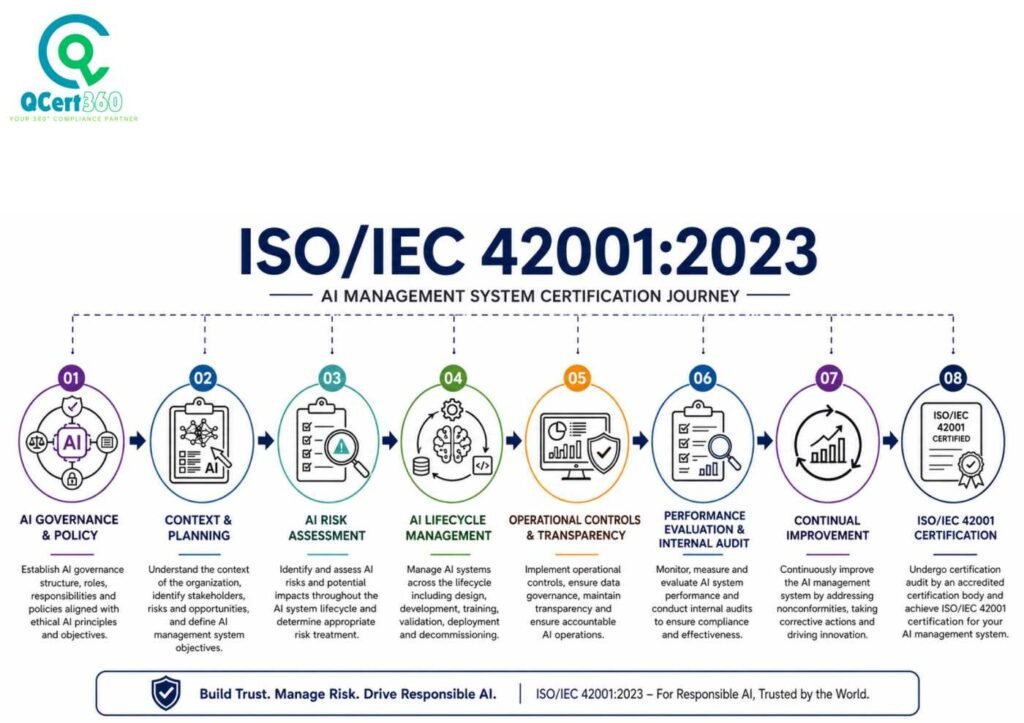
Most organizations pursuing ISO 42001 Certification in Iran move through a consistent sequence, though timelines shift depending on how many AI systems are in scope:
- Gap analysis — comparing current AI systems, data practices, and governance documents against ISO 42001 requirements.
- Scope definition — deciding which AI systems, teams, and locations across Iran fall inside the certification boundary.
- AI system inventory and risk assessment — cataloguing every AI model in use, its purpose, and its potential impact on users.
- Policy and documentation development — building the AI management policy, Statement of Applicability, and supporting procedures.
- Implementation and staff training — rolling out controls and confirming teams understand their roles.
- Internal audit — stress-testing the system internally before the external certification audit.
- Management review — leadership formally reviews performance and signs off before Stage 2.
- Certification audit (Stage 1 and Stage 2) — the certification body first checks documentation readiness, then verifies real-world implementation.
- Certificate issuance and surveillance audits — periodic surveillance audits keep the certification active after issuance.
Because coordinating with certification bodies from outside Iran adds logistical steps, most organizations build extra lead time into their Stage 2 audit planning from the start.
ISO 42001 Implementation Services in Iran — Complete Process
ISO 42001 Implementation Services in Iran help organizations build a working AIMS that satisfies ISO 42001 requirements before the certification audit even begins — not just a stack of documents, but AI governance embedded into daily operations. Depending on AI maturity and operational complexity, this phase can run from a few weeks to several months.
Implementation typically covers:
- Mapping every AI system already in production, plus those still in development, to surface governance gaps — especially in legacy AI models.
- Building AI risk registers for each AI application so risks tied to machine learning models, automated decision-making, and data usage are properly tracked.
- Integrating AIMS controls with existing frameworks such as ISO 27001, avoiding duplicate compliance work.
- Setting up monitoring for model drift, algorithm performance, data quality, and bias detection, tuned to the organization’s technical setup.
- Running awareness and training workshops for technical teams, management, and process owners so ISO 42001 requirements get applied consistently.
Solid ISO 42001 Implementation Services in Iran turn documentation into daily practice, which is what actually makes the certification audit go smoothly.
How ISO 42001 Consultants in Iran Support Certification
ISO 42001 Consultants in Iran typically stay involved from the first planning conversation through to the final audit. Their role usually covers:
- Running the initial gap analysis and turning ISO clauses into practical action items tied to the organization’s actual AI use cases.
- Building or refining documentation so it reflects real operational practice instead of generic template language.
- Coordinating internal audits and mock assessments so teams walk into the real audit knowing what to expect.
- Acting as the go-between for the organization and the certification body — a genuinely useful function given the added coordination that comes with working across borders from Iran.
- Advising on realistic timeline and budget so leadership isn’t blindsided by delays or added costs mid-project.
The best consultants also tell clients where their AI practices are genuinely weak, rather than just what they want to hear — that honesty is usually what gets an organization through the audit on the first try.
ISO 42001 Documentation Requirements for Certification in Iran
Documentation is where most certification timelines slip, so it helps to know exactly what auditors expect to review for ISO 42001 Documentation Requirements for Certification in Iran:
- AI management policy signed off by leadership
- Scope statement defining which systems, teams, and locations are covered
- Statement of Applicability (SoA) listing which controls apply and why
- AI risk assessments and risk treatment plans
- Staff training and competence records
- Non-conformity logs and incident records
- Internal audit and management review records
- Ongoing evidence of AI system performance monitoring
Auditors can usually tell within minutes when documentation was copied from a template and never adapted to the organization’s real AI systems — so documentation should reflect what actually happens on the ground, not what looks good on paper.
How to Prepare for an ISO 42001 Audit in Iran
Getting ready for an ISO 42001 Audit in Iran takes more than organizing files. Auditors want to see AI governance practices working consistently across the organization, not just described in a binder.
- Run at least one full internal audit before the external one — and actually fix what it turns up.
- Assign a named owner to every AI system in scope, someone who can answer direct questions during the audit.
- Keep evidence organized and easy to pull up quickly; scattered or outdated documentation erodes auditor confidence fast.
- Brief any staff who might be interviewed so they understand the audit’s purpose and aren’t caught off guard.
- Confirm audit logistics early — remote or on-site — since that affects scheduling and who needs to be available.
ISO 42001 Cost in Iran — Key Factors That Affect Pricing
ISO 42001 Cost in Iran shifts based on several variables, so there’s no single flat number that applies across the board:
- Number and complexity of AI systems in scope — a single customer-facing chatbot costs far less to certify than a bank’s full suite of credit and fraud-detection models.
- Organization size and number of locations — multi-branch companies need broader scope, which raises both consulting and audit time.
- Existing documentation maturity — companies starting from zero spend more consulting hours than those already running ISO 27001 or a similar framework.
- Certification body fees, which can include added costs tied to remote or cross-border audit logistics given Iran’s specific banking and travel constraints.
- Consultant fees, which depend on project length and whether the engagement is advisory-only or full hands-on implementation.
- Currency fluctuation — costs quoted in foreign currency can move significantly against the Iran USD over a multi-month project.
A detailed quote following an initial gap assessment gives a far more accurate cost picture than any flat upfront estimate.
ISO 42001 Accreditation in Iran — Why It Matters
Choosing an accredited certification body isn’t optional if the certificate needs to hold weight. ISO 42001 Accreditation in Iran is what gives customers, regulators, and international partners real confidence in the result.
- An accredited certificate is recognized by international partners, banks, and clients — a critical factor for Iran export businesses proving credibility abroad.
- Unaccredited or loosely regulated bodies can issue certificates that look official but carry little weight with serious business partners, which is a genuine risk in a market where verification isn’t always straightforward.
- Accreditation status should be verified independently, not taken from a certification body’s own marketing claims.
- Given limited direct access to some international accreditation bodies from Iran, partnering with a body that has an established process for working in this market avoids costly delays later.
Get Expert Guidance for ISO 42001 Certification in Iran with QCert360
Getting AI governance certification right in Iran means working with a team that understands the ISO 42001 standard and the practical realities of certifying an organization here — documentation, audit logistics, and accreditation checks included. QCert360 supports Iran organizations across banking, technology, healthcare, and government sectors through the full journey — gap assessment, implementation, documentation, audit coordination, and certification — so your AI systems are governed the way your clients and partners actually expect.
Frequently Asked Questions
- What is ISO 42001 Certification in Iran?
It confirms an organization’s Artificial Intelligence Management System meets the international standard for AI governance, risk management, transparency, and accountability. - Who needs ISO 42001 AI Management Certification in Iran?
Banks, fintech firms, healthcare technology providers, government digital service providers, IT export companies, telecom and e-commerce platforms, and research institutions relying on AI systems that affect customers or the public. - How long does the ISO 42001 certification process take in Iran?
It depends on how many AI systems are in scope and how mature existing documentation is, but Stage 2 audits often need extra lead time due to cross-border coordination. - What does ISO 42001 Cost in Iran depend on?
Number and complexity of AI systems, organization size, documentation maturity, certification body and consultant fees, and currency fluctuation against the USD. - What documents do auditors expect for ISO 42001 Certification in Iran?
An AI management policy, scope statement, Statement of Applicability, AI risk assessments, training records, non-conformity logs, and internal audit records. - Why does ISO 42001 Accreditation in Iran matter?
Only accredited certificates carry weight with international partners, banks, and regulators — unaccredited bodies can issue certificates with little real credibility. - How do ISO 42001 Consultants in Iran help with certification?
They run gap analysis, build accurate documentation, coordinate mock audits, liaise with the certification body, and flag real weaknesses before the formal audit. - What’s involved in preparing for an ISO 42001 Audit in Iran?
A completed internal audit, named owners for every AI system in scope, organized evidence, briefed staff, and confirmed audit logistics. - What is the duration for obtaining ISO 42001 certification in Iran?
It depends on the number of AI systems in scope and your documentation maturity. Cross-border audit coordination can add extra time, so most companies plan for a flexible timeline rather than a fixed number of weeks. - How can my company obtain ISO 42001 certification in Iran?
Complete a gap assessment, define scope, build required documentation, implement controls, pass an internal audit, then go through the certification body’s Stage 1 and Stage 2 audits. - How much does it cost to get ISO 42001 Certification?
Cost varies based on AI system complexity, organization size, documentation readiness, and certification body and consultant fees. A quote after a gap assessment gives the most accurate figure. - Is the Certification Body allowed to instruct us on the implementation of the ISO 42001 System?
No. Certification bodies must stay independent, so they can only audit your AIMS, not help build or implement it. - What services do consultants offer to assist in obtaining ISO 42001 certification?
Gap analysis, documentation support, staff training, mock audits, and guidance liaising with the certification body.
Our Services
ISO Standards
- ISO 9001 Certification
- ISO 14001 Certification
- ISO 45001 Certification
- ISO 22000 Certification
- ISO 17025 Certification
- ISO 27001 Certification
- ISO 13485 Certification
- ISO 20000-1 Certification
- ISO 41001 Certification
- ISO 22716 Certification
- ISO 50001 Certification
- ISO 22301 Certification
- ISO 29993 Certification
Product Certifications
Other international standards
- FSSC 22000 Certification
- HIPAA
- HACCP Certification
- SA 8000 Certification
- GMP Certification
- GDPR
- GDP Certification
- GLP Certification
- Certificate of Conformity