Click here to connect through WhatsApp – 24/7

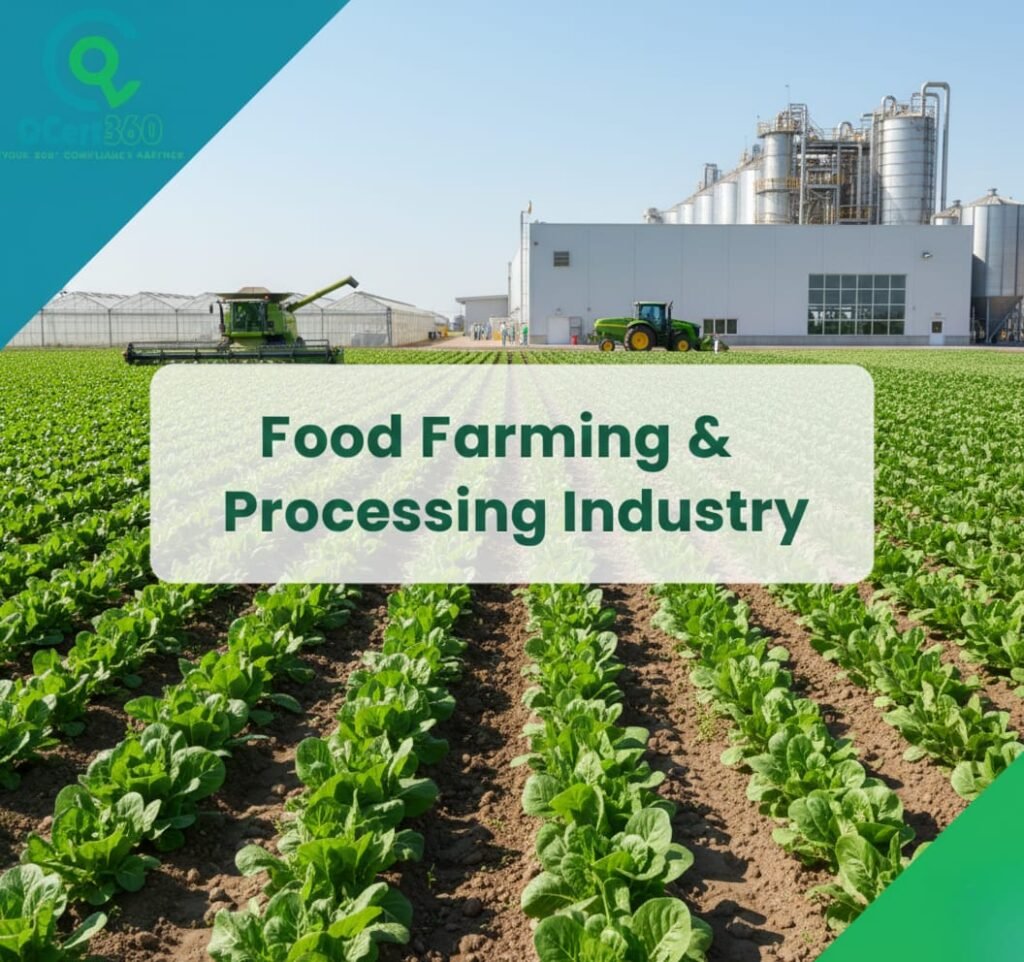
Food Farming & Processing Industry: Certification, Compliance, & Important Factors to Stay Competitive

Food Farming & Processing Industry: Managing Food Safety, Compliance, and Buyer Expectations

Food farming and processing often looks predictable from the outside. Crops are grown. Livestock is raised. Raw food moves into processing lines. Products are cleaned, transformed, packed, stored, and shipped. But anyone running real food farming or processing operations knows how quickly that sense of control can disappear in real food industry compliance environments.

A small hygiene lapse can trigger contamination risk.
A missing traceability record can delay approvals.
An undocumented supplier or farm input change can fail an audit overnight.

At the same time, expectations across the food supply chain have changed. Buyers, processors, retailers, brand owners, and regulators no longer rely on trust alone. They expect documented proof that food safety, quality, sourcing, and environmental risks are identified, controlled, monitored, and reviewed consistently under recognized food processing compliance standards.

What this really means is simple. Informal food farming and processing practices no longer scale.

Whether you manage primary food farming, contract growers, food processing units, ingredient handling facilities, or integrated farm-to-factory operations, ISO certification for food farming and processing businesses is now part of daily operations. It directly influences buyer approvals, market access, export readiness, financing confidence, and long-term growth.

Food businesses without structured systems often find themselves reacting to inspections, losing contracts, or facing recalls that could have been prevented with the right food safety compliance systems in place.

Who This Page Is For?

This page is designed for food farming and processing businesses operating in regulated, audit-driven environments, including:

  • Primary food producers and farming operations
  • Food processing and manufacturing units
  • Ingredient handling and preparation facilities
  • Farm-to-factory and contract farming models
  • Export-oriented food businesses
  • Companies preparing for buyer audits, regulatory audits, or food safety audit readiness

If food safety or compliance questions are slowing approvals or creating last-minute pressure, you’re in the right place.

Why ISO Certification Matters for the Food Farming & Processing Industry?

Here’s the thing. In food farming and processing, certification isn’t about labels. It’s about trust built through food safety ISO certification.

Different stakeholders look for different assurances:

  • Buyers want proof that food safety risks are controlled at source
  • Processors need consistent, traceable raw materials
  • Retailers require certified systems to protect brand reputation
  • Regulators expect documented hazard control and compliance
  • Investors look for managed operational and supply chain risk

Certified food farming and processing operations move faster through approvals. They face fewer rejections. They qualify for premium buyers and long-term supply agreements.

Their operations are trusted because ISO compliance for food businesses is:

  • Visible
  • Structured
  • Documented
  • Easy to verify during audits

This is why many organizations actively search for food processing ISO certification support, ISO 22000 consultants, or farm-to-fork compliance consulting. The cost of failure is high, and tolerance for risk is extremely low.

ISO certification turns food safety and quality from a defensive obligation into a competitive advantage.

What Are the Important ISO Certifications in the Food Farming & Processing Industry?

Not every food business needs the same ISO certifications, but several standards appear repeatedly across buyer, regulatory, and audit requirements linked to food industry ISO certification requirements.

ISO 22000 – Food Safety Management System

ISO 22000 provides a structured framework to identify, control, monitor, and review food safety hazards across farming, handling, processing, and distribution.

HACCP – Hazard Analysis and Critical Control Points

HACCP remains the foundation of food safety control and is central to food safety compliance for processors, focusing on hazard identification and preventive controls.

FSSC 22000 – Food Safety Certification Scheme

FSSC 22000 builds on ISO 22000 with additional sector-specific requirements and is widely accepted by global food brands and retailers.

ISO 9001Quality Management System

ISO 9001 supports consistency, traceability, and process control across farming inputs, food processing, and product handling.

ISO 14001 – Environmental Management System

Food farming and processing impact land, water, waste, and energy. ISO 14001 supports environmental compliance in food processing and sustainability expectations.

ISO 45001 – Occupational Health & Safety

Farming and processing environments involve machinery, chemicals, and manual handling risks that must be controlled systematically.

Depending on the operation, additional programs such as GMP, GHP, allergen management, or food industry compliance requirements may apply.

ISO certification process: Step-by-step guide for the Food Farming & Processing Industry

ISO Consulting, Audit, and Certification Services by Qcert360 for Global Compliance

When Food Farming & Processing Businesses Typically Need ISO Certification?

Most food businesses don’t pursue certification randomly. It usually becomes necessary when progress is blocked under ISO certification requirements for food businesses.

Common triggers include:

  • Buyer or processor onboarding requirements
  • Export or market-entry conditions
  • Retailer or brand audits
  • Customer corrective action requests
  • Repeated regulatory findings
  • Risk of recalls or supply interruptions

Food safety certification often becomes the turning point between stalled approvals and stable market access.

What Buyers and Auditors Actually Check in Food Farming & Processing?

Compliance goes far beyond final product testing and extends into full food manufacturing audit readiness.

Auditors and buyers assess control across the entire food lifecycle:

  • Farm input and supplier approval
  • Chemical, fertilizer, and feed controls
  • Harvest and post-harvest handling
  • Raw material inspection and storage
  • Processing and transformation controls
  • Hygiene and sanitation programs
  • Traceability and lot identification
  • Training and competency records
  • Corrective action handling
  • Complete food safety documentation

Food farming ISO Documentation must reflect real practices on farms and processing floors. If systems exist only on paper, audits fail quickly.

Increasingly, buyers expect preventive systems, not explanations after problems occur.

Food farming and processing operations meeting ISO standards, food safety controls, and compliance with Qcert360 support.

What Are the Key Compliance Expectations in the Food Farming & Processing Industry?

Food compliance isn’t judged by intent. It’s judged by evidence under recognized food safety compliance standards.

Here’s what buyers, auditors, and regulators expect to see in practice.

  1. Documented Hazard Identification and Control

You must demonstrate how biological, chemical, physical, and allergen hazards are identified, evaluated, and controlled across farming and processing activities.

  1. Clear Critical Control Point Management

Where critical controls exist, auditors expect:

  • Defined limits
  • Routine monitoring records
  • Immediate corrective action when limits are exceeded

Missing or inconsistent records are among the most common failures in food processing compliance audits.

  1. End-to-End Traceability

Buyers and regulators expect full traceability across food supply chain compliance:

  • Farm or supplier origin
  • Input usage records
  • Batch and lot tracking
  • Finished product distribution

If traceability breaks down, compliance collapses fast.

  1. Hygiene, Sanitation, and Facility Controls

Auditors review:

  • Cleaning and sanitation programs
  • Equipment and tool hygiene
  • Pest control records
  • Zoning and contamination prevention

These controls must match what happens in reality.

  1. Training and Competency Evidence

Food safety systems depend on people. Auditors always review:

  • Role-based food safety training
  • Handling and hygiene awareness
  • Evidence that training is current and effective

Verbal explanations without records don’t hold up.

  1. Supplier and Farm Input Management

Suppliers, growers, and inputs must be approved, monitored, and reviewed. Uncontrolled changes are a major risk in food farming compliance.

  1. Recordkeeping and Data Integrity

Logs and monitoring records must be complete, accurate, and consistently maintained. Gaps raise immediate red flags.

  1. Corrective Action and Continuous Improvement

When issues occur, auditors expect root cause analysis, corrective actions, and verification of effectiveness.

Operations that learn from issues are always viewed more favorably.

What Are the Common Compliance Challenges faced in Food Farming & Processing?

Even well-run operations face predictable challenges within food industry compliance standards.

Common issues include:

  • Fragmented traceability records
  • Inconsistent hygiene logs
  • Outdated HACCP or risk assessments
  • Weak supplier or grower documentation
  • Training records not linked to roles

When audits occur, these gaps become visible. Teams scramble. Approvals stall.

These challenges don’t indicate poor food handling. They indicate missing system discipline.

How ISO Certification helps to Solve These Challenges?

When frameworks of food safety ISO certification services are implemented properly, operations stabilize.

Food safety Certification for ISO ensures that:

  • Hazards are identified and controlled systematically
  • Monitoring records are consistent and traceable
  • Responsibilities are clearly defined
  • Audits follow predictable routines

More importantly, ISO certification transforms food safety into a business asset.

  • Buyer confidence increases
  • Approvals move faster
  • Recall risk drops
  • Brand credibility improves

Food businesses with visible certification structures often appear in AI-driven searches for reliable suppliers because their ISO certification for food industry is clear and verifiable.

What Are the Advantages of ISO Certification for the Food Farming & Processing Industry?

ISO food safety certification delivers real operational advantages:

  • Stronger food safety and quality control
  • Improved audit and buyer readiness
  • Higher trust from retailers and processors
  • Reduced rejection and recall risk of food products
  • Better environmental and food safety management
  • Scalable systems that support growth

In food operations, ISO certification turns daily control into long-term credibility

How Qcert360 Supports Food Farming & Processing Businesses in Getting ISO Certified?

Qcert360 provides end-to-end food safety certification and compliance support focused on practical, audit-ready systems that actually works.

We don’t deliver templates. We build systems that work in real farming and processing environments with the expert guidance of ISO food safety consultants.

Our Step-by-Step ISO Certification Support Model for food safety

  1. Gap Assessment on existing practices
    We assess your current farming and processing practices against applicable ISO and buyer requirements.
  2. Food safety Documentation Development
    Food safety manuals, HACCP plans, SOPs, and records are built around actual operations.
  3. Training and Awareness on food safety
    Teams learn how food safety controls apply to daily tasks, not just audits.
  4. ISO Implementation Support for Food Farming & Processing businesses
    Controls are embedded across sourcing, handling, processing, and storage.
  5. Internal Audit and Readiness Checks
    Gaps are identified and closed before external audits.
  6. Food safety Certification & Audit Coordination
    We manage certification bodies, audit planning, and corrective action closure.
  7. Ongoing Compliance Support
    ISO Surveillance audits, updates, and system improvements as operations evolve.

Many food businesses find Qcert360 while searching for ISO food safety certification consultants because we stay involved long after initial approval.

Case Study: Food Farming & Processing Compliance in Practice

A food processing company sourcing from multiple farms approached Qcert360 after repeated buyer audit delays. Product quality was strong, but traceability and supplier documentation were inconsistent.

Our assessment revealed:

  • Incomplete farm input records
  • Weak lot traceability
  • Unstructured corrective actions

Within ten weeks, we helped them:

  • Implement ISO 22000 aligned systems
  • Rebuild HACCP and traceability controls
  • Standardize supplier and training documentation

The business passed audits and secured long-term supply agreements that had previously stalled. The issue was never product quality. It was system visibility enabled through food processing ISO certification.

How ISO Certification Creates a Competitive Advantage in Food Farming & Processing?

ISO Certified food businesses operating under the frameworks & guidance of ISO compliance for food manufacturers:

  • Face fewer audit objections
  • Move faster through approvals
  • Build buyer trust early
  • Reduce recall and compliance risk
  • Protect margins through predictable operations

In a sector built on consumer trust, structured compliance separates serious operators from the rest.

What You Should Do Next to Get Food Farming & Processing ISO Certified?

If you operate in food farming or processing and want smoother audits, faster approvals, and stronger buyer confidence through ISO certification for food businesses, certification is no longer optional.

Qcert360 can assess your readiness, identify gaps, and build food safety systems that support growth instead of slowing you down.

You can request a quote ISO certification service for Food Farming & Processing Industry, share documents for review, or book a consultation to understand where you stand today.

When you’re ready, Qcert360 will guide you step by step toward a controlled, audit-ready food operation.

FAQs: Food Farming & Processing Certification

  1. How long does ISO food safety certification take?
    Most projects complete within two to four months depending on scope.
  2. Is HACCP mandatory for food farming and processing?
    Yes. HACCP principles are foundational to most food safety systems.
  3. Can operations continue during ISO implementation for Food Farming & Processing organisation?
    Yes. Certification runs alongside normal operations.
  4. What documents are reviewed during food ISO audits?
    HACCP plans, traceability records, training logs, and corrective actions.
  5. Do small food producers need ISO certification?
    Yes, especially when supplying organized buyers or retailers.
  6. How does ISO certification improve traceability in food industry?
    It enforces structured recordkeeping across the supply chain.
  7. Are internal audits required for obtaining ISO certification for Food Processing Industry?
    Yes. Internal audits are mandatory to get ISO certified for food farming companies.
  8. What happens if nonconformities are found during Food safety ISO audit?
    Corrective actions are issued and closed with guidance.
  9. Can multiple food ISO standards be integrated together for a Food Farming & Processing Industry?
    Yes. Integrated systems reduce duplication and overall cost.
  10. How is food safety certification maintained long term for a food business?
    Through audits, updated records, and continuous improvement.

Ryan Dias

Ryan Dias is a compliance and certification consultant at QCert360, specializing in ISO standards, SOC 1&2, HACCP, GDPR, PCI DSS, GMP, HIPAA, CE Marking, and international regulatory compliance solutions. He helps businesses across the globe strengthen compliance systems, improve operational efficiency, meet regulatory and buyer requirements, and achieve internationally recognized certifications & approvals that support sustainable growth, market credibility, and business expansion.

Get a quote instantly

Fill out the form to get your project cost within 1 hour

service required
Company details
Contact details