GMP & HACCP Certification in South Korea – Get Expert Certification Support for Your Food Business
GMP & HACCP Certification in South Korea – Expert Support for Food Safety Compliance
GMP & HACCP Certification Services in South Korea help food businesses prove that the food they make, handle, and ship is safe. QCert360 offers GMP certification services in South Korea and HACCP certification services in South Korea, covering everything from the first site review to audit day. Our GMP and HACCP consultants in South Korea build your system, train your people, and prepare you for an independent audit.
This guide explains what certification involves, what auditors expect, how long it takes, and what it costs. Read the sections that match your stage, then request a quotation.
GMP & HACCP Certification Services in South Korea: Overview and Business Benefits
GMP and HACCP certification services in South Korea help food businesses control hazards, maintain hygiene, and meet buyer expectations. QCert360 supports food manufacturers, processors, caterers, exporters, and other food businesses through gap analysis, documentation, staff training, system implementation, and audit preparation. Our GMP and HACCP consulting services are tailored to different operations, from small kitchens to large production facilities. By establishing documented food safety controls and preparing for an independent audit, businesses can strengthen compliance, improve traceability, and demonstrate their commitment to food safety. Certification is granted by the relevant certification body following an assessment against the applicable scheme requirements.
Food safety certification is increasingly important for businesses supplying supermarkets, hotels, institutional buyers, and international markets. These customers often expect clear evidence of contamination prevention, hygiene monitoring, corrective actions, and consistent production practices. GMP provides the foundation for hygienic operations, while HACCP identifies and controls specific food safety hazards. Together, they help businesses build a practical food safety system that supports customer confidence, audit readiness, and long-term business growth.
Several market trends in food safety explain why certification matters more each year:
- Buyer-driven standards: Retailers, hotels, and manufacturers ask suppliers for documented food safety certification before they place orders.
- Digital monitoring: Sensors, tablets, and cloud logs now replace paper checklists for temperature, cleaning, and inspection records.
- Traceability expectations: Customers expect lot-level tracking and fast, clean recalls.
- Allergen scrutiny: Cross-contact and labelling errors drive a large share of recalls worldwide.
- Food fraud awareness: Buyers now expect authenticity checks as part of supplier control.
- Remote auditing: Auditors increasingly review records online before they visit.
- Integrated systems: Many companies connect GMP and HACCP to broader management systems for quality and safety.
Meeting regulatory compliance expectations and food industry standards is a moving target. A certified system gives you a stable base to adapt from, because the same hazard-control logic applies whenever requirements shift.
What Are the Benefits of GMP and HACCP Certification for Food Manufacturers?
Safer products through improved food safety practices.
Fewer recalls by identifying and controlling food safety risks.
Stronger customer trust and confidence in product quality.
Better access to buyers and potential export markets.
Reduced waste and rework through consistent processes.
Improved complaint handling with clear procedures and records.
Effective food quality assurance through documented checks and monitoring.
Stronger food quality control with reliable production data.
Clear staff responsibilities and consistent working methods.
Fewer operational errors through standardized procedures across shifts.
What Are GMP and HACCP Certification and Why Do Businesses Need Them?
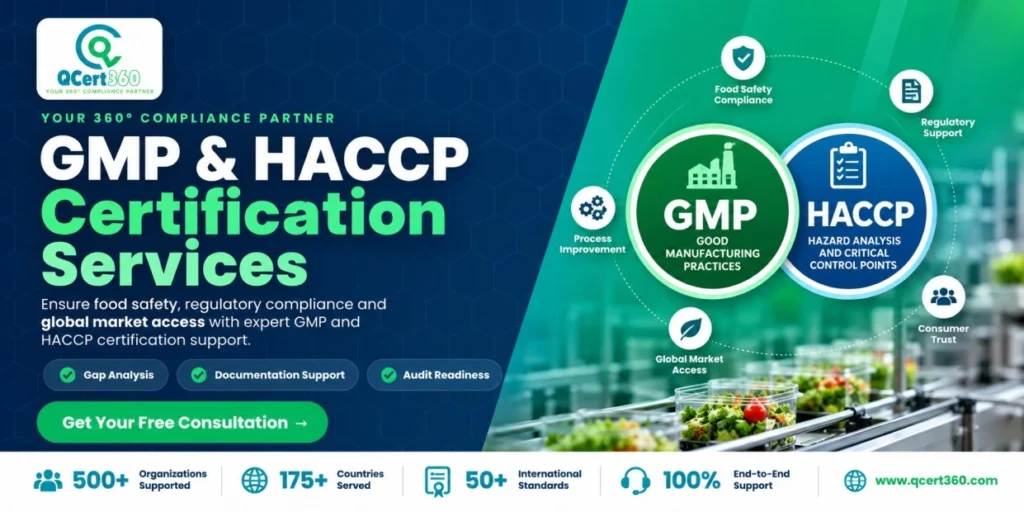
GMP and HACCP are two linked food safety methods. Good Manufacturing Practice sets the baseline conditions for clean, controlled production. Hazard Analysis and Critical Control Points identifies specific hazards and controls them at defined process steps. Certification confirms, through an independent audit, that you apply both.
GMP certification focuses on the environment and the people. It covers premises, equipment, materials, personnel, and production controls. It rests on food hygiene fundamentals, including good hygiene practices for staff and facilities and good storage practices for materials and finished goods.
HACCP certification focuses on risk. It asks you to analyze each product and process, find the steps where a hazard can be prevented or removed, and prove that your controls work. The method is preventive. It stops a problem before it reaches the customer, rather than finding it afterward.
Both methods reflect the Codex Alimentarius, the international food standards framework that buyers and auditors use as a common reference. Its general principles of food hygiene and HACCP guidance underpin most commercial food safety schemes. Many companies later extend their system to ISO 22000 food safety management, which adds management system elements such as leadership, objectives, and continual improvement.
Businesses need both for three reasons:
- Prevention: Controls stop hazards before products leave the site.
- Proof: Records and audits show customers that controls actually work.
- Consistency: Shared food manufacturing standards give every shift the same method.
Think of GMP as the foundation and HACCP as the targeted layer on top. Together they form a food safety management system that protects consumers and your brand.
GMP and HACCP Certification Requirements for Businesses in South Korea
Requirements fall into two groups. GMP requires clean premises, controlled processes, trained staff, and written procedures with records. HACCP requires a documented hazard analysis, critical control points, validated limits, monitoring, corrective actions, verification, and record keeping. An auditor checks that all of these work in daily practice, not just on paper.
What Are the GMP Certification Requirements in South Korea?
GMP certification requires hygienic premises, sanitary equipment, trained personnel, controlled production, and written procedures with matching records. Auditors check that food production controls are applied consistently. They sample records, observe work, and interview staff on the floor.
Core GMP expectations include:
- Premises hygiene: Layout, floors, walls, drainage, ventilation, lighting, and waste handling must support clean production and prevent cross-contamination.
- Equipment sanitation: Equipment must be designed for cleaning, maintained on schedule, and calibrated where measurement matters.
- Sanitation procedures: Written sanitation standard operating procedures define what to clean, how, how often, and who checks it. Cleaning and disinfection steps should name chemicals, concentrations, and contact times.
- Personal hygiene requirements: Staff follow rules on handwashing, protective clothing, jewelry, illness reporting, and behaviour in production areas.
- Pest control management: A defined program prevents, detects, and responds to pests.
- Supplier approval and raw material inspection: You approve suppliers on defined criteria and check materials on arrival.
- Traceability system: You can track materials and products one step back and one step forward.
- Food recall procedures: You can identify, isolate, and withdraw affected products quickly.
- Temperature monitoring: You measure and record temperatures for storage, processing, and transport.
- Food handling procedures: Staff handle, store, and move food in ways that prevent contamination.
Strong food production hygiene depends on understanding, not just compliance. Staff who know why a rule exists follow it under pressure. Documented quality management procedures cover complaints, changes, and records, so improvements stick.
What Are the HACCP Certification Requirements in South Korea?
HACCP certification requires a trained team, product descriptions, process flow diagrams, a documented hazard analysis, defined critical control points, validated critical limits, monitoring, corrective actions, verification, and records. Prerequisite programs, such as GMP, must support the plan. Without them, the plan has no stable base.
The seven HACCP principles structure the work:
- Conduct a hazard analysis.
- Determine the critical control points.
- Establish critical limits.
- Establish monitoring procedures.
- Establish corrective actions.
- Establish verification procedures.
- Establish documentation and record keeping.
Your hazard analysis must cover biological hazards, chemical hazards, and physical hazards. It must also cover allergens, because allergen management is a frequent audit focus. A food safety risk assessment rates each hazard by severity and likelihood, then selects controls in proportion. Good food safety risk management turns general good practice into targeted hazard prevention.
Typical food safety hazards fall into four groups:
- Biological hazards: Pathogenic bacteria, viruses, parasites, and spoilage organisms.
- Chemical hazards: Cleaning chemical residues, pesticide traces, and unapproved additives.
- Physical hazards: Glass, metal, plastic, wood, and stone fragments.
- Allergens: Undeclared or cross-contacted allergenic ingredients.
Effective food contamination prevention uses layers. Supplier controls reduce incoming risk, process controls remove hazards, and sanitation prevents re-contamination. Monitoring confirms each layer works, and corrective actions respond when it does not.
Step-by-Step GMP and HACCP Certification Process for Facilities in South Korea
The process has eight steps: commitment, gap analysis, planning, system build, training, operation, internal audit, and certification audit. A consultant shortens the path and prevents avoidable findings. Each step creates records that the certification body will later review.
How to Get GMP and HACCP Certification in South Korea
Follow these steps in order:
- Secure management commitment. Ensure that management defines the certification scope, assigns responsibilities, and provides the resources needed to implement food safety practices.
- Conduct a gap analysis. Review your existing processes and compare them with applicable GMP and HACCP requirements to identify areas that need improvement.
- Develop an implementation plan. Establish clear tasks, assign responsibilities, and set realistic timelines for implementing the required food safety procedures.
- Implement the system. Develop documented procedures, prepare a HACCP plan, establish hazard control measures, and create the necessary record-keeping forms.
- Train your employees. Provide training on personal hygiene, sanitation, hazard identification, food handling, and accurate record keeping to ensure employees understand their responsibilities.
- Implement and maintain records. Put the documented procedures into practice and maintain sufficient records to demonstrate that food safety controls are consistently followed.
- Conduct internal audits and corrective actions. Review the effectiveness of your food safety system through internal audits, identify non-conformities, and implement corrective actions before the certification audit.
- Complete the certification audit. An independent certification body evaluates the implemented system against the applicable requirements and determines whether certification can be granted.
Our GMP and HACCP audit preparation support includes mock audits that mirror the real one. Food safety audit preparation also coaches staff on how to explain their work, where to find records, and how to answer auditor questions calmly.
What Is the Process for HACCP Implementation in South Korea?
HACCP implementation follows a logical sequence. You form a multidisciplinary team, describe each product and its intended use, draw and verify a process flow diagram, perform the hazard analysis, identify critical control points, set critical limits, define monitoring, plan corrective actions, and set verification activities. Then you train operators and start recording.
After rollout, verification confirms that the plan works. It uses record review, internal audits, and sometimes microbiological testing. Manufacturing process validation shows that your critical limits actually control the hazard, for example that a cooking time and temperature reliably destroy target pathogens. Review the plan whenever products, suppliers, equipment, or processes change.
A food safety certification audit has two parts. The auditor first reviews your documents. The auditor then walks the plant, observes work, interviews staff, and samples records. Findings are graded, and you must respond with a food safety corrective action plan within the agreed timeline.
GMP and HACCP Consulting, Implementation and Compliance Services in South Korea
Consulting services help you design, build, and maintain the system. A consultant brings method, audit experience, and practical tools, while your team keeps ownership. QCert360 provides food safety consultancy that covers GMP, HACCP, and related standards, so you can buy one service or a combined package.
Our work typically includes:
- GMP consultancy in South Korea: Premises review, procedure development, training, and records.
- HACCP consultancy in South Korea: Hazard analysis, plan development, validation support, and monitoring design.
- GMP implementation services in South Korea: Hands-on rollout of hygiene, sanitation, and control programs.
- GMP certification consultants in South Korea and HACCP certification consultants in South Korea: Specialists who prepare you for the certification audit.
- HACCP implementation consultants in South Korea: Teams who lead the plan from workshop to daily use.
- GMP and HACCP compliance consultants in South Korea: Ongoing support to maintain standards after certification.
Some clients prefer to build most of the system themselves and want targeted help. Others want HACCP implementation support in South Korea that run the whole project. Either way, we adapt scope and effort to your needs.
Consultants also support food processing compliance and food manufacturing compliance by checking that daily operations match the documented system. If you plan to sell widely, that consistency makes customer audits far easier.
How Can a Food Processing Company in South Korea Implement GMP and HACCP?
A food processing company implements GMP and HACCP by fixing hygiene basics first, then building the HACCP plan on top. Start with a gap analysis, assign owners, document procedures, train staff, run the system, and audit yourself. Outside support shortens trial and error.
A practical implementation process includes the following steps:
- Establish hygiene and sanitation controls. Implement cleaning schedules, pest control measures, personal hygiene rules, and proper waste management practices.
- Approve suppliers and inspect raw materials. Evaluate suppliers, establish purchasing requirements, and inspect incoming ingredients and packaging materials to ensure they meet defined quality and safety criteria.
- Map the production process. Document each stage, from receiving raw materials to processing, packaging, storage, and distribution.
- Conduct hazard analysis. Identify biological, chemical, and physical hazards at each stage and determine critical control points where necessary.
- Establish monitoring procedures. Use calibrated thermometers, inspection checklists, and monitoring logs to verify that critical limits and other food safety controls are maintained.
- Train employees and maintain records. Ensure workers understand their duties, follow documented procedures, and accurately record food safety activities.
- Conduct internal audits. Review the implemented GMP and HACCP systems, correct identified gaps, and prepare for the certification audit.
GMP and HACCP Documentation Requirements for Food Businesses in South Korea
Documentation proves that controls exist and work. Auditors usually read documents first and then compare them with what they see on the floor. Clear food safety documentation also helps staff follow the same methods every day. Keep documents short, accurate, and controlled.
What Documents Are Required for GMP and HACCP Certification?
You need a food safety policy, a defined scope, the HACCP plan with its hazard analysis, process flow diagrams, prerequisite program procedures, monitoring and verification records, training records, supplier approval files, traceability and recall records, and corrective action logs. Internal audit reports and management review records complete the set.
Common documents include:
- Food safety policy and scope
- Product descriptions and intended use
- Process flow diagrams
- Hazard analysis and HACCP plan
- Critical control point monitoring sheets
- Cleaning, pest control, and handling procedures
- Sanitation schedules and checklists
- Supplier approval and incoming inspection records
- Temperature and calibration logs
- Mock recall and traceability test records
- Allergen controls and labelling checks
- Training and competence records
- Internal audit and corrective action records
Good standard operating procedures name who performs the task, when, how, and what record proves it. Long, generic manuals gather dust. Short, task-based instructions get used. Control versions, so staff always work from current documents, and keep records legible and signed.
GMP Gap Analysis and HACCP Plan Development Services in South Korea: How Does a GMP Gap Analysis Work?
A GMP gap analysis compares your current practice with every GMP requirement and shows what is missing, weak, or already compliant. HACCP plan development builds a tailored plan for your products and processes. Together, they form the starting point of nearly every project and set your budget and timeline.
Consultants visit your site, review records, observe work, and interview staff. They rate each area and deliver a prioritized action plan with owners and dates. The review covers premises, equipment, sanitation, personnel, suppliers, storage, traceability, and documentation.
Many businesses choose this as a low-commitment first step. It shows exactly where you stand, which fixes are urgent, and what you can do in-house.
How Does HACCP Plan Development Work?
HACCP plan development starts with a multidisciplinary team that knows the product and process. The team describes products, maps steps, identifies hazards, selects critical control points, sets critical limits, and defines monitoring, corrective actions, and verification. We keep the plan practical, so operators can use it every shift.
A strong plan has these features:
- Clear product and process descriptions: Details about ingredients, processing methods, packaging, storage conditions, and intended use.
- Risk-based hazard analysis: Identification and assessment of potential food safety hazards at each processing stage.
- Defined control measures: Procedures to prevent, eliminate, or reduce identified hazards to acceptable levels.
- Measurable critical limits: Specific limits, such as temperature or time, for each critical control point where applicable.
- Assigned monitoring responsibilities: Named employees, monitoring frequencies, and methods for checking that controls remain effective.
- Documented corrective actions: Clear instructions for handling deviations, including affected products and steps to restore control.
- A verification schedule: Planned activities to confirm that the HACCP plan is implemented correctly and remains effective, supported by appropriate records.
GMP and HACCP Certification Cost in South Korea: Key Pricing Factors
Cost depends on site size, product complexity, current maturity, support level, and audit days. It has three parts: consulting fees, certification body fees, and internal effort. Request a written quote from each provider and compare scope line by line. Compare the total cost, scope of services and level of audit preparation – not just the initial fee, not the lowest single fee.
The main drivers of GMP and HACCP certification cost in South Korea include:
- Number of sites, lines, and employees
- Range of products and process complexity
- Condition of premises and equipment
- Quality of existing records
- Depth of consulting, from advice only to full implementation
- Laboratory and microbiological testing needs
- Certification body audit days
- Surveillance audits in later years
How Much Does GMP and HACCP Certification Cost in South Korea?
Total price varies widely by facility. A small, organized site pays far less than a multi-line plant that needs equipment changes. Request a scoped quotation after a short call. Ask each provider to separate consulting, testing, training, and certification fees, so you can compare offers fairly.
QCert360 offers affordable GMP and HACCP certification services in South Korea through clear scopes and phased delivery. You can begin with a gap analysis and add services as you progress. We tie every fee to a deliverable. We also provide HACCP certification services for food businesses in South Korea that need a lean, right-sized package.
How Can You Keep Costs Under Control?
Fix basic hygiene early, keep documents lean, train internal auditors, and test only what your hazard analysis requires. Combining GMP and HACCP in one project avoids duplicate effort. An early gap analysis prevents expensive rework later, because surprises found at the certification audit cost more than surprises found in planning.
What Is the Difference Between GMP and HACCP Certification for Businesses
GMP sets general hygiene and production conditions across the whole site. HACCP identifies and controls specific hazards at defined process steps. GMP is the foundation, and HACCP is the targeted layer built on it. Most buyers expect both, so businesses usually implement them together.
Aspect | GMP | HACCP |
Focus | General hygiene and production conditions | Specific hazards and critical control points |
Approach | Baseline controls across the site | Process-step controls based on risk |
Key tools | Procedures, sanitation, training, pest control | Hazard analysis, critical limits, monitoring |
Evidence | Checklists, inspection and training records | HACCP plan, monitoring logs, verification |
Relationship | Prerequisite for HACCP | Built on GMP |
The two methods depend on each other. A strong HACCP plan fails when sanitation, pest control, or supplier control is weak. In the same way, GMP without hazard analysis leaves critical risks unmanaged. Together they give auditors confidence that you control both the environment and the process.
GMP and HACCP Certification for Food Manufacturers and Processing Companies
Manufacturers and processors face the widest hazard range, because they transform raw materials into packaged products. Audits examine process flow, equipment, cross-contamination routes, and validation. A strong system helps these businesses win contracts with larger buyers and pass customer audits more smoothly.
For GMP and HACCP certification for food processing companies in South Korea, we focus on the points where hazards enter or grow:
- Raw material receipt and storage
- Production line hygiene and equipment sanitation
- Allergen changeover and cleaning verification
- Metal detection and foreign body controls
- Cooking, chilling, and pasteurization steps
- Packing, labelling, and lot coding
- Cleaning validation and microbiological testing
South Korea food manufacturers also benefit from tying GMP and HACCP to quality management procedures. Consistent records make complaint handling, internal reviews, and customer audits easier. When you are ready, you can step up to a broader management system.
Our GMP certification consultants for food manufacturers in South Korea work with your production, quality, and maintenance teams to build controls that suit your lines. Our GMP and HACCP consulting services for food manufacturers in South Korea bring together hygiene, hazard analysis, and documentation in one plan. For plants that need hands-on rollout, GMP implementation support for food processing companies in South Korea can lead the work on the production floor.
GMP and HACCP Certification for Restaurants, Catering and Hospitality Businesses
Restaurants, caterers, and hospitality operators serve food directly to consumers, so mistakes reach people quickly. Their priorities are temperature control, cross-contact prevention, handwashing, safe storage, and staff training. A tailored HACCP system fits kitchen reality without heavy paperwork.
What Does Certification Mean for Restaurants?
GMP and HACCP certification for restaurants in South Korea centers on receiving checks, storage, cooking and holding temperatures, cleaning routines, allergen controls, and staff behaviour. Simple logs and station checklists usually work better than large manuals. Kitchens change fast, so procedures must be short and visual.
What Does Certification Mean for Catering Businesses?
GMP and HACCP certification for catering businesses in South Korea adds transport, hot and cold holding, event setups, and batch production. Caterers often cook in one place and serve in another, so time and temperature control becomes the critical control point. Clear labelling and allergen communication matter even more when food leaves the kitchen.
Key controls for both include:
- Receiving and inspecting ingredients
- Safe thawing, cooking, cooling, and reheating
- Allergen management and clear labelling
- Handwashing and illness reporting
- Cleaning and disinfection schedules
- Regular food safety training for all staff
Hotels and large catering firms also use these systems to pass customer audits and win tenders from institutional buyers.
How Can South Korea Food Exporters Meet International Food Safety Requirements?
South Korea food exporters meet international food safety requirements by building a recognized system, such as GMP and HACCP aligned with Codex principles, and proving it through audits and records. They should also confirm buyer-specific rules, strengthen traceability, validate controls, and keep documents ready for review.
Key areas of support include:
- Buyer requirement reviews: Identify food safety standards, specifications, and documentation expected by international customers.
- Export compliance checks: Review applicable destination-market requirements and identify gaps in existing food safety practices.
- Supply chain traceability: Track ingredients, suppliers, production batches, and finished products throughout the supply chain.
- Labelling and allergen controls: Check product labels, ingredient declarations, allergen information, and applicable labelling requirements.
- Lot coding and batch records: Maintain records linking raw materials to finished products and individual shipments.
- Audit preparation: Prepare for customer assessments, certification audits, and food safety inspections.
Why Is Traceability Important for Food Exporters?
Traceability helps exporters identify the source, processing history, and destination of a food product. For example, a Kenyan exporter shipping processed fruit, coffee, vegetables, or packaged foods should maintain records connecting supplier information, batch numbers, processing dates, quality checks, and shipment details.
Regular traceability tests and mock recalls help businesses assess how quickly they can identify affected batches and locate customers who received them. Effective records can support faster investigations, more targeted recalls, and greater confidence among international buyers.
QCert360 provides GMP and HACCP consulting and certification preparation support to help food businesses in South Korea strengthen their food safety systems and prepare for applicable audits. Certification requirements depend on the relevant scheme and scope, while destination-market compliance must be assessed separately.
What About Packaging Companies?
GMP and HACCP certification for food packaging companies South Korea must address packaging materials, printing inks, adhesives, migration risk, and cleanliness. Packers also need controlled storage, clean production areas, and strong supplier approval. Packaging can contaminate food before it ever reaches the filling line, so supplier and material controls carry extra weight.
Common GMP and HACCP Compliance Challenges and How to Overcome Them
The most common challenges are weak management support, poor records, untrained staff, outdated hazard analyses, and inconsistent sanitation. Each leads to audit findings and real contamination risk. Practical fixes exist for each one.
- Weak leadership support: Present the business case, assign owners, and review progress monthly.
- Paper-only systems: Link procedures to daily checks, so records reflect real work.
- Untrained staff: Use short, role-based sessions with practical demonstrations.
- Weak supplier control: Approve suppliers on clear criteria and track their performance.
- Poor traceability: Run mock recalls and fix gaps in lot coding.
- Allergen cross-contact: Separate, label, and verify cleaning after allergen runs.
- Unvalidated limits: Support critical limits with evidence, not assumption.
- Slow corrective action: Record the cause, fix it, and verify the fix worked.
- Outdated plans: Review the HACCP plan after any product or process change.
Consistent food safety monitoring catches small deviations before they become incidents. Regular internal audits and food safety training keep discipline high. When something fails, a structured corrective action approach shows auditors that your system learns.
How to Choose GMP and HACCP Certification Consultants in South Korea
Choose consultants with food industry experience, a defined method, written deliverables, and honest timelines. Ask for sample outputs and references. Confirm that they train your team, stay independent from the certification body, and avoid guarantees. A good consultant helps you own the system, not depend on them.
How Do I Choose GMP and HACCP Consultants in South Korea?
Compare providers using a short checklist:
Sector experience: Choose consultants who have worked with similar food products, processing methods, and food safety risks.
Implementation method: Look for a clear process covering gap analysis, documentation, implementation, staff training, and audit preparation.
Scope and pricing: Request a written quotation that defines the deliverables, timelines, responsibilities, and any additional costs.
Employee training: Confirm that training on hygiene, hazard control, monitoring, and record keeping is included.
Independence: Check for potential conflicts of interest and ensure that the consultant’s role is separate from the independent certification decision.
Audit support: Ask whether the service includes mock audits, non-conformity reviews, and guidance on corrective actions.
Knowledge transfer: Select a provider who helps your team manage and maintain the GMP and HACCP systems independently after implementation.
Look for providers who ask about your products, hazards, and customers before quoting. Generic templates rarely survive a real audit.
Why Choose QCert360 for GMP and HACCP Certification Support in South Korea?
QCert360 is a global ISO certification and management consulting firm serving clients across 195 countries. Our team supports audit and certification readiness across food safety and management system standards, including ISO 22000 and GMP. We bring structured methods, practical documents, and clear communication to every project.
Here is what clients can expect:
- Experienced consultants: Professionals who have worked through real audits.
- Practical systems: Lean procedures that operators actually follow.
- Transparent pricing: A clear quote before work starts.
- Skills transfer: Training that leaves your team confident.
- Full-path support: Gap analysis, implementation, mock audit, and certification support.
- Independent roles: We prepare you, and an independent certification body audits you.
Our approach rests on a simple belief: certification should be a by-product of a system that works. When your team understands the controls, audits become routine.
How to Achieve GMP and HACCP Certification Together
Achieve both together by building GMP as the foundation and layering HACCP on top in one integrated project. Share documents, training, and audits across both. This approach saves time and produces a single coherent food safety management system instead of two separate ones.
A combined route works well:
- Scope once: Define products, processes, and sites for both.
- Run one gap analysis: Cover GMP and HACCP together.
- Fix prerequisites first: Sanitation, pest control, hygiene, and supplier approval.
- Develop the HACCP plan: Build it on top of stable GMP controls.
- Train once: Teach staff the full system in one program.
- Audit together: Run combined internal audits and one corrective action process.
- Book the certification audit: Ask the certification body to assess both.
Many companies later extend the combined system to ISO 22000, which adds leadership, objectives, and improvement cycles. A shared structure makes that step smoother, because the core hazard-control work is already in place.
Get a GMP and HACCP Certification Quote in South Korea
Need help preparing your food business for GMP or HACCP certification? QCert360 can help you assess your current practices, identify implementation gaps and plan the next steps toward certification.
Share a few details about your business so we can understand your requirements.
- Business type and products you manufacture
- Facility location and number of sites
- Current food safety system, if any
- Required certification scheme, if known
- Target certification timelines
Request a quotation to discuss the scope, expected timeline and support required for your business.
Frequently Asked Questions About GMP and HACCP Certification in South Korea
What is the difference between GMP and HACCP certification?
GMP covers baseline hygiene and production conditions. HACCP controls specific hazards at critical control points. GMP supports HACCP, so most businesses use both together.
Can small food businesses in South Korea obtain HACCP certification?
Yes. HACCP applies to any size. Small businesses use simple plans, short records, and clear checklists. A consultant can scale the system to your operation and avoid heavy paperwork.
Is HACCP the same as ISO 22000?
No. HACCP is a hazard control method. ISO 22000 is a management system standard that includes HACCP principles plus leadership, planning, and improvement.
What are critical limits?
Critical limits are measurable boundaries, such as time, temperature, or pH, that separate safe from unsafe at a critical control point.
How often should we run internal audits for HACCP & GMP standards?
Run internal audits at planned intervals based on risk. Many firms audit high-risk areas quarterly and the whole system at least once a year.
What happens if a critical limit is missed?
Staff follow the defined corrective action, isolate affected product, investigate the cause, and record the event. Management reviews repeated deviations to find systemic fixes.
Do we need laboratory testing to get GMP certification?
Testing helps verify controls and validate processes. The type and frequency depend on your hazards, products, and customer requirements.
How long should we keep records?
Keep records at least as long as the product’s shelf life, and longer where customers or the certification body require it.
Can QCert360 support GMP and HACCP together?
Yes. We run combined projects from gap analysis to mock audit and support readiness for related food safety standards.
What information is needed for a GMP and HACCP quotation?
Providers generally need the business location, number of sites, products and processes, employee count, current food safety controls, required certification scheme and level of implementation support.
Can a small food processing business obtain GMP and HACCP certification?
Potentially, yes. The system can be scaled to the business’s products, processes and hazards. The business must still meet the requirements of the selected certification scheme.
Does GMP or HACCP certification replace a food business licence in South Korea?
No. Certification and regulatory licensing are distinct. Food businesses should verify the applicable licensing and regulatory requirements with the relevant authorities in South Korea.
Can GMP and HACCP be implemented together?
Yes. Businesses can implement GMP prerequisite controls and a HACCP plan within one coordinated food safety project. Whether both can be assessed under one certification arrangement depends on the certification scheme and certification body’s scope.
How do I choose a GMP and HACCP certification company in South Korea?
Compare the provider’s relevant industry experience, implementation scope, documentation support, training, pricing transparency and relationship with the certification body. Confirm which certification scheme will be used and who will issue the certificate.
Do Food Manufacturers in South Korea Need GMP and HACCP Certification?
Most food manufacturers need a documented GMP and HACCP system to serve serious buyers, even when certification itself is voluntary. Retailers, exporters, and institutional customers often request certificates before approving a supplier. Check your customer contracts and target markets, because the buyer’s requirement usually decides what you need.
Which Businesses Need GMP and HACCP Certification in South Korea?
Manufacturers, processors, packers, caterers, restaurants, storage operators, and exporters benefit most. Any business that prepares, handles, or packs food for others should consider it. Companies that supply hotels, supermarkets, airlines, or overseas buyers usually face the strongest pressure to certify.
Who Provides GMP and HACCP Certification Services in South Korea?
Two types of provider matter. Consultants, like QCert360, prepare you through gap work, documents, training, and mock audits. Independent certification bodies audit you and issue the certificate. Keep these roles separate. A consultant should never promise an audit result, because only the certification body decides.
How Long Does GMP and HACCP Certification Take in South Korea?
Most small and mid-sized facilities complete the process in roughly two to six months. Complex sites, several product lines, or weak existing records extend that range. Management time, training speed, and how quickly you close findings affect the timeline most. A gap analysis at the start gives you a realistic schedule and prevents surprises.
GMP and HACCP Certification for Food Exporters and Packaging Companies
Exporters and packers must meet buyer and destination-market expectations, which often go beyond domestic basics. They also need accurate labelling, packaging safety, and consistent records across batches. A certified system reduces shipment holds, rejections, and customer complaints.
Ready to Get your company HACCP & GMP Certified in South Korea?
Ready to strengthen your food safety system? QCert360 gives you a clear plan, expert support, and transparent pricing. Our team combines site review, documentation, training, and audit preparation in one project.
- Request a quotation for GMP & HACCP Certification Services in South Korea.
- Book a gap analysis to see exactly what your site needs.
- Talk to an HACCP & GMP expert about implementation, training, and audit readiness.
Share your products, site size, and target date. We will reply with a clear proposal and next steps. Contact QCert360 at qcert360.com and take the next step toward certified food safety.
Our Services
ISO Standards
- ISO 9001 Certification
- ISO 14001 Certification
- ISO 45001 Certification
- ISO 22000 Certification
- ISO 17025 Certification
- ISO 27001 Certification
- ISO 13485 Certification
- ISO 20000-1 Certification
- ISO 41001 Certification
- ISO 22716 Certification
- ISO 50001 Certification
- ISO 22301 Certification
- ISO 29993 Certification
Product Certifications
Other international standards
- FSSC 22000 Certification
- HIPAA
- HACCP Certification
- SA 8000 Certification
- GMP Certification
- GDPR
- GDP Certification
- GLP Certification
- Certificate of Conformity