
ISO 22000 Certification for Food Companies in Albania– Requirements, Benefits, Costs & Process
Protect Your Brand, Your Customers, and Your Export Contracts with a Certified Food Safety Management System:
A single contaminated batch, one missed allergen label, or an undocumented temperature breach can undo years of work building a food brand. Retailers are tightening supplier requirements, EU buyers are asking harder questions about traceability, and food safety inspections leave little room for improvisation. ISO 22000 certification for food companies in Albania gives quality managers and business owners a structured, internationally recognized way to answer all of this at once — with one system instead of a patchwork of spreadsheets, sticky notes, and tribal knowledge held by your most experienced employee.
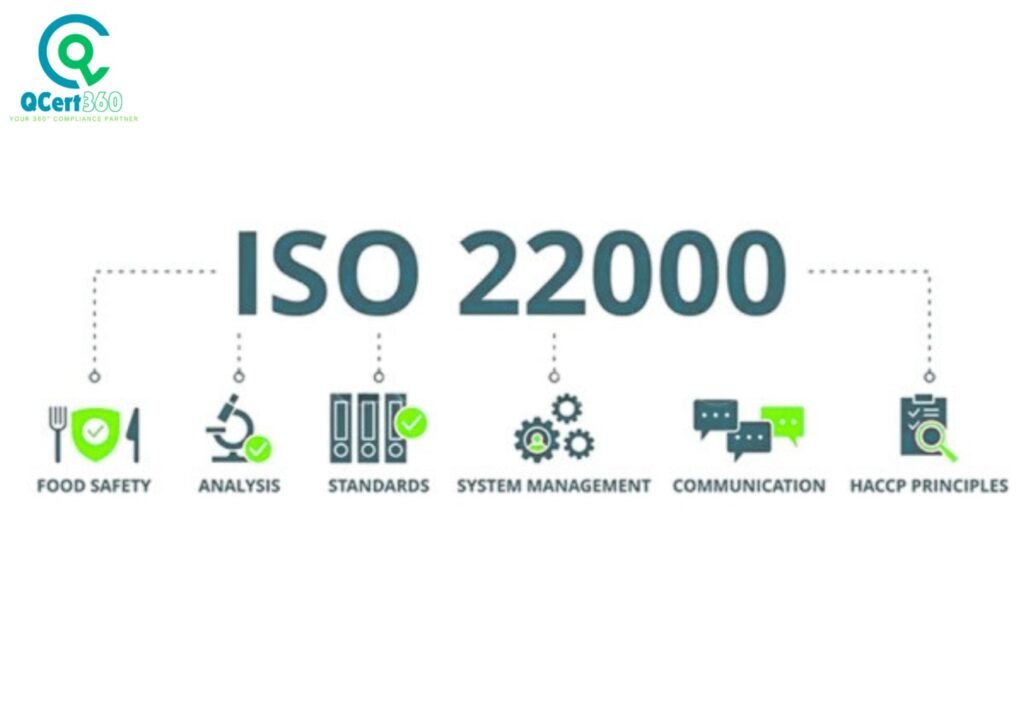
So what is ISO 22000 certification for food companies in Albania, exactly? It’s the global standard for Food Safety Management Systems (FSMS), published by the International Organization for Standardization and built on Codex Alimentarius principles. Rather than treating food safety as a checklist completed once a year before an audit, ISO 22000 asks a company to run hazard analysis, supplier control, traceability, and continuous improvement as part of normal daily operations. For a dairy, bakery, seafood processor, or ingredient supplier in the food and beverage processing industry, that means fewer surprises, faster onboarding of new retail and export clients, and a paper trail that holds up under scrutiny.
This page walks through exactly what the certification involves, what it costs, how long it takes, and how to get started — written for the people who actually have to implement it, not just sign off on it.
Is ISO 22000 Certification Mandatory for Food Companies in Albania?
This is usually the first question on a quality director’s mind, and the honest answer is nuanced.
Albania does not have a national law that names ISO 22000 by number and forces every food business to hold it. Food safety authorities enforce baseline requirements through routine inspections and the EU’s General Food Law framework, which requires HACCP-based procedures from every food business operator regardless of size. So legally, HACCP-based controls are the baseline — ISO 22000 sits above that baseline as a voluntary, certifiable management system.
Where it stops being optional, in practice, is commercial reality:
- Retail buyers increasingly require GFSI-recognized or ISO-based certification before they’ll even open a supplier file.
- ISO 22000 certification for food companies exporting to the EU has become close to a default expectation, especially when shipping to larger EU markets, where procurement teams use certification status as a fast filter before any deeper due diligence.
- ISO 22000 certification for food companies for government tenders in Albania frequently appears as a scored or mandatory criterion in public procurement for school meal programs, hospital catering, and municipal food contracts.
In other words: nobody from the ministry will fine you for not having it, but plenty of buyers will simply remove you from a shortlist for the same reason.
ISO 22000 vs HACCP for Food Companies: What's the Real Difference?
Almost every food business already has some form of HACCP plan, since it’s required under EU law. The confusion sets in when people assume ISO 22000 is just “HACCP with a certificate attached.” It isn’t.
ISO 22000 vs HACCP for food companies comes down to scope:
- HACCP is a methodology — a way of identifying Critical Control Points (CCPs) in a process and setting limits to control specific hazards. It answers the question “where can things go wrong in this process, and how do we control it?”
- ISO 22000 is a full management system that contains HACCP as one of its core technical components, but wraps it inside management responsibility, resource planning, communication protocols, emergency preparedness, internal audits, and a formal management review cycle.
Put simply, HACCP tells you how to control a hazard at the cooking step or the metal detector. ISO 22000 tells you how the entire organization — from purchasing to dispatch, including the people who never set foot on the production floor — stays accountable for food safety as a system, not just a procedure. It also formally introduces Operational Prerequisite Programmes (OPRPs), a category that sits between general Prerequisite Programmes (PRPs) and CCPs, giving food producers a more precise way to manage hazards that don’t quite meet the threshold of a full CCP but still need active monitoring.
ISO 22000 vs FSSC 22000 for Food Companies: Choosing the Right Path
The second comparison that trips people up is ISO 22000 vs FSSC 22000 for food companies.
FSSC 22000 (Food Safety System Certification 22000) is built on top of ISO 22000, adding sector-specific Prerequisite Programmes (drawn from technical specifications like ISO/TS 22002-1 for food manufacturing) plus additional requirements around food fraud prevention, food defense, and allergen management. The reason this matters commercially is recognition: FSSC 22000 is benchmarked by the Global Food Safety Initiative (GFSI), while standalone ISO 22000 is not.
How to choose:
- If your main buyers are domestic retailers, public institutions, or B2B clients who simply want a recognized, auditable FSMS — ISO 22000 on its own is typically sufficient and faster to achieve.
- If you’re shipping to multinational retailers, large EU manufacturers, or any buyer who explicitly references GFSI in their supplier questionnaire — FSSC 22000 is usually the better long-term target, since ISO 22000 forms its technical backbone anyway and the incremental work isn’t enormous.
Many of our clients start with ISO 22000 to build the foundation, then layer on the FSSC 22000 add-on requirements once the core system is stable and GFSI recognition becomes commercially necessary.
ISO 22000 Certification Benefits for Food Companies in Albania
Beyond satisfying a buyer’s checklist, the ISO 22000 certification benefits for food companies in Albania show up in places owners don’t always expect:
Market access and credibility Certification opens doors with retail chains, distributors, and export partners who use it as a pre-qualification filter. It shortens new-supplier onboarding because much of the due diligence buyers would normally do manually is already documented. This is particularly relevant for businesses in food farming and processing and those operating across logistics and supply chain networks.
Risk mitigation that protects the balance sheet A structured FSMS catches problems — a faulty supplier, a drifting CCP limit, a labeling error — before they become a recall. Recalls are expensive not just in direct cost but in shelf space that rarely comes back once lost.
Brand reputation with retailers and consumers Consumers are increasingly attentive to food provenance and safety claims. A certified system gives marketing and sales teams something concrete to point to, rather than a vague assurance.
Operational efficiency Clearer roles, documented procedures, and consistent monitoring reduce the time spent firefighting and re-explaining processes every time staff turnover hits — a genuine pain point in food production, where shift work and seasonal hiring are common.
A Note for Smaller Operations
ISO 22000 certification for small food companies in Albania doesn’t require building an enterprise-grade quality department. The standard is scalable by design — a 12-person bakery can hold the same certificate as a 200-person processing plant, with documentation scaled to match the complexity of the operation rather than a fixed template. We’ve supported single-site producers through certification in a fraction of the time it takes a multi-site manufacturer, simply because there’s less to map and fewer interfaces to control.
How to Get ISO 22000 Certification for Food Companies in Albania
There’s no shortcut that skips the groundwork, but there is a clear, well-worn path. Here’s how to get ISO 22000 certification for food companies in Albania, broken into the stages that actually matter.
The ISO 22000 Certification Process for Food Companies in Albania
- Gap Analysis — An honest comparison of your current procedures against the standard’s requirements, identifying what already exists, what needs building, and what needs restructuring.
- FSMS Design and Documentation — Building (or formalizing) the food safety policy, hazard analysis, PRPs, OPRPs, CCPs, and the management framework around them.
- Implementation — Rolling the system out on the floor: training staff, putting monitoring records into daily use, and running the system long enough to generate real evidence.
- Internal Audit — A structured self-check, performed by trained internal auditors, to catch nonconformities before an external body does.
- Management Review — Leadership formally reviews performance data and signs off on readiness.
- Stage 1 Audit (Documentation Review) — The certification body checks that your documented system meets the standard’s structure and is ready for on-site assessment.
- Stage 2 Audit (On-Site Assessment) — Auditors verify the system is genuinely operating as documented, interviewing staff and reviewing live records on the production floor.
- Certification Decision and Issuance — Once nonconformities (if any) are closed out, the certification body issues the ISO 22000 certificate, typically valid for three years subject to annual surveillance.
Want to understand exactly how this works end-to-end? See how ISO certification and compliance works with QCert360.
ISO 22000 Certification Timeline for Food Companies in Albania
Realistically, the ISO 22000 certification timeline for food companies in Albania runs:
- Small, single-site operations with reasonably mature procedures: 2–3 months
- Mid-sized manufacturers building most documentation from scratch: 3–4 months
- Multi-site or complex operations: 6–8 months
The biggest variable isn’t the certification body’s calendar — it’s how quickly internal teams can implement and evidence the new procedures in daily practice.
ISO 22000 Certification Requirements for Food Companies in Albania
The ISO 22000 certification requirements for food companies in Albania fall into two buckets: documented system requirements and physical/operational readiness.
What the System Needs to Cover
- A documented food safety policy with measurable objectives
- A completed hazard analysis identifying biological, chemical, and physical hazards across every process step
- Defined Prerequisite Programmes (PRPs) covering cleaning, pest control, water quality, waste management, and personnel hygiene
- Operational Prerequisite Programmes (OPRPs) and Critical Control Points (CCPs) with documented limits and monitoring procedures
- Traceability procedures that can identify one batch back to its raw materials and forward to its distribution point
- An emergency preparedness and recall procedure, tested at least in a simulated exercise
- Internal audit and management review cycles
ISO 22000 Certification Documentation Checklist for Food Companies in Albania
A practical ISO 22000 certification documentation checklist for food companies in Albania typically includes:
- Food safety policy and objectives
- Scope statement defining sites, products, and processes covered
- Hazard analysis worksheets (per product/process line)
- PRP and OPRP procedures
- CCP monitoring records and corrective action logs
- Supplier approval and evaluation procedures
- Traceability and mock recall test records
- Calibration records for monitoring equipment
- Training records for relevant staff
- Internal audit reports and corrective action tracking
- Management review minutes
Start with a Real Gap Analysis
Skipping straight to documentation is the most common reason certification timelines slip. An ISO 22000 gap analysis for food companies in Albania — done properly, on-site, against your actual process flow — tells you exactly where the real gaps are before a single procedure is rewritten, saving weeks of rework later. You can review our consulting methodology to understand how we approach this structured assessment.
Build Internal Capability, Not Just a Binder
A certificate that depends entirely on an outside consultant rarely survives its first surveillance audit. ISO 22000 internal audit training for food companies in Albania equips your own quality team to find and fix problems between external audits, which is exactly what auditors want to see: a system that polices itself.
Complex Operations: Multi-Site and Remote Realities
ISO 22000 Certification for Multi-Site Food Companies in Albania
Companies operating more than one production facility — a processing plant in one region and a packing site in another, for example — need a system that’s consistent enough to certify under one scope, but flexible enough to reflect real differences between sites. ISO 22000 certification for multi-site food companies in Albania typically uses a central FSMS manual with site-specific annexes for hazard analysis and PRPs, audited on a sampling basis across the network rather than every site every year.
Online ISO 22000 Certification for Food Companies in Albania
Pure remote certification for a physical food production environment isn’t realistic — auditors need to see the production floor. What does work well is a hybrid model: online ISO 22000 certification support typically covers document reviews, gap analysis kickoff sessions, training, and Stage 1 audits remotely, while reserving on-site visits for implementation walkthroughs and the Stage 2 audit itself. This cuts consulting travel costs without compromising the parts of the audit that genuinely require physical verification.
Staying Certified: Surveillance and Renewal
Certification isn’t a one-time event. ISO Food safety Certification bodies in Albania require annual ISO 22000 surveillance audits for food companies in Albania to confirm the system is still operating as designed between full recertification cycles. Most clients find the surveillance audits far less stressful than the initial certification, provided internal audits and management reviews have stayed on schedule in between.
Every three years, the cycle restarts as full ISO 22000 certification renewal for food companies in Albania, essentially a fresh Stage 2-style assessment confirming the system has matured rather than stagnated. Companies that treat surveillance audits as a genuine improvement tool — not just a box to check — tend to sail through renewal with minimal findings
ISO 22000 Certification Cost for Food Companies in Albania
There’s no single number that fits every business, because ISO 22000 certification cost for food companies in Albania depends on a handful of real variables:
- Company size and headcount — more employees generally means more training and documentation
- Number of sites — each additional location adds audit days and coordination
- Current maturity of food safety procedures — a company with strong existing HACCP documentation has less ground to cover than one starting from scratch
- Product complexity — allergen-heavy, multi-ingredient processing lines require more detailed hazard analysis than single-ingredient packing operations
- Choice of certification body and audit duration — driven by the same factors above, plus travel for on-site visits
Review our plans and pricing for a clearer picture of how engagements are structured, or request a tailored quote based on your actual operation.
Why Work with QCert360 to get ISO 22000 certified for food companies in Albania
When you’re comparing the best ISO 22000 certification consultants for food companies in Albania, look past the logo and ask about hands-on experience with local and EU food regulatory context, not just generic ISO process knowledge. QCert360 works across food safety schemes — HACCP, Halal, Kosher, and ISO 22000 — alongside the broader compliance landscape, which means your FSMS is built by people who understand how food safety certification interacts with export documentation, tender requirements, and the rest of your compliance obligations, not in isolation.
If you’ve been searching to hire an ISO 22000 consultant for food companies near me, our team supports clients across Albania with a structure built around your actual operation: a real gap analysis first, practical documentation second, and internal training that leaves your team capable of running the system long after the certificate is issued. Find out more about why companies choose QCert360.
Ready to Move Forward?
Every certification journey starts with a conversation, not a contract. Request a tailored ISO 22000 certification quote for food companies in Albania and we’ll walk you through a realistic scope, timeline, and investment based on your actual operation — no generic packages, no pressure.
Frequently Asked Questions (FAQs)
- Why do food companies in Albania choose ISO 22000 certification?
Food companies choose ISO 22000 to improve food safety, strengthen customer confidence, and meet buyer requirements.
- Can ISO 22000 certification help food companies win new contracts?
Yes, many retailers and distributors prefer working with certified food companies.
- Is ISO 22000 suitable for food companies with seasonal production?
Yes, the standard can be adapted to seasonal operations while maintaining food safety controls.
- Can food companies use ISO 22000 to improve traceability?
Yes, ISO 22000 helps food companies establish effective product tracking and recall procedures.
- Does ISO 22000 support sustainable growth for food companies?
Yes, it creates structured processes that support long-term operational stability and expansion.
- Can food companies combine ISO 22000 with Halal or Kosher certification?
Yes, many food companies implement ISO 22000 alongside Halal and Kosher certification programs.
- How does ISO 22000 improve communication within food companies?
The standard promotes clear communication between management, employees, suppliers, and customers.
- Do food companies need dedicated quality personnel for ISO 22000?
Not necessarily. Responsibilities can be assigned based on company size and operational complexity.
- Can ISO 22000 help food companies reduce customer complaints?
Yes, improved process controls often lead to fewer food safety incidents and customer complaints.
- How often should food companies review their ISO 22000 system?
Food companies should review their Food Safety Management System regularly through audits and management reviews.
Our Services
ISO Standards
- ISO 9001 Certification
- ISO 14001 Certification
- ISO 45001 Certification
- ISO 22000 Certification
- ISO 17025 Certification
- ISO 27001 Certification
- ISO 13485 Certification
- ISO 20000-1 Certification
- ISO 41001 Certification
- ISO 22716 Certification
- ISO 50001 Certification
- ISO 22301 Certification
- ISO 29993 Certification
Product Certifications
Other international standards
- FSSC 22000 Certification
- HIPAA
- HACCP Certification
- SA 8000 Certification
- GMP Certification
- GDPR
- GDP Certification
- GLP Certification
- Certificate of Conformity