
ISO Certification for Logistics Companies in Cameroon– Top ISO Consultants for Logistics & Supply Chain Businesses
ISO Certification for Logistics Companies in Cameroon – Professional ISO Consultants for Logistics Businesses
Cameroon is world’s logistics hub. Whether you run a freight forwarding company, manage a warehousing operation, operate a transport fleet, or provide end-to-end supply chain services, the pressure to prove your business is professionally managed, safe, and reliable has never been higher.
Government tender evaluations, large corporate clients, international trade partners, and donor-funded programmes are all asking the same question before they sign contracts: do you have ISO certification? If the answer is no, you are losing business to certified competitors — even when your service quality is equal or better.
ISO certification for logistics companies in Cameroon is your formal proof that your business meets internationally recognised standards for quality, safety, security, and environmental management. It tells clients, government buyers, and business partners that your operations are structured, your processes are documented, and your performance is independently verified.
This guide explains everything you need to know — clearly, without jargon. Which ISO certifications apply to logistics businesses, why you need them, how the process works, what it costs, how long it takes, and how to get started.
What is ISO Certification for Logistics Companies in Cameroon? Why it is important
ISO certification for logistics companies in Cameroon is an independent, third-party confirmation that your company’s management systems meet internationally recognised standards. It is not a government licence — it is a certificate issued by an accredited certification body after auditing your business and confirming that your operations are managed to a defined international standard.
For logistics businesses in Cameroon, ISO certification covers different areas of management depending on which standard you pursue:
- Quality — How consistently you deliver services to customer expectations
- Safety — How you protect your drivers, warehouse staff, and third parties from workplace harm
- Security — How you manage cargo security and supply chain theft or tampering risks
- Environment — How you control emissions, fuel use, waste, and environmental impact across your fleet and facilities
ISO certification is not about perfection. It is about having documented, consistently applied systems that can be independently verified — and continuously improved.
Why Do Logistics Companies Need ISO Certification in Cameroon?
Logistics companies need ISO certification in Cameroon to qualify for more contracts, build customer trust, improve operational efficiency, and meet government and corporate requirements. It demonstrates that your business follows internationally recognized standards for quality, safety, security, and environmental management, giving you a stronger competitive advantage.
Here are the most important reasons logistics businesses in Cameroon pursue ISO certification:
- Government tenders — ISO 9001 certification for logistics government tenders in Cameroon is increasingly a pre-qualification requirement. If you want to bid for public sector logistics contracts — transport services, warehousing for government programmes, distribution for institutional buyers — ISO certification is often listed as a mandatory document requirement
- Corporate client requirements — Large private sector clients — manufacturers, retailers, banks, telecommunications companies — routinely require their logistics partners to hold ISO certification before awarding contracts
- International trade and export requirements — If you work with importers or exporters, or if your clients supply to international buyers, ISO certification is frequently specified as a supplier quality requirement across global supply chains
- Fleet safety accountability — ISO 45001 fleet safety certification for your logistics operation demonstrates that you take driver safety, vehicle maintenance, and road incident prevention seriously — which matters to insurers, clients, and regulators alike
- Cargo security assurance — ISO 28000 supply chain security certification tells clients that their cargo is protected from theft, tampering, and unauthorised access throughout its journey through your network
- Competitive edge in tenders — Even when ISO certification is not mandatory, certified logistics companies consistently score higher in technical evaluations and supplier assessments than uncertified competitors
- Operational efficiency — ISO systems eliminate duplicated work, reduce errors, cut waste, and build process discipline across logistics operations — delivering measurable improvements in productivity and profitability
Is ISO Certification Mandatory for Logistics Companies in Cameroon?
ISO certification is not legally mandatory for most logistics companies in Cameroon, but it is often essential for winning government tenders, securing corporate contracts, and meeting international client requirements. While your business can operate without ISO certification, having it gives you a competitive advantage and helps you qualify for more business opportunities:
- Government procurement — Many government tender documents list ISO 9001 or ISO 28000 as a mandatory pre-qualification document. Without it, your bid may be declared non-responsive before it is evaluated
- Corporate supplier programmes — Large private sector buyers often have supplier approval processes that require ISO certification as a condition of onboarding
- International logistics contracts — Cross-border and international logistics clients frequently require certification as a baseline operating standard
- Insurance requirements — Some cargo insurance providers and fleet insurers factor ISO certification into risk assessments and premium calculations
Even where it is not strictly mandatory, the absence of ISO certification increasingly puts logistics companies at a commercial disadvantage in competitive markets. The question is not whether you will need it — it is how soon.
Which ISO Certification is Best for Logistics Companies?
Which ISO certification is best for logistics companies depends on what you do, who your clients are, and what commercial opportunities you are pursuing. Most logistics businesses in Cameroon need one or more of the following standards:
ISO 9001 — Quality Management
ISO 9001 certification for logistics companies in Cameroon is the most widely required quality standard across all logistics disciplines. It covers how you manage service delivery quality — from customer order management and warehousing through transport, last-mile delivery, and customer communication. ISO 9001 is the starting point for most logistics businesses and the most commonly required standard in government tenders and corporate supplier programmes.
ISO 28000 — Supply Chain Security
ISO 28000 certification for logistics companies in Cameroon addresses the security of the supply chain — protecting cargo from theft, tampering, smuggling, and unauthorised access. It is particularly relevant for freight forwarders, customs agents, warehousing operators, and transport companies handling high-value or sensitive cargo. ISO 28000 supply chain security certification consultants in Cameroon help logistics businesses build structured cargo security management systems that satisfy client and customs authority requirements.
ISO 45001 — Occupational Health and Safety
ISO 45001 fleet safety certification for Cameroon logistics operations is the international standard for occupational health and safety management. For transport companies managing large driver workforces and vehicle fleets, ISO 45001 provides the framework for managing road safety risks, vehicle maintenance, driver fatigue, load security, and workplace injury prevention.
ISO 14001 — Environmental Management
ISO 14001 sustainable logistics certification in Cameroon addresses the environmental impacts of logistics operations — fuel consumption, vehicle emissions, packaging waste, warehouse energy use, and tyre and oil disposal. As corporate clients pursue sustainability goals and green supply chain credentials, ISO 14001 is becoming an increasingly important differentiator for Cameroon logistics businesses serving environmentally conscious buyers.
ISO 9001 vs ISO 28000 — What's the Difference?
| Feature | ISO 9001 | ISO 28000 |
|---|---|---|
| Purpose | Improves the quality and consistency of logistics services. | Strengthens supply chain security by identifying and controlling security risks. |
| Focus Area | Customer satisfaction, service quality, and process improvement. | Cargo security, theft prevention, tamper control, and supply chain protection. |
| Best For | Transport companies, freight forwarders, warehouses, courier services, and logistics providers. | Freight forwarders, customs brokers, warehousing companies, ports, and businesses handling high-value cargo. |
| Key Benefits | Improves efficiency, reduces service errors, increases customer confidence, and supports continual improvement. | Minimizes security risks, protects cargo, enhances supply chain integrity, and builds trust with global clients. |
| Business Impact | Helps win government tenders, corporate contracts, and improves operational performance. | Demonstrates strong security management, making your business more attractive to international customers and supply chain partners. |
| Main Requirements | Quality management system, documented processes, risk-based thinking, internal audits, and continual improvement. | Security risk assessments, cargo protection procedures, access controls, incident management, and supply chain monitoring. |
| Industries | Suitable for all logistics and transportation businesses. | Ideal for organizations involved in freight, warehousing, shipping, customs clearance, and international logistics. |
Which ISO Standard Should You Choose?
Choose ISO 9001 if your priority is improving service quality, customer satisfaction, operational efficiency, and qualifying for more business opportunities.
Choose ISO 28000 if your business handles valuable cargo, international shipments, or requires stronger supply chain security and risk management.
Choose both ISO 9001 and ISO 28000 if you want to demonstrate excellence in both quality management and supply chain security. Combining these standards gives logistics companies a competitive advantage, improves customer confidence, strengthens compliance, and increases eligibility for government tenders and multinational contracts.
Many logistics companies in Cameroon implement both standards because they complement each other. ISO 9001 ensures your services are delivered consistently and efficiently, while ISO 28000 protects the movement of goods throughout the supply chain. Together, they help build a reliable, secure, and internationally recognized logistics business.
ISO Certification for Different Types of Logistics Businesses in Cameroon
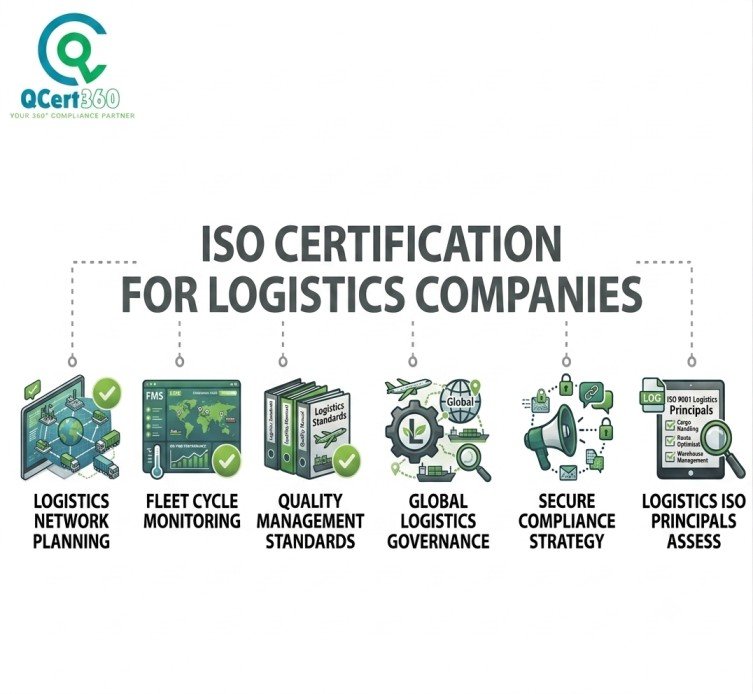
ISO Certification for Freight Forwarding Companies in Cameroon
ISO certification for freight forwarding companies in Cameroon demonstrates that your documentation management, customs clearance processes, cargo handling procedures, and client communication systems are managed to an internationally recognised quality standard. Freight forwarders pursuing ISO 9001 and ISO 28000 certification satisfy both the quality management and cargo security requirements that importers, exporters, and shipping line partners increasingly expect.
ISO 9001 certification consultants for freight forwarders in Cameroon from QCert360 build quality management systems specifically designed for freight forwarding operations — covering import and export documentation, carrier management, customs coordination, and cargo tracking.
ISO Certification for Warehousing Companies in Cameroon
ISO certification for warehousing companies in Cameroon covers the quality, safety, and security management requirements of warehouse operations — goods receipt and inspection, stock management, order picking, dispatch, temperature control (for cold chain operators), pest control, allergen management (for food product warehouses), and facility maintenance.
Warehousing businesses pursuing ISO 9001 for quality management, ISO 28000 for inventory security, and ISO 45001 for warehouse worker safety present a compelling certified credentials package to retail chains, manufacturers, and importers who are increasingly specific about warehouse quality and security standards.
ISO Certification for Transport Companies in Cameroon
ISO certification for transport companies in Cameroon — covering road transport, fleet management, last-mile delivery, and specialised logistics — addresses quality management, driver safety, vehicle maintenance, and environmental management across fleet operations.
ISO 45001 fleet safety certification in Cameroon is particularly valuable for transport companies because it demonstrates that driver safety, vehicle pre-trip inspections, fatigue management, load securing, and incident reporting are systematically managed — reducing accident risk and the associated financial and reputational consequences.
ISO Certification for Supply Chain Companies in Cameroon
ISO certification for supply chain companies in Cameroon covers end-to-end supply chain management businesses that integrate sourcing, logistics, warehousing, and distribution into a single service offering. Supply chain businesses typically need ISO 9001 for quality management, ISO 28000 for supply chain security, and often ISO 14001 for sustainable logistics management — particularly when serving multinational clients with supply chain sustainability requirements.
How to Get Logistics Company ISO Certified in Cameroon
To get a logistics company ISO certified in Cameroon, start by choosing the right ISO standard, implement a management system that meets its requirements, and complete an independent certification audit by an accredited certification body. Working with experienced ISO consultants simplifies the process, helping your business achieve certification faster while ensuring compliance with international standards. Here is exactly what happens, step by step:
Step 1 – Choose Your Standard and Define the Scope
The first decision is which ISO standard or combination of standards you need, and what the certification scope covers — which services, locations, and operations are included in the certification. QCert360 helps you make this decision based on your clients, your commercial objectives, and the tenders or contracts you are targeting.
Step 2 – Gap Analysis
A gap analysis reviews your current operations, processes, and documentation against the requirements of the chosen standard. It tells you what you already have in place, what needs to be built, and how much work is required to get certification-ready. This is the foundation for your timeline and cost estimate.
Step 3 – Build Your Management System Documentation
This is where the core work happens. Policies, procedures, risk assessments, operational controls, and monitoring frameworks are developed and documented for your logistics business. QCert360 uses logistics-specific templates and adapts them to your actual operations — so documentation reflects how your business really works, not a generic office-based management system.
Step 4 – Implement the System
The documented management system is put into practice across your operations. Staff are trained on new procedures. Records begin to be generated — trip sheets, safety inspection checklists, cargo receipt records, temperature logs, security check documentation — demonstrating that the system is genuinely operational.
Step 5 – Staff Training
All relevant staff — drivers, warehouse operators, dispatch managers, customer service teams, and senior management — receive training on the management system requirements relevant to their roles. Training records are maintained as part of the management system.
Step 6 – Internal Audit
An internal audit checks whether the management system is working as documented and meets the standard’s requirements. Any gaps or non-conformities found are corrected before the formal certification audit.
Step 7 – Management Review
Senior management formally reviews the management system performance — including audit results, client feedback, safety incident data, and objective achievement — confirming the system is operating effectively and that resources are committed to its ongoing management.
Step 8 – Certification Audit
The accredited certification body conducts a two-stage audit — first reviewing your documentation, then assessing actual implementation across your operations. QCert360 supports you throughout both audit stages.
Step 9 – Certificate Issuance
When the audit is successful and any findings are resolved, your ISO certificate is issued. You can then present it in tender submissions, client proposals, and supplier approval processes.
Ready to start? Contact QCert360 today to apply for ISO certification for your logistics company in Cameroon.
ISO Certification Process for Logistics Companies in Cameroon
The ISO certification process for logistics companies in Cameroon is the same structured pathway described above — gap analysis, documentation, implementation, training, internal audit, management review, certification audit, and certificate issuance. The key difference for logistics businesses compared to office-based organisations is that implementation must cover field operations — driver behaviour, vehicle checks, cargo handling, warehouse operations, and site security — not just back-office procedures.
QCert360‘s ISO audit services for logistics companies in Cameroon are specifically designed for this operational complexity, covering depot visits, vehicle fleet assessments, warehouse walk-throughs, and driver record reviews as part of a comprehensive logistics management system audit.
What are ISO Certification Requirements for Logistics Companies in Cameroon
ISO certification requirements for logistics companies in Cameroon include leadership commitment, documented processes, risk management, employee training, internal audits, and continual improvement. While the specific requirements vary by ISO standard, every logistics business must implement a management system that consistently meets international standards and supports ongoing compliance and operational performance:
- Leadership commitment — Senior management must be actively involved, define policy, and provide resources for the management system
- Risk assessment — Risks relevant to the standard’s objectives must be systematically identified, assessed, and addressed
- Documented procedures — Key operational activities must be documented in a way that ensures consistency regardless of which staff member performs them
- Operational controls — Controls relevant to quality, safety, security, or environmental management must be implemented and evidenced
- Monitoring and measurement — Performance data, KPIs, and audit results must be tracked and reviewed
- Continuous improvement — The management system must demonstrate ongoing improvement over time
For ISO 9001 specifically, logistics businesses must demonstrate customer focus, process management, non-conforming service management, and customer satisfaction monitoring. For ISO 28000, security risk assessment and cargo chain-of-custody controls are central requirements. For ISO 45001, hazard identification and worker safety controls across transport and warehouse environments are key.
What Documents Are Required for ISO Certification for Logistics Companies in Cameroon?
The exact list depends on which standard you are pursuing, but across the most commonly required standards for logistics businesses, the core documentation set includes:
- Policy statement — Quality policy, safety policy, security policy, or environmental policy depending on the standard
- Scope statement — Definition of which operations, services, and locations are covered by the management system
- Risk register — Documented identification and assessment of risks relevant to the standard’s requirements
- Operational procedures — Step-by-step documented procedures for key logistics activities — cargo receipt, vehicle inspection, warehouse operations, incident reporting, customer complaint handling
- Legal and regulatory compliance register — Record of applicable requirements and evidence of compliance monitoring
- Staff training records — Evidence that staff have been trained on management system requirements
- Monitoring and performance records — Service performance data, safety incident records, security check logs, vehicle maintenance records
- Internal audit records — Evidence of internal management system audits
- Management review records — Evidence of formal senior management review of system performance
- Corrective action records — Documentation of non-conformances and the corrective actions taken
QCert360 develops all required documentation for logistics company clients in Cameroon — building complete, audit-ready management system document sets tailored to each company’s service model, client base, and operational environment.
How Long Does ISO Certification Take for Logistics Companies in Cameroon?
The realistic timeline for ISO certification process timelines for most logistics businesses from first contact to certificate in hand is 8 to 16 weeks, depending on the standard being pursued, the size of the business, how many sites and vehicles are in scope, and how much existing documentation and process structure is already in place.
Factors that affect timeline:
- Existing documentation — Businesses with existing SOPs, vehicle check records, or previous quality systems move faster than those starting from scratch
- Business size and complexity — A small freight forwarder certifies faster than a large multi-depot transport and warehousing operator
- Number of sites and vehicles — More locations and fleet assets mean more documentation and a longer audit scope
- Staff availability for training — Shift-based operations require training to be scheduled across multiple sessions
- Certification body scheduling — Audit dates depend on the certification body’s availability
For logistics companies facing specific tender deadlines or contract start dates, QCert360 offers fast-track programmes that prioritise the most critical activities to reach certification as quickly as possible.
How Much Does ISO Certification Cost for Logistics Companies in Cameroon?
ISO certification cost for logistics companies in Cameroon is not a single fixed price — it depends on the standard, the size of your business, the number of sites and vehicles, the complexity of your operations, and the certification body you choose.
Main cost factors:
- Which standard(s) you need — ISO 9001 alone costs less than a combined ISO 9001, ISO 28000, and ISO 45001 programme
- Business size — Larger businesses with more staff and locations require more consultant hours and longer audit time
- Number of sites — Multi-depot or multi-warehouse logistics businesses require broader audit coverage
- Existing documentation — The more you already have in place, the less documentation work is needed
- Certification body fees — Different accredited bodies charge different audit fees based on organisation size and scope
- Surveillance costs — Annual surveillance audit fees over the three-year certificate cycle are part of the total cost to plan for
QCert360 offers affordable ISO certification for logistics companies in Cameroon with transparent, fully scoped pricing. We provide a detailed ISO certification quote for logistics company in Cameroon before any work begins — so there are no surprises. When you are ready to apply for ISO certification for logistics company in Cameroon, the process starts with a free consultation and a clear scoping exercise.
Contact QCert360 for a free ISO certification quote for your logistics company in Cameroon.
ISO 28000 Supply Chain Security Certification for Logistics Companies in Cameroon
ISO 28000 certification for logistics companies in Cameroon is the internationally recognised standard for supply chain security management. It is particularly relevant for logistics businesses handling valuable, regulated, or sensitive cargo — electronics, pharmaceuticals, food products, government supplies, and high-value consumer goods.
ISO 28000 supply chain security certification consultants Cameroon at QCert360 help logistics businesses:
- Conduct a supply chain security risk assessment identifying where cargo is most vulnerable to theft, tampering, or unauthorised access
- Build documented security controls for cargo acceptance, vehicle tracking, access management, seal integrity, and driver verification
- Establish cargo chain-of-custody documentation that traces responsibility from collection through delivery
- Implement incident reporting and investigation procedures for security events
- Satisfy the supply chain security requirements of customs authorities, trade compliance frameworks, and international logistics clients
For freight forwarders, clearing agents, and transport companies in Cameroon, ISO 28000 certification builds the security management credibility that large cargo owners, importers, and international logistics partners increasingly require.
ISO 45001 Fleet Safety Certification for Logistics Companies in Cameroon
Road transport is one of the highest-risk working environments in any industry. Driver fatigue, vehicle defects, overloading, poor road conditions, and inadequate journey planning all contribute to transport accidents that harm people, damage cargo, and expose logistics businesses to significant financial and legal consequences.
ISO 45001 fleet safety certification consultants Cameroon at QCert360 help transport and logistics businesses build occupational health and safety management systems that directly address fleet safety risks:
- Driver safety management — Formal driver selection standards, licence verification, health assessments, safety induction training, and ongoing driver performance monitoring
- Vehicle maintenance and inspection — Pre-trip inspection checklists, scheduled maintenance programmes, defect reporting procedures, and vehicle fitness records
- Journey planning and fatigue management — Formal journey risk assessment, maximum driving hour controls, rest break requirements, and emergency contact procedures for long-haul routes
- Load safety — Cargo securing standards, load limits, hazardous cargo handling procedures, and vehicle weight compliance monitoring
- Incident investigation — Formal accident and near-miss investigation, root cause analysis, and corrective action implementation
ISO 45001 demonstrates to clients, insurers, and road safety stakeholders that your fleet is managed safely — not just on paper, but in daily practice.
ISO 14001 Sustainable Logistics Certification in Cameroon
ISO 14001 sustainable logistics certification Cameroon is growing in importance as corporate clients pursue sustainability goals, green supply chain credentials, and carbon reduction commitments that extend to their logistics providers.
For logistics companies in Cameroon, ISO 14001 certification addresses:
- Fleet emissions management — Fuel efficiency monitoring, vehicle emissions standards, fleet renewal planning, and driver eco-driving training
- Waste management — Tyre disposal, oil and fluid management, packaging waste from warehouse operations, and general site waste minimisation
- Energy management — Warehouse lighting, refrigeration systems, and office energy consumption monitoring and reduction
- Environmental incident response — Fuel spill response, hazardous cargo incident management, and emergency environmental response planning
- Supplier environmental requirements — Environmental management expectations for subcontractors, fuel suppliers, and vehicle maintenance providers
As Cameroon logistics businesses compete for contracts with multinational clients who have mandatory supply chain sustainability requirements, ISO 14001 certification provides the independently verified environmental management credential that sustainability-focused buyers need.
Who Provides ISO Certification for Logistics Companies in Cameroon?
ISO registration for logistics companies in Cameroon is completed when an accredited certification body issues your certificate and registers your certification details on their public register. But to get to that point, most logistics businesses work with an ISO certification company for logistics businesses — like QCert360 — to manage the preparation process.
How the certification ecosystem works:
- ISO certification body for logistics companies in Cameroon — These are the accredited bodies that conduct the formal certification audits and issue recognised certificates. QCert360 partners with multiple accredited certification bodies so clients can choose the body with the best recognition for their specific clients and markets
- ISO certification consultants for logistics companies in Cameroon — QCert360 prepares your business for certification, builds your management system documentation, conducts internal audits, and coordinates with the certification body to manage the entire process
- ISO implementation for logistics companies in Cameroon — This is the practical work of putting the documented management system into daily operation across your transport, warehousing, freight, or supply chain activities
The best ISO consultant for logistics companies in Cameroon combines deep logistics sector knowledge with ISO technical expertise and a proven track record of meeting commercial deadlines. QCert360 brings all three to every logistics certification engagement.
Why Choose QCert360 for ISO Certification Services for Logistics Companies in Cameroon?
QCert360 provides specialist ISO certification services for logistics companies in Cameroon across ISO 9001, ISO 28000, ISO 45001, and ISO 14001 — with dedicated logistics sector expertise, proven management system documentation frameworks, and a commitment to getting your business certified on time and within budget.
Why logistics businesses in Cameroon choose QCert360:
- Logistics sector expertise — Real understanding of freight forwarding, transport fleet management, warehousing, supply chain operations, and the practical documentation requirements of logistics management system certification
- Best ISO certification company for logistics businesses in Cameroon — QCert360’s consultants have direct logistics and supply chain management system experience — not generic consulting adapted for logistics use
- Affordable ISO certification for logistics companies in Cameroon — Transparent, competitive pricing structured for logistics businesses at every scale, from owner-operated freight companies to large multi-site operators
- ISO implementation services for logistics companies — End-to-end support from gap analysis and documentation through implementation, training, internal audit, and certification body coordination
- Government tender experience — Specific knowledge of ISO 9001 certification requirements for logistics government tenders in Cameroon, ensuring your certification is structured to satisfy public procurement pre-qualification requirements
- Fast-track options — Structured accelerated programmes for logistics businesses facing specific tender deadlines or contract start requirements
- Ongoing compliance support — Surveillance audit preparation, certificate renewal management, and management system updates as your logistics business grows
Contact QCert360 today for a free consultation and ISO certification quote for your logistics company in Cameroon.
Reach out now and let QCert360 get your logistics business ISO certified.
What are the Benefits of ISO Certification for Logistics Companies in Cameroon
The benefits of ISO certification for logistics companies in Cameroon go beyond just winning tenders. Here is what certified logistics businesses in Cameroon consistently report:
- More contract wins — ISO certified logistics companies qualify for more tenders, pass more supplier approval processes, and win more corporate clients than uncertified competitors
- Higher client trust — Clients who see an accredited ISO certificate feel confident placing their cargo, their warehousing, or their supply chain in your hands
- Lower operational costs — Documented processes reduce errors, eliminate waste, and improve productivity across depot, warehouse, and fleet operations
- Fewer safety incidents — ISO 45001 implementation reduces workplace accidents and vehicle incidents — saving the human, financial, and reputational costs that accidents create
- Better supplier performance — ISO management systems include supplier management requirements that improve the performance of subcontractors, agents, and service providers across your logistics network
- Stronger insurance position — ISO certification — particularly ISO 45001 for fleet safety — can support better insurance terms based on demonstrated risk management
- International credibility — For logistics businesses handling cross-border trade or working with international clients, ISO certification signals professional credibility that domestic certification alone cannot provide
Get Your Logistics Business ISO Certified in Cameroon Today with Qcert360
ISO certification is one of the highest-return investments a logistics company in Cameroon can make. It opens government tenders, satisfies corporate clients, builds cargo security credibility, protects your drivers and workers, and signals to every business partner that you are serious about professional, sustainable logistics operations.
QCert360 makes the process straightforward. We handle the documentation, the audits, the certification body coordination, and the ongoing compliance management — so you can focus on running your business while we handle the certification.
Contact QCert360 today for a free consultation and ISO certification quote for your logistics company in Cameroon. Our logistics certification consultants will assess your business, recommend the right certification pathway, and give you a clear, honest timeline and cost estimate — with no obligation to proceed.
The next government tender, the next corporate client, the next international partner — they are all looking for ISO complaint logistics companies in Cameroon. Make sure you are one of them.
Frequently Asked Questions (FAQs)
- What does ISO certification for logistics companies in Cameroon mean?
ISO certification for logistics companies in Cameroon is independent, third-party verification that your business management systems — quality, safety, security, or environmental — meet internationally recognised standards. It is issued by an accredited certification body after auditing your operations. - Which ISO certification standard is applicable for logistics business in Cameroon?
ISO 9001 is the most universally required standard for logistics businesses. ISO 28000 is essential for cargo security and freight forwarding. ISO 45001 is critical for fleet and warehouse safety. ISO 14001 covers environmental management. The right combination depends on your clients and commercial goals — QCert360 can advise you for free. - Is ISO certification mandatory for logistics companies in Cameroon?
It is not a legal requirement for all logistics businesses but is frequently mandatory in government tenders, corporate supplier approvals, and international trade partnerships. Without it, you may be disqualified from the opportunities that matter most. - How much time does ISO certification take for logistics companies in Cameroon?
Most logistics businesses achieve certification in 8 to 16 weeks. The timeline depends on business size, number of sites, existing documentation, and certification body scheduling. Fast-track options are available for urgent deadlines. - What is the cost of ISO certification for logistics companies in Cameroon?
Costs vary based on the standard, business size, number of sites, and certification body. QCert360 offers affordable ISO certification for logistics companies in Cameroon with fully transparent pricing. Contact us for a free, no-obligation quote. - What documents are needed to get ISO certification for logistics companies in Cameroon?
Key documents include a policy statement, scope statement, risk register, operational procedures, training records, performance monitoring records, internal audit records, management review records, and corrective action records. - How to get a logistics company ISO registered in Cameroon?
Contact QCert360, complete a gap analysis, build your management system documentation, implement and train your team, conduct an internal audit, and undergo certification audits with an accredited certification body. QCert360 manages every step. - What is the difference between ISO 9001 and ISO 28000 for logistics companies?
ISO 9001 covers overall quality management — service delivery, customer satisfaction, and process consistency. ISO 28000 focuses specifically on supply chain security — protecting cargo from theft, tampering, and security threats. Many logistics businesses need both. - Can small logistics companies in Cameroon get ISO certified?
Yes. ISO certification is scalable to businesses of any size. QCert360 offers programmes specifically structured and priced for small and growing logistics businesses in Cameroon. - Why choose QCert360 for ISO certification for logistics companies in Cameroon?
QCert360 combines logistics sector expertise, ISO technical depth, affordable pricing, and fast-track capability — delivering certification that opens real commercial doors for logistics businesses across Cameroon.
Our Services
ISO Standards
- ISO 9001 Certification
- ISO 14001 Certification
- ISO 45001 Certification
- ISO 22000 Certification
- ISO 17025 Certification
- ISO 27001 Certification
- ISO 13485 Certification
- ISO 20000-1 Certification
- ISO 41001 Certification
- ISO 22716 Certification
- ISO 50001 Certification
- ISO 22301 Certification
- ISO 29993 Certification
Product Certifications
Other international standards
- FSSC 22000 Certification
- HIPAA
- HACCP Certification
- SA 8000 Certification
- GMP Certification
- GDPR
- GDP Certification
- GLP Certification
- Certificate of Conformity