
ISO Certification for Ports in Australia – End-to-End ISO Compliance & Certification Services for ports
ISO Certification for Ports in Australia – Expert ISO Consultants for Fast & Cost-Effective Compliance
Port operations sit at the intersection of safety, environmental responsibility, security, and commercial performance. Whether you manage a bulk terminal, operate a container freight facility, run a harbour authority, or provide marine engineering and logistics services, the pressure to demonstrate internationally recognised management system credentials has never been greater.
ISO certification for ports in Australia is no longer a back-office compliance exercise. It is a commercial prerequisite — shaping whether your organisation wins government tenders, satisfies major shipper and operator requirements, maintains access to critical infrastructure frameworks, and demonstrates to clients, investors, and regulators that risk is managed systematically across every layer of port operations.
This guide covers everything port operators, maritime companies, terminal operators, cargo handlers, and shipping companies need to know about ISO certification in Australia: which standards apply to which operations, how the certification process works, how long it takes, what it costs, and how to avoid the mistakes that hold port businesses back from certification. Throughout, we show how QCert360 supports maritime and port organisations across Australia with expert, end-to-end ISO certification consulting services.
What is ISO Certification for Ports in Australia?
ISO certification for ports in Australia is formal, third-party verified proof that a port organisation’s management systems — covering quality, occupational health and safety, environmental management, supply chain security, and information security — meet internationally recognised standards. It confirms that port operations are managed systematically, risks are controlled, and services are delivered to a consistent, auditable standard.
For port authorities, terminal operators, freight companies, shipping operators, and marine engineering firms, ISO certification provides:
- A recognised, externally verified benchmark of operational management quality
- Evidence that safety, environmental, and security risks are identified and controlled
- A competitive advantage in government tender evaluations and major commercial contract negotiations
- Compliance alignment with critical infrastructure and supply chain security frameworks
- Confidence for clients, partners, insurers, and regulatory bodies that your organisation operates to international best practice
ISO certification for ports is not a single document — it is a portfolio of standards, each addressing a different operational risk domain. Understanding which standards apply to your specific port operations is the critical first step.
Which ISO Certifications Does a Port in Australia Need?
The ISO certifications a port in Australia needs depend on the nature of its operations, risk profile, and the regulatory or commercial requirements it faces. Most port and maritime organisations need a combination of standards rather than a single certificate.
Core ISO standards for port and maritime operations in Australia:
- ISO 9001 (Quality Management Systems) — The foundational quality standard required across virtually all port service categories, from marine engineering firms to terminal operations and logistics providers. ISO 9001 certification for marine engineering firms in Australia confirms that quality is systematically managed across service delivery.
- ISO 45001 (Occupational Health and Safety Management) — The primary occupational health and safety certification for ports in Australia. Given the high-risk physical operating environment of port facilities, ISO 45001 is frequently mandatory or heavily weighted in port sector contracts and government tender requirements.
- ISO 14001 (Environmental Management Systems) — ISO 14001 certification for environmental compliance in ports in Australia addresses the significant environmental risks ports face: marine pollution, dredging impacts, stormwater management, noise, dust, and habitat disruption.
- ISO 28000 (Supply Chain Security Management) — ISO 28000 supply chain security certification in Australia is the recognised standard for managing security risks across the maritime supply chain, covering cargo handling, logistics operations, and freight terminal security.
- ISO 27001 (Information Security Management Systems) — ISO 27001 certification for port critical infrastructure in Australia is growing in importance as ports become increasingly digitalised — managing vessel scheduling, cargo tracking, access control, and operational technology networks.
- ISO 50001 (Energy Management) — Relevant for large port operations managing significant energy consumption across terminal equipment, refrigerated storage, lighting, and vessel services.
Many port organisations pursue combined or integrated certification programmes covering multiple standards simultaneously — particularly ISO 9001, ISO 45001, and ISO 14001, which share a common management system structure that makes integrated implementation efficient.
Not sure which combination of standards applies to your port operations? Contact QCert360 for a free scoping review.
Is ISO Certification Mandatory for Ports in Australia?
Whether ISO certification is mandatory for ports in Australia depends on the specific standard, the type of port operation, the contracts being pursued, and the infrastructure frameworks the organisation operates within. For certain standards and operational contexts, certification is a practical requirement even where it is not legally mandated.
When ISO certification is required or strongly expected:
- Government tenders and public procurement — Port logistics government tenders in Australia frequently specify ISO certification as a mandatory pre-qualification or technical evaluation requirement. Which ISO standards are required to win a port logistics government tender in Australia varies by contract, but ISO 9001 and ISO 45001 are near-universal expectations.
- Critical infrastructure frameworks — Port organisations subject to critical infrastructure obligations are increasingly expected to demonstrate that their management systems meet recognised international standards, making ISO 27001 and ISO 28000 certifications highly relevant.
- Major shipper and cargo owner requirements — Large commodity exporters, shipping lines, and logistics companies frequently require their port service providers to hold specified ISO certifications as a condition of contract.
- Environmental licensing conditions — Port operations with significant environmental footprints may have ISO 14001 certification referenced in environmental licence conditions or management plan requirements.
- Insurance and financing requirements — Lenders and insurers for major port infrastructure projects increasingly factor ISO certification status into risk assessments.
Even where ISO certification is not strictly mandated, the absence of relevant certificates in competitive tender evaluations consistently places uncertified port operators at a disadvantage. Maritime ISO certification consultants in Australia like QCert360 help port and marine businesses identify exactly which standards apply and build a certification programme aligned to their commercial priorities. ISO certification for marine operators in Australia — whether vessel operators, marine service providers, or port marine services teams — follows the same structured pathway covered in this guide.
For port organisations subject to critical infrastructure obligations, the Security of Critical Infrastructure Act ISO certification in Australia question is increasingly relevant — and the answer lies in aligning ISO 27001 and ISO 28000 management systems to the security risk management obligations those frameworks impose.
ISO 45001 Certification for the Maritime Industry in Australia
ISO 45001 certification for the maritime industry in Australia is the internationally recognised standard for occupational health and safety management, and one of the most critical certifications for port operators, terminal operators, cargo handlers, shipping companies, and marine construction firms.
The port operating environment presents some of the most complex occupational safety challenges in any industry:
- Crane and lifting operations handling heavy cargo in dynamic conditions
- Heavy vehicle and mobile plant movements in shared pedestrian areas
- Vessel mooring, loading, and unloading operations
- Confined space entry in vessels and port infrastructure
- Working at height on vessel superstructures, gantries, and elevated structures
- Hazardous materials handling — fuels, chemicals, bulk agricultural products
- Night operations and shift work safety management
- Subcontractor and labour hire workforce safety integration
ISO 45001 certification provides a structured framework for identifying these hazards, assessing and controlling risks, managing incidents, and demonstrating systematic safety leadership. How long does it take to get ISO 45001 certified for ports in Australia? Typically 8 to 20 weeks depending on the size of the port operation, the number of sites, and the current state of existing safety documentation. ISO 45001 certification service providers for ports in Australia — like QCert360 — manage the full process from gap analysis through documentation development, implementation support, internal audit, and certification audit coordination.
ISO 14001 Certification for Environmental Compliance in Ports in Australia
ISO 14001 certification for environmental compliance in ports in Australia provides the recognised framework for identifying, managing, and demonstrating control of the environmental impacts associated with port operations — from marine pollution and dredging to dust, noise, stormwater, and emissions management.
How ISO 14001 certification for ports in Australia helps manage environmental risk:
- Systematic environmental impact identification — Requires organisations to identify all significant environmental aspects of operations, ensuring nothing is overlooked
- Legal compliance assurance — Provides a structured framework for tracking and meeting environmental legislation and licence conditions
- Incident prevention — Documented environmental controls and emergency response procedures reduce pollution incidents
- Stakeholder and community confidence — Provides communities and regulators with independent verification that environmental management is taken seriously
- Supply chain environmental requirements — Major cargo owners increasingly require port service providers to demonstrate certified environmental management systems
ISO 14001 certification services for ports in Australia provided by QCert360 cover the full process — environmental aspects and impacts register development, legal register, objectives and targets, operational controls, and internal audit — through to certification audit management. Environmental ISO certification for marine construction in Australia is equally important for dredging, reclamation, wharf construction, and marine infrastructure projects where environmental impacts require structured management.
ISO 28000 Supply Chain Security Certification for Ports in Australia
ISO 28000 supply chain security certification in Australia is the internationally recognised standard for managing security risks across maritime logistics and cargo operations. ISO 28000 cargo security certification for ports in Australia covers the systematic framework for identifying and controlling security threats throughout the supply chain.
What ISO 28000 addresses for port and maritime organisations:
- Cargo theft and tampering — Documented controls for cargo custody, access management, and integrity verification
- Contraband and smuggling prevention — Structured security processes aligned to customs and border protection requirements
- Terrorism and sabotage risk — Threat and vulnerability assessment, physical security controls, and emergency response planning
- Personnel security — Background checking, access credentialing, and insider threat management
- Logistics partner security — Supply chain security requirements for subcontractors, transport providers, and logistics partners
The cost of ISO 28000 supply chain security certification for a maritime logistics company in Australia varies based on the size and complexity of the operation, the number of sites and logistics partners in scope, and the current maturity of existing security management systems. QCert360 provides fully scoped, transparent cost estimates based on each client’s specific operational profile.
ISO 27001 Certification for Port Critical Infrastructure in Australia
ISO 27001 certification for port critical infrastructure in Australia is the international standard for information security management, and its relevance to port operations has grown substantially as ports have digitalised — from vessel traffic management and berth scheduling systems to automated terminal equipment, cargo tracking platforms, and operational technology networks.
ISO 27001 provides the framework for:
- Identifying and classifying information assets and systems critical to port operations
- Assessing information security risks and implementing appropriate controls
- Managing access to operational technology and IT systems
- Responding to information security incidents systematically
- Demonstrating to government, clients, and critical infrastructure stakeholders that information security is managed to international best practice
How to Get ISO Certification for Ports in Australia
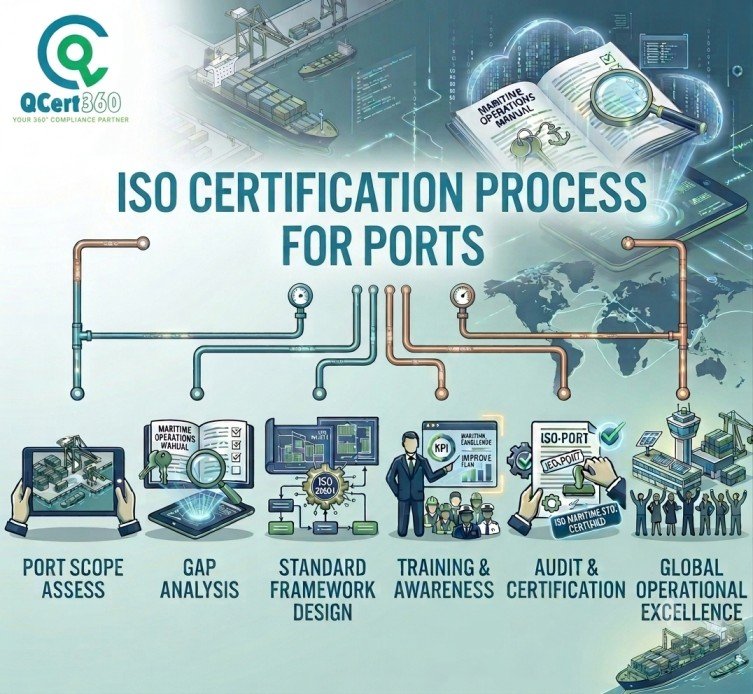
To get ISO certification for ports in Australia, a port organisation engages an experienced maritime ISO certification consultant, conducts a gap analysis against the relevant standards, develops the required management system documentation, implements the system, completes an internal audit, and undergoes certification audits with an accredited certification body.
Step 1 – Scope Definition and Standard Selection — Define which standards are needed, which operations and sites are included, and what the commercial or regulatory drivers are. For port organisations, this means mapping operational risk domains to the relevant standards and sequencing certification based on priority.
Step 2 – Gap Analysis — A structured review of current management systems and practices against the requirements of each target standard, identifying what exists and what needs to be built.
Step 3 – Management System Documentation Development — Policies, procedures, risk registers, operational controls, and performance monitoring frameworks developed using purpose-built port and maritime documentation templates.
Step 4 – System Implementation and Training — The documented system is implemented across port operations, with staff trained at all levels on their management system roles.
Step 5 – Internal Audit — A structured internal audit verifies the management system is functioning as documented. Non-conformities are resolved before the formal certification audit.
Step 6 – Stage 1 Certification Audit — The accredited certification body reviews management system documentation and confirms readiness for the on-site assessment.
Step 7 – Stage 2 Certification Audit — On-site assessment of actual port operations, interviewing staff, reviewing records, and verifying genuine implementation.
Step 8 – Certificate Issuance — ISO certificates issued and available for use in tender submissions, client proposals, and regulatory submissions.
Learn more about how ISO certification compliance works with QCert360, or review our consulting methodology. Contact QCert360 today to start your ISO certification journey for your port operations.
How Long Does ISO Certification Take for Port Operations in Australia?
How much time is required to get ISO certification for port operations in Australia depends on the number of standards being pursued, the size and complexity of the port operation, the current state of existing management systems, and the certification body’s audit scheduling availability. A realistic range is 10 to 24 weeks for a single standard to a full integrated management system covering multiple standards.
Timeline factors specific to port operations:
- Number of standards in scope — A single ISO 9001 certification is faster than a combined ISO 9001, 45001, and 14001 integrated management system
- Port size and operational complexity — A single-berth bulk terminal certifies faster than a large multi-terminal operation
- Number of sites — Multi-site organisations require broader audit scope, increasing both preparation time and duration
- Existing documentation maturity — Port operations with existing safety management plans, environmental plans, or quality procedures reach readiness significantly faster
- Workforce size and shift patterns — 24/7 shift operations require more comprehensive training records to demonstrate implementation
- ISO audit services for port companies — The availability of qualified internal audit services for port companies directly affects readiness timelines; QCert360 provides dedicated ISO audit services for port organisations as part of every certification engagement
How much time is required to get ISO certification for port operations in Australia? It depends primarily on current documentation maturity and the number of standards in scope — but with dedicated consultant support, most port organisations reach certification faster than they expect. QCert360 offers accelerated certification programmes for port organisations facing specific tender deadlines or contract commencement requirements.
The cost of ISO certification for ports in Australia varies significantly based on the number of standards being certified, the size and operational complexity of the port organisation, the current state of existing documentation, the number of sites in scope, and the certification body engaged.
Key cost drivers:
- Number of ISO standards — Single-standard certification costs less than a combined or integrated programme covering multiple standards simultaneously
- Port and organisation size — Larger organisations require more consulting hours and longer certification audit duration
- Number of sites — Multi-site port organisations require site sampling during audits, increasing both consulting and certification body costs
- Documentation development effort — Existing environmental, safety, or quality frameworks significantly reduce documentation development work
- Certification body audit fees — Vary between accredited bodies based on organisation size and audit duration
- Combined versus separate certification — Integrated management systems covering multiple standards are typically more cost-efficient than separate programmes
- Ongoing surveillance costs — Annual surveillance audit fees across the three-year certificate cycle should factor into total investment planning
QCert360 provides transparent, fully scoped pricing with no hidden costs, structuring engagements to maximise value by combining standards where possible and building on existing documentation wherever it exists.
Contact QCert360 for a free, no-obligation cost estimate tailored to your port organisation’s specific scope and requirements.
What Documents Are Required to Get ISO Certified for Ports in Australia?
include management system policies, risk and hazard registers, operational procedures, legal compliance registers, performance monitoring frameworks, internal audit records, and management review records.
Core documentation required across port ISO certifications:
- Management system policy — High-level policy committing the organisation to quality, safety, environmental, or security management
- Scope statement — Definition of the operations, sites, and services covered by the management system
- Risk and hazard registers — Documented identification and assessment of operational risks relevant to each standard
- Objectives and targets — Documented management system objectives with measurable targets and improvement plans
- Operational procedures — Documented procedures for key operational activities within the certification scope
- Legal and regulatory compliance register — Register of applicable legislation, regulations, and licence conditions
- Competency and training records — Evidence that personnel performing key roles are competent and trained
- Monitoring and measurement records — Performance data demonstrating the management system is being actively monitored
- Internal audit reports — Records confirming the system has been assessed against the standard’s requirements
- Management review records — Evidence that senior management reviews management system performance at planned intervals
- Incident and non-conformance records — Documentation of incidents, non-conformances, and corrective actions taken
QCert360 prepares all required documentation for port and maritime clients, developing a complete, audit-ready management system document set tailored to your specific operations.
ISO Certification for Specific Port Sector Organisations in Australia
ISO Certification for Harbour Authorities in Australia
Harbour authorities in Australia face a broad management system challenge — balancing vessel traffic management, waterway safety, environmental stewardship, emergency response, and infrastructure maintenance. What ISO certifications does a port authority need to comply with the Security of Critical Infrastructure Act in Australia? The answer typically covers ISO 9001 for quality management, ISO 45001 for occupational safety, ISO 14001 for environmental management of marine and foreshore environments, and ISO 27001 or ISO 28000 where critical infrastructure or security obligations apply. ISO certification for harbour authorities in Australia from QCert360 addresses all of these requirements in a coordinated, efficiently managed programme.
ISO Certification for Port Infrastructure Companies in Australia
Port infrastructure companies — involved in wharf construction, berth maintenance, dredging, and capital works — require ISO certification that addresses construction quality, worker safety, and environmental management simultaneously. ISO certification for port infrastructure companies in Australia commonly covers ISO 9001, ISO 45001, and ISO 14001 in an integrated management system.
ISO Certification for Freight Terminal Operators in Australia
ISO certification for freight terminal operators in Australia typically involves ISO 9001 for terminal service quality, ISO 45001 for occupational health and safety across terminal operations, and ISO 28000 where supply chain security management is required for container, bulk, or general cargo handling.
ISO Certification for Cargo Handling Companies in Australia
ISO certification for cargo handling companies in Australia most commonly prioritises ISO 45001 for occupational health and safety in high-risk lifting and cargo operations, alongside ISO 9001 for service quality management and ISO 14001 where significant environmental management obligations apply.
ISO Certification for Terminal Operators in Australia
ISO certification for terminal operators in Australia from QCert360 covers all relevant standards — quality, safety, environmental, and security — in a coordinated certification programme designed around the specific cargo type, operational model, and client requirements of each terminal.
ISO Certification for Logistics and Port Companies in Australia
ISO certification for logistics and port companies in Australia typically involves ISO 9001, ISO 45001, and — for supply chain security — ISO 28000, covering the full range of transport, warehousing, freight forwarding, and port services that integrated logistics businesses provide.
ISO Certification for Shipping Companies in Australia
ISO certification for shipping companies in Australia from QCert360 addresses ISO 9001 for quality management, ISO 45001 for safety management, and ISO 14001 where vessel environmental management requirements apply — covering vessel operators, marine agents, fleet managers, and crewing organisations.
ISO Certification for Maritime Companies in Australia
Across the full spectrum of maritime businesses — marine surveyors, naval architects, marine operators, port agents, and offshore service providers — ISO certification for maritime companies in Australia demonstrates management system maturity and professional credibility. QCert360 has supported maritime companies through ISO 9001, ISO 45001, ISO 14001, ISO 28000, and ISO 27001 certification programmes.
ISO Certification for Bulk Terminal Operators in Australia
ISO certification for bulk terminal operators in Australia from QCert360 addresses the dust, noise, spill risk, and heavy equipment safety requirements specific to coal, iron ore, grain, minerals, and liquid bulk handling operations through integrated ISO 9001, 45001, and 14001 certification.
Why Choose QCert360 as Your ISO Certification Consulting Company for Ports in Australia?
QCert360 is a trusted ISO certification consulting company for ports in Australia, with deep maritime sector expertise, proven port-specific management system documentation frameworks, and established relationships with accredited certification bodies — delivering ISO certification outcomes that are commercially relevant, audit-ready, and valued by the clients and regulators that matter most to your port business.
Why port and maritime organisations across Australia choose QCert360:
- ISO certification consultants for port operations in Australia — Dedicated consultants with direct port and maritime management system experience, not generalists adapting generic templates
- End-to-end service — From initial scope definition and gap analysis through documentation development, implementation, internal audit, and certification audit coordination
- Port-specific documentation — Purpose-built management system documentation developed for port and maritime environments, reflecting real operational contexts
- Multiple standard capability — Expertise across ISO 9001, ISO 45001, ISO 14001, ISO 28000, and ISO 27001 for efficient integrated management system development
- Dedicated project managers — A single point of contact managing your certification project from start to certificate issuance
- Accredited certification body partnerships — Access to multiple accredited certification bodies ensuring your certificates are credible, recognised, and accepted
- Transparent, competitive pricing — Fully scoped quotes with no hidden costs
- Ongoing compliance support — Surveillance audit support, certificate renewal management, and system updates as your port operations evolve
Contact QCert360 today for a free consultation on ISO certification for your port operations in Australia.
📧 Reach out to QCert360 now and take the first step toward ISO certification for your port organisation.
Benefits of Working with ISO Certification Consultants for Port Operations in Australia
- Speed — Port-specific templates and structured processes compress the time from gap analysis to certificate issuance
- Reduced audit failure risk — Internal pre-audits and gap resolution minimise the risk of adverse findings in formal certification audits
- Maritime-specific documentation — Documentation that reflects real port operating environments rather than generic management system frameworks
- Tender-ready compliance packs — Complete certification documentation prepared for use in government tender submissions and major commercial contract negotiations
- Multi-standard integration — Combined ISO 9001, 45001, 14001, and 28000 programmes built as integrated management systems rather than disconnected parallel programmes
- Commercial application guidance — Expert advice on using ISO certification in tender submissions, client presentations, and commercial negotiations
- Ongoing compliance management — Continued support through surveillance audits, certificate renewals, and scope updates as your port operations grow
See real results in our case studies.
Frequently Asked Questions (FAQs)
- What ISO certifications does a port authority need to comply with the Security of Critical Infrastructure Act in Australia?
Port organisations should consider ISO 27001 for information security management, ISO 28000 for supply chain security, ISO 45001 for occupational health and safety, ISO 14001 for environmental management, and ISO 9001 for quality management. The right combination depends on the port’s operations and security obligations.
- How does ISO 14001 certification for ports in Australia help manage environmental risk?
ISO 14001 helps port operators identify environmental aspects, monitor legal compliance, implement environmental controls, set measurable objectives, and manage incidents through a structured, auditable environmental management system.
- How long does it take to get ISO 45001 certified for ports in Australia?
ISO 45001 certification typically takes 8 to 20 weeks, depending on the port’s size, number of sites, workforce complexity, and existing documentation. Fast-track programmes are also available through QCert360.
- Which ISO standards are required to win a port logistics government tender in Australia?
ISO 9001 and ISO 45001 are the most commonly required standards. ISO 14001 and ISO 28000 may also be required depending on environmental and cargo security requirements specified in the tender.
- What is the cost of ISO 28000 supply chain security certification for a maritime logistics company in Australia?
The cost depends on organisation size, supply chain complexity, number of sites, logistics partners, and existing security management systems. QCert360 provides transparent, customised cost estimates.
- How to get ISO certification for ports in Australia?
Work with QCert360 to complete a gap analysis, develop management system documentation, implement the system, conduct an internal audit, and complete a two-stage certification audit with an accredited certification body.
- Is ISO certification mandatory for ports in Australia?
ISO certification is not legally mandatory for all ports, but it is often required for government tenders, major commercial contracts, and critical infrastructure frameworks, making it a practical business requirement.
- Which ISO certification is best for port operations in Australia?
ISO 9001, ISO 45001, ISO 14001, and ISO 28000 provide the most complete coverage. The best certification depends on whether your focus is quality, safety, environmental management, or supply chain security.
- What documents are required to get ISO certified for ports in Australia?
Required documents typically include the management system policy, scope statement, risk and hazard registers, objectives and targets, operational procedures, legal compliance register, competency and training records, monitoring records, internal audit reports, management review records, and incident and non-conformance records.
- Can a small maritime company in Australia get ISO certified?
Yes. ISO certifications are suitable for maritime businesses of all sizes. QCert360 offers flexible and cost-effective certification programmes tailored to the size and complexity of each organisation.
Get ISO Compliant for ports in Australia with QCert360
For port operators, terminal managers, harbour authorities, cargo handlers, shipping companies, and maritime logistics providers in Australia, ISO certification is the foundation of credible, competitive, and responsible operations. It determines whether you win the next government tender, satisfy the next major client requirement, and demonstrate to regulators and the community that risk — safety, environmental, security, and quality — is managed to international best practice.
QCert360 has the maritime sector expertise, the port-specific documentation frameworks, the accredited certification body relationships, and the dedicated project management capability to guide your organisation through ISO certification efficiently, credibly, and with a direct line of sight to commercial return.
Contact QCert360 today for a free, no-obligation consultation. Our maritime ISO certification consultants will review your port operations, identify which standards apply, outline your certification pathway, and provide a transparent cost estimate — with no obligation to proceed.
Don’t let a missing ISO certificate cost you your next port contract or tender opportunity. Let QCert360 get your port organisation certified and ready to compete.
Our Services
ISO Standards
- ISO 9001 Certification
- ISO 14001 Certification
- ISO 45001 Certification
- ISO 22000 Certification
- ISO 17025 Certification
- ISO 27001 Certification
- ISO 13485 Certification
- ISO 20000-1 Certification
- ISO 41001 Certification
- ISO 22716 Certification
- ISO 50001 Certification
- ISO 22301 Certification
- ISO 29993 Certification
Product Certifications
Other international standards
- FSSC 22000 Certification
- HIPAA
- HACCP Certification
- SA 8000 Certification
- GMP Certification
- GDPR
- GDP Certification
- GLP Certification
- Certificate of Conformity