
ISO Certification for Solar Companies in Indonesia– Leading ISO Consultants for Solar Manufacturers, EPC, Installation & Renewable Energy Companies
ISO Certification for Solar Companies in Indonesia – Accredited ISO Consulting for Solar Installers, EPC & Manufacturers
Indonesia’s solar energy sector is expanding fast. Utility-scale solar projects are powering the national grid. Solar EPC companies are building commercial rooftop installations across Indonesia and beyond. Solar panel manufacturers and inverter suppliers are serving both domestic and export markets. Off-grid solar installers are reaching rural communities across the country.
With that growth comes a sharper competitive environment. Government energy procurement, development finance institutions, international buyers, and large commercial clients all want the same thing before signing contracts with a solar company: proof that you operate to internationally recognised quality, safety, environmental, and management standards.
That proof is ISO certification.
ISO certification for solar companies in Indonesia is not paperwork for its own sake. It is independently verified evidence that your solar business — whether you manufacture, install, develop, operate, or maintain solar systems — meets internationally recognised management standards. It opens tenders, satisfies client due diligence, and builds the credibility that serious solar business development demands.
This guide covers everything solar businesses in Indonesia need to know about ISO certification. Which standards apply, which is right for your type of solar business, how the certification process works, what it costs, how long it takes, and how to get started. We’ll also show you how QCert360 helps solar companies across Indonesia get certified efficiently and commercially effectively.
What ISO Certifications Does a Solar Company Need in Indonesia?
What ISO certifications does a solar company need in Indonesia depends on what type of solar business you run. Solar manufacturing, EPC contracting, installation, O&M, and utility-scale development each face different risk profiles, client expectations, and regulatory contexts — and therefore need different combinations of ISO standards.
Here are the main certifications that apply to solar businesses in Indonesia:
ISO 9001 — Quality Management
ISO 9001 certification for solar manufacturers in Indonesia and for solar installation and EPC companies is the most widely required certification across the solar sector. It covers how you manage quality across product manufacturing, project delivery, installation workmanship, and client service. ISO 9001 is the baseline quality credential that government energy tenders, international buyers, and project finance institutions check for first.
ISO 14001 — Environmental Management
ISO 14001 certification for solar panel manufacturers in Indonesia addresses the environmental impacts of solar product manufacturing — materials sourcing, waste generation, chemical handling, energy use, and end-of-life product management. For solar EPC companies and developers, ISO 14001 covers project site environmental management during construction and operation.
ISO 45001 — Occupational Health and Safety
Why do solar installation companies need ISO 45001 in Indonesia? Solar installation involves working at height, handling electrical systems under live conditions, lifting and positioning heavy panels, and managing sites with multiple trades working simultaneously. ISO 45001 provides the structured safety management framework that protects workers, satisfies client safety requirements, and demonstrates to project owners and insurers that safety risk is systematically managed.
ISO 50001 — Energy Management
ISO 50001 energy management certification solar company in Indonesia is relevant for solar manufacturers with energy-intensive production processes and for solar developers managing the energy performance of operational solar assets. ISO 50001 demonstrates systematic energy performance monitoring and improvement — directly aligned with the core value proposition of the solar industry.
ISO 27001 — Information Security
ISO 27001 certification for solar companies data security in Indonesia is increasingly relevant as solar operations become more connected. IoT-enabled monitoring systems, SCADA platforms, remote asset management, and cloud-based performance analytics create information security risks that ISO 27001 certification addresses. ISO 27001 certification solar monitoring IoT company credentials demonstrate that connected solar infrastructure and operational data are protected against cyber threats and unauthorised access.
ISO 9001 vs ISO 14001 for Solar Manufacturing Companies in Indonesia: What is the difference
| Aspect | ISO 9001 for Solar Manufacturers in Indonesia | ISO 14001 for Solar Manufacturers in Indonesia |
|---|---|---|
| Focus | ISO 9001 focuses on product and service quality. | ISO 14001 focuses on environmental management. |
| Purpose | Ensures your solar panels, inverters, or installation workmanship consistently meet specifications and customer requirements. | Ensures your manufacturing processes, site operations, and supply chain practices minimise environmental impact. |
| Key Benefit | Improves product consistency, customer satisfaction, and quality management across solar manufacturing and installation. | Reduces environmental impact, improves sustainability, and strengthens environmental compliance across manufacturing and operations. |
| Business Value | Demonstrates a commitment to delivering high-quality solar products and services. | Demonstrates a commitment to responsible environmental management and sustainable business practices. |
| Best Approach | Both are commercially valuable, and many solar manufacturers pursue them together. QCert360 helps clients decide the right combination and builds integrated management systems that achieve both efficiently. | Both are commercially valuable, and many solar manufacturers pursue them together. QCert360 helps clients decide the right combination and builds integrated management systems that achieve both efficiently. |
ISO Certification for Different Types of Solar Businesses in Indonesia
ISO Certification for Solar Panel Manufacturers in Indonesia
Solar panel manufacturers in Indonesia face quality management requirements across raw material procurement, cell processing, module assembly, testing, and quality control. ISO 9001 certification for solar manufacturers in Indonesia provides the quality management framework that international buyers, project developers, and government procurement bodies need to see before sourcing panels from a Indonesia manufacturer.
ISO 14001 certification for solar panel manufacturers in Indonesia addresses the environmental management requirements of manufacturing — chemical waste from cell processing, energy consumption in production, packaging materials, and end-of-life panel recycling obligations.
ISO Certification for Solar Inverter Manufacturers in Indonesia
ISO certification for solar inverter manufacturers in Indonesia covers quality management across electronics design, component sourcing, assembly, testing, and after-sales service management. Inverter reliability is critical to solar system performance — and ISO 9001 certification demonstrates that quality is built into the design and manufacturing process, not just inspected at the end.
ISO Certification for Solar EPC and Installation Companies in Indonesia
ISO certification for solar EPC and installation companies in Indonesia covers quality management across project design, procurement, construction, commissioning, and handover. EPC companies pursuing ISO 9001 demonstrate that project delivery processes are managed consistently — from feasibility through grid connection — regardless of project size or location.
ISO 45001 is equally critical for solar installation companies. Working at height, electrical isolation procedures, hot work permits, crane lifts for large utility-scale racking systems, and on-site coordination between multiple contractors create significant occupational safety risks that ISO 45001 management systems are specifically designed to address.
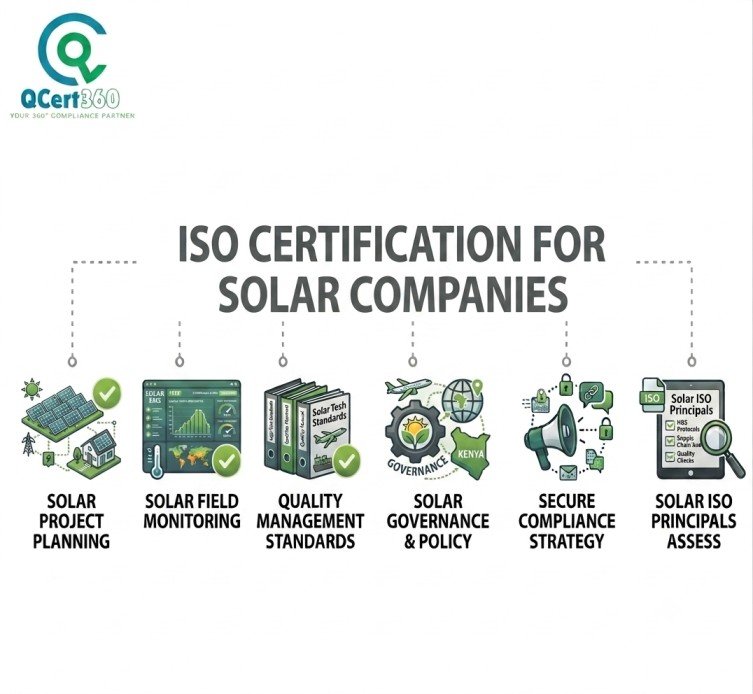
ISO Certification for Solar Installation Companies in Indonesia
ISO certification for solar installation companies in Indonesia — covering residential, commercial, and industrial solar installation — demonstrates that installation quality, electrical workmanship standards, health and safety management, and customer service processes are systematically managed. ISO certification for solar contractors in Indonesia and ISO certification for commercial solar installers in Indonesia are directly relevant for businesses pursuing commercial property clients, government installation contracts, and large-scale solar programme partnerships where certified installer status is a qualification requirement.
ISO Certification for Utility Scale Solar Projects in Indonesia
ISO certification for utility scale solar projects in Indonesia covers the full lifecycle of large-scale solar development — from environmental and social impact management during project development through EPC quality management during construction and O&M quality and safety management during operation. Utility-scale solar projects financed by development banks or institutional investors almost always require ISO certification across the project delivery chain.
ISO Certification for Solar Developers in Indonesia
ISO certification for solar developers in Indonesia covers project development quality management — site assessment, feasibility studies, permitting, stakeholder engagement, procurement, and contractor management. For solar developers pursuing financing from development finance institutions or international private equity, ISO 9001 and ISO 14001 are frequently specified as due diligence requirements.
ISO Certification for Solar O&M Companies in Indonesia
ISO certification for solar O&M companies in Indonesia — covering operations, maintenance, and performance monitoring of solar assets — demonstrates that asset management, preventive maintenance, fault response, performance reporting, and health and safety management are systematically managed across operational solar portfolios. As Indonesia’s installed solar base grows, O&M quality management is becoming a key differentiator for O&M service providers.
What Are ISO Certification Requirements for Solar Companies in Indonesia?
ISO certification requirements for solar companies in Indonesia vary by standard but share core elements across all ISO management system standards. Understanding these requirements helps solar businesses plan their certification programme realistically.
Leadership and commitment — Senior management must define an organisational policy, set management system objectives, assign roles and responsibilities, and ensure adequate resources are committed. This is not delegated to a single compliance officer — ISO standards require visible leadership involvement.
Context and stakeholder understanding — Your solar business must identify the internal and external factors that affect your management system objectives. For a solar EPC company, this includes understanding client technical requirements, project-specific obligations, supply chain risks, and operational safety context.
Risk-based approach — All ISO management standards require systematic identification and management of risks. For ISO 9001 in solar manufacturing, this means quality risks across the production process. For ISO 45001 in solar installation, this means hazard identification and safety risk assessment for all installation activities.
Documented information — Policies, procedures, work instructions, and records must be documented and controlled. ISO documentation for solar companies needs to reflect how your solar business actually operates — not generic templates that don’t match your processes.
Operational controls — The controls that manage quality, safety, environmental, or security risks must be implemented, monitored, and evidenced. For solar businesses, this means everything from inspection and test plans during manufacturing to daily safety briefings on installation sites.
Performance monitoring — Key performance indicators, audit programmes, and management review processes must be in place to demonstrate that the management system is achieving its objectives.
Continual improvement — ISO certification is not a one-time achievement. Your management system must demonstrate ongoing improvement through corrective actions, objective review, and management system updates.
What is the ISO Certification Process for Solar Panel Manufacturers in Indonesia?
The ISO certification audit process for solar companies in Indonesia follows a structured pathway. QCert360 acts as your ISO certification provider for solar manufacturers in Indonesia, EPC contractors, installers, developers, and O&M operators — managing every step from gap assessment to certificate issuance. Here is exactly how the process works:
Step 1 — ISO Gap Assessment for Solar Companies in Indonesia
An ISO gap assessment for solar companies in Indonesia reviews your current management practices against the chosen standard’s requirements. It identifies what you already have in place, what needs to be built, and how much work is required to reach certification readiness. This is the foundation for an accurate timeline and cost estimate.
Step 2 — Scope Definition
Define exactly what the certification covers — which solar products, services, project types, locations, and functions are included in the management system. Scope definition is a critical decision that shapes the commercial value and practical manageability of the certification.
Step 3 — ISO Documentation for Solar Companies
ISO documentation for solar companies is developed — policies, procedures, work instructions, risk assessments, objectives, and monitoring frameworks tailored to solar manufacturing, EPC contracting, installation, or O&M operations. QCert360 uses solar-specific documentation templates that reflect real solar business operations, not generic manufacturing or construction frameworks adapted for solar use.
Step 4 — ISO Implementation for Solar Companies
The documented management system is put into practice. Staff are trained, records begin to be generated, and the system starts operating across solar manufacturing, project delivery, or O&M activities. ISO implementation for solar companies requires active engagement from site managers, project engineers, safety officers, and production supervisors — not just back-office compliance staff.
Step 5 — ISO Training for Solar Companies in Indonesia
ISO training for solar companies in Indonesia is delivered to all relevant personnel — from production line operators and solar installation electricians through project managers, HSE officers, and senior management. Training builds genuine understanding of management system requirements and staff roles within the system.
Step 6 — Internal Audit
An internal audit reviews the implemented management system against the standard’s requirements. Non-conformities are identified and corrected before the formal certification audit. QCert360 conducts internal audits using solar-sector-specific audit checklists.
Step 7 — Management Review
Senior management formally reviews the management system performance — audit results, safety incident data, quality performance metrics, environmental monitoring data, and objective achievement — confirming the system is effective and that improvement priorities are identified.
Step 8 — Stage 1 Certification Audit
The accredited certification body reviews your management system documentation, confirming the system is complete and your organisation is ready for the full on-site Stage 2 assessment.
Step 9 — Stage 2 Certification Audit
The certification body conducts an on-site assessment of actual implementation across your solar manufacturing facility, project sites, or O&M operations. Staff are interviewed, records are reviewed, and physical operations are inspected.
Step 10 — ISO Certificate Issuance and Registration
Your ISO certificate is issued and the certification details are registered. ISO registration for solar companies in Indonesia makes certification status publicly verifiable — giving clients, procurement bodies, and project finance institutions the ability to independently confirm your certificate’s validity. Accredited ISO certification for solar companies from an internationally recognised body is the only form of ISO certification that carries commercial weight in government tenders, development finance due diligence, and international client pre-qualification.
How Long Does It Take to Get ISO Certified as a Solar Company in Indonesia?
How long does it take to get ISO certified as a solar company in Indonesia? For most solar businesses, the realistic timeline from initial engagement to certificate issuance is 8 to 20 weeks, depending on the type of solar business, the standard being pursued, the current state of existing documentation, and the certification body’s scheduling.
Factors that affect the timeline:
- Type of solar business — A solar panel manufacturer with complex production processes takes longer than a small commercial solar installer
- Number of standards — Pursuing ISO 9001 alone is faster than a combined ISO 9001 and ISO 14001 programme
- Existing documentation — Solar businesses with existing quality plans, HSE management systems, or environmental management plans move faster
- Number of sites and projects — Multi-site operations and active construction projects require broader audit coverage
- Staff availability — Implementation pace depends on how quickly project managers, site supervisors, and production staff engage with management system requirements
Can a small solar EPC company get ISO certified quickly in Indonesia? Yes — for smaller solar installation businesses with a focused scope, dedicated consultant support from QCert360 can achieve ISO 9001 certification in as little as 8 to 10 weeks.
How Much Does ISO Certification Cost for a Solar Manufacturing Company in Indonesia?
How much does ISO certification cost for a solar manufacturing company in Indonesia? ISO certification cost varies based on the standard, the size and complexity of the business, the number of sites in scope, and the certification body engaged. There is no single fixed price.
Key cost factors for solar company ISO certification:
- Standard or combination of standards — ISO 9001 alone costs less than a combined ISO 9001, ISO 14001, and ISO 45001 programme
- Business size and complexity — A solar panel manufacturer with a large production workforce and multiple product lines costs more to certify than a small solar EPC contractor
- Number of project sites — Solar EPC and installation companies with multiple active project sites require broader audit sampling, increasing both consultant and certification body costs
- Existing management system maturity — Solar businesses with existing quality, safety, or environmental management documentation require significantly less documentation development work
- Certification body fees — These vary between accredited bodies based on company size, scope, and audit duration
- Ongoing surveillance costs — Annual surveillance audit fees over the three-year certificate cycle are part of the total investment
QCert360 provides fully transparent, scoped pricing for ISO certification for solar companies in Indonesia. You receive a detailed cost breakdown before any engagement begins — no hidden costs, no surprise invoices.
Contact QCert360 to get a free ISO certification cost estimate for your solar business.
Is ISO Certification Mandatory for Solar Panel Exporters in Indonesia?
Is ISO certification mandatory for solar panel exporters in Indonesia? For export markets, ISO certification is frequently a contractual or market access requirement rather than a domestic legal mandate. Solar panel buyers in Europe, the Middle East, and Asian markets routinely require their suppliers to hold ISO 9001 certification as evidence of quality management system compliance. Development finance institutions financing solar projects in export markets frequently require ISO certification across the supply chain.
Even where not explicitly mandated, solar panel exporters without ISO certification consistently lose business to ISO certified competitors — particularly in procurement processes conducted by professional project developers, utilities, and large commercial buyers who use ISO certification as a supplier qualification filter.
Which ISO certification is best for a utility-scale solar developer in Indonesia? The combination of ISO 9001 for project delivery quality, ISO 14001 for environmental management, and ISO 45001 for construction and operational safety provides the most comprehensive credentials for development finance institution due diligence, power purchase agreement counterparty assessment, and grid operator qualification requirements.
ISO 50001 Energy Management Certification for Solar Companies in Indonesia
ISO 50001 energy management certification solar company in Indonesia deserves specific attention. ISO 50001 energy management certification for solar companies in Indonesia is not just a compliance exercise — it is directly aligned with the core commercial proposition of the solar industry.
ISO certification for utility-scale solar developers in Indonesia — particularly for those seeking development finance, entering power purchase agreements, or qualifying for grid operator contracts — typically requires ISO 9001 for project quality, ISO 14001 for environmental management, and ISO 45001 for construction and operational safety. ISO 50001 adds the energy management layer that demonstrates systematic performance monitoring of operational solar assets.
Solar panel manufacturers with energy-intensive production processes can use ISO 50001 to demonstrate systematic energy performance improvement — reducing production costs, cutting carbon footprint, and providing verifiable evidence of energy management excellence to clients and investors.
Who Provides ISO Certification for Solar Companies in Indonesia?
Who provides ISO certification for solar companies in Indonesia? ISO certificates are issued by accredited certification bodies — independent organisations authorised under internationally recognised accreditation frameworks to audit and certify management systems. These are the bodies whose certificates are accepted in government tenders, development finance due diligence, and international buyer qualification processes.
The ISO certification ecosystem for solar companies:
- Accredited certification bodies — These conduct the formal Stage 1 and Stage 2 audits and issue recognised ISO certificates. QCert360 partners with multiple accredited certification bodies, allowing solar clients to select the body with the best recognition profile for their specific markets and clients
- ISO implementation consultants for solar companies in Indonesia — QCert360 as your ISO certification consultant for solar EPC companies in Indonesia and solar manufacturers prepares your business for certification, builds management system documentation, conducts internal audits, and coordinates with certification bodies throughout the process
- ISO certification agency for renewable energy companies in Indonesia — QCert360 acts as the full-service certification agency, managing every step from initial gap assessment through accredited ISO certification for solar companies
The best ISO certification company for solar industry in Indonesia brings solar sector operating knowledge together with ISO technical expertise and an established track record of managing certification programmes for solar manufacturers, EPC contractors, developers, and O&M operators.
When you search for an ISO certification consultant near me for solar business in Indonesia, QCert360 operates nationally across Indonesia — supporting solar businesses and remote project sites regardless of location. You can also apply for ISO certification solar company online — QCert360 offers remote consulting options for solar businesses that want to initiate the certification process digitally, with on-site visits scheduled for implementation support and audit preparation stages.
ISO Compliance for Solar Companies in Indonesia
ISO compliance for solar companies in Indonesia is an ongoing commitment, not a one-time certification achievement. Once your solar business is ISO certified, maintaining compliance requires:
- Annual surveillance audits — Conducted by the certification body to confirm the management system remains effective between full recertification cycles
- Three-year recertification — Full recertification audit at the end of each three-year certificate cycle to renew certification
- Continual improvement — Demonstrated improvement through corrective actions, updated objectives, and management review outcomes
- Change management — Significant changes to your solar business — new product lines, new project types, new sites, new services — must be assessed and reflected in the management system
- Staff training continuity — New staff, changes in roles, and evolving technical requirements necessitate ongoing ISO training for solar company personnel
ISO registration for solar companies in Indonesia — maintaining your certification on the certification body’s public register — requires active surveillance audit compliance. QCert360 provides ongoing compliance support to help solar businesses maintain certification readiness throughout the certificate lifecycle.
Why Choose QCert360 for ISO Certification consulting expert for Solar Companies in Indonesia?
QCert360 is a specialist ISO certification provider for solar manufacturers, EPC contractors, installers, developers, and O&M companies in Indonesia. We combine renewable energy sector knowledge with ISO technical expertise and a proven track record of delivering commercially relevant certification for solar businesses.
Why solar companies across Indonesia choose QCert360:
- Solar sector expertise — Deep understanding of solar manufacturing processes, EPC project delivery, installation safety, O&M management, and the specific management system requirements of utility-scale and commercial solar operations
- End-to-end service — ISO gap assessment, documentation development, ISO implementation for solar companies, ISO training for solar companies in Indonesia, internal audits, certification body coordination, and ongoing ISO compliance for solar companies in Indonesia — all under one roof
- ISO implementation consultants for solar companies in Indonesia — Qualified consultants with direct solar energy sector experience, not generalists adapting industrial templates for solar use
- Multi-standard capability — For solar businesses needing ISO 9001, ISO 14001, and ISO 45001 together, QCert360 builds integrated management systems that achieve all standards efficiently
- Accredited ISO certification for solar companies — QCert360 works exclusively with properly accredited certification bodies, ensuring your ISO certificate is recognised in government tenders, international markets, and development finance contexts
- Transparent pricing — Fully scoped cost estimates before engagement begins, with no hidden costs
Contact QCert360 today for a free consultation on ISO certification for your solar company in Indonesia.
Reach out now and let QCert360 get your solar business ISO certified.
Benefits of ISO Certification for Solar Companies in Indonesia
ISO certification delivers real, measurable value for solar businesses in Indonesia:
- Tender access — ISO certified solar companies qualify for more government and institutional tenders, pass more supplier pre-qualification processes, and consistently score higher in technical evaluations
- Client confidence — Enterprise clients, property developers, and power offtakers feel more confident placing solar contracts with ISO certified businesses
- Export market access — ISO 9001 certification opens export markets for solar panel manufacturers and suppliers seeking international buyers
- Project finance readiness — Development finance institutions and project lenders use ISO certification as a due diligence indicator for EPC, O&M, and manufacturer contracts
- Reduced rework and incidents — ISO 9001 and ISO 45001 implementation drives process discipline that reduces installation errors, product defects, and safety incidents
- Environmental credibility — ISO 14001 certification demonstrates that your solar business practices what the industry preaches about environmental responsibility
- Operational efficiency — Documented, consistently followed processes improve productivity across manufacturing, project delivery, and service operations
Frequently Asked Questions (FAQs)
- How to get ISO compliant as a solar company in Indonesia?
Engage QCert360 as your ISO implementation consultant, complete a gap assessment, define the certification scope, build management system documentation, implement across your solar operations, train your team, conduct an internal audit, and undergo certification audits with an accredited body. QCert360 manages every step. - What ISO certification standard does a solar company need in Indonesia?
ISO 9001 for quality management is the baseline for all solar businesses. ISO 14001 for environmental management is critical for manufacturers and developers. ISO 45001 for safety is essential for installers and EPC companies. ISO 50001 covers energy management. ISO 27001 applies to connected solar monitoring and data systems. - How long does it take to get ISO certified as a solar company in Indonesia?
Typically 8 to 20 weeks depending on business type, standards pursued, existing documentation, and certification body scheduling. Small solar EPC companies can achieve ISO 9001 certification in as little as 8 to 10 weeks with dedicated consultant support. - How much does ISO certification cost for a solar manufacturing company in Indonesia?
Costs vary based on the standard, business size, number of sites, and existing documentation. QCert360 provides transparent, fully scoped pricing. Contact us for a free cost estimate. - What is the difference between ISO 9001 and ISO 14001 for solar manufacturers in Indonesia?
ISO 9001 covers quality management — ensuring products and services consistently meet specifications. ISO 14001 covers environmental management — controlling the environmental impacts of manufacturing and operations. Many solar manufacturers pursue both together. - Why do solar installation companies need ISO 45001 in Indonesia?
Solar installation involves working at height, live electrical work, heavy lifting, and multi-trade site coordination — all high-risk activities. ISO 45001 provides the structured safety management framework for identifying, controlling, and monitoring these risks systematically. - Is ISO certification mandatory for solar panel exporters in Indonesia?
Not as a domestic legal requirement, but ISO 9001 is frequently required by international buyers, project developers, and development finance institutions as a supplier qualification condition. Without it, solar exporters consistently lose business to certified competitors. - Which ISO certification is best for a utility-scale solar developer in Indonesia?
ISO 9001 for project delivery quality, ISO 14001 for environmental management, and ISO 45001 for construction and operational safety together provide the most comprehensive credentials for development finance institution requirements and grid operator qualification. - Can a small solar EPC company get ISO certified quickly in Indonesia?
Yes. With focused scope definition and dedicated consultant support from QCert360, small solar EPC companies can achieve ISO 9001 certification in 8 to 10 weeks. The management system is scaled to match the actual size and complexity of the business. - Who provides ISO certification for solar companies in Indonesia?
ISO certificates are issued by accredited certification bodies. QCert360 acts as the ISO certification agency for renewable energy companies in Indonesia — preparing solar businesses for certification and coordinating with accredited bodies to manage the full process.
Get Your Solar Business ISO Certified in Indonesia with QCert360
Indonesia’s solar energy sector is growing, and the companies that will win the largest contracts — from government procurement to development-financed utility projects to international commercial clients — are the ones that can prove they meet internationally recognised management standards.
ISO certification is how you prove it.
QCert360 has the solar sector knowledge, the ISO technical depth, and the accredited certification body relationships to get your solar business certified efficiently, practically, and with a direct commercial return. Whether you manufacture solar panels, build EPC projects, install commercial rooftop systems, develop utility-scale solar farms, or manage solar O&M portfolios, we have a certification programme structured for your specific business.
Contact QCert360 today for a free consultation. We will assess your business, identify the right certification pathway, and give you a clear timeline and cost estimate with no obligation.
Don’t let missing ISO certification cost you your next solar tender, client contract, or export opportunity. Let QCert360 get your solar company certified and ready to compete.
Our Services
ISO Standards
- ISO 9001 Certification
- ISO 14001 Certification
- ISO 45001 Certification
- ISO 22000 Certification
- ISO 17025 Certification
- ISO 27001 Certification
- ISO 13485 Certification
- ISO 20000-1 Certification
- ISO 41001 Certification
- ISO 22716 Certification
- ISO 50001 Certification
- ISO 22301 Certification
- ISO 29993 Certification
Product Certifications
Other international standards
- FSSC 22000 Certification
- HIPAA
- HACCP Certification
- SA 8000 Certification
- GMP Certification
- GDPR
- GDP Certification
- GLP Certification
- Certificate of Conformity