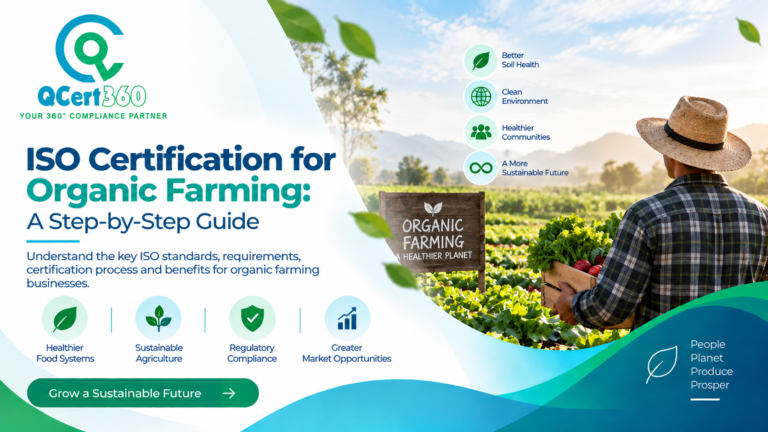
ISO Certification for Organic Farming: Standards, Requirements & Benefits
Organic farming runs on trust. Buyers pay a premium because they believe in what happens in the soil, in the field and in storage. That trust breaks easily. A mislabeled lot, an undocumented input or a contaminated harvest can undo a season of careful work.
ISO certification for organic farming protects that trust with evidence. It adds a documented, independently audited management system on top of good farming practice. This page explains which standards apply, how they differ from organic certification, what auditors expect, what certification costs and which market trends make it more valuable today.
Which ISO Standards Fit Organic Farms?
ISO 9001, ISO 14001, ISO 22000 and ISO 45001 form the core set for organic farms. They cover consistent operations, environmental control, food safety and worker safety. ISO 22005 supports traceability, and ISO 50001 or ISO 14064 add energy and emissions control. An independent body audits you, then certifies you for three years with yearly surveillance.
Is ISO Certification the Same as Organic Certification?
No. Organic certification verifies that your production methods meet an organic standard. ISO certification verifies that your management system controls quality, environment, food safety or worker safety. They answer different questions, and many strong operators hold both.
Organic certification covers what you grow with and how you grow it: approved inputs, conversion periods, buffer zones and separation of products. ISO certification does not approve inputs, and it does not grant the right to sell products as organic. Never present an ISO certificate as proof of organic status.
Think of it this way. Organic standards define the rules of production. ISO management systems define how your organization follows those rules consistently, records them and corrects mistakes fast. Together they give buyers stronger assurance than either alone.
What Is ISO Certification for Organic Farming?
Organic farming ISO certification is independent proof that your operation runs under an internationally recognized management system standard. An auditor checks that your procedures, controls and records meet the standard, and that your people follow them through the crop cycle.
ISO certification for organic farms, cooperatives and agribusinesses can cover:
- Land preparation, seed sourcing and planting
- Cultivation, irrigation and pest and disease control
- Harvesting, handling, storage and dispatch
- Producer group coordination and supplier control
- Coordination with processors, packers and exporters
You define the scope, and the auditor tests it against real activity in the field and the office.
Why Organic Farms Need ISO Certification?
Organic operations face tight margins, weather swings and demanding buyers. ISO certification brings structure to that pressure. It helps you control risk, prove practice and earn confidence from retailers, exporters and consumers who cannot inspect your fields themselves.
Is ISO certification mandatory for organic farming? Usually not. ISO certification is voluntary unless a buyer, contract or program requires it. Many now do, especially for export and retail supply. Certification also works alongside legal duties and organic rules. It never replaces them.
Common pressures that ISO standards address:
- Inconsistent practices across fields, seasons or member farms
- Contamination and mixing risks during harvest and storage
- Buyer questions about origin, inputs and handling
- Worker injuries in physically demanding field work
- Climate variability and supply disruption
- Growing demand for sustainability evidence
Which ISO Standards Do Organic Farms Need?
Most organic farms start with ISO 9001 or ISO 14001, then add ISO 22000 when they supply food buyers directly. Producer groups and exporters often add ISO 45001 and traceability controls. The table below summarizes ISO standards for organic farms.
Standard | Focus | What it controls on an organic farm | Certifiable? |
ISO 9001 | Field procedures, input control, supplier evaluation | Yes | |
ISO 14001 | Environmental management system | Soil, water, waste, biodiversity | Yes |
ISO 22000 | Food safety management system | Hygiene, contamination hazards, recall readiness | Yes |
ISO 45001 | Occupational health and safety | Machinery, manual handling, heat, field hazards | Yes |
ISO 22005 | Food chain traceability | Lot and batch identification, records | Guidance-based |
Energy management | Pumps, cold storage, drying, transport | Yes | |
ISO 46001 | Water efficiency management | Irrigation and water use | Yes |
ISO 14064 | Greenhouse gas accounting | Emissions inventories and verification | Verified |
ISO 31000 | Risk management guidance | Climate, market and operational risk thinking | No, guidance only |
Does ISO 9001 Help Organic Farms?
Yes. ISO 9001 farming systems bring consistency to crop planning, input control, harvesting, storage and supplier coordination. A quality management system replaces habit with documented method, so results stay steady across seasons, fields and people.
The quality management system does practical work on an organic farm:
- Defines standard procedures for each crop stage
- Controls seeds, compost and biological treatments
- Evaluates suppliers, contractors and packers
- Tracks yields, grades and rejected produce
- Handles complaints and corrective action
- Reviews performance through internal audits
Producer groups gain the most. When many members follow the same documented method, buyers receive uniform organic produce with fewer surprises.
Why Is ISO 14001 Important for Organic Farming?
ISO 14001 matters because environmental care is the point of organic farming. The standard helps you identify impacts, control them and improve results over time. It turns good intentions into measurable, auditable practice that supports sustainable agriculture claims.
An environmental management system guides decisions on issues that define organic operations:
- Soil health: rotation, cover cropping, compost use and erosion control
- Water use: irrigation efficiency, runoff and source protection
- Waste: crop residues, packaging and plastics
- Biodiversity: hedgerows, habitats and pollinator protection
- Nutrient management: manure, compost and leaching risk
ISO 14001 for organic farms treats soil conservation and water management in organic farming as core operational controls. You set objectives, such as reduced water per hectare or improved organic matter, assign owners and track progress.
The standard also supports regenerative agriculture goals. Regenerative practices aim to rebuild soil and ecosystems, and an ISO 14001 system gives you a structure to measure whether they work.
How Does ISO 22000 Apply to Organic Farms?
ISO 22000 applies to any organization in the food chain, including primary producers. It helps organic farms identify and control food safety hazards during growing, harvest, handling and storage. A food safety management system gives buyers confidence that natural production is also safe production.
ISO 22000 organic food systems address risks that organic status does not remove. Organic produce can still carry biological, chemical and physical hazards. Food safety hazards in organic crop production include:
- Pathogens from manure, compost or contaminated water
- Cross-contamination from equipment, crates and vehicles
- Foreign objects such as stones, metal and plastic
- Pest activity in storage
- Poor hygiene during harvest and packing
Good controls include hygiene rules for workers, water testing, compost handling methods, cleaning schedules and supplier checks. Sector guidance such as ISO/TS 22002-3 describes prerequisite programs for farming, and it fits well alongside ISO 22000.
Recall readiness completes the picture. If a problem appears, your records must show which fields, dates and lots are affected.
ISO 45001 for Farm Workers
ISO 45001 protects people by turning hazard awareness into a system. It requires risk assessment, safe work methods, training and incident learning. Farms depend on physical work, so ISO 45001 for farm workers delivers real, practical gains.
Typical hazards include:
- Tractors, tools and powered equipment
- Manual lifting, repetitive tasks and awkward postures
- Heat, sun, cold and long working hours
- Slips, falls and vehicle movement
- Handling of permitted natural pest-control substances
- Remote work and limited emergency access
Under ISO 45001, you consult workers, brief seasonal staff, keep training records, prepare emergency plans and investigate near misses. Safer sites also mean steadier harvests, because injuries and absences disrupt tight schedules.
ISO 22005 Traceability From Field to Buyer
Traceability lets you show exactly where a lot came from and where it went. ISO 22005 traceability principles guide how you design that system. Most certification programs assess traceability through ISO 9001 or ISO 22000 rather than issuing a stand-alone ISO 22005 certificate.
Strong farm-to-market traceability links inputs, fields, harvest dates, storage locations and outbound shipments. It supports traceability from field to buyer for organic produce, which buyers and auditors increasingly expect across the organic supply chain.
Traceability also drives preventing contamination and commingling of organic and non-organic products. Your system should cover:
- Field and lot identification
- Separate storage and labeled containers
- Cleaning of shared equipment and vehicles
- Transport and packing segregation
- Mass balance checks comparing inputs and outputs
- Records that link every step
Good records also make recalls faster and disputes easier to resolve.
Supporting Standards for Organic Farming
Some operations add further standards as they grow:
- ISO 50001 improves energy use in irrigation pumps, cold rooms, drying and transport.
- ISO 46001 helps manage water efficiency.
- ISO 14064 verifies greenhouse gas inventories, useful for buyers who report supply chain emissions.
- ISO 14067 guides product carbon footprints.
- ISO/IEC 27001 protects farm data as precision agriculture and digital records expand.
- ISO 31000 offers risk management guidance, though it is not certifiable.
When you combine standards, build an integrated system. One set of policies, one internal audit program and one management review cover everything, which cuts duplication and audit effort.
Requirements of ISO Certification for Organic Farming
The requirements of ISO certification for organic farming center on documented processes, proof of implementation and continual improvement. You must show that your system exists, that people follow it and that it improves.
Core requirements include:
- Defined scope. State crops, sites, members and activities covered.
- Policies and objectives. Set goals for quality, environment, food safety and safety.
- Risk and opportunity planning. Assess hazards, weather, contamination and market risks.
- Documented procedures. Cover the full crop cycle from planting to dispatch.
- Input and supplier control. Verify seeds, compost, biological treatments and contractors.
- Competence and training. Prove workers understand their roles.
- Monitoring and records. Track yields, inspections, water use, incidents and complaints.
- Traceability. Link lots, fields and shipments.
- Internal audits and management review. Check the system and correct gaps.
- Corrective action. Fix root causes, not symptoms.
Tip: Map one full crop cycle, from land preparation to dispatch, against the standard. You will spot quality, environmental and food safety gaps early.
What Does an ISO Auditor Check on an Organic Farm?
An ISO auditor checks whether your documented system matches what happens in the field and the packhouse. They review records, observe work, walk the site and interview staff. They rely on objective evidence, not promises.
What does an ISO auditor check on an organic farm? Expect focus on:
- Crop plans, field records and input logs
- Storage, segregation and hygiene controls
- Water sources, irrigation and soil practices
- Worker training and safety controls
- Supplier and contractor evaluation
- Traceability tests, such as tracing a lot back to its field
- Complaint, incident and corrective action files
- Internal audit and management review results
Prepare by running your own procedures every day, not just before the audit.
Benefits of ISO Certification for Organic Farming
The benefits of ISO certification for organic farming show up in quality, safety, buyer trust and efficiency. Certified operations run tighter systems, prove their practices and earn access to more demanding markets.
- Stronger buyer confidence. Independent audits back your claims about control and consistency.
- Better market access. Retailers, distributors and importers favor certified suppliers.
- Improved traceability. Records reduce mixing errors and speed up recalls.
- Lower waste. Standard procedures cut post-harvest losses and rework.
- Safer workplaces. Structured risk control reduces injuries and downtime.
- Environmental performance. Measured soil, water and waste practices improve steadily.
- Resilience. Documented emergency and continuity plans help you handle disruption.
- Easier audits. Organized records make other inspections smoother.
- Financing appeal. Lenders and investors value verified management systems.
ISO certification for organic farm exporters carries extra weight. Export buyers depend on documents, and a recognized certificate helps you pass supplier approval faster.
Organic Farming Market Trends
Organic demand stays strong while the production base holds steady. That combination raises the value of proof, reliability and traceability.
FiBL and IFOAM report that global retail sales of organic food and drink rose to 145.0 billion euros in 2024, an increase of 6.9 billion euros. Meanwhile, organic farmland stood at 98.9 million hectares, about 2.1 percent of total farmland, with a slight 0.2 percent decline from 2023. The same data shows the number of organic producers reached 4.8 million worldwide. Global Organic Market hits All-Time High | IFOAM +2
Trade links are tightening too. Combined organic imports into the EU and the United States reached 5.9 million metric tons in 2024, up 12.3 percent. Longer supply chains mean more handovers, more documents and more chances for errors. Buyers respond by asking for stronger evidence. IFOAM
Several trends shape what buyers expect:
- Rising sales against flat land. Competition shifts toward reliability, quality and proof.
- Traceability demands. Retailers want lot-level records from field to shelf.
- Regenerative agriculture interest. Buyers want measurable soil and ecosystem outcomes.
- Climate and water risk. Weather swings make continuity planning essential.
- Digital farm records. Sensors and software improve control and raise data security needs.
- Supplier due diligence. Retailers audit suppliers on safety, sustainability and labor practice.
- Emissions reporting. Buyers ask farms for data that supports their own sustainability reports.
ISO certification helps you meet each expectation with documented evidence.
How to Get ISO Certification for an Organic Farm
To get certified, choose your standards, assess your gaps, build and run your system, audit it internally and pass an external audit. How to get ISO certification for an organic farm follows the same ISO certification process every time:
- Select standards. Match them to buyer requirements and risks.
- Define scope. List crops, sites, members and activities.
- Run a gap analysis. Compare current practice with each requirement.
- Build the system. Write only the procedures and records you need.
- Train your people. Everyone must understand their roles.
- Operate the system. Gather records across real activity.
- Complete an internal audit and management review. Fix issues early.
- Choose a third-party certification body for organic farming. Pick an independent body that issues recognized certificates.
- Pass the Stage 1 audit. The auditor reviews documents and readiness.
- Pass the Stage 2 audit. The auditor verifies implementation.
- Receive your certificate. Maintain it through annual surveillance audits.
How Long Does ISO Certification Take for an Organic Farm?
Most organic farms need about three to eight months. The crop calendar matters, because auditors want to see the system operating during real production. A single-site farm with solid records moves faster than a multi-member cooperative building systems from scratch.
Three factors drive timing:
- Starting maturity. Existing records and procedures save time.
- Scale. More sites and members mean more training and sampling.
- Management commitment. Quick decisions keep progress steady.
How Much Does ISO Certification Cost for an Organic Farm?
ISO certification cost depends on farm size, number of sites, employees or members, scope and chosen standards. How much does ISO certification cost for an organic farm? No fixed price fits everyone, so a quote based on your profile is the only reliable answer.
Typical cost elements:
- Stage 1 and Stage 2 audits
- Annual surveillance audits
- Recertification audit every three years
- Optional consulting and gap analysis
- Internal training and staff time
Integrated audits often lower total cost compared with certifying each standard separately.
ISO Certificate Validity and Small Farms
An ISO certificate stays valid for three years. Surveillance audits confirm the system still works, and a recertification audit renews the certificate at the end of the cycle.
Can small organic farmers get ISO certified? Yes. Standards scale to size. Small farms can use lean documentation, short procedures and simple records. Farmer groups and cooperatives can also certify together under a shared system, which spreads cost and effort across members.
Common Gaps We See on Organic Farms
Gap assessments often show the same weaknesses:
- Incomplete input and harvest records
- Weak separation of organic and non-organic product
- Generic risk assessments that ignore real field tasks
- Poor water testing and hygiene documentation
- Training files that do not prove competence
- No tested plan for weather or supply disruption
How QCert360 Supports Organic Farming Operations
QCert360 helps organic farms, producer groups, cooperatives and agribusinesses achieve ISO certification with clear guidance and audit services aligned to international standards. We support clients across 195 countries.
Our support includes:
- Standard selection advice. We help you choose the right mix of ISO 9001, ISO 14001, ISO 22000, ISO 45001 and supporting standards.
- Gap assessment. We compare your operations with each requirement.
- Implementation guidance. We help you build practical systems that fit real farm work.
- Independent audit and certification. We assess conformity objectively.
- Ongoing support. We stay with you through surveillance and recertification.
Frequently Asked Questions
Which ISO standards do organic farms need?
Most start with ISO 9001 or ISO 14001, then add ISO 22000 and ISO 45001. Exporters and groups often add traceability controls and energy or emissions standards.
Is ISO certification the same as organic certification?
No. Organic certification verifies production methods against an organic standard. ISO certification verifies your management system.
Is ISO certification mandatory for organic farming?
Usually not. It is voluntary unless a buyer, contract or program requires it.
Does ISO 9001 help organic farms?
Yes. It standardizes procedures, controls inputs and suppliers and improves consistency across seasons and members.
Why is ISO 14001 important for organic farming?
It gives you a system to manage soil, water, waste and biodiversity, and to prove improvement over time.
How does ISO 22000 apply to organic farms?
It helps identify and control biological, chemical and physical hazards, from harvest hygiene to storage and recall readiness.
How long does ISO certification take for an organic farm?
Typically three to eight months, depending on size, complexity and crop calendar.
How much does ISO certification cost for an organic farm?
Cost varies with size, sites, scope and standards. Request a tailored quote.
Can small organic farmers get ISO certified?
Yes. Requirements scale to size, and groups can share systems.
What does an ISO auditor check on an organic farm?
Records, inputs, storage, water and soil practice, training, supplier control, traceability tests and corrective action.
Start Your ISO Certification Journey with QCert360
Organic farming earns trust in the field, and ISO certification carries that trust to the buyer. It helps you prove control, protect workers and win markets that demand evidence.
Talk to QCert360 today for a free consultation and a certification quote tailored to your organic operation.
[Get Your Free ISO Certification Quote for organic farming business]
Our Services
ISO Standards
- ISO 9001 Certification
- ISO 14001 Certification
- ISO 45001 Certification
- ISO 22000 Certification
- ISO 17025 Certification
- ISO 27001 Certification
- ISO 13485 Certification
- ISO 20000-1 Certification
- ISO 41001 Certification
- ISO 22716 Certification
- ISO 50001 Certification
- ISO 22301 Certification
- ISO 29993 Certification
Product Certifications
Other international standards
- FSSC 22000 Certification
- HIPAA
- HACCP Certification
- SA 8000 Certification
- GMP Certification
- GDPR
- GDP Certification
- GLP Certification
- Certificate of Conformity
QCert360 provides a wide range of services including ISO certification, audit support, compliance consulting, and training. They specialize in helping businesses achieve global standards and certifications like ISO 9001, ISO 27001, ISO 14001, and many others. Their team ensures a seamless experience from consultation to certification, supporting clients at every stage.
The time it takes to achieve certification can vary depending on the complexity of the standard and the readiness of your organization. On average, it takes about 3 to 6 months. QCert360 works closely with clients to streamline the process, ensuring that all requirements are met efficiently and within a reasonable timeline.
QCert360 is a trusted partner with years of experience in helping businesses obtain international certifications. Their expert consultants provide tailored solutions, ensuring your organization not only meets but exceeds industry standards. With a customer-centric approach, they focus on offering end-to-end support to simplify the certification journey.
QCert360 serves a wide range of industries including manufacturing, healthcare, information technology, education, and services, among others. They customize their certification solutions to meet the unique requirements of each industry, ensuring relevance and compliance with global standards.
Yes, QCert360 provides ongoing support even after certification. They offer services like surveillance audits, recertification guidance, and consultancy to help maintain and improve your certification status. Their team ensures that your organization stays compliant and up-to-date with any changes in certification standards.
Getting started with QCert360 is simple. You can contact them via their website to request a consultation. Their team will assess your needs, discuss the best certification options for your business, and outline the steps involved. From there, they’ll guide you through the entire process, ensuring you’re prepared for certification.
QCert360 stands out due to its customer-focused approach, industry expertise, and comprehensive service offerings. Their team doesn’t just help you obtain certification but works to ensure your organization thrives in compliance with international standards. They also offer personalized consultation, making the process smoother and more efficient, ensuring long-term success for your business.
The cost of certification varies depending on factors such as the type of certification, the size and complexity of your organization, and the specific industry requirements. QCert360 offers competitive pricing and provides tailored quotes based on your unique needs. They ensure transparency and work with you to find the most cost-effective solution for your certification goals.
Yes, QCert360 offers internal audit services to help assess and improve your organization’s processes. Their expert auditors conduct thorough reviews of your systems and operations to ensure they meet required standards. They also provide actionable recommendations to help enhance efficiency and compliance, making sure you’re fully prepared for external audits.
If your organization doesn’t pass an audit or certification assessment, QCert360 works with you to understand the reasons for non-compliance and provides support to rectify the issues. They offer guidance on corrective actions and help you prepare for a re-assessment. Their goal is to ensure your organization meets the necessary standards for certification, and they will be by your side to make the process as smooth as possible.