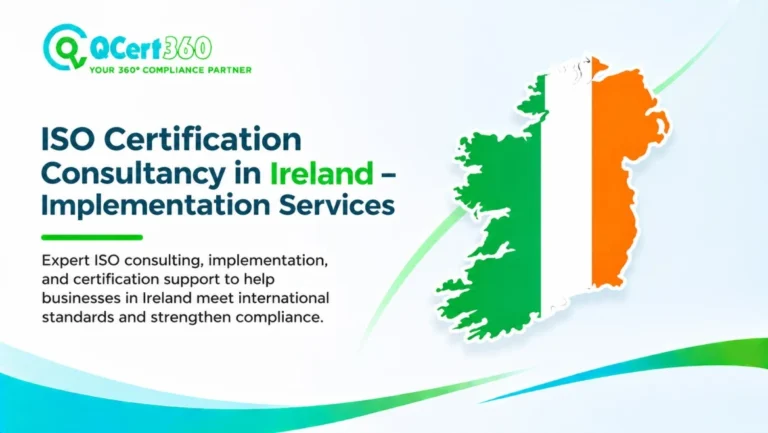
Get Expert ISO Certification Consultancy and Implementation Support in Ireland: Top 10 company
ISO certification consultancy in Ireland helps organisations select the right ISO standard, implement a management system, train employees, conduct internal audits and prepare for independent certification audits. The Irish National Accreditation Board (INAB) accredits certification bodies within defined scopes. The National Standards Authority of Ireland (NSAI) is Ireland’s national standards body and also operates a certification service. QCert360 provides ISO consulting, implementation guidance, training, internal audit support and certification readiness services. QCert360 does not issue ISO certificates or guarantee certification outcomes.
Irish businesses operate in sectors where quality, safety, environmental performance, information security and regulatory compliance matter to customers and regulators. Pharmaceutical manufacturers, medical technology companies, data centres, financial services organisations, food producers, construction contractors and technology businesses may need to demonstrate that their management systems meet recognised international requirements.
ISO certification can help organisations demonstrate that their processes are controlled, risks are managed and improvement activities are documented. It can also support supplier approval, tender applications, customer confidence and international business relationships.
However, ISO certification does not automatically establish compliance with every Irish or European Union law. Organisations must identify their own legal and contractual obligations and implement the controls that apply to their activities.
This guide explains ISO certification consultancy in Ireland, the roles of INAB and NSAI, relevant Irish and EU regulations, suitable ISO standards, implementation steps, costs, timelines and QCert360’s consulting services for businesses in Dublin, Cork, Galway, Limerick and other Irish locations.
What Is ISO Certification Consultancy in Ireland?
ISO certification consultancy is a professional service that helps organisations implement and maintain management systems based on international ISO standards.
An ISO consultant in Ireland supports the organisation before the external certification audit. The work may include gap analysis, management system documentation, risk assessment, employee training, implementation guidance, internal audits and corrective action support.
An independent certification body performs the certification audit and decides whether the organisation meets the applicable standard.
ISO Consultant vs Certification Body: What Is the Difference?
ISO consultant | Independent certification body |
Helps select the appropriate ISO standard | Audits the organisation against the selected standard |
Conducts gap assessments | Conducts Stage 1 and Stage 2 certification audits |
Provides implementation guidance | Evaluates conformity and audit evidence |
Supports employee training | Interviews employees during certification audits |
Helps prepare internal audits | Makes the independent certification decision |
Supports corrective action | Issues, maintains, suspends or withdraws certification according to its procedures |
The distinction is important because certification must remain impartial. A consultant should not promise that a certificate will be issued, and a certification body must protect its independence when making certification decisions.
For Irish businesses, ISO certification may be requested by multinational customers, public-sector buyers, healthcare organisations, construction contractors, manufacturers and international suppliers. In other cases, organisations implement ISO standards to improve their own processes and manage business risks.
An ISO certificate is not a legal compliance certificate. It demonstrates that a management system has been independently assessed against a specified standard and scope. Legal compliance must be assessed separately.
Which Authorities Oversee ISO Standards, Accreditation and Compliance in Ireland?
Ireland has several authorities responsible for standards, accreditation, data protection, cybersecurity, workplace safety, environmental protection, financial regulation and product oversight.
The following organisations are particularly relevant to businesses considering ISO certification and compliance management.
Irish authority | Main responsibility | Business relevance |
Irish National Accreditation Board (INAB) | National accreditation body | Accredits certification bodies, laboratories and other conformity assessment organisations within defined scopes |
National Standards Authority of Ireland (NSAI) | National standards body | Develops and publishes Irish standards and operates certification services |
Data Protection Commission (DPC) | Data protection supervision and enforcement | GDPR and Irish data protection requirements |
National Cyber Security Centre (NCSC) | National cybersecurity coordination | Cybersecurity guidance and NIS2-related preparation |
Health and Safety Authority (HSA) | Workplace health and safety | Occupational safety and health requirements |
Environmental Protection Agency (EPA) | Environmental protection and regulation | Environmental licensing, monitoring and enforcement |
Central Bank of Ireland | Financial regulation and supervision | Financial-sector requirements, including DORA |
Health Products Regulatory Authority (HPRA) | Medicines and health products regulation | Medicines, medical devices and related products |
Food Safety Authority of Ireland (FSAI) | Food safety oversight | Food hygiene, safety and related requirements |
Competition and Consumer Protection Commission (CCPC) | Competition and consumer protection | Consumer and competition-related obligations |
Workplace Relations Commission (WRC) | Employment rights and workplace relations | Employment rights and workplace disputes |
Office of Government Procurement (OGP) | Public procurement policy and frameworks | Government procurement and tender requirements |
AI Office of Ireland | Coordination of EU AI Act implementation | AI governance and coordination with competent authorities |
The authority that applies to an organisation depends on its industry, activities, products, services and legal status. Businesses should check the latest official guidance before relying on a regulatory interpretation.
Which Irish and EU Laws Affect ISO Compliance in Ireland?
Irish businesses may need to comply with national legislation, EU regulations, statutory instruments, industry-specific rules and contractual obligations.
The following areas are particularly relevant when planning an ISO management system.
Law or regulatory framework | Main requirement area | Related ISO standard |
General Data Protection Regulation (GDPR) and Data Protection Act 2018 | Personal data protection and processing responsibilities | ISO/IEC 27001 and ISO/IEC 27701 |
NIS2 Directive and Irish transposition legislation | Cybersecurity risk management and incident reporting for in-scope entities | ISO/IEC 27001 and ISO 22301 |
EU Artificial Intelligence Act | AI system governance, risk management and applicable obligations | ISO/IEC 42001 |
Digital Operational Resilience Act (DORA) | ICT risk management and operational resilience for in-scope financial entities | ISO/IEC 27001 and ISO 22301 |
Safety, Health and Welfare at Work Act 2005 | Employer responsibilities and workplace safety | |
Corporate Sustainability Reporting Directive (CSRD) | Sustainability reporting for organisations within scope | ISO 14001 and ISO 14064-1 |
Criminal Justice (Corruption Offences) Act 2018 | Prevention and accountability relating to corruption offences | |
Protected Disclosures Acts | Whistleblowing and protected reporting arrangements | ISO 37002 |
Criminal Justice (Money Laundering and Terrorist Financing) Act 2010, as amended | Anti-money laundering obligations for designated persons | ISO 37301, as supporting compliance management |
Environmental legislation and EPA requirements | Environmental protection, licensing and waste management | ISO 14001 |
Food safety legislation | Food hygiene, safety and traceability | |
Medical device and medicines regulation | Product safety, quality and regulatory requirements | ISO 13485, where applicable |
Public procurement requirements | Tender-specific eligibility and supplier conditions | ISO 9001, ISO 14001 and ISO 45001, where requested |
These standards can help organisations manage relevant processes, but they do not replace legal duties. A company should maintain a legal and regulatory requirements register that identifies applicable obligations, responsible personnel, operational controls and compliance evidence.
GDPR and ISO 27001 in Ireland
The General Data Protection Regulation and Ireland’s Data Protection Act 2018 establish requirements for organisations that process personal data.
The Data Protection Commission (DPC) supervises GDPR compliance in Ireland. Organisations must establish appropriate technical and organisational measures to protect personal data, manage data subject requests and respond appropriately to personal data breaches.
Under GDPR Article 33, a personal data breach must be reported to the relevant supervisory authority without undue delay and, where feasible, within 72 hours of becoming aware of it when the breach is likely to result in a risk to individuals’ rights and freedoms. Where the breach is likely to result in a high risk, affected individuals must also be informed without undue delay.
ISO/IEC 27001 provides an information security management system framework for identifying risks, implementing controls, managing incidents and improving security practices. ISO/IEC 27701 provides additional privacy information management requirements and guidance.
However, ISO/IEC 27001 certification does not automatically establish GDPR compliance. Organisations must separately assess lawful processing, data subject rights, retention, processor relationships, international transfers and breach notification responsibilities.
Official guidance: Data Protection Commission – Breach Notification.
NIS2 Directive and Cybersecurity in Ireland
The NIS2 Directive (EU) 2022/2555 establishes cybersecurity risk management and incident reporting requirements for entities operating in specified essential and important sectors.
Ireland missed the original transposition deadline of 17 October 2024. On 8 July 2026, the European Commission announced that it had referred Ireland and three other Member States to the Court of Justice of the European Union for failing to notify full transposition measures.
The National Cyber Security Centre has published NIS2 information and preparatory material. Its published guidance also explains that the earlier NIS1 framework continues to apply to designated operators of essential services until the new national framework is implemented.
Businesses that may fall within NIS2 should assess their likely scope, cybersecurity risks, supplier dependencies, incident response procedures and management responsibilities. They should monitor the latest Irish legislation rather than assume that draft requirements have already become enforceable domestic law.
ISO/IEC 27001 can provide a structured framework for information security risk management. ISO 22301 can support business continuity planning. Neither standard automatically satisfies every NIS2 obligation.
Official references:
- National Cyber Security Centre – NIS2
- European Commission – Ireland referred to the Court of Justice over NIS2.
EU AI Act and ISO/IEC 42001 in Ireland
The EU Artificial Intelligence Act, Regulation (EU) 2024/1689, establishes a risk-based regulatory framework for AI systems. Its requirements apply in phases and depend on the type of AI system and the organisation’s role as a provider, deployer, importer or other relevant operator.
Ireland’s Regulation of Artificial Intelligence Act 2026 established the AI Office of Ireland as an independent statutory body. The Office coordinates national implementation of the EU AI Act and works with relevant sector regulators under Ireland’s distributed regulatory model.
The EU Digital Omnibus on AI, Regulation (EU) 2026/1744, was adopted on 8 July 2026 and published in the Official Journal on 24 July 2026. Businesses should use the current consolidated version of the EU AI Act when checking applicable obligations and implementation dates.
ISO/IEC 42001 provides an AI management system framework. It can help organisations establish responsibilities, assess AI-related risks, manage system development and use, and improve governance. Our ISO 42001 guide for AI companies covers it in more detail.
However, ISO/IEC 42001 certification does not automatically establish compliance with the EU AI Act. Legal obligations must be assessed separately.
Official references:
- AI Office of Ireland
- Regulation of Artificial Intelligence Act 2026 – Irish Government
- EU Artificial Intelligence Act – EUR-Lex
- Digital Omnibus on AI – Regulation (EU) 2026/1744.
DORA and Financial Services in Ireland
The Digital Operational Resilience Act (DORA), Regulation (EU) 2022/2554, applies to financial entities within its scope and establishes requirements relating to ICT risk management, incident reporting, resilience testing and third-party ICT risk.
Financial organisations should assess their DORA obligations according to their regulatory status and activities. ISO/IEC 27001 and ISO 22301 can support information security and business continuity arrangements, but neither replaces DORA’s specific requirements.
Corporate Sustainability Reporting in Ireland
Ireland transposed the Corporate Sustainability Reporting Directive through the European Union (Corporate Sustainability Reporting) Regulations 2024.
The EU subsequently introduced changes and timing adjustments to sustainability reporting requirements. Organisations should check the current scope, thresholds and reporting dates before determining whether they are required to report.
ISO 14001 can support environmental management, while ISO 14064-1 provides a framework for quantifying and reporting greenhouse gas emissions at the organisational level. Neither standard replaces the applicable sustainability reporting legislation.
Official reference: Department of Enterprise – Corporate Sustainability Reporting Regulations.
Which ISO Standards Are Most Relevant to Irish Businesses?
The right ISO standard depends on the organisation’s industry, operational risks, customer expectations and regulatory requirements.
The following standards are commonly relevant to Irish organisations.
ISO standard | Full name or purpose | Relevant industries |
Manufacturing, construction, engineering, professional services and suppliers | ||
Environmental Management System | Manufacturing, construction, energy, logistics and industrial facilities | |
Occupational Health and Safety Management System | Construction, engineering, manufacturing and logistics | |
Food Safety Management System | Food processing, dairy, catering, beverage and agricultural businesses | |
Information Security Management System | Technology, financial services, data centres and professional services | |
Privacy Information Management System | Organisations processing personal data | |
Business Continuity Management System | Financial services, healthcare, IT and critical service providers | |
Anti-Bribery Management System | Construction, procurement, finance and organisations exposed to bribery risks | |
ISO 37002 | Whistleblowing Management Systems | Large employers, regulated organisations and businesses with formal reporting channels |
ISO 37301 | Compliance Management System | Regulated businesses and organisations with complex compliance obligations |
Medical Device Quality Management System | Medical device manufacturers and relevant suppliers | |
Artificial Intelligence Management System | AI developers, technology companies and organisations using AI systems | |
Energy Management System | Energy-intensive facilities and industrial operations | |
ISO 14064-1 | Greenhouse Gas Emissions Quantification and Reporting | Organisations measuring and reporting organisational emissions |
Medical Laboratory Quality and Competence | Medical laboratories | |
Testing and Calibration Laboratory Competence | Testing and calibration laboratories | |
Asset Management System | Utilities, infrastructure, transport and asset-intensive organisations |
Which ISO Standard Should an Irish Business Implement First?
Start with the standard that addresses your most important business requirement.
- Manufacturing companies: ISO 9001 for quality management, ISO 14001 for environmental management and ISO 45001 for workplace safety.
- Pharmaceutical and biotechnology companies: ISO 9001 and relevant quality management controls, alongside applicable good manufacturing practice and regulatory requirements.
- Medical technology companies: ISO 13485 for medical device quality management, alongside applicable EU Medical Device Regulation requirements.
- Technology and SaaS companies: ISO/IEC 27001 for information security, ISO/IEC 27701 for privacy management and ISO 22301 for continuity.
- Banks and financial services companies: ISO/IEC 27001, ISO 22301 and ISO 37301 as supporting management frameworks, alongside applicable Central Bank and DORA requirements.
- Food producers and exporters: ISO 22000 or FSSC 22000, depending on customer and supply-chain requirements.
- Construction contractors: ISO 9001, ISO 14001 and ISO 45001, with relevant sector safety requirements.
- Energy and utilities: ISO 50001, ISO 14001, ISO 45001 and ISO 55001, depending on operational needs.
ISO 9001 is a common starting point for organisations seeking a general quality management framework. It is not automatically the best first standard for every business. A medical device manufacturer, for example, may need to prioritise ISO 13485 because of its specific quality and regulatory environment.
Sector-Specific Schemes Used Alongside ISO Standards in Ireland
Some Irish industries use additional sector schemes and assurance programmes alongside ISO standards.
Examples include:
- Construction: Safe-T-Cert provides a construction-focused safety management certification scheme.
- Food and agriculture: Bord Bia operates quality assurance and sustainability programmes, including Origin Green.
- Food manufacturing: FSSC 22000 may be required by international retailers or food supply-chain customers.
- Medical devices: ISO 13485 is used alongside applicable EU medical device legislation and conformity assessment requirements.
These schemes are not interchangeable with ISO standards. Organisations should check the requirements of the specific buyer, regulator or certification programme.
Which ISO Standard Editions Should Irish Businesses Plan For?
Organisations should identify the current edition of each standard before beginning implementation or planning a transition.
Three important revisions affect organisations holding certificates to earlier editions.
Standard | Revised edition | Transition deadline for existing certified organisations |
ISO 9001 | ISO 9001:2026 | 30 September 2029 |
ISO 14001 | ISO 14001:2026 | 30 April 2029 |
ISO 37001 | ISO 37001:2025 | 28 February 2027 |
ISO 9001:2026 Transition in Ireland
ISO 9001:2026 was published on 16 September 2026, replacing ISO 9001:2015.
The transition period for organisations certified to ISO 9001:2015 ends on 30 September 2029 under the published Global ACI transition requirements.
Organisations should:
- Review their existing ISO 9001:2015 management system.
- Conduct a gap assessment against ISO 9001:2026.
- Update relevant policies, procedures and controls.
- Train employees on revised requirements.
- Conduct internal audits against the new edition.
- Agree the transition audit schedule with their certification body.
From 31 March 2028, new and initial accredited certifications under the applicable Global ACI transition requirements may only be issued to ISO 9001:2026.
Official reference: Global ACI – ISO 9001:2026 Transition Requirements.
ISO 14001:2026 Transition in Ireland
ISO 14001:2026 was published in April 2026, replacing ISO 14001:2015.
Organisations certified to ISO 14001:2015 must complete their transition by 30 April 2029 under the published transition requirements.
Businesses should review their environmental aspects, compliance obligations, operational controls, environmental objectives and performance evaluation arrangements against the revised edition.
From 31 October 2027, new and initial accredited certifications under the applicable transition requirements may only be issued to ISO 14001:2026.
Official reference: Global ACI – ISO 14001:2026 Transition Requirements.
ISO 37001:2025 Transition in Ireland
ISO 37001:2025 replaces ISO 37001:2016 and updates the requirements for anti-bribery management systems.
The transition period ends on 28 February 2027. Organisations holding ISO 37001:2016 certificates should contact their certification body and agree the required transition audit arrangements.
The revised edition includes changes relating to compliance culture, conflicts of interest and the anti-bribery function.
Official reference: IAF MD 30:2025 – Transition Requirements for ISO 37001:2025.
Other Important ISO Editions
Other standards relevant to Irish businesses include:
- ISO/IEC 27001:2022 – Information Security Management Systems.
- ISO 45001:2018 – Occupational Health and Safety Management Systems.
- ISO 22000:2018 – Food Safety Management Systems.
- ISO 13485:2016 – Medical Device Quality Management Systems.
- ISO 22301:2019 – Business Continuity Management Systems.
- ISO 50001:2018 – Energy Management Systems.
- ISO/IEC 42001:2023 – Artificial Intelligence Management Systems.
- ISO 37301:2021 – Compliance Management Systems.
- ISO 15189:2022 – Medical Laboratories.
- ISO/IEC 17025:2017 – Testing and Calibration Laboratories.
Confirm the latest edition and any amendments before implementation. The availability of accredited certification to a newly published edition can depend on the certification body’s accreditation and transition status.
How Do INAB and NSAI Fit Into ISO Certification in Ireland?
INAB and NSAI have different responsibilities within Ireland’s standards and conformity assessment infrastructure.
What Is INAB?
The Irish National Accreditation Board (INAB) is Ireland’s national accreditation body. It assesses and accredits conformity assessment organisations, including management systems certification bodies, laboratories and inspection bodies.
For management systems certification, INAB accredits certification bodies against EN ISO/IEC 17021-1, together with relevant scheme-specific requirements where applicable.
INAB’s directory allows businesses to check which organisations are accredited and the standards or activities included in their accreditation scope.
What Is NSAI?
The National Standards Authority of Ireland (NSAI) is Ireland’s national standards body. It develops and publishes Irish standards, including standards adopted from European and international publications.
NSAI also operates certification services. Its certification activities should be distinguished from its role in publishing standards.
Is NSAI the Only ISO Certification Body in Ireland?
No. NSAI is one certification provider. Other certification bodies may also operate in Ireland, including organisations accredited by INAB and international certification bodies accredited by their own national accreditation bodies.
Businesses should compare certification providers based on their accreditation, scope, industry experience, audit arrangements, customer acceptance and fees.
How to Verify an Accredited ISO Certification Body in Ireland
Before appointing a certification body, check:
- Its registered legal name.
- The accreditation body responsible for its accreditation.
- Whether its accreditation is current.
- Whether the accreditation covers your required ISO standard.
- Whether the relevant industry or technical sector is included.
- Whether the certification body is ready to audit the edition you require.
- Whether the certificate will be accepted by your customers and tender authorities.
- Whether surveillance and recertification costs are clearly stated.
A company operating in Ireland is not automatically an INAB-accredited certification body. Likewise, accreditation for ISO 9001 does not automatically cover ISO 14001, ISO 27001 or other standards.
Use the official INAB Directory of Accredited Bodies to verify management systems certification accreditation.
QCert360 is an ISO consulting and audit support provider, not a certification body or accreditation body. We help organisations prepare for independent certification audits. We do not issue certificates.
QCert360's ISO Consultancy and Implementation Services in Ireland
QCert360 supports organisations that want to implement, improve or transition their management systems according to relevant international standards.
Our ISO consultancy services focus on practical implementation, employee awareness, process improvement, documented evidence and preparation for independent certification audits.
- ISO Standard Selection and Gap Analysis in Ireland
We review your business activities, customer requirements, existing processes and operational risks to help identify the appropriate ISO standard.
A gap analysis compares your current management system with the requirements of the selected standard and identifies areas requiring improvement.
- ISO Compliance Mapping
We help organisations identify relevant legal, regulatory and customer requirements and map them to management system processes and controls.
This can help businesses maintain a clearer record of responsibilities, operational controls and compliance evidence. Legal interpretation should be confirmed with qualified legal advisers where necessary.
- ISO Documentation and Implementation Support
We provide guidance on developing and improving:
- Quality, environmental and information security policies.
- Management system procedures.
- Risk assessments and operational controls.
- Objectives and performance indicators.
- Documented information and records.
- Monitoring and evaluation processes.
- Corrective action procedures.
Documentation should reflect actual business processes rather than rely on generic templates. See why documentation is important for achieving ISO certification.
- ISO Training for Employees in Ireland
Employees need to understand the management system and their responsibilities within it.
QCert360 supports ISO awareness and role-specific training to help staff understand relevant procedures, controls, responsibilities and audit expectations.
- ISO Internal Audit Support in Ireland
Internal audits help an organisation determine whether its management system meets the requirements of the selected standard and is operating effectively.
We support internal audit planning, audit activities, reporting and corrective action follow-up.
- Management Review Preparation
Management review allows leadership to assess the performance and effectiveness of the management system.
We help prepare relevant information covering audit findings, objectives, risks, customer feedback, nonconformities, resource needs and improvement opportunities.
- Corrective Action Guidance
When a problem or nonconformity is identified, organisations should understand its underlying cause and take appropriate corrective action.
We help businesses structure root-cause analysis, action plans and follow-up reviews.
- ISO Certification Audit Readiness in Ireland
Before the external certification audit, we help review the management system, identify outstanding gaps and prepare employees and records. Our audit preparation checklist is a useful starting point.
The independent certification body performs the certification audit and makes the certification decision.
- Integrated Management System Consulting in Ireland
Organisations implementing several standards can benefit from coordinated processes, internal audits, documentation and management reviews. Learn more about integrated management systems.
QCert360 supports integrated management system projects involving standards such as ISO 9001, ISO 14001, ISO 45001 and ISO/IEC 27001, according to the agreed project scope.
Our approach is to help businesses develop management systems that support their everyday operations, not paperwork that exists only to pass an audit.
What Do ISO Audit Support Services Include?
ISO audit support can involve different types of assessment. Businesses should understand what each service covers and who is responsible for the final certification decision.
Audit or assessment | Who performs it | Main purpose |
Gap analysis | Consultant or internal team | Identifies differences between current processes and standard requirements |
Internal audit | Organisation’s competent internal auditors, with support where appropriate | Checks whether the management system is implemented and effective |
Readiness audit | Consultant or readiness reviewer | Identifies remaining gaps before the certification audit |
Supplier audit | Customer or appointed auditor | Evaluates supplier performance against contract requirements |
Stage 1 certification audit | Independent certification body | Reviews documentation, scope and readiness |
Stage 2 certification audit | Independent certification body | Evaluates implementation and effectiveness |
Surveillance audit | Independent certification body | Checks continued conformity after certification |
Recertification audit | Independent certification body | Reviews the management system before the end of the certification cycle |
QCert360 supports gap analysis, internal audit activities, readiness assessments and preparation for customer or supplier audits. Certification audits are performed by independent certification bodies.
What Is the ISO Certification Process in Ireland?
The ISO certification process usually follows a series of implementation and audit stages. The time and effort required depend on the organisation’s size, existing processes, operational complexity and chosen standard.
Step 1: Identify Your Business Requirements
Determine why your organisation needs ISO certification. This may involve a customer requirement, supplier approval, tender condition, export contract, internal improvement objective or regulatory expectation.
Step 2: Select the Appropriate ISO Standard
Choose the standard that best matches your business activities, risks and customer expectations.
Step 3: Define the Certification Scope
Identify the locations, departments, services, products and activities that will be covered by the management system.
Step 4: Conduct a Gap Analysis
Review existing processes against the selected standard and identify areas that require improvement.
Step 5: Obtain Management Commitment
Senior management should approve the required resources, objectives, responsibilities and implementation plan.
Step 6: Develop and Implement the Management System in Ireland
Establish relevant policies, procedures, risk controls, operational processes and records.
Step 7: Train Employees
Provide awareness and role-specific training so employees understand their responsibilities and relevant management system requirements.
Step 8: Operate the System and Maintain Evidence
The management system must be put into practice. Maintain relevant records to demonstrate that processes and controls are operating.
Step 9: Conduct Internal Audits and Management Review
Review conformity, effectiveness, audit results, risks, performance and improvement opportunities.
Step 10: Select a Certification Body and Complete External Audits
Verify the certification body’s accreditation and scope, obtain a written quotation and schedule the certification audit.
The certification body generally conducts Stage 1 and Stage 2 audits before making its independent certification decision.
After certification, the organisation must continue operating the management system and complete the required surveillance and recertification activities.
How to Choose an ISO Certification Body in Ireland
Selecting the right certification body is an important part of the certification process. A low quotation alone should not determine the decision.
Consider the following factors:
Accreditation: Verify which accreditation body has accredited the certification provider. For INAB-accredited certification bodies, use the official INAB directory.
Standard scope: Check that the certification body’s accreditation covers the exact ISO standard you need.
Industry scope: Verify that the relevant technical or industry sector is included where sector-specific accreditation applies.
International acceptance: Ask important customers and tender authorities whether they accept the certification body’s accreditation.
Edition readiness: Confirm that the certification body is ready and authorised to conduct accredited audits against the latest edition.
Audit experience: Ask about its experience with organisations of similar size and operational complexity.
Impartiality: Confirm that the certification body maintains the required independence and has not provided consulting that compromises its certification decision.
Certificate scope: Ensure that the proposed scope accurately describes your business activities, locations, products and services.
Quotation transparency: Request a breakdown of Stage 1, Stage 2, surveillance and recertification fees, along with any travel or additional audit costs.
QCert360 does not endorse one certification body for every organisation. We help businesses prepare for certification, while the organisation selects an independent certification body that meets its requirements. Our guide on how to choose the right ISO consultant for your industry may also help.
How Much Does ISO Consultancy and Certification Cost in Ireland?
The cost of ISO consultancy and certification in Ireland depends on the organisation’s size, number of locations, selected standards, operational complexity and existing management system maturity.
There are two separate cost categories: consultancy fees and certification body fees.
Cost category | What it may include |
ISO consultancy | Gap analysis, implementation guidance and project support |
Documentation support | Policies, procedures, risk assessments and records |
Employee training | ISO awareness and role-specific training |
Internal audit support | Audit planning, execution support and reporting |
Certification audit | Stage 1 and Stage 2 audit fees |
Surveillance audits | Periodic independent audits after certification |
Recertification | Audit activities at the end of the certification cycle |
Additional expenses | Travel, accommodation and other agreed costs |
Factors That Affect ISO Certification Cost in Ireland
The total cost may increase or decrease depending on:
- Number of employees and work shifts.
- Number of locations included in the certification scope.
- Complexity of business processes and operational activities.
- Existing policies, procedures and records.
- Number of ISO standards being implemented.
- Amount of consulting and documentation support required.
- Certification audit duration.
- Travel and accommodation requirements.
- Surveillance and recertification arrangements.
For an accurate estimate, request separate written quotations from the consultant and certification body.
Request an ISO consultancy quotation in Ireland from QCert360 by sharing your industry, employee count, locations and required ISO standard. This helps establish a suitable consulting scope.
How Long Does ISO Implementation Take in Ireland?
ISO implementation time depends on the organisation’s size, operational complexity, selected standard and existing management practices. For more detail, see how long ISO implementation takes for different businesses.
A small business with established processes may prepare in a few months. A larger organisation with multiple locations or several standards may need six to twelve months or longer.
These are general planning estimates, not guaranteed implementation periods.
What Can Speed Up ISO Implementation in Ireland?
- Strong commitment from senior management.
- A clearly appointed internal project coordinator.
- Existing procedures that can be improved rather than rewritten.
- Employees who understand their responsibilities.
- A clearly defined certification scope.
- Timely completion of corrective actions.
What Can Delay ISO Implementation?
- Unclear responsibilities.
- Limited employee awareness.
- Missing operational records.
- Several sites with different processes.
- Multiple standards being implemented at the same time.
- Delays in management decisions.
- Insufficient time to operate the system before the external audit.
The organisation needs enough time to implement the management system and generate evidence that it works. Plan backwards from customer, tender or regulatory deadlines.
QCert360 ISO Consultancy Support Across 10 Cities and Towns in Ireland
Irish businesses operate across different commercial and industrial centres. The relevant ISO standard depends on the organisation’s activities, customers, operational risks and applicable regulations.
QCert360 provides consulting, implementation guidance, training, internal audit support and certification readiness services through agreed delivery arrangements.
City or town | Relevant business sectors | ISO standards that may be considered |
ISO certification in Dublin | Financial services, technology, data centres and professional services | ISO/IEC 27001, ISO 22301, ISO 37301 and ISO/IEC 42001 |
ISO certification in Cork | Pharmaceuticals, food, port operations and technology | ISO 9001, ISO 22000, ISO 14001 and ISO 45001 |
ISO certification in Galway | Medical technology and technology | ISO 13485, ISO 9001 and ISO/IEC 27001 |
ISO certification in Limerick | Aerospace, engineering, logistics and financial services | ISO 9001, ISO 45001 and ISO/IEC 27001 |
ISO certification in Waterford | Life sciences and manufacturing | ISO 13485, ISO 9001, ISO 14001 and ISO 45001 |
ISO certification in Kilkenny | Food, beverage, pharmaceutical and service businesses | ISO 22000, ISO 9001 and ISO 14001 |
ISO certification in Athlone | Medical technology, manufacturing and technology | ISO 13485, ISO 9001 and ISO/IEC 27001 |
ISO certification in Sligo | Medical technology, pharmaceuticals and tourism | ISO 13485, ISO 9001 and ISO 14001 |
ISO certification in Dundalk | Food, logistics and manufacturing | ISO 22000, ISO 9001 and ISO 45001 |
ISO certification in Drogheda | Pharmaceuticals, logistics and manufacturing | ISO 9001, ISO 14001 and ISO 45001 |
These examples illustrate potential industry applications. They do not represent confirmed QCert360 client projects or a claim that QCert360 maintains a physical office in each location. Project availability and delivery arrangements should be confirmed when requesting a quotation.
Which Irish Industries Benefit Most From ISO Consultancy and Implementation?
ISO management systems can support organisations across manufacturing, healthcare, financial services, technology, construction, food production and other sectors.
ISO Certification for Pharmaceuticals and Biotechnology in Ireland
Pharmaceutical manufacturers and suppliers may use ISO 9001 to support quality management, alongside applicable good manufacturing practice and regulatory requirements. ISO 14001, ISO 45001 and ISO 50001 may support environmental, workplace safety and energy management.
ISO Certification for Medical Technology and Medical Devices in Ireland
Medical device manufacturers may implement ISO 13485 to establish a quality management system for medical device design, development, production and related activities.
The standard should be considered alongside the EU Medical Device Regulation and applicable conformity assessment requirements.
ISO Certification for Technology, SaaS and Data Centres in Ireland
Technology companies, software providers and data centres handling customer information may consider ISO/IEC 27001 for information security, ISO/IEC 27701 for privacy management and ISO 22301 for business continuity.
Organisations developing or using AI systems may also consider ISO/IEC 42001.
ISO Certification for Financial Services and Investment Management in Ireland
Financial organisations may use ISO/IEC 27001 and ISO 22301 to support information security and operational resilience. ISO 37301 can provide a structured approach to compliance management.
These standards should complement, not replace, applicable Central Bank requirements and DORA obligations.
ISO Certification for Agri-Food, Dairy and Beverage Manufacturing in Ireland
Food processors, dairy businesses and beverage manufacturers may implement ISO 22000 or FSSC 22000 to manage food safety hazards, hygiene, traceability and operational controls.
Customer-specific requirements and Bord Bia programmes may also apply.
ISO Certification for Construction and Engineering in Ireland
Construction companies and engineering contractors may implement ISO 45001 for occupational health and safety, ISO 9001 for quality management and ISO 14001 for environmental management.
Sector-specific safety schemes, tender conditions and client requirements should also be reviewed.
ISO Certification for Energy, Renewables and Utilities in Ireland
Energy and utility organisations may consider ISO 50001 for energy management, ISO 14001 for environmental management, ISO 45001 for workplace safety and ISO 55001 for asset management.
ISO Certification for Aviation, Logistics and Transport in Ireland
Transport and logistics organisations may use ISO 9001 to improve service consistency, ISO 45001 to manage workplace safety and ISO 14001 to address environmental impacts.
ISO Certification for Healthcare, Laboratories and Education in Ireland
Healthcare providers may use ISO 9001 to improve service processes. Medical laboratories may consider ISO 15189, while testing and calibration laboratories may consider ISO/IEC 17025, according to their activities and accreditation objectives.
ISO Certification for Retail, Hospitality and Professional Services in Ireland
Retailers, hotels, professional service providers and other service organisations may use ISO 9001 to improve customer service and ISO 14001 to manage environmental responsibilities.
In every industry, the certification scope should accurately describe the activities being assessed. The selected standard should reflect the organisation’s actual requirements rather than simply following a general industry trend.
Why Combine Multiple ISO Standards Into an Integrated Management System?
An integrated management system combines common requirements from multiple standards into coordinated business processes.
For example, an organisation implementing ISO 9001, ISO 14001 and ISO 45001 can coordinate its documentation, risk assessments, internal audits, corrective actions and management reviews.
Benefits of an Integrated Management System
- Less duplication in documentation.
- Coordinated internal audit programmes.
- Shared management review processes.
- A consistent approach to risk management.
- Clearer responsibilities across departments.
- Better visibility of quality, environmental and safety performance.
- Potentially fewer separate audit visits where the certification body can combine audits.
An integrated management system does not remove the individual requirements of each ISO standard. Each standard’s specific controls and evidence must still be addressed.
For many businesses, it is practical to establish one strong management system first and then integrate additional standards according to business needs.
ISO and Regulatory Trends Affecting Irish Businesses in 2027 and 2028
Several developments are relevant to organisations planning ISO implementation and compliance activities in Ireland.
NIS2 Cybersecurity Preparation
The delay in Irish NIS2 transposition and the European Commission’s July 2026 referral have increased the importance of monitoring cybersecurity legislation. Potentially affected organisations should review their risk management, incident response and supplier security arrangements.
AI Governance and the EU AI Act
The AI Office of Ireland now coordinates national AI Act implementation. Organisations developing or deploying AI systems should assess their role, system risk classification and applicable legal obligations. ISO/IEC 42001 can support AI governance and risk management.
DORA and Financial Sector Resilience
Financial entities within DORA’s scope need appropriate ICT risk management, incident reporting, resilience testing and third-party oversight. ISO/IEC 27001 and ISO 22301 can support parts of these management activities.
Data Protection and Information Security
GDPR responsibilities continue to make privacy management, information security and incident response important for organisations handling personal data. ISO/IEC 27001 and ISO/IEC 27701 can provide supporting management frameworks.
Sustainability Reporting and Environmental Management
Irish businesses should monitor the changing EU sustainability reporting framework and assess which requirements apply to their size and activities. ISO 14001 and ISO 14064-1 can support environmental management and emissions measurement.
Construction and Occupational Safety
Construction contractors and engineering organisations continue to need effective workplace safety controls. ISO 45001 can provide a structured occupational health and safety management system.
Energy Management and Decarbonisation
Energy-intensive organisations may use ISO 50001 to monitor energy performance, identify improvement opportunities and support energy management objectives.
Revised ISO Standards
The ISO 9001:2026 and ISO 14001:2026 revisions require organisations certified to earlier editions to plan their transitions. ISO 37001:2025 also has a defined transition deadline of 28 February 2027.
The common theme across these developments is evidence. Customers, regulators and business partners increasingly expect organisations to demonstrate that relevant controls are implemented, monitored and reviewed.
What Are the Common Challenges of ISO Implementation in Ireland?
ISO implementation can become difficult when organisations treat it as a documentation exercise rather than an operational improvement programme.
Common challenge | Practical solution |
Unclear which legal requirements apply | Maintain a legal and customer requirements register |
EU regulations and Irish legislation change | Assign responsibility for monitoring updates and reviewing compliance |
Limited management involvement | Appoint a management sponsor and agree responsibilities |
Documents copied from generic templates | Develop procedures around actual business processes |
Separate GDPR, quality and safety systems | Integrate common controls where appropriate |
Missing audit records | Start collecting evidence during implementation |
Internal audits are ineffective | Train competent auditors and use a risk-based audit plan |
Multiple ISO standards are managed separately | Coordinate shared documentation, audits and management reviews |
Uncertainty about certification-body accreditation | Verify the provider’s accreditation and scope through official directories |
The aim should be to establish a management system that employees can use consistently and management can evaluate. Documentation and controls should be proportionate to the organisation’s size, risks and activities.
Frequently Asked Questions About ISO Certification Consultancy in Ireland
- Is ISO certification mandatory in Ireland?
No. ISO certification is generally voluntary in Ireland. However, customers, tenders, contracts or industry-specific requirements may ask an organisation to hold a particular certificate. Applicable legal obligations must be met separately. - What does an ISO certification consultant do in Ireland?
An ISO consultant helps businesses select the appropriate standard, conduct gap assessments, implement management systems, prepare documentation, train employees and support internal audits before the external certification audit. - Who accredits ISO certification bodies in Ireland?
The Irish National Accreditation Board (INAB) is Ireland’s national accreditation body. It accredits management systems certification bodies within defined scopes. Its official directory allows organisations to verify accreditation details. - Is NSAI the only ISO certification body in Ireland?
No. NSAI operates a certification service, but other INAB-accredited and international certification bodies also work in Ireland. Businesses should compare accreditation, scope, industry coverage, price and customer acceptance. - What is the difference between INAB and NSAI?
INAB is Ireland’s national accreditation body. It assesses the competence of conformity assessment organisations, including certification bodies. NSAI is Ireland’s national standards body and also operates certification services. Their roles are different. - Does ISO 27001 certification guarantee GDPR compliance?
No. ISO/IEC 27001 provides an information security management framework, while ISO/IEC 27701 provides privacy management requirements and guidance. Organisations must separately assess GDPR obligations, including lawful processing, data subject rights, retention and breach notification. - What is the GDPR breach notification deadline in Ireland?
Where a personal data breach is likely to result in a risk to individuals’ rights and freedoms, the relevant supervisory authority must be notified without undue delay and, where feasible, within 72 hours of becoming aware of the breach. A high-risk breach may also require communication to affected individuals. - Has Ireland transposed the NIS2 Directive?
Ireland missed the original 17 October 2024 transposition deadline. The European Commission announced on 8 July 2026 that it had referred Ireland to the Court of Justice of the European Union for failing to notify full transposition measures. Businesses should check the latest Irish legislative status and NCSC guidance. - Which ISO standard supports NIS2 preparation?
ISO/IEC 27001 can support information security risk management, while ISO 22301 can support business continuity. Neither standard automatically establishes NIS2 compliance. Organisations must assess the legal requirements applicable to their activities. - Does ISO/IEC 42001 help with the EU AI Act?
ISO/IEC 42001 provides an AI management system framework that can support AI risk management and governance. It does not replace the legal requirements of the EU AI Act. Organisations must assess their role and applicable obligations separately. - Which ISO standard should an Irish business implement first?
Choose the standard that addresses your most important customer, regulatory or operational requirement. ISO 9001 is a common foundation for general quality management, while medical device manufacturers may prioritise ISO 13485 and technology businesses may prioritise ISO/IEC 27001. - Which ISO standard is suitable for pharmaceutical companies in Ireland?
Pharmaceutical businesses may use ISO 9001 to support quality management and ISO 14001, ISO 45001 or ISO 50001 for environmental, safety and energy management. Applicable pharmaceutical good manufacturing practice and regulatory requirements remain separate obligations. - Which ISO standard is suitable for medical device manufacturers in Ireland?
ISO 13485 is specifically designed for medical device quality management systems. Organisations must also assess applicable EU Medical Device Regulation requirements and conformity assessment obligations. - Which ISO standard is suitable for construction companies in Ireland?
ISO 45001 supports occupational health and safety management, ISO 9001 supports quality management and ISO 14001 supports environmental management. Construction companies may also need to consider sector-specific safety schemes and tender requirements. - How much does ISO consultancy cost in Ireland?
The cost depends on employee count, sites, standard selection, operational complexity and the level of consulting support required. Consultancy fees and independent certification body fees are separate. Request written quotations based on your actual scope. - How long does ISO implementation take in Ireland?
A small organisation with established processes may prepare in a few months. Larger or multi-site organisations may need six to twelve months or longer. The management system must be implemented and generate sufficient evidence before the certification audit. - What is the ISO certification process in Ireland?
The process generally involves standard selection, scope definition, gap analysis, implementation, employee training, internal audit, management review, certification-body selection and external certification audits. - Can an ISO consultant company in Ireland guarantee certification?
No. An ISO consultant can help an organisation prepare, but the independent certification body makes the certification decision based on audit evidence. Be cautious of providers promising guaranteed certificates. - What is the ISO 9001:2026 transition deadline?
Organisations certified to ISO 9001:2015 must complete their transition to ISO 9001:2026 by 30 September 2029 under the published Global ACI transition requirements. Contact your certification body for an individual transition plan. - What is the ISO 14001:2026 transition deadline?
Organisations certified to ISO 14001:2015 must complete their transition to ISO 14001:2026 by 30 April 2029. The certification body should confirm the applicable transition audit arrangements. - What is the ISO 37001:2025 transition deadline?
The transition period from ISO 37001:2016 to ISO 37001:2025 ends on 28 February 2027. Certified organisations should contact their certification body and plan their transition. - Do Irish public tenders require ISO certification?
Some public tenders specify ISO certificates or equivalent evidence, but the requirements vary by contracting authority and procurement. Businesses should review the individual tender documents and verify the requested certification scope. See also mandatory ISO certifications for tender qualification. - Can a small business in Ireland get ISO certified?
Yes. Organisations of different sizes can implement ISO management systems. The system’s scope, documentation and controls should be proportionate to the organisation’s activities, risks and resources. See also why small businesses shouldn’t delay getting ISO certified. - Can an Irish business implement multiple ISO standards together?
Yes. Organisations can integrate common processes across standards such as ISO 9001, ISO 14001 and ISO 45001. Each standard’s specific requirements must still be addressed. - Can QCert360 provide remote ISO consultancy in Ireland?
QCert360 can provide consulting and implementation guidance through agreed remote delivery arrangements. The service scope may include gap analysis, documentation guidance, employee training, internal audit support and certification readiness. - Does QCert360 issue ISO certificates in Ireland?
No. QCert360 provides ISO consulting, implementation guidance, training, internal audit support and certification preparation. Independent certification bodies conduct certification audits and make certification decisions.
Request an ISO Certification Consultancy and Implementation Quotation in Ireland
Selecting an ISO standard is only the beginning. Businesses also need a practical implementation plan, employee involvement, reliable records and an independent certification body whose accreditation and scope meet their requirements.
QCert360 supports Irish organisations with:
- ISO standard selection and gap analysis.
- ISO management system implementation guidance.
- Documentation and process improvement support.
- Employee awareness and ISO training.
- Internal audit and corrective action support.
- Management review preparation.
- Certification audit readiness.
- Integrated management system consulting.
- Transition planning for revised ISO editions.
Whether your organisation is planning ISO 9001, ISO 14001, ISO 45001, ISO 22000, ISO/IEC 27001, ISO 13485, ISO 37001 or another management system, QCert360 can help you define a suitable consulting scope.
To request a quotation, share your organisation’s industry, employee count, number of locations, required ISO standards and target implementation timeline.
Contact QCert360 for ISO certification consultancy in Ireland and receive a proposed consulting scope and implementation approach.
Our Services
ISO Standards
- ISO 9001 Certification
- ISO 14001 Certification
- ISO 45001 Certification
- ISO 22000 Certification
- ISO 17025 Certification
- ISO 27001 Certification
- ISO 13485 Certification
- ISO 20000-1 Certification
- ISO 41001 Certification
- ISO 22716 Certification
- ISO 50001 Certification
- ISO 22301 Certification
- ISO 29993 Certification
Product Certifications
Other international standards
- FSSC 22000 Certification
- HIPAA
- HACCP Certification
- SA 8000 Certification
- GMP Certification
- GDPR
- GDP Certification
- GLP Certification
- Certificate of Conformity
QCert360 provides a wide range of services including ISO certification, audit support, compliance consulting, and training. They specialize in helping businesses achieve global standards and certifications like ISO 9001, ISO 27001, ISO 14001, and many others. Their team ensures a seamless experience from consultation to certification, supporting clients at every stage.
The time it takes to achieve certification can vary depending on the complexity of the standard and the readiness of your organization. On average, it takes about 3 to 6 months. QCert360 works closely with clients to streamline the process, ensuring that all requirements are met efficiently and within a reasonable timeline.
QCert360 is a trusted partner with years of experience in helping businesses obtain international certifications. Their expert consultants provide tailored solutions, ensuring your organization not only meets but exceeds industry standards. With a customer-centric approach, they focus on offering end-to-end support to simplify the certification journey.
QCert360 serves a wide range of industries including manufacturing, healthcare, information technology, education, and services, among others. They customize their certification solutions to meet the unique requirements of each industry, ensuring relevance and compliance with global standards.
Yes, QCert360 provides ongoing support even after certification. They offer services like surveillance audits, recertification guidance, and consultancy to help maintain and improve your certification status. Their team ensures that your organization stays compliant and up-to-date with any changes in certification standards.
Getting started with QCert360 is simple. You can contact them via their website to request a consultation. Their team will assess your needs, discuss the best certification options for your business, and outline the steps involved. From there, they’ll guide you through the entire process, ensuring you’re prepared for certification.
QCert360 stands out due to its customer-focused approach, industry expertise, and comprehensive service offerings. Their team doesn’t just help you obtain certification but works to ensure your organization thrives in compliance with international standards. They also offer personalized consultation, making the process smoother and more efficient, ensuring long-term success for your business.
The cost of certification varies depending on factors such as the type of certification, the size and complexity of your organization, and the specific industry requirements. QCert360 offers competitive pricing and provides tailored quotes based on your unique needs. They ensure transparency and work with you to find the most cost-effective solution for your certification goals.
Yes, QCert360 offers internal audit services to help assess and improve your organization’s processes. Their expert auditors conduct thorough reviews of your systems and operations to ensure they meet required standards. They also provide actionable recommendations to help enhance efficiency and compliance, making sure you’re fully prepared for external audits.
If your organization doesn’t pass an audit or certification assessment, QCert360 works with you to understand the reasons for non-compliance and provides support to rectify the issues. They offer guidance on corrective actions and help you prepare for a re-assessment. Their goal is to ensure your organization meets the necessary standards for certification, and they will be by your side to make the process as smooth as possible.