Learn How Remote Audits Help Save Time, Cut Costs, and Improve Accuracy
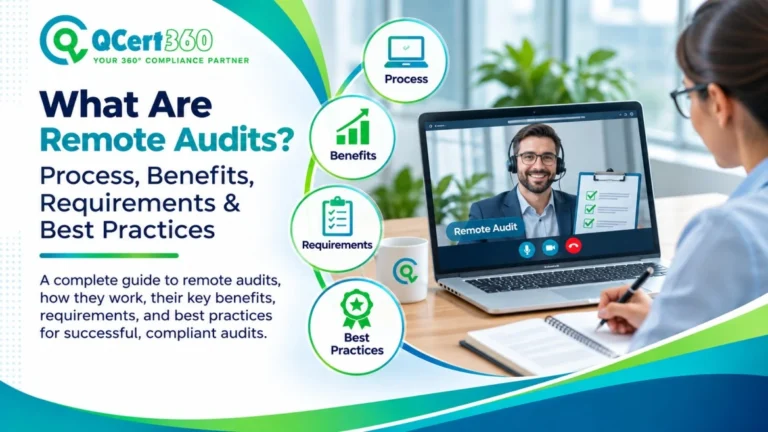
A remote audit is an audit conducted online instead of requiring the auditor to be physically present at an organization’s premises. Auditors use secure video conferencing, screen sharing, document portals and digital evidence to determine whether an organization meets applicable ISO standards, regulations or internal requirements.
Also known as virtual audits or e-audits, remote audits are used for ISO management system assessments, internal audits, supplier audits and various compliance reviews. Depending on the audit scope and risk, they can be conducted entirely online or combined with on-site inspections through a hybrid approach.
Traditional on-site audits can involve considerable travel, accommodation and scheduling arrangements. For organizations operating across multiple locations, these requirements can increase audit costs and disrupt everyday activities. Remote auditing provides another way to review documented information, interview employees and verify certain operational controls without requiring every audit activity to take place at the facility.
The growing use of video conferencing, cloud document sharing, digital collaboration platforms and secure system access has made remote auditing more practical. International auditing guidance also addresses the use of these technologies. ISO 19011:2026 provides guidance on management system auditing, while ISO/IEC TS 17012:2024 and IAF MD 4:2025 address remote auditing methods and the use of information and communication technology (ICT).
In this guide, QCert360 explains how remote audits work, their requirements, benefits, limitations and best practices, helping organizations prepare for effective remote auditing.
Remote Audits: Key Points at a Glance
- Definition: Remote audits use digital communication technologies to assess an organization’s compliance without requiring the auditor to be physically present for every activity.
- Types: Common approaches include full remote audits, hybrid audits, desk audits and ICT-assisted on-site audits.
- Standards: ISO 19011:2026, ISO/IEC TS 17012:2024, IAF MD 4:2025 and ISO/IEC 17021-1:2015 provide relevant auditing guidance and requirements.
- Benefits: Remote auditing can reduce travel expenses, simplify scheduling, improve access to digital evidence and support multi-site audit programmes.
- Limitations: Physical inspections, safety-related observations and certain high-risk activities may still require on-site verification.
- Preparation: Organizations should arrange secure technology, documented evidence, employee availability and a suitable audit plan.
- QCert360 support: QCert360 helps organizations prepare for internal audits, mock audits and certification assessments across various ISO standards.
What Are Remote Audits? Definition, Types and Scope
A remote audit is an audit performed entirely or partly through information and communication technology (ICT) rather than relying exclusively on physical presence. Auditors review documents and records, interview employees, observe processes through live video and examine relevant systems to collect objective evidence.
Remote audits follow the same fundamental auditing principles as traditional audits. The audit objectives, scope, criteria, evidence requirements and reporting process must remain appropriate to the activity being assessed.
The main difference is the method used to access information and verify compliance.
Types of Remote Audits
Not every remote audit follows the same approach. The appropriate model depends on the audit objectives, operational risks, industry requirements and the extent to which physical verification is necessary.
Audit model | How it works | Best suited for |
Full remote audit | Audit activities are conducted online using secure digital platforms. | Document-heavy, IT, service and management system audits. |
Hybrid audit | Online document reviews and interviews are combined with targeted on-site inspections. | Multi-site organizations and operations requiring physical verification. |
Desk audit | Focuses primarily on documented information, policies and records without live operational observation. | Document reviews, readiness assessments and supplier pre-assessments. |
ICT-assisted on-site audit | The auditor is physically present but uses technology such as cameras, video systems or remote expert support. | Large facilities, specialist inspections and difficult-to-access locations. |
The right audit model should be selected after assessing the organization’s activities, audit risks and applicable certification scheme.
For example, an organization with a well-documented information security management system may be able to demonstrate many controls through secure screen sharing and digital records. A manufacturing facility with machinery, chemical storage and workplace safety requirements may need direct physical inspection.
Remote Audit vs On-Site Audit: Key Differences
Remote and on-site audits share the same fundamental purpose: collecting objective evidence and determining whether applicable requirements are fulfilled. However, their methods and practical limitations differ.
Comparison factor | Remote audit | On-site audit |
Auditor location | Off-site | At the organization’s premises |
Evidence collection | Digital records, interviews and video | Physical observation, interviews and records |
Travel expenses | Generally lower | Generally higher |
Scheduling | More flexible | Requires travel and coordination |
Physical inspection | Limited by available technology | Direct physical observation |
Employee interaction | Online interviews | Face-to-face interviews |
Multi-site coverage | Easier to coordinate remotely | May require multiple site visits |
Best suited for | Document reviews, IT and suitable management system activities | Physical processes and activities requiring direct observation |
Remote audits can reduce logistical requirements, but they are not automatically better than on-site audits. The audit method must provide sufficient reliable evidence to achieve the audit objectives.
For many organizations, a hybrid approach provides a practical balance between remote document review and direct verification of physical operations.
Are Remote Audits Valid? Standards and Requirements
Yes. Remote audits are recognized in international auditing guidance and conformity assessment requirements. However, an audit cannot be conducted remotely simply because an organization prefers an online assessment.
The audit team must establish that the selected approach is suitable for the audit objectives and that sufficient reliable evidence can be collected.
Several international references provide guidance on remote auditing and the use of ICT.
Important Standards and Guidelines for Remote Auditing
- ISO 19011:2026 – Guidelines for Auditing Management Systems
ISO 19011:2026 is the fourth edition of the international standard providing guidance on auditing management systems. Published on 27 May 2026, it addresses auditing principles, audit programme management, audit activities and auditor competence.
The 2026 edition reflects changes in organizational operations, including digitization, technology and virtual environments. It also places increased attention on risk analysis and mitigation.
ISO 19011 is a guidance standard, not a certification standard. Organizations do not obtain ISO 19011 certification.
Official reference: https://www.iso.org/standard/19011
- ISO/IEC TS 17012:2024 – Guidelines for the Use of Remote Auditing Methods
ISO/IEC TS 17012:2024 provides specific guidance on using remote auditing methods when conducting management system audits.
It applies to organizations planning and conducting internal and external management system audits, including first-party, second-party and third-party audits.
An important distinction is that this technical specification does not intend to replace on-site audit methods. Instead, it provides guidance on using remote techniques as an effective and efficient auditing tool.
Official reference: https://www.iso.org/standard/84718.html
- IAF MD 4:2025 – Use of ICT for Conformity Assessment Purposes
IAF MD 4:2025 is a mandatory document addressing the consistent use of information and communication technology during conformity assessment activities.
Its scope includes management system certification, product certification, personnel certification, validation and verification activities.
The document was issued on 30 January 2025 and has an application date of 30 January 2026. It supersedes IAF MD 4:2023.
When ICT is used as part of the conformity assessment methodology, the applicable requirements of this document must be followed by the relevant conformity assessment bodies and accreditation bodies.
Official reference: https://iaf.nu/en/iaf-documents-/
- ISO/IEC 17021-1:2015 – Requirements for Certification Bodies
ISO/IEC 17021-1:2015 establishes requirements for the competence, consistency and impartiality of organizations providing management system auditing and certification.
It is particularly relevant to certification bodies conducting third-party management system audits.
The standard provides a framework for ensuring that certification activities are performed consistently and competently.
Official reference: https://www.iso.org/standard/61651.html
- Scheme-Specific Requirements
Some certification programmes have additional requirements governing remote assessments.
For example, food safety and other specialized certification schemes may specify when remote assessment methods are permitted, what activities require physical verification and how audit evidence must be documented.
Organizations should always check the latest rules issued by the relevant scheme owner and certification body.
What Are the Limitations of Remote Audits?
Remote auditing is suitable for many activities, but it cannot replace physical observation in every situation.
Activities involving hazardous materials, heavy machinery, production conditions, workplace safety and physical infrastructure may require direct on-site verification.
For example, an auditor assessing an organization’s ISO 45001 occupational health and safety management system may need to observe machinery guarding, emergency exits, workplace conditions and employee safety practices.
Similarly, a food manufacturing facility assessed against ISO 22000 may require physical inspection of hygiene practices, production areas, storage conditions and contamination controls.
Before conducting a certification audit remotely, the audit team should:
- Evaluate whether the audit objectives can be achieved using ICT.
- Assess risks associated with remote evidence collection.
- Confirm that the selected technology is suitable.
- Agree on confidentiality and information security arrangements.
- Establish how technical problems will be handled.
- Document the use of ICT and its effectiveness in the audit records.
Remote auditing is therefore a risk-based decision rather than a universal replacement for on-site auditing.
How Does a Remote Audit Work? The Process Step by Step
A remote audit follows the same general audit lifecycle as an on-site assessment. However, it requires additional preparation involving technology, digital evidence and communication arrangements.
The following steps explain how organizations can prepare for and participate in a remote audit.
Step 1: Define the Audit Scope and Criteria
The first step is to establish what will be audited.
The audit team identifies the applicable ISO standard, organizational processes, locations, departments and audit objectives. It also determines which activities can be verified remotely.
For example, an ISO 9001 audit may include reviewing quality procedures, examining customer feedback records, interviewing process owners and evaluating corrective action reports.
Step 2: Assess Remote Audit Feasibility and Risks
Before selecting a remote audit approach, the auditor evaluates whether the required evidence can be obtained reliably.
Important considerations include:
- Internet connectivity and platform reliability.
- Availability of employees and process owners.
- Confidentiality of organizational information.
- Access to digital records and management systems.
- Language and time-zone differences.
- Physical activities requiring direct observation.
If the risks cannot be adequately controlled, the audit team should consider a hybrid or on-site approach.
Step 3: Prepare and Agree on the Audit Plan
The auditor prepares an audit plan covering the schedule, audit sessions, processes, interview participants and evidence requirements.
The organization should receive the plan in advance so that relevant employees can arrange their availability.
The plan should also identify the communication platform and procedures for managing interruptions.
Step 4: Organize Digital Audit Evidence
Organizations should prepare the relevant documents and records before the audit begins.
These may include:
- Quality policies and procedures.
- Environmental management records.
- Risk assessments.
- Internal audit reports.
- Management review records.
- Corrective action reports.
- Employee training records.
- Monitoring and measurement results.
- Information security policies and access records.
Documents should be organized in a secure, access-controlled repository.
Step 5: Conduct the Opening Meeting
The auditor begins with an online opening meeting involving the relevant management representatives and process owners.
The meeting confirms the audit objectives, scope, criteria, schedule, communication arrangements and confidentiality expectations.
Participants should also understand whether recording is permitted and how technical problems will be managed.
Step 6: Collect and Verify Audit Evidence
This is the main assessment stage.
Auditors use video conferencing, interviews, screen sharing and secure document access to examine whether organizational processes meet the applicable requirements.
For example, during an ISO 27001 audit, an auditor may request a screen-shared demonstration of user access controls, review information security incident records and interview the IT manager.
Evidence must be evaluated for its relevance, reliability and sufficiency. Simply uploading a policy document does not automatically demonstrate that the corresponding process is effectively implemented.
Step 7: Evaluate Findings and Conduct the Closing Meeting
After collecting evidence, the auditor evaluates the findings against the audit criteria.
Any identified nonconformities, observations and opportunities for improvement are discussed during the closing meeting.
The auditor explains the findings and provides the relevant evidence supporting the audit conclusions.
Step 8: Prepare the Audit Report and Follow Up
The audit team prepares the audit report, documenting the scope, activities, findings and conclusions.
Where applicable, the report should also explain how ICT was used and any limitations encountered.
The organization then prepares corrective actions for identified nonconformities. Their implementation and effectiveness are verified according to the applicable audit and certification requirements.
Example: How a Remote ISO 9001 Audit Works
Consider a manufacturing company preparing for an ISO 9001 quality management system audit.
The company has organized its quality procedures, inspection records, customer complaint reports and corrective action documentation in a secure digital repository.
Instead of conducting every audit activity at the facility, the audit team uses an agreed video conferencing platform and secure document access.
The process may include:
- Document review: The auditor examines the quality policy, documented procedures, process maps and previous audit reports.
- Employee interviews: The quality manager and department supervisors explain how quality controls are implemented.
- Screen sharing: The auditor reviews inspection records, nonconformity reports and customer feedback data.
- Process verification: Relevant employees demonstrate how production monitoring and corrective actions are recorded.
- Audit findings: The auditor evaluates the available evidence and identifies any nonconformities.
- Reporting: The audit team documents the results and communicates the findings.
If the auditor cannot adequately verify machinery conditions, production activities or other physical requirements through remote methods, an on-site inspection may be necessary.
This example illustrates how remote and hybrid auditing can be applied. It does not mean every ISO 9001 certification audit can be completed entirely online.
Benefits of Remote Auditing
Remote auditing offers several operational advantages when the audit objectives and activities are suitable for online assessment.
- Lower Audit and Travel Costs
Remote audits can reduce expenses associated with flights, accommodation, transportation and other travel arrangements. They may also reduce administrative work associated with coordinating multi-location assessments.
However, organizations should consider technology costs and the time required to prepare digital evidence.
- Reduced Operational Disruption
Employees do not need to spend as much time coordinating physical auditor visits.
Audit interviews and document reviews can be arranged in planned online sessions, allowing organizations to manage their everyday activities more efficiently.
- Greater Multi-Site Audit Flexibility
Organizations with multiple offices, branches or international locations may find it easier to coordinate remote audit activities.
Auditors can review suitable records and interview employees across different locations without travelling to each site for every audit activity.
- Flexible Scheduling
Remote audit arrangements can offer more flexibility when coordinating auditors, employees and different time zones.
This can make it easier to organize suitable audit dates, although actual availability depends on the auditor and certification body.
- Improved Digital Traceability
Digital evidence repositories and access logs can help organizations maintain a structured record of the documents reviewed and information shared during the audit.
Recordings and screenshots should only be used where permitted and in accordance with agreed confidentiality arrangements.
- Support for Business Continuity
Remote audit methods can help organizations continue suitable audit activities when travel restrictions, severe weather or other disruptions make physical visits difficult.
- Better Access to Specialized Expertise
Remote communication can make it easier to involve technical specialists who are located in different regions, provided their participation meets the applicable competence and confidentiality requirements.
Challenges and Limitations of Remote Audits
Although remote audits offer practical advantages, organizations should understand the challenges before selecting this approach.
Challenge | Possible impact | Recommended solution |
Limited physical observation | Certain operational controls cannot be verified directly. | Use hybrid or on-site inspections where necessary. |
Poor internet connectivity | Interviews and live demonstrations may be interrupted. | Test connectivity and prepare backup communication methods. |
Information security risks | Sensitive records may be exposed during document sharing. | Use secure platforms and restricted access permissions. |
Incomplete digital evidence | Auditors may be unable to verify the implementation of controls. | Organize evidence and maintain an updated document repository. |
Communication difficulties | Employees may misunderstand questions or instructions. | Provide clear schedules and communication arrangements. |
Reduced direct interaction | Some workplace conditions and non-verbal cues may be harder to assess. | Use live interviews and appropriate visual verification methods. |
The most important consideration is evidence reliability. If the auditor cannot verify a requirement convincingly through remote methods, an additional on-site assessment may be necessary.
Remote Audit Checklist: What Should Organizations Prepare?
Preparing the required information before an audit can reduce delays and make the assessment more effective.
Organizations should use the following checklist when preparing for a remote audit.
Preparation area | What to check |
Audit scope | Confirm the applicable standard, processes, departments and locations. |
Audit plan | Review the schedule, audit objectives and assigned responsibilities. |
Documented information | Prepare policies, procedures, work instructions and relevant records. |
Previous audit reports | Keep previous internal and external audit findings available. |
Corrective actions | Organize nonconformity reports and corrective action evidence. |
Employee availability | Ensure relevant process owners and employees can attend interviews. |
Technology | Test video conferencing, screen sharing and document access. |
Internet connectivity | Confirm stable internet access and backup arrangements. |
Information security | Apply appropriate access permissions and confidentiality controls. |
Physical verification | Identify processes that may require on-site inspection. |
Communication | Share contact details and escalation procedures for technical problems. |
Completing this checklist helps organizations identify preparation gaps before the audit begins.
It is also useful for internal audits, supplier assessments and certification readiness reviews.
What Technology Is Required for a Remote Audit?
Remote audits depend on reliable technology for communication, document review and evidence verification.
The exact requirements depend on the audit scope, industry and applicable certification programme.
Common technology requirements include:
- Video Conferencing Platforms
Video conferencing allows auditors to conduct opening meetings, interview employees and communicate with process owners.
The platform should support stable communication and appropriate access controls.
- Secure Document-Sharing Systems
Auditors need access to relevant documents and records. Secure document repositories allow organizations to share information while controlling who can view or download files.
- Screen-Sharing Tools
Screen sharing helps auditors review digital systems, demonstrate software controls and examine electronic records in real time.
- Live Video Equipment
Cameras and mobile devices can help auditors observe selected work areas, equipment and operational activities where remote visual inspection is appropriate.
- Digital Audit Management Tools
Audit management software can help organize audit plans, checklists, evidence, findings and corrective actions.
- Cybersecurity Controls
Organizations should use suitable security measures, including encrypted communication, multi-factor authentication, restricted permissions and access monitoring.
Before an audit, both parties should agree on the technology, information-sharing arrangements and confidentiality requirements.
Requirements of ISO Certification for Best Practices for Conducting Remote Audits
Effective remote auditing requires planning and communication. Organizations should not simply transfer an on-site audit schedule to an online meeting platform.
The following practices can improve audit preparation and evidence collection.
- Plan the Audit Thoroughly
Define the scope, objectives, audit criteria, participants and schedule in advance. Identify activities that may require on-site verification.
- Secure the Technology
Use approved communication and document-sharing platforms. Apply appropriate authentication, access restrictions and confidentiality arrangements.
- Organize Audit Evidence
Keep documents in a structured repository with clear file names and access permissions. This helps auditors locate the required information without unnecessary delays.
- Conduct Live Verification
Use screen sharing, live interviews and suitable video walkthroughs to verify how processes operate. Avoid relying exclusively on uploaded documents when implementation needs to be demonstrated.
- Maintain Clear Communication
Explain the audit schedule and responsibilities to employees before the assessment. Ensure that process owners understand what information they need to provide.
- Respect the Limitations of Remote Methods
Use hybrid or on-site assessment where physical conditions, safety risks or other limitations prevent reliable remote verification.
- Protect Confidential Information
Agree on how documents, recordings, screenshots and other sensitive information will be accessed, stored and handled.
- Review and Improve the Process
After the audit, collect feedback and identify any technology or communication issues. Use this information to improve future audit arrangements
Which ISO Standards Can Be Audited Remotely?
Remote auditing can be used for suitable activities across various ISO management system standards. However, the feasibility of a fully remote or hybrid assessment depends on the audit scope, risks, scheme requirements and certification body’s decision.
Examples include:
ISO standard | Management system | Potential remote audit activities |
Document review, quality records, customer feedback and corrective actions. | ||
Environmental Management System | Environmental policies, compliance records, objectives and monitoring data. | |
Occupational Health and Safety Management System | Safety procedures, training records and risk assessment documentation. | |
Information Security Management System | Information security policies, access controls, incident records and digital system demonstrations. | |
Food Safety Management System | Food safety documentation, HACCP records, monitoring procedures and traceability records. | |
Medical Device Quality Management System | Quality records, design documentation, supplier controls and corrective actions. | |
Business Continuity Management System | Business continuity plans, risk assessments, testing records and recovery arrangements. | |
Energy Management System | Energy policies, consumption records, objectives and performance monitoring. |
For standards involving physical operations, remote document reviews and interviews may need to be combined with on-site inspections.
Organizations should not assume that the availability of remote auditing methods automatically means their certification audit can be completed entirely online.
The applicable certification body and scheme owner should confirm the permitted approach before the assessment is arranged.
Key Takeaways: Strategic Value of Remote Audits
Remote auditing has become an important method for conducting suitable management system and conformity assessment activities.
The main points organizations should understand are:
- Recognized auditing approach: International guidance and conformity assessment documents address the use of remote auditing methods and ICT.
- Risk-based selection: Remote, hybrid and on-site approaches should be selected according to audit objectives and evidence requirements.
- Technology and preparation matter: Secure communication platforms and well-organized digital evidence support effective assessments.
- Physical verification remains important: Certain safety, manufacturing and operational activities require on-site inspection.
- Suitable for multiple ISO standards: Remote methods can support various quality, environmental, information security and other management system audits, subject to applicable requirements.
Organizations that plan remote audits carefully can reduce logistical challenges while maintaining the reliability and integrity of their audit programmes.
Advance Your Compliance Goals with QCert360’s Remote Audit Support
Organizations across different industries face increasing compliance requirements, evolving operational risks and growing expectations from customers and business partners. Managing audits across multiple locations can become challenging when every activity depends on physical visits.
QCert360 provides ISO certification and management consulting support to organizations seeking to establish, implement and maintain internationally recognized management systems.
Our team helps organizations assess audit readiness, prepare documented information, identify compliance gaps and organize internal and mock audits before certification assessments.
We support organizations working with various standards and compliance frameworks, including:
- ISO 9001 – Quality Management System
- ISO 14001 – Environmental Management System
- ISO 45001 – Occupational Health and Safety Management System
- ISO/IEC 27001 – Information Security Management System
- ISO 22000 – Food Safety Management System
- ISO 13485 – Medical Device Quality Management System
- ISO 22301 – Business Continuity Management System
- GMP and HACCP requirements
Depending on the applicable certification scheme and audit requirements, our team can help organizations prepare for remote, hybrid or on-site audit arrangements.
Our support includes:
- Audit readiness assessment and gap analysis.
- Internal audit and mock audit preparation.
- Documentation review and implementation guidance.
- Risk assessment and corrective action support.
- Preparation of employees for audit interviews.
- Assistance with certification audit coordination.
For startups, manufacturers, service providers and growing businesses, proper audit preparation can help reduce avoidable delays and improve confidence during certification assessments.
Planning an ISO audit?
Contact QCert360 to discuss your requirements and identify the appropriate audit preparation and certification support for your organization.
Website: https://www.qcert360.com/
Frequently Asked Questions About Remote Audits
- What are remote audits?
Remote audits, also called virtual audits or e-audits, are assessments conducted using digital communication technologies instead of relying entirely on physical visits. Auditors use video conferencing, screen sharing, secure document portals and digital evidence to evaluate whether an organization meets applicable requirements.
- What does a remote auditor do?
A remote auditor reviews documented information, interviews employees, examines digital records, observes suitable processes through live video and evaluates evidence against the audit criteria. The auditor also records findings, identifies nonconformities and prepares an audit report.
- Can audits be done remotely?
Yes. Many internal, supplier and management system audit activities can be conducted remotely when the audit objectives can be achieved through reliable digital evidence. However, activities requiring physical observation or direct inspection may need an on-site or hybrid approach.
- How do you conduct a remote audit?
A remote audit generally involves defining the scope, assessing feasibility, preparing an audit plan, organizing digital evidence, conducting online meetings and interviews, verifying controls, documenting findings and following up on corrective actions.
- What are the challenges of remote auditing?
Common challenges include limited physical observation, internet connectivity problems, incomplete digital evidence, communication difficulties and information security risks. Proper planning, secure platforms and hybrid audit arrangements can help address these limitations.
- Are remote audits accepted for ISO certification?
Remote auditing methods are recognized in international conformity assessment guidance. However, whether a specific ISO certification audit can be conducted fully or partly remotely depends on the applicable requirements, audit risks, certification scheme and certification body’s assessment.
- How much does a remote audit cost compared with an on-site audit?
Remote audit costs depend on the audit scope, duration, standard, complexity and provider. Remote arrangements may reduce travel and accommodation expenses, but technology, preparation and auditor time still contribute to the overall cost. Organizations should request a quotation based on their specific requirements.
- Which ISO standards allow remote audits?
Remote auditing methods may be used for suitable activities involving ISO 9001, ISO 14001, ISO 45001, ISO/IEC 27001, ISO 22000, ISO 13485 and other management system standards. The permitted approach depends on audit objectives, risk levels and applicable certification requirements.
- What documents are required for a remote ISO audit?
Common documents include management system policies, procedures, risk assessments, internal audit reports, management review records, employee training records, corrective action reports and relevant monitoring records. The exact evidence requirements depend on the ISO standard and audit scope.
- Can an ISO certification audit be conducted entirely online?
Some certification audit activities may be conducted remotely, but a fully online certification audit is not automatically permitted for every organization or standard. The certification body must evaluate feasibility, applicable accreditation requirements, operational risks and the need for physical verification.
- What technology is required for remote auditing?
Remote audits commonly require a reliable internet connection, secure video conferencing, document-sharing systems, screen-sharing tools and suitable devices for visual verification. Additional cybersecurity controls may be necessary when sensitive organizational information is involved.
- What is the difference between a remote audit and a virtual audit?
The terms remote audit and virtual audit are generally used interchangeably. Both describe audit activities conducted using digital communication technologies instead of requiring the auditor to be physically present for every activity.
Our Services
ISO Standards
- ISO 9001 Certification
- ISO 14001 Certification
- ISO 45001 Certification
- ISO 22000 Certification
- ISO 17025 Certification
- ISO 27001 Certification
- ISO 13485 Certification
- ISO 20000-1 Certification
- ISO 41001 Certification
- ISO 22716 Certification
- ISO 50001 Certification
- ISO 22301 Certification
- ISO 29993 Certification
Product Certifications
Other international standards
- FSSC 22000 Certification
- HIPAA
- HACCP Certification
- SA 8000 Certification
- GMP Certification
- GDPR
- GDP Certification
- GLP Certification
- Certificate of Conformity
QCert360 provides a wide range of services including ISO certification, audit support, compliance consulting, and training. They specialize in helping businesses achieve global standards and certifications like ISO 9001, ISO 27001, ISO 14001, and many others. Their team ensures a seamless experience from consultation to certification, supporting clients at every stage.
The time it takes to achieve certification can vary depending on the complexity of the standard and the readiness of your organization. On average, it takes about 3 to 6 months. QCert360 works closely with clients to streamline the process, ensuring that all requirements are met efficiently and within a reasonable timeline.
QCert360 is a trusted partner with years of experience in helping businesses obtain international certifications. Their expert consultants provide tailored solutions, ensuring your organization not only meets but exceeds industry standards. With a customer-centric approach, they focus on offering end-to-end support to simplify the certification journey.
QCert360 serves a wide range of industries including manufacturing, healthcare, information technology, education, and services, among others. They customize their certification solutions to meet the unique requirements of each industry, ensuring relevance and compliance with global standards.
Yes, QCert360 provides ongoing support even after certification. They offer services like surveillance audits, recertification guidance, and consultancy to help maintain and improve your certification status. Their team ensures that your organization stays compliant and up-to-date with any changes in certification standards.
Getting started with QCert360 is simple. You can contact them via their website to request a consultation. Their team will assess your needs, discuss the best certification options for your business, and outline the steps involved. From there, they’ll guide you through the entire process, ensuring you’re prepared for certification.
QCert360 stands out due to its customer-focused approach, industry expertise, and comprehensive service offerings. Their team doesn’t just help you obtain certification but works to ensure your organization thrives in compliance with international standards. They also offer personalized consultation, making the process smoother and more efficient, ensuring long-term success for your business.
The cost of certification varies depending on factors such as the type of certification, the size and complexity of your organization, and the specific industry requirements. QCert360 offers competitive pricing and provides tailored quotes based on your unique needs. They ensure transparency and work with you to find the most cost-effective solution for your certification goals.
Yes, QCert360 offers internal audit services to help assess and improve your organization’s processes. Their expert auditors conduct thorough reviews of your systems and operations to ensure they meet required standards. They also provide actionable recommendations to help enhance efficiency and compliance, making sure you’re fully prepared for external audits.
If your organization doesn’t pass an audit or certification assessment, QCert360 works with you to understand the reasons for non-compliance and provides support to rectify the issues. They offer guidance on corrective actions and help you prepare for a re-assessment. Their goal is to ensure your organization meets the necessary standards for certification, and they will be by your side to make the process as smooth as possible.