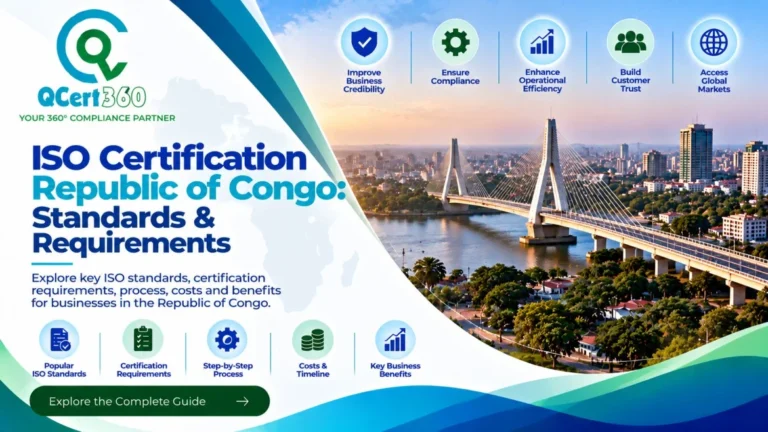
ISO Certification Republic of Congo: Standards, Requirements, Cost and Timeline
ISO certification is independent proof that your organization runs a documented management system to a recognised international standard. An accredited certification body audits your processes, records and controls. If you meet the standard, it issues a certificate for your defined scope.
Congolese suppliers use it to win vendor approvals and tenders. The supplier economy here runs on oil and gas activity, ports and logistics, construction and maintenance, food supply, public and private services, and a growing base of technology-enabled operations. Buyers want proof that your teams control quality, manage safety risks and keep records when issues arise. That applies to field-service contractors, transport operators, facilities teams, food businesses, IT providers and professional services working with cross-border partners.
QCert360 supports ISO certification in the Republic of Congo as part of its work across 60+ countries. Request a free ISO certification quote to start.
Which ISO Standards Do Buyers Request Most in the Republic of Congo?
Buyers most often request ISO 9001, ISO 14001, ISO 45001, ISO/IEC 27001 and ISO 22000. ISO 50001 and ISO 13485 follow where the sector requires them.
Together they help buyers approve suppliers, check tender readiness, confirm consistent delivery and rely on controlled records across teams and sites.
How Big Is the Congolese Economy, and Why Does It Shape Supplier Checks?
The Republic of Congo’s GDP is estimated at about US$ 15.72 billion. Services contribute about 45% of GDP, industry (including construction) about 40.12% and agriculture about 9.44%.
Exports explain why supplier checks are strict. Crude petroleum is the top export at about US$ 5.43 billion, and refined copper follows at about US$ 1.85 billion. Oil accounts for roughly 89% of total exports.
Project owners therefore focus on inspection records, contractor controls and traceable corrective actions across the supply chain.
Why Do ISO Certifications Matter in the Republic of Congo?
They turn everyday work into auditable evidence. When a buyer outsources construction, maintenance, transport, warehousing, catering, facilities, security, IT support or inspection work, it wants proof that delivery does not depend on one person’s experience.
ISO standards set out how your teams perform work, control change, handle incidents and complaints, and close corrective actions. They also suit multi-site delivery and subcontractor chains. One controlled way of working applies across locations and shifts, while site-specific controls cover local risks and client rules.
What Role Does Accreditation Play in ISO Certification?
Accreditation confirms that a certification body is competent and impartial. Choose a body that audits to the international requirements for management system certification (ISO/IEC 17021-1) and holds recognised accreditation. Buyers, project owners and procurement teams often check this before they accept your certificate.
Ask any provider to show its accreditation scope for your standard and sector. This protects you from certificates that buyers later reject.
How Do Regional Frameworks Affect Certification Demand?
The Republic of Congo operates within regional economic frameworks, including CEMAC and the OHADA business-law area, and takes part in wider African trade initiatives. These frameworks push cross-border suppliers toward common, recognised quality, safety and environmental evidence.
For timber and forestry exporters, buyers also look for legality and traceability evidence. This sits alongside the country’s timber-trade arrangements with the EU. ISO systems give you the records to support those checks. Confirm which national and regional requirements apply to your sector before you set your scope.
Which ISO Standards Fit Which Industry?
ISO Standard | Industry or Sector | Why Buyers Request It |
ISO 9001 | Services, logistics, construction, distribution | Consistent delivery, supplier control, inspections, complaint handling |
ISO 14001 | Construction, logistics, site operations, facilities | Waste control, spill readiness, chemical storage, site impact management |
ISO 45001 | Construction, maintenance, transport, warehouses | Hazard control, incident reporting, contractor controls, safer work methods |
ISO/IEC 27001 | IT services, shared services, data handling | Access control, backups, incident response, vendor security checks |
ISO 22000 | Catering, food supply, food logistics | Hygiene controls, allergen handling, traceability, monitoring records |
ISO 50001 | Large facilities, energy-intensive operations | Energy baselines, monitoring, improvement actions, performance review |
ISO 13485 | Healthcare supply, packaging, servicing support | Traceability, validation, controlled documentation for buyer approvals |
What Does ISO 9001 Quality Management Do for Congolese Businesses?
It builds consistent outcomes through defined processes and measurable controls. It sets clearer workflows for purchasing, supplier evaluation, service delivery, inspections and complaint handling.
Service businesses use it to standardise customer onboarding, job execution, reporting and closure records. Product-based operations use it to control inspection criteria, traceability and corrective actions when defects occur. If buyers ask for proof of steady quality across shifts and locations, ISO 9001 shows that performance does not rely on individuals. Organizations should also plan for the ISO 9001:2026 revision when they scope their certification.
What Does ISO 14001 Environmental Management Cover?
It controls the environmental aspects of your operations, facilities and suppliers. In practice that means waste segregation, chemical storage, spill response and performance monitoring.
Logistics, construction and site-based teams use it for structured storage, disposal, site checks and incident reporting. During supplier approvals, it lets you present environmental practices with supporting evidence. Recent amendments to ISO 14001 add climate change considerations, which matters for oil, timber and mining suppliers facing ESG questions.
What Does ISO 45001 Occupational Health and Safety Cover?
It turns hazard control into a planned system with training and evidence. It helps you identify risks such as slips and falls, lifting injuries, equipment hazards, electrical risks, driving risks and contractor risks. You then apply controls through procedures and competence checks.
It also supports incident reporting, corrective actions and emergency readiness. Businesses with field work, maintenance or high-risk tasks use ISO 45001 to keep safety routines consistent and reviewed.
Why Do Banks and IT Providers Rely on ISO/IEC 27001 Information Security?
They use it to protect confidentiality, integrity and availability of information. If you run online systems, payment tools, customer databases, HR platforms or cloud services, it helps you control access rights, onboarding and offboarding, incident response, supplier checks and backups.
It is most useful when partners ask for evidence on data protection, vendor risk handling and secure processing of sensitive information. See our ISO/IEC 27001 service for details.
What Does ISO 22000 Food Safety Management Include?
It manages food safety using HACCP-based thinking and documented controls. It covers hazards from receiving and storage through preparation, packing and service.
Common controls include hygiene routines, allergen awareness, temperature monitoring, supplier approval, traceability records and corrective actions for deviations. Restaurants, caterers, food processors and food suppliers use ISO 22000 to stay ready for inspections and client audits.
Who Needs ISO 13485 Medical Device Quality Management?
Companies that manufacture, package, service or supply medical devices need it. It controls quality and product safety through documented processes, traceability, validation and quality checks tied to patient safety.
Businesses that supply parts or services into healthcare supply chains use ISO 13485 to meet buyer approval requirements.
What Does ISO 50001 Energy Management Offer?
It manages energy use through monitoring, planning and improvement actions. You build an energy baseline, track consumption, identify major energy uses and improve performance through maintenance routines and operational controls.
Facilities with high electricity demand use ISO 50001 to cut energy costs and track results in management reviews and audits.
How Does the ISO Certification Process Work in the Republic of Congo?
It runs in ten steps, from gap review to recertification.
- Step 1, gap review: Confirm your scope, sites, products or services and key processes. Find gaps against your chosen standard, including outsourced work such as subcontracted transport, security or IT.
- Step 2, documentation build: Prepare policies, procedures, work instructions and controlled forms that match real operations, not generic templates.
- Step 3, system roll-out: Apply controls across departments and locations. Assign process owners and set record routines your teams can keep up during peak periods.
- Step 4, training and awareness: Train employees and contractors by role. Confirm competence for task-critical roles and keep the evidence, such as attendance, evaluations and authorisations.
- Step 5, internal audit: Audit the full scope. Record findings clearly and track corrective actions to closure.
- Step 6, management review: Review audit results, performance trends, incidents, customer feedback, supplier performance and improvement actions. Record decisions, owners and timelines.
- Step 7, Stage 1 audit: The certification body reviews documented readiness, scope and audit planning. You fix any gaps before Stage 2.
- Step 8, Stage 2 audit: Auditors verify implementation through interviews, site checks and record review across purchasing, delivery, inspections, HSE controls and corrective actions.
- Step 9, certificate issuance: The certificate is issued for your defined scope once you close nonconformities and the body accepts your corrective action evidence.
- Step 10, surveillance and recertification: Surveillance audits confirm ongoing conformity. Recertification renews the certificate at the end of the cycle.
What Are the Requirements for ISO Certification in the Republic of Congo?
ISO Requirements vary by standard, but most organizations prepare around the same management system structure. Link your controls to real operational risks, and keep records that prove consistency across shifts and sites.
- Leadership: Show commitment through policy, roles, responsibilities and management review.
- Defined scope: Cover sites, services, exclusions and outsourced processes.
- Process control: Control core workflows such as purchasing, service delivery, maintenance, transport, food handling and IT operations.
- Risk review: Apply practical controls tied to operational realities, including contractor and supplier risks.
- Document and record control: Make sure teams use current versions and keep the required evidence.
- Competence management: Cover onboarding, training and qualification tracking for task-critical roles.
- Supplier and contractor controls: Evaluate, approve and monitor suppliers, and act on corrective actions.
- Monitoring and measurement: Use targets, checks, inspections and trend review.
- Internal audits: Complete them across the full scope and track findings to closure.
- Corrective actions: Review root causes and run follow-up checks to prevent repeat issues.
What Are the Benefits of ISO Certification in the Republic of Congo?
It gives buyers auditable evidence that you control and review your processes.
- Faster vendor approval: Buyers recognise ISO-based controls and records.
- Consistent delivery: Results hold across shifts, sites and subcontractors.
- Fewer repeat issues: Corrective action tracking and closure evidence prevent recurrence.
- Stronger supplier control: Evaluation routines and traceable purchasing records tighten oversight.
- Safer work practices: Hazard controls, competence checks and incident learning reduce risk.
- Better environmental control: You hold evidence for waste, spill readiness and chemical handling.
- Improved data protection: Access controls, backups and incident response routines protect information.
- Clearer onboarding: Role-based training and usable work instructions help new staff.
- Better food safety assurance: Hygiene monitoring, allergen control and traceability back your claims.
- Stronger tender readiness: Your records align with buyer checklists.
What Market Trends Are Shaping ISO Demand in the Republic of Congo?
Real GDP growth is projected at around 2.8%, tied to oil-market conditions, fiscal discipline and the pace of non-oil activity.
Non-oil activity is the key trend, because most jobs are created outside the oil sector. World Bank analysis expects non-oil growth to average around 3.7%, driven by agriculture and services. In supplier terms, that raises demand for ISO 9001 and ISO 22000 in distribution, food supply, warehousing and service delivery. It also raises demand for ISO/IEC 27001 among companies handling customer, payroll and procurement data.
Export structure shapes buyer expectations too. With oil making up a very large share of exports, vendor screening focuses on inspection records, contractor supervision, incident reporting and corrective action evidence. This matters most for contractors working near storage, transport and site operations. Climate and ESG expectations from international buyers in oil, timber and mining add further pressure for ISO 14001 and ISO 45001.
What Challenges Do Congolese Organizations Face With ISO Implementation?
Three problems come up most often: weak records, loose contractor control and variable supply.
- Record discipline: Teams often do the work correctly but lack the evidence. Missing inspection logs, approvals, calibration checks, permit records, toolbox-talk attendance, handover notes or supplier evaluations quickly become audit findings. Auditors verify controls through traceable records, not verbal confirmation.
- Contractor and subcontractor control: Different vendors follow different work methods, PPE routines, permit habits and reporting standards. Without a routine for selection, induction, supervision and performance review, you see incomplete permits, inconsistent checklists, unclear responsibilities and slow corrective action closure.
- Supply variability: Materials, spares and consumables change with availability, which makes acceptance criteria and traceability inconsistent. Disputes follow when defects surface later. ISO 9001 controls fix this only when you actively maintain supplier evaluation, incoming checks and nonconformance handling.
How Much Does ISO Certification Cost in the Republic of Congo?
Cost depends on the standard, scope, number of sites, headcount and process complexity. Multi-site audits need more audit time because auditors check evidence at each location. Higher-risk scopes also add time, including construction, field-service work, food operations and complex IT environments.
More sites, higher headcount and longer audit time are the biggest cost drivers. Get your free customised ISO certification quote from QCert360.
How Long Does ISO Certification Take in the Republic of Congo?
It depends on scope readiness and how fast you can apply controls across teams.
- Smaller organizations: With a clear scope and stable routines, they often certify in a few months.
- Mid-sized organizations: They take longer, because training, internal audits and corrective action closure need coordination across departments.
- Multi-site scopes: They take additional time, since you must show consistent implementation across locations during Stage 2.
How Can QCert360 Help You Get ISO Certified in the Republic of Congo?
QCert360 is a global ISO auditing and management consulting firm with a presence in 60+ countries. We help hospitality, logistics, construction, IT services, food supply and manufacturing support businesses get certified. Our approach follows the scope and sites you operate, and focuses on practical evidence such as records, interviews and on-site verification.
- Certification support: ISO 9001, ISO 14001, ISO 45001, ISO 27001, ISO 22000, ISO 50001 and many other standards.
- Multi-site certification: For organizations operating across several locations in the Republic of Congo or the wider region.
- Industry-specific expertise: Auditors and consultants who understand your sector’s requirements.
- Surveillance audits: Annual checks that confirm continued compliance and system effectiveness.
- Recertification audits: A full system review every three years.
- Internationally recognised results: Certificates accepted for tenders and contracts.
Book a free ISO consultation with QCert360 today.
What ISO Training Courses Are Available?
Align training with job roles and audit readiness so it stays practical across sites and shifts.
- Lead auditor training: Covers audit planning, audit programme management, interviewing techniques, sampling methods, evidence evaluation, nonconformity writing and audit reporting.
- Lead implementer training: Covers how to build, run and maintain a management system that matches real operations. Topics include scope-setting, process mapping, internal audits, management review and corrective action closure.
Frequently Asked Questions
Which ISO standards are most requested by buyers in the Republic of Congo?
ISO 9001, ISO 14001, ISO 45001, ISO/IEC 27001 and ISO 22000 are the most common requests.
Can small businesses in the Republic of Congo get ISO certified?
Yes. You need a clear scope and consistently maintained records.
What is the difference between Stage 1 and Stage 2 audits?
Stage 1 checks readiness and documented controls. Stage 2 checks implementation using site evidence and records.
Do we need an internal audit before the certification audit?
Yes. Internal audits are expected before Stage 2.
How long does ISO certification take?
It depends on readiness, scope and number of sites.
What records do auditors usually review first?
Training records, internal audit reports, corrective actions and operational logs.
Can multiple ISO standards be audited together?
Yes, through an integrated management system.
How often are surveillance audits carried out?
Typically once a year during the certification cycle.
What usually increases ISO certification cost the most?
More sites, higher headcount and longer audit time.
Does ISO certification support tenders and vendor approvals?
Yes. Many buyers use ISO certification as a supplier screening requirement.
Our Services
ISO Standards
- ISO 9001 Certification
- ISO 14001 Certification
- ISO 45001 Certification
- ISO 22000 Certification
- ISO 17025 Certification
- ISO 27001 Certification
- ISO 13485 Certification
- ISO 20000-1 Certification
- ISO 41001 Certification
- ISO 22716 Certification
- ISO 50001 Certification
- ISO 22301 Certification
- ISO 29993 Certification
Product Certifications
Other international standards
- FSSC 22000 Certification
- HIPAA
- HACCP Certification
- SA 8000 Certification
- GMP Certification
- GDPR
- GDP Certification
- GLP Certification
- Certificate of Conformity
QCert360 provides a wide range of services including ISO certification, audit support, compliance consulting, and training. They specialize in helping businesses achieve global standards and certifications like ISO 9001, ISO 27001, ISO 14001, and many others. Their team ensures a seamless experience from consultation to certification, supporting clients at every stage.
The time it takes to achieve certification can vary depending on the complexity of the standard and the readiness of your organization. On average, it takes about 3 to 6 months. QCert360 works closely with clients to streamline the process, ensuring that all requirements are met efficiently and within a reasonable timeline.
QCert360 is a trusted partner with years of experience in helping businesses obtain international certifications. Their expert consultants provide tailored solutions, ensuring your organization not only meets but exceeds industry standards. With a customer-centric approach, they focus on offering end-to-end support to simplify the certification journey.
QCert360 serves a wide range of industries including manufacturing, healthcare, information technology, education, and services, among others. They customize their certification solutions to meet the unique requirements of each industry, ensuring relevance and compliance with global standards.
Yes, QCert360 provides ongoing support even after certification. They offer services like surveillance audits, recertification guidance, and consultancy to help maintain and improve your certification status. Their team ensures that your organization stays compliant and up-to-date with any changes in certification standards.
Getting started with QCert360 is simple. You can contact them via their website to request a consultation. Their team will assess your needs, discuss the best certification options for your business, and outline the steps involved. From there, they’ll guide you through the entire process, ensuring you’re prepared for certification.
QCert360 stands out due to its customer-focused approach, industry expertise, and comprehensive service offerings. Their team doesn’t just help you obtain certification but works to ensure your organization thrives in compliance with international standards. They also offer personalized consultation, making the process smoother and more efficient, ensuring long-term success for your business.
The cost of certification varies depending on factors such as the type of certification, the size and complexity of your organization, and the specific industry requirements. QCert360 offers competitive pricing and provides tailored quotes based on your unique needs. They ensure transparency and work with you to find the most cost-effective solution for your certification goals.
Yes, QCert360 offers internal audit services to help assess and improve your organization’s processes. Their expert auditors conduct thorough reviews of your systems and operations to ensure they meet required standards. They also provide actionable recommendations to help enhance efficiency and compliance, making sure you’re fully prepared for external audits.
If your organization doesn’t pass an audit or certification assessment, QCert360 works with you to understand the reasons for non-compliance and provides support to rectify the issues. They offer guidance on corrective actions and help you prepare for a re-assessment. Their goal is to ensure your organization meets the necessary standards for certification, and they will be by your side to make the process as smooth as possible.