
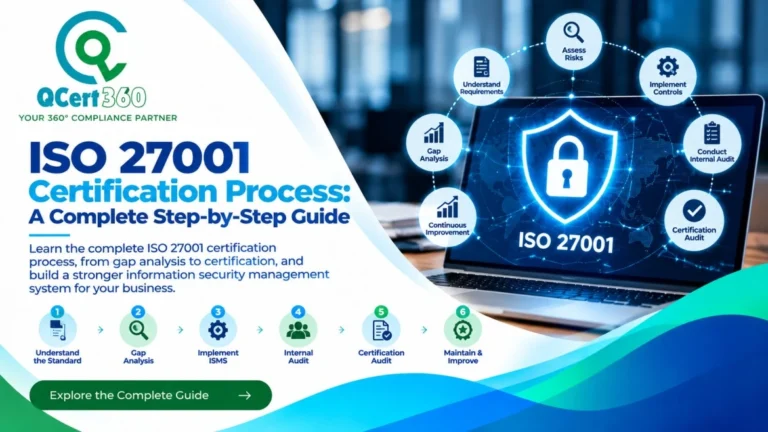
ISO 27001 Process Guide: Learn How to Implement an Information Security Management System
Most organizations that stall on ISO 27001 do not stall on the security work. They stall on not knowing what comes next. Gap analysis, risk assessment, policy writing, control rollout, internal audit, external audit, and then a three-year cycle of keeping it all alive: the sequence matters as much as the content.
This page lays out the ISO 27001 certification process step by step, from the first scoping conversation through your first surveillance audit. It covers realistic timelines, documentation requirements, what auditors actually check at each stage, and where organizations most often lose time. If you want to get ISO 27001 certified or need ISO 27001 certification services, this page gives you the full roadmap and how to start.
What Is the ISO 27001 Certification Process?
The ISO 27001 certification process runs through six practical phases: gap analysis and scoping, risk assessment, policy and documentation, control implementation, training and internal audit, and the external certification audit. An accredited, independent certification body conducts the external audit in two stages, Stage 1 for documentation readiness and Stage 2 for on-site verification, before issuing a certificate valid for three years with annual surveillance audits. Most organizations complete the full journey in four to twelve months, depending on size, existing maturity and how much of the work runs in parallel.
What Are the Six Phases of ISO 27001 Certification Process?
Six phases carry an organization from a blank page to a certified, operating ISMS. Each phase builds the evidence the next one depends on. For a broader look at what the resulting system actually is, see what an ISMS is and why every business needs one.
Phase | Typical duration | What it produces |
1. Gap analysis and scoping | 2 to 4 weeks | Scope statement, gap report, project plan |
2. Risk assessment | 3 to 6 weeks | Risk register, risk treatment plan, statement of applicability |
3. Policy and documentation | 4 to 8 weeks | ISMS policy, procedures, records templates |
4. Control implementation | 6 to 10 weeks | Configured technical and organizational controls |
5. Training and internal audit | 2 to 4 weeks | Training records, internal audit report, corrective actions |
6. External certification audit | 6 to 12 weeks, including scheduling | Stage 1 report, Stage 2 report, certificate |
These phases overlap in practice. Documentation often starts while risk assessment is still running, and control implementation frequently begins before every policy is finalized. Treat the table as a sequence of dependencies, not a strict calendar.
Phase 1: Gap Analysis and Scoping
It tells you exactly where your current practice falls short of ISO/IEC 27001, before you write a single new policy. Gap analysis and scoping for ISO 27001 compares what you already do against every clause and Annex A control, then produces a prioritized list of what needs to change.
Key tasks in this phase:
- Define the ISMS scope, including which sites, teams, systems and services are covered
- Identify information assets and their owners
- Assess current security controls against the standard
- Score each gap by risk and effort
- Build a remediation roadmap and project plan
A scope drawn too broadly is the single most common reason projects run long. Start with your core business processes and the systems that actually hold sensitive data, then expand scope in a later surveillance audit once the system is running well.
Phase 2: Risk Assessment
It turns your asset list into a prioritized set of decisions about what to protect and how. The information security risk assessment identifies threats, weaknesses, likelihood and impact for each significant asset group, then feeds directly into every control decision that follows.
This phase produces three linked documents:
- Risk register. Every identified risk, scored and owned.
- Risk treatment plan. The decision for each risk: reduce, transfer, avoid or accept, with a named owner and a date.
- Statement of applicability. A record of every Annex A control, whether it applies to you, why, and its implementation status.
How do you write a statement of applicability? List all 93 Annex A controls, mark each as included or excluded, justify the decision by reference to your risk assessment, and note where each included control is actually implemented. Auditors sample these links closely, so a control marked “implemented” with nothing behind it becomes a finding fast.
A weak risk assessment causes more audit failures than any other single gap. Use a consistent, documented methodology, involve people who actually run the business processes you are assessing, and revisit the register whenever systems, vendors or threats change, not just once before certification.
Phase 3: ISO 27001 Policy and Documentation
It gives your ISMS a written backbone that staff can actually follow and auditors can actually verify. This phase produces the ISO 27001 documentation that clauses 4 through 10 require, calibrated to your organization’s size rather than padded for its own sake.
Typical outputs include:
- Information security policy, approved and communicated
- A set of mandatory procedures covering areas such as document control, access control, incident management, change management and business continuity
- Work instructions for day-to-day tasks
- Record templates for training, access reviews, incidents and audits
Keep procedures short enough that people actually use them. A lengthy, technically perfect incident response procedure that nobody follows in a real incident is a worse outcome than a short one everyone knows by heart. Documentation overload is one of the most common reasons an ISMS becomes unmanageable within a year of certification, so resist the urge to document everything that could conceivably happen.
Phase 4: Control ISO 27001 Implementation
It is where policy becomes practice. Control implementation deploys the technical and organizational controls your statement of applicability selected, and configures the systems that produce ongoing evidence.
This phase typically covers:
- Access control mechanisms, including joiner, mover and leaver processes
- Logging and monitoring configuration
- Incident response procedures, tested rather than just written
- Backup and recovery systems, with restoration actually verified
- Supplier and vendor security requirements built into contracts
This is usually the longest phase, because it touches real infrastructure rather than paper. Fix the actual configuration first; update the document to match it, not the other way around. Auditors check whether documented controls match deployed settings, and a mismatch here is one of the fastest routes to a nonconformity.
Phase 5: ISO 27001 Training and Internal Audit
It proves the system works before an external auditor tests it. ISO 27001 audit preparation in this phase covers two separate activities: getting people ready, and testing the system itself.
- Security awareness training for all staff, tailored to role, with attendance recorded
- Internal auditor training for whoever will run your internal audit, since they need to be independent of the areas they check
- Internal ISMS audit, testing every clause and control against real evidence
- Documented findings and a corrective action plan, with fixes verified before moving on
An internal audit that finds nothing is a warning sign, not good news. A genuinely thorough internal audit almost always surfaces something. If yours comes back clean, look harder before you schedule Stage 1.
Phase 6: The External ISO 27001 Certification Audit
It is the independent verification that turns your ISMS into a certified one. An accredited certification body conducts this in two distinct stages, and only that body, not a consultant or implementation partner, can issue the certificate.
What is the difference between Stage 1 and Stage 2 audits? Stage 1 reviews your documentation, often remotely, checking that your scope, policies, risk assessment and statement of applicability are complete and aligned with the standard. It typically surfaces readiness gaps to close before Stage 2. Stage 2 is the on-site or on-location assessment, where auditors interview staff, sample evidence, observe processes and verify that controls operate in practice, not just on paper.
Audit stage | What is reviewed | Typical format |
Stage 1 | Scope, policies, risk assessment, statement of applicability, readiness | Documentation review, often remote |
Stage 2 | Implementation evidence, staff interviews, technical controls, records | On-site or on-location assessment |
Certification decision | Nonconformities closed, evidence sufficient | Issued by the certification body |
Nonconformities found during Stage 2 must be addressed, usually through a corrective action plan, before the certificate is issued. Minor findings rarely delay certification; major findings usually do.
How Long Does ISO 27001 Certification Take?
Most organizations complete the full process in four to twelve months. A small organization with reasonable existing security practices can move through all six phases in roughly four to six months. A larger organization, a multi-site group, or one starting from a low security baseline should plan for nine to twelve months, and complex environments with significant legacy technical debt sometimes take longer.
Three factors drive the actual timeline more than headcount does:
- Existing maturity. Organizations with some documented practices and functioning access controls move faster than those building from nothing.
- Dedicated resourcing. A named project owner with real time allocated moves the project along. An ISMS treated as a side task, squeezed between other responsibilities, routinely adds several months.
- Scope size. A tightly defined scope covering one product or business unit certifies faster than an enterprise-wide scope spanning every site and system.
Do not wait until you feel completely ready before booking Stage 1. Most organizations schedule it once the core system is documented and operating, roughly 80 to 85 percent complete, and use Stage 1 findings to close the remaining gaps before Stage 2.
How Much Does ISO 27001 Certification Process Cost?
No fixed number applies to every organization, because cost scales with headcount, number of sites, scope complexity and how much implementation support you use. A realistic quote depends on your specific profile.
ISO 27001 certification cost typically breaks into two separate categories:
- Implementation and consulting costs, covering gap analysis, risk assessment, policy development, control rollout, training and internal audit support, whether you build this in-house or bring in external help.
- Certification body audit fees, covering Stage 1, Stage 2, annual surveillance audits and the recertification audit every three years, charged separately by the accredited body that issues your certificate.
Additional factors that shift cost include the number of locations in scope, whether you integrate the audit with other standards you hold, and how much of your existing documentation and controls can be reused rather than built from scratch. Internal staff time is the cost most organizations underestimate, since gap closure, evidence gathering and interviews all draw on people who also have day jobs.
What Documents Are Required for ISO 27001 Certification?
A defined, controlled set of policies, records and procedures, sized to your organization rather than padded for volume. The ISO 27001 documentation checklist typically covers three layers.
Mandatory management system documents:
- ISMS scope statement
- Information security policy
- Risk assessment methodology
- Risk treatment plan
- Statement of applicability
- Risk assessment report
- Internal audit program
- Management review records
Core procedures, commonly covering areas such as document control, record control, internal audit, corrective action, access control, incident management, business continuity and change management. The exact number varies by organization and scope; treat any fixed count as a rough guide rather than an ISO requirement, since the standard specifies outcomes, not a precise document list.
Supporting records:
- Asset inventory
- Training records
- Internal and external audit reports
- Incident logs
- Access control lists
- Backup logs
- Vendor and supplier agreements
- Security testing results
Keep every document version-controlled and dated. Auditors check version histories as a quick signal of whether a document is actively maintained or was written once and forgotten.
Common Mistakes That Delay ISO 27001 Certification Process
Four mistakes account for most delays and failed audits.
- Scope drawn too broadly. A scope covering every system and site from day one multiplies complexity, timeline and cost. Start narrow, with your core business processes, and expand scope in a future surveillance audit.
- A thin risk assessment. A risk assessment done quickly to satisfy a checklist, rather than genuinely engaging business stakeholders, misses real risks and leaves critical controls unimplemented. This surfaces at audit as missing evidence, not just a documentation gap.
- Documentation overload. Overly long, overly detailed procedures become unmaintainable and generate employee resistance. Keep documents essential and concise, and use templates rather than writing everything from scratch.
- Weak management support. Without executive sponsorship, the project competes for resources against every other priority and drifts. Regular steering committee involvement and a clear line from the ISMS to business outcomes keeps momentum.
What Happens if We Fail the Stage 2 Audit?
Failing outright is rare; most Stage 2 audits produce findings that get addressed rather than a flat rejection. Findings are classified by severity, and how you respond depends on the classification.
- Minor nonconformities rarely block certification. You submit a corrective action plan and timeline, and the certification body typically proceeds.
- Major nonconformities usually must be corrected and verified, sometimes through a follow-up visit, before the certificate is issued.
- A pattern of findings across multiple areas may signal the system is not yet operating consistently, in which case the certification body may recommend more implementation time before a repeat Stage 2.
Treat every finding as useful information rather than a failure. The purpose of the audit is to confirm your system works, not to catch you out, and a clean but shallow first audit is less valuable than one that surfaces real gaps you then close properly.
What Does an ISO Auditor Check in a Recycling Facility?
An ISO auditor checks whether your documented system matches real operations. They walk the site, observe work, review records and interview staff. They rely on objective evidence, not promises.
What does an ISO auditor check in a recycling facility? Expect focus on:
- Incoming material inspection and rejection records
- Scale calibration and weighing accuracy
- Storage layout, segregation and fire controls
- Machine guarding, isolation and safe work methods
- Waste, spill and emissions controls
- Training records and competence evidence
- Supplier and downstream buyer evaluation
- Incident, complaint and corrective action files
- Internal audit and management review results
The best preparation is simple: follow your own procedures every day.
Can We Get ISO 27001 Certified Without an ISO Consultant?
Yes. Nothing in the standard requires external help, and organizations with strong internal security and project management capability do implement an ISMS entirely in-house. Most organizations still bring in outside support because it reduces time and risk: proven methodology, ready-made templates, and a structured internal audit process that an in-house team would otherwise need to build from scratch.
Whether you use a consultant or not, remember the distinction that trips up many first-time applicants: implementation support and certification are two separate functions. A consultant, or your own internal team, can prepare the ISMS and run the internal audit, but only an accredited, independent certification body can conduct the Stage 1 and Stage 2 audits and issue the certificate. Keeping these functions separate protects the impartiality of the certification itself.
How Long Is an ISO 27001 Certificate Valid?
Three years, with a structured cycle of checks in between. What is the ISO 27001 surveillance audit cycle?
- Year 1: Initial certification, following successful Stage 1 and Stage 2 audits
- Year 2: First annual surveillance audit, a lighter check confirming the ISMS continues operating
- Year 3: Second annual surveillance audit
- End of Year 3: Full recertification audit, renewing the certificate for another three-year cycle
A surveillance audit that finds serious, unresolved problems can lead to certificate suspension, so the discipline built during the original certification project needs to continue afterward, not stop once the certificate arrives.
How Do You Choose an ISO 27001 Certification Body?
On accreditation and audit quality, not price alone. A third-party certification body for ISO 27001 should hold recognized accreditation to issue management system certificates, and you should be able to verify that accreditation independently rather than take a claim at face value.
Questions worth asking before you commit:
- Is your accreditation current, and can I verify it through an independent registry?
- Do your auditors understand my sector, technology stack and cloud environment?
- Can you audit ISO/IEC 27001 alongside other standards I hold or plan to pursue?
- What is your typical scheduling lead time for Stage 1 and Stage 2?
- How do you keep certification decisions independent from any implementation or consulting arm?
- What does the surveillance and recertification cycle cost over three years, not just the first audit?
A provider that promises certification in a fixed, very short timeframe regardless of your starting point is worth questioning closely, since a genuine audit outcome depends on your system’s actual readiness, not a sales deadline.
HISO 27001 Market Trends in 2027
Demand for certified ISMS programs keeps rising as breach costs stay high and buyers push security requirements further down their supply chains.
Global information security spending is forecast to reach roughly USD 212 billion in 2027, up from about USD 193 billion the year before, according to widely cited analyst estimates, though figures vary by research firm and methodology. Breach costs remain a major driver behind certification demand: one leading annual industry report put the global average cost of a data breach at close to USD 5 million in its most recent edition, a notable rise from the prior year. Treat all of these figures as directional given the range across sources.
Several shifts are shaping how organizations approach certification:
- Procurement-driven demand. More enterprise buyers require independent ISO/IEC 27001 evidence before onboarding a vendor, shortening due diligence for certified suppliers and stalling deals for uncertified ones.
- AI governance intersecting with security. As organizations adopt AI tools faster than policy can keep pace, certification bodies and consultants increasingly recommend pairing an ISMS with AI-specific governance work.
- Faster detection reducing breach cost. Organizations with mature monitoring and tested incident response consistently report lower breach costs and faster containment, reinforcing the operational case for certification beyond compliance alone.
- Integrated audits. Organizations holding multiple standards, such as ISO 9001 or ISO 22301 alongside ISO/IEC 27001, increasingly request combined audits to reduce disruption and cost.
- Supply chain scrutiny. Certification is extending beyond the certifying organization itself, with buyers now asking certified suppliers to demonstrate security requirements down to their own vendors.
The pattern across every driver is the same: independent, evidenced proof of a working system matters more than a written claim of good practice. This is a big part of why ISO 27001 is becoming so important across sectors.
ISO 27001 Audit & Certification Services: What You Get
Our ISO 27001 certification services cover the full journey outlined above, from first gap check through your first surveillance audit. You get a clear scope, a defined plan for each phase, and reports that explain findings in plain language rather than audit jargon.
Typical service components:
- ISO 27001 gap assessment services. We compare your current practice against every clause and Annex A control and rank the gaps by risk and effort.
- ISO 27001 implementation support. We help you build the risk assessment, policies, procedures and control configurations that fit how your organization actually operates.
- Internal audit support. We help you run a genuinely thorough internal audit rather than a superficial checklist exercise.
- Independent Stage 1 and Stage 2 audits. Our accredited auditors verify conformity against evidence and issue the certification decision.
- Surveillance and recertification audits. We keep your certificate current across the full three-year cycle.
We keep audit teams independent from implementation support throughout, protecting the impartiality that makes the certificate meaningful to your customers.
How to Apply for ISO 27001 Certification and Request a Quote
To apply for ISO 27001 certification, share a short profile of your organization, systems and current security maturity. A clear profile lets us scope the work accurately from the first conversation.
To request an ISO 27001 certification quote, prepare:
- Headcount, number of sites and the systems or services you want in scope
- Your current stage: not started, partially documented or already operating an ISMS
- Any existing certifications, such as ISO 9001, that could support an integrated audit
- A target certification date, especially if a customer or tender deadline is driving it
We reply with a scoped plan, the expected phases and timeline, and a quote for your specific profile.
Frequently Asked Questions
What is the ISO 27001 certification process?
It runs through six phases: gap analysis and scoping, risk assessment, policy and documentation, control implementation, training and internal audit, and the external Stage 1 and Stage 2 certification audit.
How long does ISO 27001 certification take?
Most organizations complete the full process in four to twelve months, depending on size, existing maturity and available resourcing.
How much does ISO 27001 certification cost?
Cost depends on headcount, sites, scope and whether you use implementation support. Request a tailored quote based on your organization’s profile.
Who issues the ISO 27001 certificate?
An accredited, independent certification body issues the certificate after successful Stage 1 and Stage 2 audits. A consultant or implementation partner can prepare your ISMS but cannot issue the certificate itself.
What is the difference between Stage 1 and Stage 2 audits?
Stage 1 reviews your documentation and readiness, often remotely. Stage 2 verifies on-site or on-location that the system operates in practice, through interviews, evidence sampling and observation.
Can we get ISO 27001 certified without a consultant?
Yes. It is not required, though most organizations use external support to reduce time and risk. Certification itself must still come from an independent, accredited body regardless of who helps you prepare.
How long is an ISO 27001 certificate valid?
Three years, with annual surveillance audits in years two and three, followed by a full recertification audit.
What documents are required for ISO 27001 certification?
Core documents include the ISMS scope statement, information security policy, risk assessment methodology, risk treatment plan, statement of applicability, internal audit program and management review records, alongside supporting procedures and evidence records.
What happens if we fail the Stage 2 audit?
Outright failure is rare. Findings are classified by severity, and most are resolved through a corrective action plan rather than a full restart of the process.
Can small companies get ISO 27001 certified?
Yes. Requirements scale to organization size, and a small company can use a lean scope, simple documentation and streamlined procedures while still meeting every clause of the standard.
Ready to Start Your ISO 27001 Certification process Journey?
The path from gap analysis to certificate is well defined, and most delays come from scope creep, thin risk assessment or underpowered project resourcing, not from the standard itself being unreasonable. A clear plan through all six phases keeps the project moving and the resulting certificate genuinely earned.
Talk to QCert360 today for a free consultation, and request an ISO 27001 certification quote tailored to your organization.
Request Your Free ISO 27001 Certification Quote →
Our Services
ISO Standards
- ISO 9001 Certification
- ISO 14001 Certification
- ISO 45001 Certification
- ISO 22000 Certification
- ISO 17025 Certification
- ISO 27001 Certification
- ISO 13485 Certification
- ISO 20000-1 Certification
- ISO 41001 Certification
- ISO 22716 Certification
- ISO 50001 Certification
- ISO 22301 Certification
- ISO 29993 Certification
Product Certifications
Other international standards
- FSSC 22000 Certification
- HIPAA
- HACCP Certification
- SA 8000 Certification
- GMP Certification
- GDPR
- GDP Certification
- GLP Certification
- Certificate of Conformity
QCert360 provides a wide range of services including ISO certification, audit support, compliance consulting, and training. They specialize in helping businesses achieve global standards and certifications like ISO 9001, ISO 27001, ISO 14001, and many others. Their team ensures a seamless experience from consultation to certification, supporting clients at every stage.
The time it takes to achieve certification can vary depending on the complexity of the standard and the readiness of your organization. On average, it takes about 3 to 6 months. QCert360 works closely with clients to streamline the process, ensuring that all requirements are met efficiently and within a reasonable timeline.
QCert360 is a trusted partner with years of experience in helping businesses obtain international certifications. Their expert consultants provide tailored solutions, ensuring your organization not only meets but exceeds industry standards. With a customer-centric approach, they focus on offering end-to-end support to simplify the certification journey.
QCert360 serves a wide range of industries including manufacturing, healthcare, information technology, education, and services, among others. They customize their certification solutions to meet the unique requirements of each industry, ensuring relevance and compliance with global standards.
Yes, QCert360 provides ongoing support even after certification. They offer services like surveillance audits, recertification guidance, and consultancy to help maintain and improve your certification status. Their team ensures that your organization stays compliant and up-to-date with any changes in certification standards.
Getting started with QCert360 is simple. You can contact them via their website to request a consultation. Their team will assess your needs, discuss the best certification options for your business, and outline the steps involved. From there, they’ll guide you through the entire process, ensuring you’re prepared for certification.
QCert360 stands out due to its customer-focused approach, industry expertise, and comprehensive service offerings. Their team doesn’t just help you obtain certification but works to ensure your organization thrives in compliance with international standards. They also offer personalized consultation, making the process smoother and more efficient, ensuring long-term success for your business.
The cost of certification varies depending on factors such as the type of certification, the size and complexity of your organization, and the specific industry requirements. QCert360 offers competitive pricing and provides tailored quotes based on your unique needs. They ensure transparency and work with you to find the most cost-effective solution for your certification goals.
Yes, QCert360 offers internal audit services to help assess and improve your organization’s processes. Their expert auditors conduct thorough reviews of your systems and operations to ensure they meet required standards. They also provide actionable recommendations to help enhance efficiency and compliance, making sure you’re fully prepared for external audits.
If your organization doesn’t pass an audit or certification assessment, QCert360 works with you to understand the reasons for non-compliance and provides support to rectify the issues. They offer guidance on corrective actions and help you prepare for a re-assessment. Their goal is to ensure your organization meets the necessary standards for certification, and they will be by your side to make the process as smooth as possible.