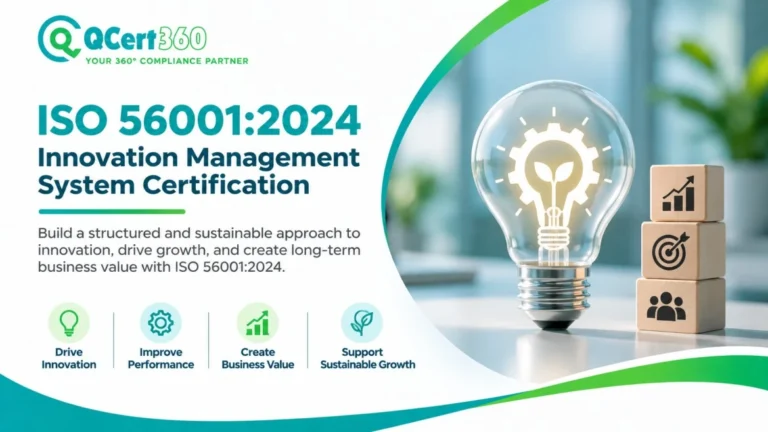
ISO 56001:2024 Innovation Management System Certification
ISO 56001:2024 is the international standard for establishing, implementing and continually improving an Innovation Management System (IMS). Published in September 2024 by the International Organization for Standardization (ISO), it provides a structured framework that helps organizations manage innovation, improve their innovation capabilities and create measurable value from new ideas, products, services and processes.
ISO 56001 certification allows organizations to demonstrate that their innovation management system meets internationally recognized requirements. It helps businesses move beyond informal brainstorming and establish systematic processes for identifying opportunities, managing innovation projects, evaluating results and improving performance.
Whether you operate a startup, manufacturing company, technology business or large enterprise, ISO 56001 can help connect innovation activities with your business strategy.
QCert360 provides ISO 56001 consulting, implementation support, training, gap analysis and internal audit services to help organizations prepare for independent certification.
ISO 56001 Certification at a Glance
- What is ISO 56001? An international requirements standard for establishing and maintaining an Innovation Management System.
- Is ISO 56001 certifiable? Yes. Organizations can undergo independent third-party audits against ISO 56001:2024.
- Who needs it? Startups, SMEs, manufacturers, technology companies, research institutions and large enterprises.
- What are its benefits? Better innovation governance, structured idea management, improved decision-making and measurable innovation performance.
- How do you get certified? Through gap analysis, system development, implementation, internal audits, management review and an independent certification audit.
- How can QCert360 help? Through ISO 56001 consulting, documentation, training, readiness assessments and internal audit support.
What Is ISO 56001:2024?
ISO 56001:2024 is an international management system standard that specifies requirements for establishing, implementing, maintaining and continually improving an Innovation Management System.
The standard helps organizations develop their innovation capabilities, improve innovation performance and realize value for customers, users and other interested parties.
Unlike general innovation guidance, ISO 56001 contains requirements that organizations must fulfil to demonstrate conformity. These requirements can be assessed through an independent certification audit.
The standard is built around eight innovation management principles:
- Realization of value.
- Future-focused leaders.
- Strategic direction.
- Culture.
- Exploiting insights.
- Managing uncertainty.
- Adaptability.
- Systems approach.
These principles help organizations connect innovation with leadership, business objectives, employee involvement and long-term organizational performance.
ISO 56001 is applicable to organizations of all sizes and sectors. It covers different forms of innovation, including new or improved products, services, processes, business models and organizational methods.
Official reference: ISO 56001:2024 – Innovation Management System Requirements.
ISO 56001 vs ISO 56002: What Is the Difference?
ISO 56001 and ISO 56002 both belong to the ISO 56000 family of innovation management standards. However, they serve different purposes.
ISO 56001 specifies requirements for an Innovation Management System and can be used as the basis for third-party certification. ISO 56002 provides guidance on establishing, implementing, maintaining and improving an innovation management system.
Here is a comparison:
Standard | Purpose | Certifiable? |
ISO 56000 | Fundamentals, vocabulary and principles of innovation management | No |
ISO 56001:2024 | Requirements for an Innovation Management System | Yes |
ISO 56002:2019 | Guidance for establishing and improving an IMS | No |
ISO 56003 | Guidance and tools for innovation partnerships | No |
ISO 56007 | Tools and methods for managing opportunities and ideas | No |
ISO 56002:2019 is currently undergoing revision. Its replacement is under development, so organizations should refer to the published edition until an updated standard is officially released.
Businesses can use ISO 56002 guidance alongside ISO 56001 requirements to develop a structured approach to innovation management.
Who Needs ISO 56001 Certification?
ISO 56001 certification is suitable for organizations that want to manage innovation systematically, improve their ability to respond to changing market conditions and demonstrate their innovation capabilities.
The standard is not limited to research and development departments or technology companies. It can be applied to different organizational functions and business activities.
The following organizations can benefit from implementing ISO 56001:
Startups often depend on new ideas, product development and changing business models. ISO 56001 helps smaller organizations establish structured innovation processes without relying entirely on informal decision-making.
Manufacturers can use an Innovation Management System to manage product development, production improvements, process innovation and manufacturing technology initiatives.
Technology businesses can apply ISO 56001 to manage software development, digital transformation, research activities and new technology solutions.
- Large Enterprises
Large organizations often manage multiple innovation projects across departments and locations. ISO 56001 provides a common management framework for aligning innovation activities with organizational strategy.
Educational and research organizations can use the standard to manage research opportunities, knowledge development, intellectual property and the commercialization of new ideas.
Public institutions and social enterprises can apply innovation management principles when developing public services, social programs and new approaches to community challenges.
The standard is applicable to organizations regardless of their size, products, services or innovation approach.
ISO 56001 Requirements and Clauses Explained
ISO 56001:2024 follows the harmonized structure used by several ISO management system standards, including ISO 9001, ISO 14001, ISO 45001 and ISO/IEC 27001.
Its main requirements are covered under Clauses 4 to 10.
Clause | Title | Main requirements |
Clause 4 | Context of the Organization | Understand internal and external issues, interested parties and the scope of the IMS. |
Clause 5 | Leadership | Establish leadership commitment, innovation policy, responsibilities and accountability. |
Clause 6 | Planning | Identify risks and opportunities, establish innovation objectives and plan activities. |
Clause 7 | Support | Provide resources, competence, awareness, communication, knowledge and documented information. |
Clause 8 | Operation | Establish and manage innovation initiatives, processes and portfolios. |
Clause 9 | Performance Evaluation | Monitor, measure and evaluate innovation performance, conduct internal audits and management reviews. |
Clause 10 | Improvement | Address nonconformities, implement corrective actions and continually improve the IMS. |
Understanding the Requirements in Practice
Clause 4: Context of the Organization
Organizations need to understand the internal and external factors that influence their innovation activities. This includes market conditions, technology developments, stakeholder expectations and organizational capabilities.
Clause 5: Leadership
Top management must demonstrate commitment to innovation management by establishing an innovation policy, assigning responsibilities and providing strategic direction.
Clause 6: Planning
Organizations must identify innovation-related risks and opportunities, establish measurable objectives and determine the actions required to achieve them.
Clause 7: Support
This clause focuses on the resources and capabilities needed to manage innovation. It includes employee competence, awareness, communication, knowledge and documented information.
Clause 8: Operation
Organizations must establish processes for identifying opportunities, developing concepts, managing innovation initiatives and realizing value from successful solutions.
Clause 9: Performance Evaluation
Innovation performance needs to be monitored and evaluated. Organizations should establish suitable indicators, conduct internal audits and review the effectiveness of their management system.
Clause 10: Improvement
Organizations must address identified nonconformities and continually improve the effectiveness of their Innovation Management System.
ISO 56001 does not require organizations to use one specific innovation methodology. Businesses may apply approaches such as design thinking, lean startup, TRIZ, open innovation and stage-gate methods where appropriate.
ISO 56001 Documentation Checklist
Documentation and records provide evidence that an organization’s Innovation Management System has been established and is operating effectively.
The specific documented information required depends on the organization’s activities, scope, complexity and applicable standard requirements.
A practical ISO 56001 documentation checklist includes:
- Innovation policy and strategy.
- Innovation objectives and implementation plans.
- Defined roles, responsibilities and authorities.
- Innovation governance structure.
- Innovation process descriptions and decision-making criteria.
- Innovation portfolio and project records.
- Risk and opportunity assessments.
- Employee competence and training records.
- Knowledge management and intellectual property records.
- Innovation performance indicators and evaluation reports.
- Internal audit reports.
- Management review records.
- Nonconformity and corrective action records.
This is a practical preparation checklist, not a fixed list of separately mandatory documents. Organizations should determine their documented information based on the actual requirements and their operational context.
How to Get ISO 56001 Certified: Step-by-Step Process
Obtaining ISO 56001 certification involves establishing an effective Innovation Management System and demonstrating conformity through an independent certification audit.
The following steps explain how organizations can prepare.
Step 1: Conduct an ISO 56001 Gap Analysis
Start by evaluating existing innovation practices against ISO 56001:2024 requirements.
The gap analysis helps identify missing processes, documentation requirements, leadership responsibilities and areas that need improvement.
Step 2: Obtain Management Commitment
Top management should establish the direction for innovation management and provide the resources needed to implement the system.
Leadership involvement is important because innovation objectives must support the organization’s overall business strategy.
Step 3: Define the IMS Scope and Context
Determine which organizational activities, departments, locations and innovation processes will be covered by the management system.
Identify relevant interested parties and understand their expectations.
Step 4: Develop the Innovation Management System
Establish the required policies, objectives, processes, responsibilities and performance evaluation methods.
The system should reflect the organization’s size, business activities and innovation maturity.
Step 5: Implement the System and Train Employees
Communicate the innovation policy and introduce the established processes across relevant departments.
Provide employee awareness and competence training so that individuals understand their responsibilities.
Step 6: Conduct an Internal Audit
Evaluate whether the Innovation Management System meets the applicable ISO 56001 requirements.
Identify nonconformities, record findings and implement corrective actions where necessary.
Step 7: Complete Management Review
Top management should review the system’s performance, objectives, audit results, resources and improvement opportunities.
This helps determine whether the organization is ready for the independent certification audit.
Step 8: Complete the Certification Audit
An independent certification body conducts the certification audit.
The audit generally includes:
- Stage 1 audit: A review of the management system’s documentation, scope and readiness.
- Stage 2 audit: An assessment of implementation and conformity with ISO 56001 requirements.
The certification body reviews the audit findings and makes the independent certification decision.
Step 9: Maintain and Improve the System
After certification, the organization must continue operating and improving its Innovation Management System.
Surveillance audits and subsequent recertification audits are conducted according to the applicable certification cycle and certification body’s requirements.
Important: ISO itself does not issue certificates. Certification is provided by independent certification bodies. If accredited certification is required, verify the body’s accreditation status and confirm that its accreditation scope covers ISO 56001.
How Much Does ISO 56001 Certification Cost?
The cost of ISO 56001 certification varies depending on the organization’s size, scope and implementation requirements.
There is no single certification price applicable to every business. The total cost may include consulting, system development, training, internal audits and independent certification audit fees.
The following factors generally influence the overall cost:
Cost factor | How it affects the cost |
Organization size | Employee count and organizational complexity influence the resources required. |
Number of locations | Multi-site operations may require additional implementation and audit activities. |
Existing management systems | Organizations with established ISO systems may be able to integrate processes. |
Innovation maturity | Existing innovation practices can influence the amount of implementation work required. |
Documentation requirements | New or revised policies, processes and records may require additional support. |
Training requirements | Employee and management training needs can affect implementation costs. |
Certification audit fees | Independent certification bodies determine audit costs based on their applicable requirements and scope. |
For an accurate quotation, organizations should request an assessment based on their actual operations and certification scope.
Looking for ISO 56001 certification support? Contact QCert360 to discuss your requirements and request a quotation for consulting and implementation assistance.
How Long Does ISO 56001 Certification Take?
The time required to prepare for ISO 56001 certification depends on the organization’s current innovation management practices and the complexity of its operations.
A smaller organization with established processes may complete implementation within a few months. Larger organizations with multiple locations, complex innovation portfolios or limited existing documentation may require a longer preparation period.
The overall timeline depends on:
- Current innovation management maturity.
- Organization size and operational scope.
- Availability of management and employee resources.
- Documentation and process development requirements.
- Employee training and implementation progress.
- Internal audit and corrective action completion.
- Availability of the independent certification body.
A readiness assessment can help establish a more realistic implementation schedule.
Benefits of ISO 56001 Certification
ISO 56001 helps organizations establish a systematic approach to innovation rather than depending on isolated ideas or individual initiatives.
Its potential benefits include:
- Structured Innovation Management
The standard helps organizations establish repeatable processes for identifying opportunities, developing ideas and managing innovation initiatives.
- Better Innovation Governance
Defined responsibilities, leadership involvement and innovation objectives help improve accountability across departments.
- Improved Management of Uncertainty
Innovation involves technical, financial, operational and market uncertainties. ISO 56001 encourages organizations to assess these uncertainties, experiment systematically and learn from results.
- Stronger Innovation Culture
An established management system encourages collaboration, knowledge sharing and employee involvement in innovation activities.
- Improved Business Adaptability
Organizations can use structured innovation processes to respond to changing customer needs, market developments and emerging technologies.
- Better Innovation Performance Evaluation
Defined objectives and performance indicators help management evaluate innovation activities and identify areas for improvement.
- Greater Stakeholder Confidence
Independent certification can provide customers, partners, investors and other interested parties with evidence that the organization has implemented an Innovation Management System meeting ISO 56001 requirements.
- Integration with Other ISO Standards
ISO 56001 follows a harmonized management system structure, supporting integration with standards such as ISO 9001, ISO 14001 and ISO/IEC 27001.
Certification does not guarantee successful innovation or commercial results. It provides a systematic framework for managing innovation activities and improving the organization’s ability to realize value.
Why ISO 56001 Matters for Modern Businesses
Businesses are operating in an environment shaped by digital transformation, artificial intelligence, sustainability expectations and changing customer requirements.
Organizations need more than creative ideas to remain competitive. They also need effective ways to evaluate opportunities, allocate resources, manage risks and turn promising ideas into practical solutions.
ISO 56001 provides a structured approach to these activities.
For example, a manufacturing company developing a new production technology can use an Innovation Management System to identify improvement opportunities, assess technical feasibility, allocate resources, test solutions and evaluate performance.
Similarly, a software company can apply innovation management processes when developing new digital products, evaluating emerging technologies or responding to changing user requirements.
By connecting innovation with organizational strategy, ISO 56001 helps businesses establish a repeatable approach to developing and managing new solutions.
ISO 56001 Certification Services by QCert360
QCert360 provides ISO 56001 consulting and implementation support to organizations seeking to establish an effective Innovation Management System and prepare for independent certification.
Our approach focuses on understanding your business activities, identifying implementation gaps and developing processes that align with ISO 56001:2024 requirements.
Our ISO 56001 services include:
ISO 56001 Gap Analysis
We assess your existing innovation management practices against the requirements of ISO 56001 and identify areas that need improvement.
Innovation Management System Documentation
We assist with developing relevant policies, procedures, objectives, responsibilities and documented information required for the management system.
ISO 56001 Implementation Support
We guide your organization through the implementation of innovation management processes and help integrate them into existing business operations.
Employee Awareness and Training
We provide training support to help management and employees understand the requirements and their responsibilities within the Innovation Management System.
Internal Audit Support
We help assess the effectiveness of the implemented system, identify nonconformities and prepare for the independent certification audit.
Management Review Preparation
We support organizations in reviewing system performance, evaluating objectives and identifying opportunities for continual improvement.
Integration with Other ISO Standards
Organizations already certified to ISO 9001, ISO 14001, ISO 45001 or ISO/IEC 27001 can explore integrating ISO 56001 with their existing management systems.
Why Work with QCert360?
- Experience in ISO management system consulting and implementation support.
- Structured gap analysis and readiness assessment.
- Practical documentation and implementation guidance.
- Employee awareness and internal audit support.
- Assistance with integrating multiple management systems.
- Support throughout the certification preparation process.
QCert360 provides consulting and preparation services. The final certification audit and certification decision are conducted independently by the selected certification body. Where accredited certification is required, organizations should verify the certification body’s relevant accreditation scope.
Ready to establish your Innovation Management System?
Contact QCert360 to discuss your ISO 56001 requirements, arrange a readiness assessment and receive a tailored implementation roadmap.
Frequently Asked Questions About ISO 56001 Certification
- What is ISO 56001:2024?
ISO 56001:2024 is an international standard that specifies requirements for establishing, implementing, maintaining and continually improving an Innovation Management System. It helps organizations manage innovation systematically and demonstrate their innovation capabilities.
- Is ISO 56001 certification available?
Yes. ISO 56001:2024 is a certifiable management system standard. Organizations can undergo independent third-party audits to demonstrate conformity with its requirements.
- When was ISO 56001 published?
ISO published the first edition of ISO 56001 in September 2024. It was developed by ISO technical committee ISO/TC 279, which focuses on innovation management.
- Is ISO 56001 certification mandatory?
No. ISO 56001 certification is generally voluntary. Organizations may adopt the standard to improve innovation management practices and demonstrate conformity with internationally recognized requirements.
- Can startups and SMEs obtain ISO 56001 certification?
Yes. ISO 56001 is applicable to organizations of all sizes. Startups and SMEs can adapt their Innovation Management Systems to their organizational structure, resources and business objectives.
- Is ISO 56001 only for product innovation?
No. ISO 56001 covers different forms of innovation, including products, services, processes, business models and organizational methods.
- What documents are required for ISO 56001 certification?
Organizations may need documented information relating to their innovation policy, objectives, governance, processes, responsibilities, risk assessments, performance evaluation, internal audits and management reviews. The specific requirements depend on the organization’s scope and activities.
- How much does ISO 56001 certification cost?
The cost depends on organizational size, scope, number of locations, existing processes, implementation requirements and certification audit fees. A quotation should be based on an assessment of the organization’s requirements.
- How long does ISO 56001 certification take?
The implementation timeline varies according to organizational size, innovation maturity, available resources and audit readiness. Smaller organizations with established processes may be ready within a few months, while more complex organizations may require additional time.
- Who provides ISO 56001 certification?
Independent third-party certification bodies conduct audits and make certification decisions. Organizations seeking accredited certification should verify the certification body’s accreditation status and relevant scope.
- Can ISO 56001 be integrated with ISO 9001 or ISO/IEC 27001?
Yes. ISO 56001 uses the harmonized management system structure, which supports integration with other standards. Organizations can align common processes such as leadership, planning, support, internal audits and management reviews.
- What is the difference between ISO 56001 and ISO 56002?
ISO 56001 specifies requirements for an Innovation Management System and can be used for certification. ISO 56002 provides guidance on establishing and improving an innovation management system but is not a certification standard.
- Does ISO 56001 guarantee successful innovation?
No. Certification does not guarantee that every innovation initiative will succeed or generate commercial returns. It provides a systematic framework for managing innovation, evaluating opportunities, handling uncertainty and improving performance.
- How can QCert360 help with ISO 56001 certification?
QCert360 provides ISO 56001 gap analysis, consulting, documentation support, implementation guidance, training, internal audits and certification readiness assistance. Final certification is provided by an independent certification body.
Take the Next Step Towards ISO 56001 Certification
Establish a structured approach to innovation with ISO 56001:2024. QCert360 can help your organization understand the requirements, implement an effective Innovation Management System and prepare for independent certification.
Contact QCert360 today to discuss your ISO 56001 certification requirements and request a consultation.
Our Services
ISO Standards
- ISO 9001 Certification
- ISO 14001 Certification
- ISO 45001 Certification
- ISO 22000 Certification
- ISO 17025 Certification
- ISO 27001 Certification
- ISO 13485 Certification
- ISO 20000-1 Certification
- ISO 41001 Certification
- ISO 22716 Certification
- ISO 50001 Certification
- ISO 22301 Certification
- ISO 29993 Certification
Product Certifications
Other international standards
- FSSC 22000 Certification
- HIPAA
- HACCP Certification
- SA 8000 Certification
- GMP Certification
- GDPR
- GDP Certification
- GLP Certification
- Certificate of Conformity
QCert360 provides a wide range of services including ISO certification, audit support, compliance consulting, and training. They specialize in helping businesses achieve global standards and certifications like ISO 9001, ISO 27001, ISO 14001, and many others. Their team ensures a seamless experience from consultation to certification, supporting clients at every stage.
The time it takes to achieve certification can vary depending on the complexity of the standard and the readiness of your organization. On average, it takes about 3 to 6 months. QCert360 works closely with clients to streamline the process, ensuring that all requirements are met efficiently and within a reasonable timeline.
QCert360 is a trusted partner with years of experience in helping businesses obtain international certifications. Their expert consultants provide tailored solutions, ensuring your organization not only meets but exceeds industry standards. With a customer-centric approach, they focus on offering end-to-end support to simplify the certification journey.
QCert360 serves a wide range of industries including manufacturing, healthcare, information technology, education, and services, among others. They customize their certification solutions to meet the unique requirements of each industry, ensuring relevance and compliance with global standards.
Yes, QCert360 provides ongoing support even after certification. They offer services like surveillance audits, recertification guidance, and consultancy to help maintain and improve your certification status. Their team ensures that your organization stays compliant and up-to-date with any changes in certification standards.
Getting started with QCert360 is simple. You can contact them via their website to request a consultation. Their team will assess your needs, discuss the best certification options for your business, and outline the steps involved. From there, they’ll guide you through the entire process, ensuring you’re prepared for certification.
QCert360 stands out due to its customer-focused approach, industry expertise, and comprehensive service offerings. Their team doesn’t just help you obtain certification but works to ensure your organization thrives in compliance with international standards. They also offer personalized consultation, making the process smoother and more efficient, ensuring long-term success for your business.
The cost of certification varies depending on factors such as the type of certification, the size and complexity of your organization, and the specific industry requirements. QCert360 offers competitive pricing and provides tailored quotes based on your unique needs. They ensure transparency and work with you to find the most cost-effective solution for your certification goals.
Yes, QCert360 offers internal audit services to help assess and improve your organization’s processes. Their expert auditors conduct thorough reviews of your systems and operations to ensure they meet required standards. They also provide actionable recommendations to help enhance efficiency and compliance, making sure you’re fully prepared for external audits.
If your organization doesn’t pass an audit or certification assessment, QCert360 works with you to understand the reasons for non-compliance and provides support to rectify the issues. They offer guidance on corrective actions and help you prepare for a re-assessment. Their goal is to ensure your organization meets the necessary standards for certification, and they will be by your side to make the process as smooth as possible.