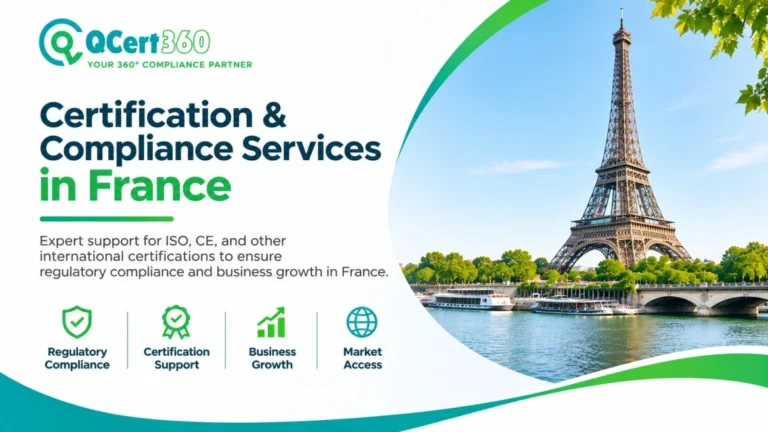
Certification & Compliance Services in France: Get expert support
France has one of Europe’s largest economies and a well-developed regulatory framework covering quality, environmental protection, workplace safety, data privacy, cybersecurity, product conformity and corporate governance. Businesses operating in France must understand the French legal requirements as well as applicable European Union regulations.
Certification and compliance services in France help organizations establish management systems, demonstrate conformity with recognized standards and meet customer and industry expectations. ISO certification, product compliance and independent audits can also strengthen business credibility, support supplier qualification and improve access to new markets.
QCert360 provides certification and compliance consulting services to businesses across France, including Paris, Lyon, Marseille, Toulouse, Bordeaux, Lille, Nantes and Strasbourg. Our services include ISO consulting, gap assessments, management system implementation, documentation, employee training, internal audits and certification audit preparation.
We support organizations seeking ISO 9001, ISO 14001, ISO 45001, ISO/IEC 27001, ISO/IEC 27701, ISO 22000, ISO 13485 and other international standards.
Whether you are a manufacturer, technology company, healthcare provider, financial institution or food business, QCert360 helps you identify relevant requirements and prepare your organization for independent certification assessments.
What certification and compliance services does QCert360 offer in France?
QCert360 supports French businesses with ISO certification consulting, management system implementation, compliance assessments, internal audits and certification audit preparation. Our services cover quality management, environmental management, occupational health and safety, information security, privacy management, food safety, medical devices and other industry-specific frameworks.
Certification and Compliance Services We Offer in France
Different industries in France have different certification and compliance requirements. Selecting the appropriate standard depends on your business activities, customer expectations, regulatory obligations and operational objectives.
QCert360 provides consulting and implementation support for the following standards and compliance frameworks.
- ISO 9001:2026: Quality management system consulting to improve process consistency, customer satisfaction and organizational performance.
- ISO 14001:2026: Environmental management system support to help organizations manage environmental impacts, resource consumption and sustainability objectives.
- ISO 45001:2018: Occupational health and safety management system implementation and audit preparation.
- ISO/IEC 27001:2022: Information security management system consulting to identify security risks and protect business information.
- ISO/IEC 27701:2025: Privacy information management system support for organizations handling personal information.
- ISO/IEC 42001:2023: Artificial intelligence management system consulting for organizations developing, providing or using AI systems.
- ISO 22000: Food safety management system consulting for food manufacturers, processors, distributors and related businesses.
- ISO 13485:2016: Medical device quality management system support for manufacturers and suppliers.
- HACCP and GMP: Food safety, hygiene and good manufacturing practice support.
- HDS Certification: Readiness and implementation support for organizations providing health data hosting services in France.
- SecNumCloud: Compliance readiness guidance for organizations targeting ANSSI’s trusted cloud qualification.
- CE Marking: Product conformity assessment and regulatory documentation guidance for applicable European product requirements.
- SOC 2 and PCI DSS: Readiness support for technology businesses, SaaS providers and organizations handling payment card information.
The applicable edition, certification scheme and assessment requirements should be confirmed before starting an implementation project.
ISO Certification Services for Businesses in France
ISO certification helps organizations demonstrate that their management systems meet the requirements of internationally recognized standards. French businesses use ISO standards to improve operational performance, manage business risks, meet customer expectations and strengthen their position in competitive markets.
QCert360 provides ISO consulting and implementation support to organizations across different industries in France.
ISO 9001 Certification in France
ISO 9001 is an internationally recognized quality management standard. It helps organizations establish consistent business processes, improve customer satisfaction, monitor operational performance and support continual improvement.
The latest edition, ISO 9001:2026, was published in September 2026, replacing ISO 9001:2015. French organizations planning new certification or transitioning from the previous edition should review the updated requirements and applicable transition arrangements.
ISO 14001 Certification in France
ISO 14001:2026 provides a framework for establishing and maintaining an environmental management system. It helps businesses identify environmental impacts, manage resource consumption, address environmental risks and improve environmental performance.
Manufacturing companies, construction businesses, logistics providers and energy organizations can use ISO 14001 to demonstrate a structured approach to environmental management.
ISO 45001 Certification in France
ISO 45001:2018 helps organizations establish an occupational health and safety management system. It supports workplace hazard identification, risk assessment, employee participation and the implementation of appropriate safety controls.
French businesses can use this standard to improve workplace safety management and support their responsibilities under the French Code du travail.
ISO/IEC 27001 Certification in France
ISO/IEC 27001:2022 provides requirements for establishing and maintaining an information security management system. It helps organizations identify information security risks and implement controls to protect business and customer information.
Technology companies, financial institutions, SaaS providers and organizations processing sensitive information can benefit from this standard.
ISO/IEC 27701 Certification in France
ISO/IEC 27701:2025 provides requirements and guidance for establishing a privacy information management system. It helps organizations manage personally identifiable information and establish accountability for privacy-related activities.
It is particularly relevant to businesses handling customer information, employee records and other personal data under the GDPR and France’s Loi Informatique et Libertés.
Other ISO Certification Solutions
QCert360 also supports organizations seeking ISO 22000, ISO 13485, ISO/IEC 42001 and other international management system standards.
Our approach focuses on understanding existing business processes, identifying gaps, preparing suitable documentation and helping employees implement the selected management system.
Why Is Compliance Important for Businesses in France?
Compliance is an important responsibility for businesses operating in France. Organizations must consider applicable French legislation, European Union regulations, industry requirements and contractual obligations.
Depending on the business sector, these requirements may involve data protection, financial regulation, workplace safety, environmental management, product conformity and corporate governance.
Failure to meet applicable obligations can lead to regulatory investigations, financial penalties, enforcement actions, contract losses and reputational damage.
For example, under the GDPR, serious infringements can attract administrative fines of up to €20 million or 4% of an undertaking’s total worldwide annual turnover, whichever is higher. France’s data protection authority, the Commission Nationale de l’Informatique et des Libertés (CNIL), is responsible for enforcing applicable data protection requirements.
French businesses must also consider important national legislation:
- Sapin II Law: Establishes anti-corruption obligations for qualifying companies and requires appropriate prevention and detection measures.
- Duty of Vigilance Law: Requires certain large companies to establish and implement vigilance plans addressing human rights, health, safety and environmental risks.
- Waserman Law: Strengthens whistleblower protection and establishes internal reporting requirements for organizations within scope.
- Code du travail: Establishes employment and workplace health and safety responsibilities.
- Loi Informatique et Libertés: Complements the GDPR and governs personal data protection in France.
Certification and structured internal audits can help businesses document their processes, identify weaknesses and demonstrate management system conformity.
Compliance also offers commercial benefits. French businesses supplying government departments, financial institutions, healthcare organizations and large corporate customers may need to demonstrate their quality, security and environmental management systems during procurement and supplier assessments.
Key Regulatory Bodies and Accreditation Authorities in France
France has several regulatory and accreditation authorities responsible for different industries and compliance areas. Understanding their responsibilities helps businesses identify the requirements relevant to their operations.
COFRAC (Comité français d’accréditation)
COFRAC is France’s national accreditation body. It assesses the competence and impartiality of certification bodies, inspection bodies and laboratories against relevant international standards.
Organizations seeking accredited ISO certification should verify that the certification body’s accreditation covers the required standard and certification scope.
Official resource: COFRAC
CNIL (Commission Nationale de l’Informatique et des Libertés)
CNIL is France’s independent data protection authority. It oversees compliance with the GDPR and the Loi Informatique et Libertés, publishes guidance, investigates complaints and can impose administrative penalties.
Official resource: CNIL
ANSSI (Agence nationale de la sécurité des systèmes d’information)
ANSSI is France’s national cybersecurity agency. It provides cybersecurity guidance, supports national cyber resilience and manages qualification schemes such as SecNumCloud.
Official resource: ANSSI
Other Important Regulatory Authorities
- Autorité des Marchés Financiers (AMF): Regulates financial markets and oversees investor protection.
- Autorité de Contrôle Prudentiel et de Résolution (ACPR): Supervises banks and insurance organizations.
- Agence française anticorruption (AFA): Monitors anti-corruption compliance under Sapin II.
- Agence nationale de sécurité du médicament et des produits de santé (ANSM): Regulates medicines and relevant health products.
- Haute Autorité de santé (HAS): Oversees healthcare quality and related assessment frameworks.
- Agence du Numérique en Santé (ANS): Manages frameworks relating to digital healthcare and health data hosting certification.
- DGCCRF: Oversees consumer protection, competition and product safety matters.
- Direction générale de l’alimentation (DGAL): Handles food safety and animal and plant health responsibilities.
- DREAL: Oversees regional environmental, planning and housing responsibilities.
- ADEME: Supports environmental transition, energy efficiency and resource management.
- Inspection du travail and DREETS: Handle employment and workplace regulatory matters.
Businesses should consult the relevant authority to confirm the requirements applicable to their sector and activities.
Common Compliance Challenges for Businesses in France
Organizations operating in France often face challenges when managing national legislation, EU regulations, customer expectations and certification requirements.
- Complex Employment and Labour Requirements
French employment legislation includes requirements covering working conditions, employee protection, collective agreements and workplace risk assessments.
Businesses must also maintain the Document Unique d’Évaluation des Risques Professionnels (DUERP), which records workplace risks and the preventive measures established by the employer.
- Data Protection and Privacy
The GDPR and Loi Informatique et Libertés require organizations to manage personal information responsibly. Businesses may need to maintain records of processing activities, conduct data protection impact assessments where required and manage data subject requests and security incidents.
ISO/IEC 27001 and ISO/IEC 27701 can support structured information security and privacy management.
- Environmental and Sustainability Obligations
French businesses may face environmental permitting, waste management, energy reporting and sustainability disclosure requirements.
Applicable obligations can include ICPE requirements, the AGEC Law and relevant European sustainability reporting rules.
- Cybersecurity and Digital Resilience
Technology companies, financial institutions and organizations providing essential services must assess cybersecurity obligations under applicable French and European frameworks.
NIS2 transposition, DORA and sector-specific requirements are particularly relevant to organizations operating in regulated industries.
- Documentation and Audit Evidence
Regulators, customers and certification auditors may request documented evidence of business processes, policies, controls and corrective actions. Organizations must ensure that records are accurate, current and accessible.
- Language and Local Requirements
Businesses operating in France may need to maintain documentation and communicate compliance information in French, depending on the applicable legal, contractual and audit requirements.
Understanding Major Compliance Standards and Regulations in France
French businesses should distinguish between legal requirements, voluntary international standards, industry certifications and customer assurance frameworks.
Standard or regulation | Main purpose |
GDPR | Personal data protection across the EU |
Loi Informatique et Libertés | French data protection legislation |
ISO 9001:2026 | Quality management |
ISO 14001:2026 | Environmental management |
Occupational health and safety | |
Information security management | |
ISO/IEC 27701:2025 | Privacy information management |
ISO/IEC 42001:2023 | Artificial intelligence management |
DORA | Digital operational resilience in the financial sector |
NIS2 Directive | Cybersecurity requirements for covered entities |
Sapin II | Anti-corruption compliance |
Duty of Vigilance Law | Human rights and environmental due diligence |
DUERP | Workplace risk assessment documentation |
HDS | Health data hosting certification |
SecNumCloud | Trusted cloud service qualification |
EU MDR 2017/745 | Medical device regulatory requirements |
Product conformity under applicable EU legislation | |
SOC 2 | Assurance reporting on service organization controls |
PCI DSS | Payment card data security |
ISO standards help organizations establish structured management systems. However, obtaining an ISO certificate does not automatically establish compliance with every French or European legal requirement.
Businesses should assess their applicable obligations separately and seek qualified legal advice when interpreting complex regulatory requirements.
How QCert360 Supports Certification and Compliance in France
French businesses often need to manage national legislation, EU regulations, customer requirements and international certification standards at the same time.
QCert360 helps organizations approach these requirements through structured consulting and management system implementation support.
Our services include:
Gap Assessment
We assess existing business processes against the selected ISO standard or compliance framework. This helps identify missing documentation, process weaknesses and areas requiring improvement.
Documentation and Management System Development
We help organizations prepare policies, procedures, risk assessments, objectives and other documented information based on the selected standard and business activities.
Management System Implementation
We guide management teams and employees in understanding their responsibilities and implementing the required processes across relevant business operations.
Employee Awareness and Training
We provide guidance and training to help employees understand quality, environmental, workplace safety, information security and other relevant management system responsibilities.
Internal Audits and Management Reviews
We support organizations in conducting internal audits, reviewing management system performance and identifying corrective actions before external certification assessments.
Certification Audit Preparation
We help businesses organize documentation, evidence and employees for independent certification audits. Formal certification decisions are made by the independent certification body.
Our approach is based on documented evidence, defined requirements and practical implementation. We tailor each project to the organization’s industry, size, operational complexity and certification objectives.
For technology and SaaS businesses, we can also help align information security and privacy management activities across ISO/IEC 27001, ISO/IEC 27701 and SOC 2 requirements, where appropriate.
Industries in France That Benefit from Certification and Compliance Services
Different industries use certification and compliance frameworks to address operational risks, customer expectations and regulatory responsibilities.
Technology, SaaS and Cloud Services
Technology companies and cloud service providers may use ISO/IEC 27001, ISO/IEC 27701, ISO/IEC 42001 and SOC 2 to demonstrate information security, privacy and AI governance maturity.
Organizations providing cloud services to sensitive customers may also need to consider ANSSI’s SecNumCloud qualification requirements.
Healthcare and Medical Technology
Healthcare organizations, medical device manufacturers and health technology providers may require ISO 13485, HDS certification and applicable EU MDR compliance support.
Businesses hosting personal health data on behalf of others should assess whether HDS certification applies to their activities.
Financial Services and Fintech
Banks, insurance providers, investment firms and fintech companies may need to address ACPR and AMF requirements, DORA obligations and information security expectations.
ISO/IEC 27001 and structured operational risk management can support their compliance programs.
Manufacturing and Industrial Businesses
Manufacturers and industrial organizations use ISO 9001, ISO 14001, ISO 45001 and applicable CE marking requirements to manage quality, environmental responsibilities, workplace safety and product conformity.
Renewable Energy and Environmental Services
Energy companies and environmental service providers may benefit from ISO 14001 and ISO 50001 to improve environmental and energy management.
They may also need to address ICPE permits, carbon reporting and other applicable environmental obligations.
Food, Agriculture and Retail
Food manufacturers, processors, distributors and retailers use HACCP, ISO 22000 and GMP practices to manage food safety, hygiene and production controls.
Emerging Compliance Trends in France for 2027
French organizations should monitor regulatory and industry developments that may affect their compliance responsibilities.
- NIS2 and Cybersecurity Resilience
France is working towards transposing the NIS2 Directive through national legislation concerning critical infrastructure resilience and cybersecurity.
As of November 2026, the French transposition legislation has not been promulgated. ANSSI’s Référentiel Cyber France (ReCyF) provides a useful reference for organizations preparing for expected cybersecurity requirements.
Businesses should monitor the legislative process and assess whether they may fall within the future scope.
- EU AI Act Implementation
The EU AI Act establishes obligations for organizations developing, supplying or using AI systems within its scope. Its requirements are being introduced in phases.
ISO/IEC 42001 provides a management system framework that can help businesses establish AI governance processes, identify risks and assign responsibilities.
- Sustainability Reporting and Due Diligence
European sustainability reporting and corporate due diligence requirements have undergone significant changes under the EU simplification measures adopted in 2026.
Businesses should assess the revised scope and reporting timelines rather than relying on earlier CSRD and CSDDD thresholds.
- Stronger Data Protection Expectations
CNIL continues to focus on areas such as cookies, personal data security, international data transfers and individuals’ privacy rights.
Organizations should regularly review their privacy policies, security controls and data processing activities.
- Supply Chain Due Diligence
French and European businesses face growing expectations to identify and manage human rights, environmental and governance risks across relevant supply chains.
Organizations should review applicable vigilance and due diligence requirements based on their size and activities.
- Digital and Technology-Based Auditing
Organizations are increasingly using digital records, automated monitoring and centralized compliance systems to improve audit preparation and maintain evidence of conformity.
Steps to Achieve Certification and Compliance in France
Organizations planning to obtain ISO certification should follow a structured implementation and audit preparation process.
Step 1: Identify the Required Standard
Determine which ISO standard or compliance framework applies to your business. Consider customer expectations, industry requirements, regulatory obligations and business objectives.
Step 2: Conduct a Gap Assessment
Review existing processes and compare them with the requirements of the selected standard. Identify areas requiring improvement.
Step 3: Develop Required Documentation
Prepare policies, procedures, risk assessments, objectives and other documented information required by the management system.
Step 4: Implement the Management System
Apply the documented processes across relevant business activities. Assign responsibilities and establish appropriate monitoring arrangements.
Step 5: Train Employees
Provide awareness training so employees understand the management system, their responsibilities and the procedures relevant to their roles.
Step 6: Conduct Internal Audits
Evaluate whether the management system meets the applicable requirements and operates effectively. Address identified nonconformities.
Step 7: Complete Management Review
Management should review audit results, performance information, objectives, risks and opportunities for improvement.
Step 8: Complete the Independent Certification Audit
Select an appropriately accredited certification body whose accreditation scope covers the required standard. The certification body conducts the audit and makes the independent certification decision.
Step 9: Maintain Certification
Continue monitoring performance, conducting internal audits, reviewing the management system and completing surveillance audits according to the certification programme.
Why Choose QCert360 for Certification and Compliance Services in France?
Selecting the right consulting partner can make the certification preparation process easier to manage.
QCert360 supports businesses with practical consulting and management system implementation services across multiple international standards.
Our key service strengths include:
- Multiple Certification Standards: Consulting support across quality, environmental, occupational health and safety, information security, food safety and other management system standards.
- Industry-Specific Guidance: Support tailored to the organization’s sector, size, activities and compliance objectives.
- Structured Implementation: A clear approach covering gap assessments, documentation, implementation, employee training and internal audits.
- Certification Audit Preparation: Practical guidance to help organizations understand and prepare for independent certification audits.
- International Service Experience: Support for businesses operating across different countries and regulatory environments.
- Continual Improvement: Guidance to help organizations maintain and improve their management systems after initial implementation.
We focus on helping businesses understand what is required, establish suitable processes and prepare for independent assessment.
QCert360: Your Certification and Compliance Partner in France
France offers significant opportunities for businesses looking to establish operations, serve European customers and expand into international markets. However, organizations must understand the certification, regulatory and industry requirements that apply to their activities.
QCert360 provides ISO consulting, compliance assessments, internal audits and certification preparation services to businesses across France.
Whether you are planning ISO 9001:2026 certification, ISO 14001:2026 certification, ISO 45001, ISO/IEC 27001, ISO 22000, ISO 13485 or another management system, our team can help you understand the requirements and prepare an appropriate implementation approach.
Looking for certification and compliance services in France?
Contact QCert360 to discuss your business requirements, identify the appropriate standard and receive consulting support tailored to your organization.
Frequently Asked Questions: Certification and Compliance Services in France
- What are certification and compliance services in France?
Certification and compliance services help businesses understand applicable standards, regulatory requirements and customer expectations. These services may include ISO consulting, management system implementation, compliance assessments, internal audits and certification audit preparation.
- Is ISO certification mandatory in France?
ISO certification is generally voluntary in France. However, public authorities, large companies and regulated customers may require specific certifications as part of supplier qualification or tender processes. Businesses must also comply with applicable legal requirements regardless of whether they hold ISO certification.
- Which ISO certifications are most requested by French businesses?
Commonly requested standards include ISO 9001 for quality management, ISO 14001 for environmental management, ISO 45001 for occupational health and safety and ISO/IEC 27001 for information security. ISO/IEC 27701, ISO 13485, ISO 22000 and ISO/IEC 42001 are also relevant to specific industries.
- What is COFRAC accreditation and why does it matter?
COFRAC is France’s national accreditation body. It assesses the competence and impartiality of certification, inspection and testing organizations against relevant international standards. Businesses seeking accredited certification should verify the certification body’s accreditation scope for their selected standard.
- What does CNIL do in France?
CNIL is France’s independent data protection authority. It oversees compliance with the GDPR and the Loi Informatique et Libertés, publishes regulatory guidance, investigates complaints and can impose administrative penalties for relevant violations.
- What are the penalties for GDPR violations in France?
For the most serious infringements, GDPR administrative fines can reach €20 million or 4% of an undertaking’s total worldwide annual turnover, whichever is higher. CNIL can also issue warnings, corrective orders and other enforcement measures.
- Does ISO/IEC 27001 certification guarantee GDPR compliance?
No. ISO/IEC 27001 establishes an information security management system, but GDPR compliance involves additional legal responsibilities, including lawful processing, transparency, data subject rights and breach notification. ISO/IEC 27701 can help organizations manage privacy responsibilities systematically.
- What is HDS certification in France?
HDS stands for Hébergeur de Données de Santé. It is a French certification framework for organizations hosting personal health data on behalf of others when the relevant legal requirements apply. Certification is granted by an appropriately accredited certification body following an independent assessment against the HDS requirements.
- What is ANSSI SecNumCloud qualification?
SecNumCloud is a qualification framework managed by ANSSI for trusted cloud service providers. It establishes specific security and data sovereignty requirements. It is an ANSSI qualification, not an ISO certification, and is relevant to organizations serving sensitive and public sector workloads.
- Has France transposed the NIS2 Directive into national law?
As of November 2026, France has not promulgated its NIS2 transposition legislation. The proposed national framework is progressing through the legislative process. Organizations should monitor official ANSSI and parliamentary updates and prepare for applicable cybersecurity requirements.
- Does DORA apply to businesses in France?
DORA has applied since 17 January 2025 to financial entities within its scope across the European Union. It also establishes requirements for certain ICT third-party service providers. Technology suppliers serving banks, insurers and investment firms may face additional contractual and security assessment requirements.
- What is the Sapin II Law and which companies must comply?
Sapin II is France’s anti-corruption legislation. Its main mandatory anti-corruption programme requirements apply to qualifying companies and groups meeting the relevant employee and turnover thresholds, generally 500 employees and €100 million in turnover. Covered organizations must establish measures such as a code of conduct, risk mapping, whistleblowing arrangements, third-party due diligence and training.
- What is the Duty of Vigilance Law in France?
The Duty of Vigilance Law requires qualifying large French companies to establish, publish and implement a vigilance plan addressing serious human rights, health and safety, environmental and other relevant risks arising from their operations and business relationships.
- What are the whistleblower requirements under the Waserman Law?
The Waserman Law strengthened whistleblower protection in France. Organizations with at least 50 employees generally need an internal procedure for collecting and processing reports, subject to applicable rules. Employers must also protect whistleblowers against retaliation.
- What is DUERP and who needs it?
DUERP stands for Document Unique d’Évaluation des Risques Professionnels. It is a workplace risk assessment document that French employers are required to prepare and maintain under the Code du travail. ISO 45001 can help organizations establish a structured approach to identifying and managing workplace risks.
- Do businesses in France need an environmental permit under ICPE regulations?
Businesses operating classified installations may need to comply with the ICPE framework, depending on their activities, capacity and environmental risks. The applicable procedure may involve declaration, registration or authorization. ISO 14001 can help organizations manage environmental responsibilities but does not replace an ICPE permit.
- How does the CSRD affect French businesses?
The Corporate Sustainability Reporting Directive establishes sustainability reporting obligations for companies within its scope. EU simplification legislation adopted in 2026 has changed the scope and timelines of these requirements. Businesses should check the current thresholds and applicable reporting periods rather than relying on older guidance.
- How does the EU AI Act affect organizations in France?
The EU AI Act applies in France and introduces obligations for organizations developing, supplying or using AI systems within its scope. Requirements depend on the type and risk classification of the AI system. ISO/IEC 42001 provides a management system framework to support responsible AI governance but does not automatically establish legal compliance.
- How long does ISO certification take in France?
The timeline depends on the selected standard, organization size, number of employees, existing management system maturity and audit availability. Many small and medium-sized businesses may need several months from initial gap assessment to certification. A gap assessment helps establish a more realistic project timeline.
- How can QCert360 help my business obtain ISO certification in France?
QCert360 supports organizations with requirement mapping, gap assessments, documentation, management system implementation, employee training, internal audits and certification audit preparation. We cover standards including ISO 9001, ISO 14001, ISO 45001, ISO/IEC 27001, ISO/IEC 27701, ISO 22000 and ISO 13485. Formal certification is issued by an independent certification body.
Our Services
ISO Standards
- ISO 9001 Certification
- ISO 14001 Certification
- ISO 45001 Certification
- ISO 22000 Certification
- ISO 17025 Certification
- ISO 27001 Certification
- ISO 13485 Certification
- ISO 20000-1 Certification
- ISO 41001 Certification
- ISO 22716 Certification
- ISO 50001 Certification
- ISO 22301 Certification
- ISO 29993 Certification
Product Certifications
Other international standards
- FSSC 22000 Certification
- HIPAA
- HACCP Certification
- SA 8000 Certification
- GMP Certification
- GDPR
- GDP Certification
- GLP Certification
- Certificate of Conformity
QCert360 provides a wide range of services including ISO certification, audit support, compliance consulting, and training. They specialize in helping businesses achieve global standards and certifications like ISO 9001, ISO 27001, ISO 14001, and many others. Their team ensures a seamless experience from consultation to certification, supporting clients at every stage.
The time it takes to achieve certification can vary depending on the complexity of the standard and the readiness of your organization. On average, it takes about 3 to 6 months. QCert360 works closely with clients to streamline the process, ensuring that all requirements are met efficiently and within a reasonable timeline.
QCert360 is a trusted partner with years of experience in helping businesses obtain international certifications. Their expert consultants provide tailored solutions, ensuring your organization not only meets but exceeds industry standards. With a customer-centric approach, they focus on offering end-to-end support to simplify the certification journey.
QCert360 serves a wide range of industries including manufacturing, healthcare, information technology, education, and services, among others. They customize their certification solutions to meet the unique requirements of each industry, ensuring relevance and compliance with global standards.
Yes, QCert360 provides ongoing support even after certification. They offer services like surveillance audits, recertification guidance, and consultancy to help maintain and improve your certification status. Their team ensures that your organization stays compliant and up-to-date with any changes in certification standards.
Getting started with QCert360 is simple. You can contact them via their website to request a consultation. Their team will assess your needs, discuss the best certification options for your business, and outline the steps involved. From there, they’ll guide you through the entire process, ensuring you’re prepared for certification.
QCert360 stands out due to its customer-focused approach, industry expertise, and comprehensive service offerings. Their team doesn’t just help you obtain certification but works to ensure your organization thrives in compliance with international standards. They also offer personalized consultation, making the process smoother and more efficient, ensuring long-term success for your business.
The cost of certification varies depending on factors such as the type of certification, the size and complexity of your organization, and the specific industry requirements. QCert360 offers competitive pricing and provides tailored quotes based on your unique needs. They ensure transparency and work with you to find the most cost-effective solution for your certification goals.
Yes, QCert360 offers internal audit services to help assess and improve your organization’s processes. Their expert auditors conduct thorough reviews of your systems and operations to ensure they meet required standards. They also provide actionable recommendations to help enhance efficiency and compliance, making sure you’re fully prepared for external audits.
If your organization doesn’t pass an audit or certification assessment, QCert360 works with you to understand the reasons for non-compliance and provides support to rectify the issues. They offer guidance on corrective actions and help you prepare for a re-assessment. Their goal is to ensure your organization meets the necessary standards for certification, and they will be by your side to make the process as smooth as possible.