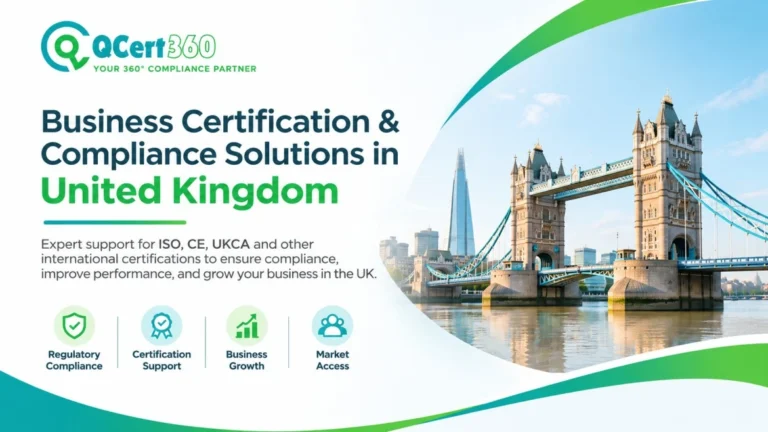
Business Certification & Compliance Solutions in the United Kingdom
Businesses operating in the United Kingdom must meet a range of quality, safety, environmental, information security and product compliance requirements. Whether you operate in manufacturing, healthcare, financial services, food production or technology, meeting the right standards helps build customer confidence, strengthen business operations and support market access.
QCert360 provides business certification and compliance solutions in the United Kingdom, helping organizations understand applicable requirements, implement management systems and prepare for independent certification audits. Our services include ISO consulting, gap assessments, documentation, employee training, internal audits and certification audit preparation.
From London, Manchester and Birmingham to Edinburgh, Glasgow, Leeds, Bristol, Cardiff and Belfast, we support businesses looking to improve their management systems and demonstrate compliance with internationally recognized standards.
Whether you are seeking ISO 9001 certification, ISO 14001 certification, ISO 45001 certification, ISO 27001 certification, HACCP, GMP or product compliance support, QCert360 helps you develop a structured approach based on your organization’s activities, size and objectives.
What certification and compliance services does QCert360 offer in the UK?
QCert360 supports UK businesses with ISO management system consulting, compliance assessments, documentation, implementation guidance, internal audits and certification audit preparation. We cover quality management, environmental management, occupational health and safety, information security, food safety, medical device quality and other industry-specific requirements.
Certification and Compliance Services We Offer in the UK
Different industries face different regulatory and customer requirements. QCert360 helps organizations identify relevant standards and prepare management systems that address their operational and compliance needs.
Our key business certification and compliance services include:
- ISO 9001:2026: Quality management system consulting to improve process consistency, customer satisfaction and operational performance.
- ISO 14001:2026: Environmental management system support to help organizations manage environmental impacts, resource use and environmental responsibilities.
- ISO 45001:2018: Occupational health and safety management system implementation and audit preparation.
- ISO/IEC 27001:2022: Information security management system consulting to help protect business information and manage security risks.
- ISO/IEC 27701: Privacy information management system support to strengthen personal data governance and privacy management.
- ISO/IEC 42001:2023: Artificial intelligence management system consulting for organizations developing, providing or using AI systems.
- ISO 22000: Food safety management system support for food manufacturers, processors, distributors and related businesses.
- ISO 13485:2016: Medical device quality management system consulting for manufacturers and organizations operating in the medical device supply chain.
- HACCP and GMP: Food safety, hygiene and good manufacturing practice support for relevant industries.
- Cyber Essentials and Cyber Essentials Plus: Readiness support to help organizations understand the scheme requirements and prepare for assessment.
- UKCA and CE Marking: Product conformity and regulatory documentation guidance based on the applicable product regulations.
- SOC 2 and PCI DSS: Readiness and compliance support for organizations handling sensitive information and payment card data.
The applicable standard, edition and certification requirements should always be confirmed against the organization’s activities and the current scheme rules.
ISO Certification Services for Businesses in the United Kingdom
ISO certification helps organizations demonstrate that their management systems meet the requirements of a recognized international standard. UK businesses use ISO standards to improve operational consistency, manage risks, strengthen customer confidence and meet supplier qualification requirements.
QCert360 provides ISO consulting and implementation support for organizations seeking certification across different industries.
ISO 9001 Certification in the UK
ISO 9001 is an internationally recognized quality management standard. It helps organizations establish consistent processes, monitor performance, manage customer requirements and improve operational efficiency.
The latest edition, ISO 9001:2026, was published in September 2026. UK organizations seeking new certification or transitioning from ISO 9001:2015 should review the updated requirements and applicable certification transition arrangements.
ISO 14001 Certification in the UK
ISO 14001:2026 provides a framework for managing environmental responsibilities and improving environmental performance. It helps businesses identify environmental impacts, manage resource consumption, address environmental risks and establish measurable improvement objectives.
Manufacturers, construction companies, logistics providers and other organizations can use ISO 14001 to demonstrate a structured approach to environmental management.
ISO 45001 Certification in the UK
ISO 45001:2018 helps organizations establish an occupational health and safety management system. It supports hazard identification, risk assessment, workplace safety controls, employee participation and continual improvement.
It can help businesses demonstrate a systematic approach to managing workplace health and safety responsibilities under applicable UK legislation.
ISO/IEC 27001 Certification in the UK
ISO/IEC 27001:2022 provides requirements for establishing and maintaining an information security management system. It helps organizations identify information security risks and implement appropriate controls to protect business and customer information.
Technology companies, financial service providers, SaaS businesses and organizations handling sensitive information can benefit from this standard.
Other ISO Certification Solutions
QCert360 also supports organizations seeking ISO 22000, ISO 13485, ISO/IEC 27701, ISO/IEC 42001 and other management system standards.
Our approach focuses on understanding the organization’s existing processes, identifying gaps, developing suitable documentation and preparing employees for internal and external audits.
Why Is Compliance Important for Businesses in the UK?
Compliance is an important part of operating a business in the United Kingdom. Organizations must understand the legal, regulatory and contractual requirements that apply to their activities.
Depending on the industry, these requirements may involve data protection, financial conduct, product safety, workplace health and safety, environmental management and consumer protection.
Failure to meet applicable requirements can result in regulatory action, financial penalties, operational disruption, contract losses and reputational damage.
For example, under UK GDPR and the Data Protection Act 2018, serious infringements can attract maximum fines of up to £17.5 million or 4% of an undertaking’s annual worldwide turnover, whichever is higher. The applicable maximum depends on the nature of the infringement.
The Data (Use and Access) Act 2025 introduced changes to the UK’s data protection framework in phases. Most remaining data protection provisions commenced on 5 February 2026, while the Information Commissioner’s Office transitioned to the Information Commission on 30 September 2026. The organization continues to be known as the ICO.
Compliance also has commercial benefits. Businesses supplying government departments, NHS organizations, financial institutions and large corporate buyers may need to demonstrate their management systems, security controls and quality processes during supplier assessments and tender applications.
Certification can help organizations provide independent evidence of management system conformity, although it does not automatically establish compliance with every legal obligation.
What Are the Key Regulatory Bodies and Accreditation Authorities in the UK?
The United Kingdom has several regulatory and accreditation authorities responsible for different industries and compliance areas. Understanding their responsibilities helps businesses identify the requirements relevant to their operations.
United Kingdom Accreditation Service (UKAS)
UKAS is the UK’s national accreditation body. It assesses the competence of certification, inspection, testing and calibration organizations against relevant international standards.
Businesses considering accredited ISO certification should check whether the certification body’s accreditation covers the specific management system standard and certification scope required.
Official resource: United Kingdom Accreditation Service
Financial Conduct Authority (FCA) and Prudential Regulation Authority (PRA)
The FCA and PRA supervise different areas of the UK’s financial services sector. Their responsibilities include financial conduct, prudential supervision, governance and operational resilience.
Information Commissioner’s Office (ICO) and Information Commission
The Information Commission oversees data protection and privacy matters under UK GDPR, the Data Protection Act 2018 and the Privacy and Electronic Communications Regulations (PECR). The ICO’s governance transitioned to the Information Commission in September 2026.
Official resource: Information Commissioner’s Office
Health and Safety Executive (HSE)
The HSE is responsible for regulating workplace health and safety in Great Britain. It enforces relevant legislation, including the Health and Safety at Work etc. Act 1974.
Official resource: Health and Safety Executive
Other Important Regulatory Authorities
- Care Quality Commission (CQC): Regulates health and social care services in England.
- Medicines and Healthcare products Regulatory Agency (MHRA): Regulates medicines and medical devices.
- Competition and Markets Authority (CMA): Oversees competition and consumer protection matters.
- Environment Agency: Regulates environmental matters in England.
- Scottish Environment Protection Agency (SEPA): Oversees environmental regulation in Scotland.
- Natural Resources Wales: Regulates environmental matters in Wales.
- Northern Ireland Environment Agency (NIEA): Oversees environmental regulation in Northern Ireland.
- Food Standards Agency (FSA): Oversees food safety and consumer protection in England, Wales and Northern Ireland.
- Food Standards Scotland: Responsible for food safety in Scotland.
- National Cyber Security Centre (NCSC): Provides cybersecurity guidance and supports the Cyber Essentials scheme.
- Office for Product Safety and Standards (OPSS): Supports product safety and product regulation policy in Great Britain.
Businesses should consult the relevant regulator directly to confirm the legal requirements applicable to their sector.
Common Compliance Challenges for Businesses in the UK
UK businesses often face challenges when managing multiple standards, regulatory obligations and customer requirements.
- Changing Regulatory Requirements
Data protection, cybersecurity, environmental and product regulations continue to evolve. Organizations must monitor relevant changes and update their policies and procedures when necessary.
- Industry-Specific Compliance
A financial services company may need to address FCA requirements, while a medical device manufacturer must consider applicable MHRA and UK medical device regulations. A food manufacturer has different food safety responsibilities.
- UKCA and CE Marking Requirements
Businesses placing products on the market must identify the correct conformity assessment and marking requirements. The rules can differ between Great Britain, Northern Ireland and the European Union.
- Documentation and Audit Evidence
Organizations need appropriate policies, procedures, records and evidence to demonstrate that their management systems are implemented and maintained.
- Supply Chain Requirements
Large customers and procurement teams may request evidence of quality management, information security, environmental performance and other compliance controls before approving suppliers.
- Maintaining Certification
Certification requires ongoing management system maintenance. Internal audits, management reviews, corrective actions and surveillance audits help organizations maintain conformity over time.
Understanding Major Compliance Standards and Regulations in the UK
Businesses should distinguish between legal requirements, voluntary management system standards, industry schemes and customer assurance frameworks.
The following are some of the important requirements and frameworks relevant to UK organizations.
Standard or regulation | Main purpose |
UK GDPR and Data Protection Act 2018 | Personal data protection and privacy obligations |
PECR | Electronic communications and marketing privacy requirements |
Information security management | |
ISO/IEC 27701 | Privacy information management |
Cyber Essentials | Baseline cybersecurity controls |
NIS Regulations 2018 | Cybersecurity and resilience requirements for organizations within scope |
FCA Handbook | Financial services conduct and regulatory requirements |
Health and Safety at Work etc. Act 1974 | Workplace health and safety duties |
ISO 45001 | Occupational health and safety management |
Environment Act 2021 | Environmental protection and related responsibilities |
ISO 14001:2026 | Environmental management system requirements |
Companies Act 2006 | Company governance and reporting obligations |
Bribery Act 2010 | Prevention of bribery |
Modern Slavery Act 2015 | Modern slavery transparency and reporting requirements for relevant organizations |
UKCA and CE marking regulations | Product conformity requirements for applicable product categories |
UK Medical Devices Regulations 2002 | Medical device regulatory framework, as amended |
SOC 2 | Independent assurance reporting on service organization controls |
PCI DSS | Payment card data security requirements |
ISO standards can support organizations in managing relevant risks and demonstrating structured processes. However, implementing or obtaining ISO certification does not automatically make a business legally compliant.
How QCert360 Supports Business Certification and Compliance in the UK
QCert360 helps UK organizations prepare for certification through a structured consulting and audit-readiness approach.
We work with businesses to understand their activities, identify applicable management system requirements and develop practical implementation plans.
Our support includes:
Gap Assessment
We review existing business processes against the selected ISO standard or compliance framework. This helps identify missing documentation, process weaknesses and areas requiring improvement.
Documentation and Management System Development
We help organizations prepare suitable policies, procedures, process documents, risk assessments and records based on the selected standard and business operations.
Implementation Support
We guide employees and management teams in understanding their responsibilities and applying the management system requirements in daily operations.
Employee Awareness and Training
We provide guidance and training to help employees understand quality, environmental, workplace safety, information security and other relevant management system responsibilities.
Internal Audits and Management Reviews
We support organizations in conducting internal audits, evaluating management system performance and identifying corrective actions before the external certification audit.
Certification Audit Preparation
We help businesses prepare documentation, evidence and employees for independent certification audits. Formal certification decisions are made by the independent certification body.
Our approach is based on documented evidence, clear requirements and practical implementation. We tailor our consulting support to the organization’s size, industry, operational complexity and certification objectives.
Industries in the UK That Benefit from Certification and Compliance Services
Different industries use certification and compliance frameworks to address operational risks, customer expectations and regulatory responsibilities.
Financial Services and Fintech
Financial institutions, fintech companies and payment service providers may use ISO/IEC 27001, ISO/IEC 27701, SOC 2 and PCI DSS to strengthen information security, privacy management and payment data protection.
Healthcare and Life Sciences
Healthcare organizations, medical device manufacturers and pharmaceutical businesses may require ISO 13485, GMP and relevant quality management and regulatory compliance support.
Manufacturing and Engineering
Manufacturers use ISO 9001, ISO 14001, ISO 45001 and applicable product conformity frameworks to manage quality, environmental responsibilities, workplace safety and product requirements.
Technology and SaaS Businesses
Technology companies and software service providers may benefit from ISO/IEC 27001, ISO/IEC 42001, SOC 2 and Cyber Essentials to address information security, AI governance and customer assurance requirements.
Food, Retail and Hospitality
Food manufacturers, processors, distributors, retailers and hospitality businesses use HACCP, ISO 22000 and GMP practices to manage food safety and hygiene.
Energy, Construction and Utilities
These organizations may use ISO 14001 and ISO 45001 to manage environmental impacts and occupational health and safety risks. Applicable reporting and permitting obligations must also be addressed separately.
Emerging Compliance Trends in the UK for 2026
UK organizations should monitor regulatory and industry developments that may affect their compliance responsibilities.
Artificial Intelligence Governance
The UK currently follows a regulator-led, principles-based approach to AI governance rather than a single comprehensive AI Act. ISO/IEC 42001 provides a management system framework for organizations managing AI-related risks and responsibilities.
Data Protection Reform
The Data (Use and Access) Act 2025 introduced changes to data protection requirements, including provisions relating to subject access requests, automated decision-making and privacy management. Businesses should review their procedures against the provisions applicable to them.
Stronger Cybersecurity and Resilience Requirements
The Cyber Security and Resilience (Network and Information Systems) Bill is progressing through Parliament. As of 8 November 2026, it has completed its third reading in the House of Lords and returned to the House of Commons for consideration of Lords amendments. It has not yet received Royal Assent.
Organizations operating essential services and relevant digital supply chains should monitor its progress and assess whether the proposed changes could affect them.
Environmental Management and Sustainability
Businesses are facing increased expectations to demonstrate environmental responsibility, manage resource consumption and monitor environmental impacts. ISO 14001:2026 provides an updated framework for environmental management.
Corporate Fraud Prevention
The failure-to-prevent-fraud offence under the Economic Crime and Corporate Transparency Act 2023 increases the importance of proportionate fraud prevention procedures for organizations within scope.
Online Safety and Consumer Protection
The Online Safety Act 2023 and Digital Markets, Competition and Consumers Act 2024 introduce requirements affecting relevant digital services, online platforms and businesses.
Steps to Achieve Business Certification in the UK
Organizations planning to obtain ISO certification should follow a structured implementation and audit preparation process.
Step 1: Identify the Required Standard
Determine which ISO standard or compliance framework applies to your business. Consider customer requirements, industry expectations, legal obligations and operational objectives.
Step 2: Conduct a Gap Assessment
Review existing processes and compare them with the requirements of the selected standard. Identify areas that need improvement.
Step 3: Develop Required Documentation
Prepare policies, procedures, risk assessments, objectives and other documented information required by the management system.
Step 4: Implement the Management System
Apply the documented processes across relevant business activities. Assign responsibilities and establish suitable monitoring arrangements.
Step 5: Train Employees
Provide awareness training so employees understand the management system, their responsibilities and the procedures relevant to their roles.
Step 6: Conduct Internal Audits
Evaluate whether the management system meets the applicable requirements and is operating effectively. Address identified nonconformities.
Step 7: Complete Management Review
Management should review audit results, performance information, objectives, risks and improvement opportunities.
Step 8: Complete the Independent Certification Audit
Select an appropriately accredited certification body whose accreditation scope covers the required standard. The certification body conducts the audit and makes the independent certification decision.
Step 9: Maintain Certification
Continue monitoring performance, conducting internal audits, reviewing the management system and completing surveillance audits according to the certification programme.
Why Choose QCert360 for Certification and Compliance Services in the UK?
Choosing the right consulting partner can make the certification preparation process easier to manage.
QCert360 supports organizations with practical consulting and management system implementation services across multiple international standards.
Our key service strengths include:
- Multiple Certification Standards: Support across quality, environmental, occupational health and safety, information security, food safety and other management system standards.
- Industry-Specific Guidance: Consulting support tailored to the organization’s industry, size, activities and compliance objectives.
- Structured Implementation: A clear approach covering gap assessment, documentation, implementation, training and internal audits.
- Audit Readiness: Practical preparation to help organizations understand certification audit requirements.
- International Service Experience: Support for businesses operating across different markets and regulatory environments.
- Continual Improvement: Guidance to help organizations maintain and improve their management systems after initial implementation.
We focus on helping businesses understand what is required, establish suitable processes and prepare for independent assessment.
QCert360: Your Business Certification and Compliance Partner in the United Kingdom
Managing certification and regulatory requirements does not have to become a complicated process. With the right management system and practical implementation support, businesses can establish clear responsibilities, improve operational controls and demonstrate conformity with recognized standards.
QCert360 provides ISO consulting, compliance assessment, internal audit and certification preparation services for businesses across the United Kingdom.
Whether your organization is planning to implement ISO 9001:2026, ISO 14001:2026, ISO 45001, ISO/IEC 27001, ISO 22000 or another management system standard, our team can help you understand the requirements and prepare an appropriate implementation approach.
Looking for business certification and compliance solutions in the United Kingdom?
Contact QCert360 to discuss your certification requirements, understand the applicable standard and receive support tailored to your business.
Frequently Asked Questions: Business Certification and Compliance in the United Kingdom
- What are business certification and compliance services in the UK?
Business certification and compliance services help organizations understand applicable standards, regulatory requirements and customer expectations. These services may include ISO consulting, management system implementation, internal audits, compliance assessments and certification audit preparation.
- Is ISO certification mandatory in the UK?
ISO certification is generally voluntary in the United Kingdom. However, some customers, public sector procurement processes and supply chain agreements require specific certifications. Businesses must also comply with applicable legal requirements, whether or not they hold ISO certification.
- Which ISO certifications are commonly required by UK businesses?
Commonly requested standards include ISO 9001 for quality management, ISO 14001 for environmental management, ISO 45001 for occupational health and safety, and ISO/IEC 27001 for information security. The appropriate standard depends on the business sector and customer requirements.
- What is UKAS accreditation?
UKAS is the United Kingdom’s national accreditation body. It assesses the competence of certification, testing, inspection and calibration organizations against relevant standards. Businesses seeking accredited ISO certification should check the certification body’s accreditation and confirm that its scope covers the required standard.
- Does ISO/IEC 27001 certification guarantee UK GDPR compliance?
No. ISO/IEC 27001 helps organizations establish and maintain an information security management system, but it does not automatically satisfy every UK GDPR requirement. Businesses must separately address lawful data processing, transparency, individual rights, breach reporting and other applicable obligations. ISO/IEC 27701 can provide additional privacy management support.
- How does the Data (Use and Access) Act 2025 affect UK businesses?
The Data (Use and Access) Act 2025 introduces changes to UK data protection and electronic communications legislation. Its provisions have commenced in phases, with most remaining data protection provisions taking effect on 5 February 2026. Businesses should review relevant procedures and guidance to understand their obligations.
- What are the maximum fines for serious UK GDPR violations?
For the most serious infringements, the maximum administrative fine can reach £17.5 million or 4% of an undertaking’s annual worldwide turnover, whichever is higher. The applicable maximum depends on the type of infringement.
- What is Cyber Essentials and how is it different from Cyber Essentials Plus?
Cyber Essentials is a UK government-backed cybersecurity certification scheme that focuses on essential technical security controls. Cyber Essentials Plus includes additional independent technical verification to check whether the required controls are implemented effectively.
- What is the difference between UKCA and CE marking?
UKCA and CE are conformity markings used under different product regulatory frameworks. UKCA applies to relevant products placed on the Great Britain market, while CE marking applies under applicable EU legislation and continues to be recognised for many product categories in Great Britain. Requirements differ by product and market, particularly for Northern Ireland.
- Do UK businesses need to use a UK-based certification body?
Not necessarily. Businesses can consider certification bodies operating in different countries, provided the body has appropriate accreditation for the required standard and certification scope. Always verify the accreditation status and scope before proceeding.
- How long does ISO certification take in the UK?
The timeline depends on the selected standard, company size, number of employees, operational complexity, existing processes and audit availability. The implementation and preparation process may take several months for many small and medium-sized businesses.
- How much does ISO certification cost in the UK?
ISO certification costs depend on the standard, organization size, number of locations, audit duration, certification body and implementation requirements. Consulting fees and independent certification audit fees should be assessed separately when comparing quotations.
- What is the difference between ISO consulting and certification?
ISO consulting involves helping an organization understand the standard, develop its management system, implement procedures and prepare for an audit. Certification involves an independent assessment by a certification body, which makes the certification decision. QCert360 provides consulting and audit preparation support rather than acting as the independent certification decision-maker.
- What happens during an ISO certification audit?
An ISO certification audit generally involves two stages. Stage 1 evaluates the organization’s readiness and management system documentation. Stage 2 assesses whether the system has been implemented and is operating effectively. The certification body reviews audit findings before making its certification decision.
- How long is an ISO certificate valid?
ISO management system certificates are typically issued with a three-year certification cycle, subject to applicable certification rules. Surveillance audits are normally conducted during the certification cycle, followed by a recertification audit before expiry.
- Which regulatory authorities oversee UK business compliance?
Important authorities include the FCA and PRA for financial services, the Information Commission for data protection, HSE for workplace safety, CQC and MHRA for relevant healthcare activities, CMA for competition and consumer matters, and environmental regulators across the four UK nations.
- How does ISO 45001 help UK businesses meet health and safety requirements?
ISO 45001 provides a framework for identifying workplace hazards, assessing risks, implementing safety controls and improving occupational health and safety performance. It can support organizations in managing their responsibilities under UK health and safety legislation, but certification does not replace statutory compliance.
- Do UK businesses need to comply with the NIS Regulations?
The Network and Information Systems Regulations 2018 apply to organizations within their defined scope, including relevant operators of essential services and certain digital service providers. The proposed Cyber Security and Resilience legislation is progressing through Parliament and may introduce further requirements. Businesses should monitor its status and assess whether they fall within the applicable scope.
- How can UK businesses prepare for AI governance requirements?
Businesses can establish AI governance policies, identify AI-related risks, define responsibilities and introduce appropriate monitoring and control processes. ISO/IEC 42001 provides a management system framework for organizations developing, providing or using AI systems.
- How can QCert360 help my business obtain ISO certification in the UK?
QCert360 supports businesses with standard selection, gap assessments, management system documentation, implementation guidance, employee training, internal audits and certification audit preparation. We help organizations prepare for independent certification audits covering standards such as ISO 9001, ISO 14001, ISO 45001, ISO/IEC 27001, ISO 22000 and ISO 13485.
Our Services
ISO Standards
- ISO 9001 Certification
- ISO 14001 Certification
- ISO 45001 Certification
- ISO 22000 Certification
- ISO 17025 Certification
- ISO 27001 Certification
- ISO 13485 Certification
- ISO 20000-1 Certification
- ISO 41001 Certification
- ISO 22716 Certification
- ISO 50001 Certification
- ISO 22301 Certification
- ISO 29993 Certification
Product Certifications
Other international standards
- FSSC 22000 Certification
- HIPAA
- HACCP Certification
- SA 8000 Certification
- GMP Certification
- GDPR
- GDP Certification
- GLP Certification
- Certificate of Conformity
QCert360 provides a wide range of services including ISO certification, audit support, compliance consulting, and training. They specialize in helping businesses achieve global standards and certifications like ISO 9001, ISO 27001, ISO 14001, and many others. Their team ensures a seamless experience from consultation to certification, supporting clients at every stage.
The time it takes to achieve certification can vary depending on the complexity of the standard and the readiness of your organization. On average, it takes about 3 to 6 months. QCert360 works closely with clients to streamline the process, ensuring that all requirements are met efficiently and within a reasonable timeline.
QCert360 is a trusted partner with years of experience in helping businesses obtain international certifications. Their expert consultants provide tailored solutions, ensuring your organization not only meets but exceeds industry standards. With a customer-centric approach, they focus on offering end-to-end support to simplify the certification journey.
QCert360 serves a wide range of industries including manufacturing, healthcare, information technology, education, and services, among others. They customize their certification solutions to meet the unique requirements of each industry, ensuring relevance and compliance with global standards.
Yes, QCert360 provides ongoing support even after certification. They offer services like surveillance audits, recertification guidance, and consultancy to help maintain and improve your certification status. Their team ensures that your organization stays compliant and up-to-date with any changes in certification standards.
Getting started with QCert360 is simple. You can contact them via their website to request a consultation. Their team will assess your needs, discuss the best certification options for your business, and outline the steps involved. From there, they’ll guide you through the entire process, ensuring you’re prepared for certification.
QCert360 stands out due to its customer-focused approach, industry expertise, and comprehensive service offerings. Their team doesn’t just help you obtain certification but works to ensure your organization thrives in compliance with international standards. They also offer personalized consultation, making the process smoother and more efficient, ensuring long-term success for your business.
The cost of certification varies depending on factors such as the type of certification, the size and complexity of your organization, and the specific industry requirements. QCert360 offers competitive pricing and provides tailored quotes based on your unique needs. They ensure transparency and work with you to find the most cost-effective solution for your certification goals.
Yes, QCert360 offers internal audit services to help assess and improve your organization’s processes. Their expert auditors conduct thorough reviews of your systems and operations to ensure they meet required standards. They also provide actionable recommendations to help enhance efficiency and compliance, making sure you’re fully prepared for external audits.
If your organization doesn’t pass an audit or certification assessment, QCert360 works with you to understand the reasons for non-compliance and provides support to rectify the issues. They offer guidance on corrective actions and help you prepare for a re-assessment. Their goal is to ensure your organization meets the necessary standards for certification, and they will be by your side to make the process as smooth as possible.