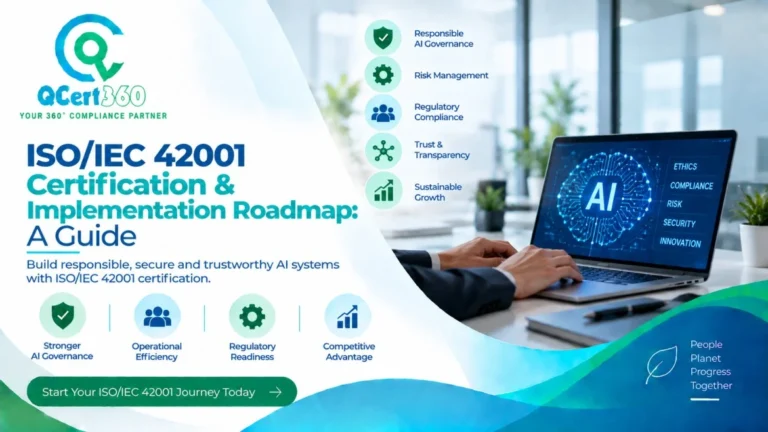
ISO/IEC 42001 Certification & Implementation Roadmap: From AI Governance to Responsible AI
AI now screens applications, prices risk, supports diagnoses and answers customers. It moves faster than most controls can follow. Models drift, data changes, vendors update their tools overnight, and teams adopt new AI tools without telling anyone.
Boards, customers and partners have started asking a simple question: how do you govern your AI? ISO/IEC 42001 certification gives you a documented, independently audited answer. If you want to get ISO/IEC 42001 certified, this page explains the standard, lays out a practical ISO/IEC 42001 implementation roadmap, and covers what auditors expect, what certification costs and which market trends make it timely.
What Does ISO/IEC 42001 Certification Involve?
ISO/IEC 42001 is the first international management system standard for AI. It sets requirements for an AI management system that governs policy, risk, impact assessment, data, lifecycle, oversight and improvement. It applies to organizations that develop, provide or use AI. An independent body audits you in two stages, then certifies you for three years with yearly surveillance.
What Is ISO/IEC 42001?
It is an international standard, published in 2023, that tells organizations how to establish, run and improve an AI management system (AIMS). The ISO 42001 standard treats AI as an enterprise capability that needs leadership, accountability, controls and continual improvement, not just good engineering.
An AIMS is the set of policies, roles, processes and records that governs how you build, buy and use AI. It follows the familiar plan-do-check-act cycle and the same high-level structure as ISO 9001 and ISO/IEC 27001. That makes it easy to combine with systems you already run.
AI needs its own standard because it behaves differently from ordinary software. It learns from data, can change after release, and often cannot explain its own outputs. Those traits create risks that classic quality and security systems do not fully cover.
ISO/IEC 42001 certification for AI developers, providers and users applies to three roles:
Role | What you do | AIMS focus |
Developer | Build or train models and AI systems | Design controls, testing, data quality, documentation |
Provider | Offer AI-based products or services | Transparency, customer information, incident handling |
User | Deploy AI in your own operations | Intended use, oversight, vendor control, impact on people |
Many organizations play more than one role, and the scope should reflect that.
Why Organizations Need ISO/IEC 42001 Certification
AI risk does not sit in one team. Bias, security gaps, opaque decisions, poor data and weak oversight can all appear at once. AI governance brings those threads into one system, and certification proves the system works.
Consider the cost of weak control. A biased model harms people and invites complaints. An unexplained decision damages customer trust. A vendor model update breaks a process without warning. An AI incident with no owner drags on for weeks. An AIMS makes ownership, testing and response routine.
Is ISO/IEC 42001 certification mandatory? No. It is voluntary. Buyers, partners and procurement teams increasingly ask for it, and it sits alongside legal duties without replacing them.
Common pressures the standard addresses:
- Unclear ownership of AI decisions
- Untested bias and fairness risks
- Weak data quality and lineage
- Uncontrolled vendor and open-source models
- Missing incident and rollback procedures
- Customer questions about responsible AI
Who Needs ISO/IEC 42001 Certification?
Any organization of any size that develops, provides or uses AI can benefit. It matters most where AI affects people, money, safety or rights.
Organization type | Why it fits |
AI and SaaS product companies | Buyers ask for proof of governance during procurement |
Banks, insurers and fintechs | Credit, fraud and pricing models carry fairness risk |
Healthcare and life sciences | Clinical support tools need oversight and traceability |
HR and recruitment platforms | Screening tools affect hiring decisions |
Public sector and education | AI touches citizens and learners |
Consultancies and IT service firms | Clients expect governed AI in delivered solutions |
Inside the Standard: Clauses and Annex A Controls
The standard has two working parts. Clauses 4 to 10 define the management system. Annex A supplies the AI-specific controls you select and apply.
Clause theme | What it asks | Typical output |
Context | Understand your AI role, stakeholders and scope | Scope statement, interested parties list |
Leadership | Commit, set policy, assign roles | AI policy, role charters |
Planning | Assess risks, opportunities and impacts | Risk register, impact assessments |
Support | Provide resources, competence and documentation | Training records, document control |
Operation | Control the AI lifecycle | Lifecycle procedures, testing records |
Performance evaluation | Monitor, audit and review | KPIs, internal audits, management review |
Improvement | Correct and improve | Corrective actions, lessons learned |
What are the Annex A controls in ISO/IEC 42001? The Annex A controls are 38 controls grouped under nine control objectives. You review each one and decide whether it applies, then record your reasoning in a statement of applicability.
Control objective | What it covers |
AI policies | Policy alignment with organizational values |
Internal organization | Roles, responsibilities, ways to raise concerns |
Resources | Data, tools, computing and people for AI |
Impact assessment | Effects on individuals, groups and society |
AI system life cycle | Design, testing, deployment, monitoring, retirement |
Data for AI systems | Quality, provenance and preparation of data |
Information for interested parties | Transparency, user information, incident communication |
Use of AI systems | Responsible use and intended-use limits |
Third-party and customer relationships | Supplier, partner and customer responsibilities |
Is ISO/IEC 42001 the Same as ISO/IEC 27001?
No. ISO/IEC 27001 protects information through a security management system. ISO/IEC 42001 governs how AI systems are developed, provided and used responsibly. They overlap on security and data, and they share a management system structure.
ISO/IEC 27001 and ISO/IEC 42001 work best together. The first secures your data, access and infrastructure. The second adds impact assessment, fairness, transparency, oversight and lifecycle control on top. Organizations that already hold ISO/IEC 27001 often move faster, because risk assessment, internal audit, document control and management review already exist.
Integrating ISO/IEC 42001 with existing management systems also pays off. Add ISO 22301 for continuity of AI-dependent services, ISO/IEC 27701 for privacy, and ISO 9001 for quality. One policy set, one audit program and one management review can then cover everything.
Does ISO/IEC 42001 Certification Prove Legal Compliance?
No. Certification shows that your management system conforms to the standard. It does not certify a model, approve a product or guarantee compliance with any law. AI rules differ across regions and change quickly, so keep legal review as a separate duty. An AIMS makes that duty easier to meet, because your records, risk assessments and oversight evidence are ready.
Requirements of ISO/IEC 42001 Certification
The requirements of ISO/IEC 42001 certification center on documented processes, proof of use and continual improvement. You must show that your AIMS exists, that people follow it and that it improves.
Core requirements include:
- Defined scope. State which AI systems, roles, sites and business units are covered, so auditors know exactly what to test.
- Leadership and policy. Approve an AI policy and assign accountable roles, with senior management visibly owning the system.
- AI risk management. Assess risks and opportunities across the AI lifecycle, and define treatments with owners and dates.
- AI impact assessment. Evaluate effects on individuals, groups and society, not just business or technical risk.
- Control selection. Choose Annex A controls, justify exclusions and link each control to a risk it treats.
- Lifecycle procedures. Cover design, data, testing, deployment, monitoring and retirement for every in-scope system.
- Competence. Train staff and prove they can do their AI-related tasks, with records tied to each role.
- Monitoring and measurement. Track performance, incidents and drift against defined targets.
- Internal audits and management review. Check the system, close gaps and record leadership decisions.
- Corrective action. Fix root causes, not just symptoms, and verify that fixes hold.
ISO/IEC 42001 Implementation Roadmap: How to Implement ISO/IEC 42001 Step by Step
How to implement ISO/IEC 42001 step by step starts with a clear path. This roadmap moves from leadership support to certification and beyond. Each step builds evidence auditors will later ask for.
- Secure leadership support and assign roles. Get senior management to own the AIMS, name an accountable lead, and form an AI governance group with technical, legal, risk, security and business members. Budget, time and authority decide whether the project moves.
- Build an AI inventory and define AIMS scope. Start by building an AI inventory and defining AIMS scope. List every AI system you build, buy or embed, record owners, vendors, data sources and decisions supported, then decide which systems and units the certificate will cover.
- Run a gap analysis. Compare current practice with every clause and Annex A control, using real documents and interviews. Rate each gap by risk and effort, and note where existing ISO/IEC 27001 or ISO 9001 processes already cover requirements.
- Set the AI policy and objectives. Write a short, clear policy on responsible AI use, then set measurable objectives, such as bias testing coverage, incident response time and model review frequency. Approve both at senior level and communicate them to staff.
- Run AI risk and impact assessments. Focus on running AI risk and impact assessments across the AI lifecycle. Assess data, models, outputs, users and affected people, rate likelihood and severity, and define treatments. Repeat assessments after major changes or new use cases.
- Select controls and write the statement of applicability. Review each Annex A control, decide whether it applies and record why. Link each selected control to the risk it treats and the procedure or record that proves it works.
- Build lifecycle, data and oversight controls. Write procedures for design, data governance, testing, release, monitoring and retirement. Define human oversight points, escalation paths, rollback rules and vendor requirements, and keep the documents short enough for teams to actually use.
- Train and build awareness. Give leaders, developers, data teams, procurement and front-line users training that fits their role. Keep attendance and competence records, and make sure staff can explain how the policy affects their daily work.
- Operate and monitor. Run the AIMS on live systems long enough to build records. Focus on monitoring AI performance, incidents and model drift, log issues and near misses, and review trends so evidence shows the system works over time.
- Complete internal audit and management review. Preparing for an ISO/IEC 42001 audit begins here. Use trained, independent internal auditors to test every clause and control, then present results to management. Fix findings, verify the fixes and record decisions.
- Choose a certification body and pass both audits. Select a third-party certification body for ISO/IEC 42001 that understands AI and can audit your scope. Pass Stage 1, where the auditor reviews documents and readiness, then Stage 2, where they verify implementation on site or remotely.
- Certify, then keep improving. The certificate stays valid for three years, with annual surveillance audits. Keep updating the AI inventory, reassessing risks and reviewing controls as new models, vendors and use cases arrive.
AI Risk and Impact Assessment: The Heart of the AIMS
AI risk management looks at what can go wrong with a system. AI impact assessment looks at who can be affected and how. Both are needed, and both must be repeated as systems change.
A solid assessment covers:
- Purpose, intended users and foreseeable misuse
- Data sources, quality and representativeness
- Model accuracy, robustness and security
- Effects on individuals, groups and society
- Safeguards, oversight and fallback options
Bias and fairness testing should match the use case. Define which groups and outcomes matter, test before release and after changes, and record results and fixes. AI transparency and explainability means users and affected people can understand what the system does, what its limits are and how to challenge outcomes.
Controls That Matter Most in Practice
Several controls draw the most audit attention:
- Data governance for AI: document data sources, quality checks, labeling, privacy controls, retention and access for training, testing and monitoring data. Poor data undermines every other control, so auditors look here early.
- AI lifecycle controls: require design review, testing criteria, release approval, change control, monitoring and retirement steps for every system. Each stage should leave a record.
- Human oversight: define where people review, override or approve AI output, and give them the authority, time and information to do it. Oversight that exists only on paper fails audits.
- Third-party AI vendor management: assess vendors before adoption, then set contract terms for data use, model updates, explainability reports, incident notice and security posture. Review vendors on a schedule, not just at signing.
- Generative AI governance: set rules for approved tools, prompt and output handling, confidential data, human review and staff use of unapproved tools. Clear rules reduce shadow AI.
What Documents Do You Need for ISO/IEC 42001 Certification?
You need policies, procedures and records that prove the AIMS works. Keep only what helps you control the process and show evidence.
- AI policy and objectives
- Scope statement and AI inventory
- Risk and impact assessment records
- Statement of applicability
- Lifecycle, data and change procedures
- Testing, bias and performance results
- Vendor assessments and contracts
- Incident and corrective action logs
- Training and competence records
- Internal audit reports and management review minutes
What Does an ISO/IEC 42001 Auditor Check?
An auditor checks whether your documented AIMS matches real practice. They review records, sample AI systems, interview owners and test whether controls work.
What does an ISO/IEC 42001 auditor check? Expect focus on:
- Scope, inventory and role assignments
- AI policy approval and staff awareness
- Risk and impact assessments for sampled systems
- Statement of applicability and control evidence
- Testing, monitoring and drift records
- Human oversight points in live processes
- Vendor assessments and contract terms
- Incident handling and corrective actions
- Internal audit and management review results
Preparing for an ISO/IEC 42001 audit is easiest when evidence is stored in one place, owners can explain their systems without notes and every sampled system has a complete assessment trail.
Benefits of ISO/IEC 42001 Certification for AI-Driven Organizations
An ISO auditor checks whether your documented system matches real operations. They walk the site, observe work, review records and interview staff. They rely on objective evidence, not promises.
What does an ISO auditor check in a recycling facility? Expect focus on:
- Incoming material inspection and rejection records
- Scale calibration and weighing accuracy
- Storage layout, segregation and fire controls
- Machine guarding, isolation and safe work methods
- Waste, spill and emissions controls
- Training records and competence evidence
- Supplier and downstream buyer evaluation
- Incident, complaint and corrective action files
- Internal audit and management review results
The best preparation is simple: follow your own procedures every day.
Benefits of ISO Certification for the Recycling Industry
The benefits of ISO/IEC 42001 certification for AI-driven organizations show up in trust, control and speed of approval.
- Stronger customer trust. Independent audit backs your responsible AI claims.
- Faster procurement. Buyers see governance evidence up front, which shortens security and risk reviews.
- Clear accountability. Every system has an owner and a review cycle.
- Lower incident risk. Testing and oversight catch problems earlier.
- Better vendor control. Contracts and reviews cover model updates and data use.
- Audit readiness. Records answer questions from partners and reviewers.
- Safer innovation. Guardrails let teams launch with confidence.
- Continual improvement. Data drives better decisions.
AI Governance Market Trends
Adoption is racing ahead of governance, and buyers are starting to ask for proof.
Estimates for the 2026 AI governance market vary by research firm and scope, from roughly USD 0.75 billion to USD 3.3 billion, with forecast annual growth between about 20 and 24.8 percent. Other forecasts run higher, so treat all figures as directional.
Several shifts shape what buyers expect:
- Adoption outpaces oversight. About 65 percent of organizations use generative AI and 42 percent of large enterprises actively deploy AI systems. Yet Economist Impact research finds only about 8 percent maintain a comprehensive AI governance framework.
- Weak controls raise breach risk. IBM’s breach research found 63 percent of organizations lacked AI governance policies, and among those reporting an AI-related security incident, 97 percent lacked proper AI access controls.
- Shadow AI. Gartner predicts that 40 percent of enterprises will face shadow AI security breaches by 2030, which raises the value of an AI inventory and clear usage rules.
- Vendor management moves into scope. Buyers now ask for service terms covering data access, model update cadence, explainability reports and security posture, and teams publish dashboards for bias testing frequency, incident response time and model rollback rate.
- Integrated systems. Organizations pair ISO/IEC 42001 with ISO/IEC 27001 and ISO 22301 to run security, AI governance and continuity together.
- Tooling and skills. Governance platforms turn frameworks like ISO/IEC 42001 into inventories, assessments and records. Meanwhile job postings for AI ethics and responsible AI roles grew 68 percent year over year in 2024, while qualified applicants per posting fell 22 percent.
- Certification as differentiator. ISO/IEC 42001 certification is creating a market for advisory and audit services that reaches beyond regulated sectors into technology and professional services firms seeking a competitive edge.
The pattern is clear. Buyers want governed, explainable and monitored AI, and they want proof. ISO/IEC 42001 gives you documented evidence rather than claims.
ISO/IEC 42001 Certification Services: What You Get
Our ISO/IEC 42001 certification services cover the full journey from first gap check to certificate and surveillance. You get a clear scope, a defined audit plan and reports that explain findings in plain language.
Typical service components include:
- ISO/IEC 42001 gap assessment services. We review your AI inventory, policies, risk records and controls against the standard, then give you a ranked list of gaps.
- ISO/IEC 42001 implementation support. We help you build practical policies, assessments, lifecycle procedures and evidence records that fit how your teams already work.
- Independent Stage 1 and Stage 2 audits. Our auditors check conformity against evidence and issue a clear certification decision.
- Surveillance and recertification audits. We keep your certificate current across the three-year cycle.
We keep audit teams independent from implementation support to protect impartiality.
How to Choose an ISO/IEC 42001 Certification Body
Choose an ISO/IEC 42001 certification body on evidence, not price alone. A weak audit gives you a certificate buyers may question. A strong one gives you insight and credibility.
Ask each candidate:
- Do your auditors understand AI, data and model lifecycle risk?
- Can you audit ISO/IEC 27001 and ISO/IEC 42001 together?
- How will you sample AI systems within my scope?
- What is your audit plan, timeline and reporting format?
- How do you keep audit and implementation support impartial?
- What does surveillance involve, and what will it cost?
Compare answers, then pick the body that gives clear, specific replies.
How to Apply ISO 42001 certification and Request a Quote? ?
To apply for ISO/IEC 42001 certification, share a short profile of your organization and AI use. A clear profile lets us scope the audit and price it accurately.
To request an ISO/IEC 42001 certification quote, prepare:
- Your organization size and number of sites
- The AI systems and roles (developer, provider or user) in scope
- Any existing certifications, such as ISO/IEC 27001 or ISO 9001
- Your target certification date and any customer deadline
We reply with a scoped plan, audit stages and a fixed quote for your profile.
How Long Does ISO/IEC 42001 Certification Take?
Most organizations need about three to nine months. Scope size, number of AI systems, existing management systems and available governance staff all affect timing. An organization with ISO/IEC 27001 in place usually moves faster.
A typical project moves through these phases:
- Inventory and gap analysis: roughly two to four weeks
- System build and training: one to three months
- Operation and evidence building: one to three months
- Internal audit and management review: two to four weeks
- Stage 1 and Stage 2 audits: scheduled a few weeks apart
How Much Does ISO/IEC 42001 Certification Cost?
How much does ISO/IEC 42001 certification cost? The ISO certification cost depends on organization size, number of AI systems in scope, sites, complexity and any integrated standards. No fixed price fits everyone, so a quote based on your profile is the only reliable answer.
Typical cost elements:
- Stage 1 and Stage 2 audits
- Annual surveillance audits
- Recertification audit every three years
- Optional consulting and gap analysis
- Internal training and staff time
Integrated audits with ISO/IEC 27001 often lower the total. The wider ISO certification process follows the same audit stages across standards.
ISO 42001 Certificate Validity and Small Organizations
An ISO/IEC 42001 certificate stays valid for three years. Surveillance audits confirm the AIMS still works, and a recertification audit renews the certificate at the end of the cycle.
Can small companies and startups get ISO/IEC 42001 certified? Yes. The standard scales to size. A small team can keep documents lean, start with a narrow scope such as its core product, and grow the AIMS as it adds systems. Auditors judge whether the system works, not how many pages it has.
ISO/IEC 42001 certification for SaaS and AI startups often pays back fastest. Enterprise buyers send long security and AI questionnaires, and a certificate answers many of them at once. It also shows early governance maturity to investors and partners.
Common Gaps We See in AI Governance
- No complete inventory of AI systems and vendors
- Risk assessments that ignore affected people
- Bias testing done once and never repeated
- Policies written but not known by staff
- Vendor models adopted with no contract terms
- No rollback or incident plan for AI failures
- Monitoring that tracks uptime but not drift
- Human oversight defined on paper but not in workflow
How QCert360 Supports Your ISO/IEC 42001 Journey
QCert360 helps AI developers, providers and users achieve ISO/IEC 42001 certification with clear guidance and audit services aligned to international standards. We support clients across 195 countries.
Our support includes:
- Scope and inventory guidance. We help you define what the AIMS covers.
- Gap assessment. We compare your practices with each clause and control.
- Implementation guidance. We help you build practical, usable procedures.
- Independent audit and certification. We assess conformity objectively.
- Ongoing support. We stay with you through surveillance and recertification.
Frequently Asked Questions
What is ISO/IEC 42001?
It is the first international standard for an AI management system, covering governance, risk, impact assessment, lifecycle control and improvement.
Is ISO/IEC 42001 certification mandatory?
No. It is voluntary, though buyers and partners increasingly ask for it.
Who needs ISO/IEC 42001 certification?
Any organization that develops, provides or uses AI, especially where AI affects people, money, safety or rights.
Is ISO/IEC 42001 the same as ISO/IEC 27001?
No. ISO/IEC 27001 secures information, while ISO/IEC 42001 governs responsible AI development and use.
Does ISO/IEC 42001 certification prove legal compliance?
No. It certifies your management system, and legal review remains separate.
What are the Annex A controls in ISO/IEC 42001?
Thirty-eight controls under nine objectives, chosen and justified in a statement of applicability.
How long does ISO/IEC 42001 certification take?
Typically three to nine months, depending on scope and readiness.
How much does ISO/IEC 42001 certification cost?
Cost varies with size, scope and standards. Request a tailored quote.
Can small companies and startups get ISO/IEC 42001 certified?
Yes. Requirements scale to size.
What does an ISO/IEC 42001 auditor check?
Scope, inventory, policy, risk and impact assessments, controls, monitoring, oversight, vendor records and corrective actions.
Ready to Get ISO/IEC 42001 Certified with QCert360?
AI earns trust when you can prove it is governed. ISO/IEC 42001 certification gives you that proof across policy, risk, data, lifecycle and oversight. It helps you win approvals, reduce incidents and build confidence with every stakeholder.
Talk to QCert360 today for a free consultation, and request an ISO/IEC 42001 certification quote tailored to your AI operations.
Our Services
ISO Standards
- ISO 9001 Certification
- ISO 14001 Certification
- ISO 45001 Certification
- ISO 22000 Certification
- ISO 17025 Certification
- ISO 27001 Certification
- ISO 13485 Certification
- ISO 20000-1 Certification
- ISO 41001 Certification
- ISO 22716 Certification
- ISO 50001 Certification
- ISO 22301 Certification
- ISO 29993 Certification
Product Certifications
Other international standards
- FSSC 22000 Certification
- HIPAA
- HACCP Certification
- SA 8000 Certification
- GMP Certification
- GDPR
- GDP Certification
- GLP Certification
- Certificate of Conformity
QCert360 provides a wide range of services including ISO certification, audit support, compliance consulting, and training. They specialize in helping businesses achieve global standards and certifications like ISO 9001, ISO 27001, ISO 14001, and many others. Their team ensures a seamless experience from consultation to certification, supporting clients at every stage.
The time it takes to achieve certification can vary depending on the complexity of the standard and the readiness of your organization. On average, it takes about 3 to 6 months. QCert360 works closely with clients to streamline the process, ensuring that all requirements are met efficiently and within a reasonable timeline.
QCert360 is a trusted partner with years of experience in helping businesses obtain international certifications. Their expert consultants provide tailored solutions, ensuring your organization not only meets but exceeds industry standards. With a customer-centric approach, they focus on offering end-to-end support to simplify the certification journey.
QCert360 serves a wide range of industries including manufacturing, healthcare, information technology, education, and services, among others. They customize their certification solutions to meet the unique requirements of each industry, ensuring relevance and compliance with global standards.
Yes, QCert360 provides ongoing support even after certification. They offer services like surveillance audits, recertification guidance, and consultancy to help maintain and improve your certification status. Their team ensures that your organization stays compliant and up-to-date with any changes in certification standards.
Getting started with QCert360 is simple. You can contact them via their website to request a consultation. Their team will assess your needs, discuss the best certification options for your business, and outline the steps involved. From there, they’ll guide you through the entire process, ensuring you’re prepared for certification.
QCert360 stands out due to its customer-focused approach, industry expertise, and comprehensive service offerings. Their team doesn’t just help you obtain certification but works to ensure your organization thrives in compliance with international standards. They also offer personalized consultation, making the process smoother and more efficient, ensuring long-term success for your business.
The cost of certification varies depending on factors such as the type of certification, the size and complexity of your organization, and the specific industry requirements. QCert360 offers competitive pricing and provides tailored quotes based on your unique needs. They ensure transparency and work with you to find the most cost-effective solution for your certification goals.
Yes, QCert360 offers internal audit services to help assess and improve your organization’s processes. Their expert auditors conduct thorough reviews of your systems and operations to ensure they meet required standards. They also provide actionable recommendations to help enhance efficiency and compliance, making sure you’re fully prepared for external audits.
If your organization doesn’t pass an audit or certification assessment, QCert360 works with you to understand the reasons for non-compliance and provides support to rectify the issues. They offer guidance on corrective actions and help you prepare for a re-assessment. Their goal is to ensure your organization meets the necessary standards for certification, and they will be by your side to make the process as smooth as possible.