
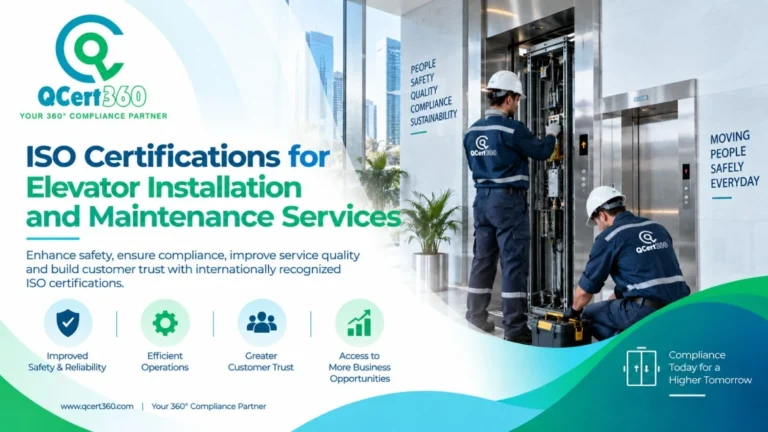
ISO Certifications for Elevator Installation and Maintenance Services
Elevators run all day, every day, in homes, hospitals, offices and airports. Passengers rarely think about the people behind them until a lift stops. For elevator companies, that invisible responsibility is the whole job. One skipped check or one poorly documented repair can mean an injury, a shutdown or a lost contract.
ISO certification for elevator companies gives you a proven way to control that risk. It turns good technical habits into a documented, audited system that clients, insurers and project owners can trust.
This page explains which standards apply, what auditors expect, what certification costs and how QCert360 helps you get certified.
Which ISO Standards Fit Elevator Companies?
ISO 9001, ISO 45001 and ISO 14001 form the core set for elevator installation and maintenance firms. ISO/IEC 27001 protects your data and connected systems. ISO 22301 keeps service running during disruption. An independent certification body audits each one and issues a certificate valid for three years, with yearly surveillance audits.
What Is ISO Certification for Elevator Installation and Maintenance Services?
ISO certification for elevator installation and maintenance services is independent proof that your company runs its work under an internationally recognized management system. An auditor checks that your processes, safety controls and records meet the standard, and that your team follows them on real jobs.
One point needs clarity. An ISO management system certificate does not approve a specific lift design, and it does not replace product testing or statutory inspections. It confirms how you manage the work: planning, installation, commissioning, preventive maintenance, breakdown response, escalator maintenance and elevator modernization.
You define the scope. It can cover:
- Passenger, freight, hospital and residential lifts
- Escalators and moving walkways
- New installation and commissioning
- Routine servicing and emergency callouts
- Repairs, upgrades and full modernization projects
Why Elevator and Lift Companies Need ISO Certification
Elevator work is safety-critical, and small errors carry large consequences. ISO certification brings discipline, evidence and accountability to every job. It also gives buyers a clear signal that your firm manages quality, safety and risk on purpose, not by luck.
Vertical transportation now sits at the center of modern buildings. Owners expect high uptime. Insurers ask hard questions after incidents. Developers want contractors who can prove control before they award work. Your best technicians cannot answer those demands alone. A management system can.
Is ISO certification mandatory for elevator installation companies? In most cases, no. ISO certification is voluntary. Yet many tenders, main contractors and facility owners now ask for it as a condition of doing business. Certification also sits alongside the legal and code requirements that apply to your work. It never replaces them.
Here is what the market typically expects from lift service providers:
- Documented installation and maintenance procedures
- Proof of technician competence and training
- Controlled records for every inspection and repair
- A structured way to handle complaints and defects
- Evidence that safety risks are identified and controlled
ISO standards answer each of those expectations directly.
Which ISO Certifications Do Elevator Companies Need?
Most elevator companies start with ISO 9001 and ISO 45001, then add ISO 14001, ISO/IEC 27001 or ISO 22301 as their operations grow. Your choice depends on your clients, your risks and your contracts. The table below summarizes ISO standards for elevator and escalator service providers.
Standard | Focus | What it controls in elevator work | Certifiable? |
ISO 9001 | Installation, testing, maintenance and customer service consistency | Yes | |
ISO 45001 | Occupational health and safety | Technician safety, site hazards, contractor control | Yes |
ISO 14001 | Environmental management system | Waste oil, scrap parts, packaging, energy use | Yes |
ISO/IEC 27001 | Drawings, service records, remote monitoring data | Yes | |
ISO 22301 | Business continuity | Emergency response and service recovery | Yes |
ISO 31000 | Risk management guidance | Structured risk thinking across all operations | No, guidance only |
Facility and energy management | Building services and energy performance | Yes |
The sections below explain each standard in practical terms.
ISO 9001 for Elevator Services: Quality You Can Prove
ISO 9001 sets the requirements for a quality management system. In elevator work, it standardizes how you survey sites, review designs, install equipment, test, hand over and support customers afterward. Every project follows the same controlled path, whoever leads the crew.
ISO 9001 for elevator services tackles the problems that hurt margins most: rework, repeat callouts, missing records and unclear responsibilities. It replaces informal habits with repeatable methods.
The requirements for ISO 9001 certification in elevator installation include:
- Defined processes for quotation, planning, installation and commissioning
- Quality objectives tied to uptime, callbacks and customer satisfaction
- Controlled checklists, test reports and handover records
- Supplier and subcontractor evaluation, including spare parts sources
- Tracking of complaints, defects and nonconformities
- Corrective action that fixes root causes
- Internal audits and management review
A strong system also links maintenance data to decisions. If the same door operator fails across five sites, your records should show it, and your process should trigger action.
ISO 45001 Elevator Safety: Protecting Your Technicians
ISO 45001 sets the requirements for an occupational health and safety management system. It gives elevator companies a structured method to find hazards, assess risks, apply controls and learn from incidents. Few trades expose people to more varied hazards than installing and servicing lifts.
Why is ISO 45001 important for elevator technicians? Their daily tasks include shaft entry, car-top work, pit access, machine room electrical work and heavy lifting. Each task carries risks such as falls, crushing, electric shock and moving equipment. A safety management system for elevator technicians makes those risks visible and controlled before work starts.
Working at heights and shaft safety deserve special attention under ISO 45001. Your system should cover:
- Task-specific risk assessments for installation and maintenance jobs
- Permit and isolation methods, including lockout and tagout
- Fall protection, PPE and rescue planning
- Safe systems for two-person and lone working
- Contractor and subcontractor safety control
- Incident reporting, investigation and follow-up
- Training records and competence checks
Leadership involvement matters here. ISO 45001 expects managers to take responsibility for safety and to involve workers in decisions. That shift alone often reduces near misses.
ISO 45001 elevator safety also supports your legal compliance. The standard requires you to identify the safety obligations that apply to your work and to check that you meet them.
What Is the Difference Between ISO 9001 and ISO 45001 for Lift Companies?
ISO 9001 protects the quality of your service and the satisfaction of your customers. ISO 45001 protects the people who deliver that service. Both use the same management system structure, so they fit together naturally, but they answer different questions.
Here is the difference in practice:
- ISO 9001 asks: “Did we install and maintain this lift correctly and consistently?”
- ISO 45001 asks: “Did our people stay safe while doing it?”
A company that holds only one standard leaves a gap. Quality without safety puts technicians at risk. Safety without quality lets defects reach customers. Most buyers prefer to see both.
ISO 14001 for Lift Companies: Cutting Environmental Impact
ISO 14001 sets the requirements for an environmental management system. It helps elevator firms control waste, emissions and resource use across installation, servicing and elevator modernization work. Clients with sustainability targets increasingly ask for it.
ISO 14001 for lift companies covers aspects that often go unmanaged:
- Used hydraulic oil, gear oil and lubricants
- Scrap metal, cables, motors and replaced components
- Batteries, lighting and electronic waste
- Packaging from equipment deliveries
- Vehicle use for service routes
- Noise and dust at building sites
Modernization projects offer the biggest gains. Replacing old drives and motors with efficient units reduces energy use, and ISO 14001 helps you plan disposal, recycling and reuse responsibly. The standard also requires you to identify and meet the environmental obligations that apply to your operations.
ISO 27001 for Elevator Companies: Securing Data and Connected Systems
ISO/IEC 27001 sets the requirements for an information security management system. Elevator companies hold valuable information: technical drawings, control software access, maintenance histories, client contracts and building access details. ISO 27001 for elevator companies protects all of it.
Connected lifts raise the stakes. Modern controllers send performance data to cloud portals and support remote diagnostics. Remote elevator monitoring information security therefore becomes a safety and reputation issue, not just an IT matter. A breach could expose building layouts or let an unauthorized person interfere with equipment.
An ISO/IEC 27001 system helps you:
- Classify information assets and assess cyber and access risks
- Control who can reach drawings, firmware and service tools
- Secure mobile devices used by field technicians
- Manage third-party and vendor access
- Prepare for and respond to security incidents
ISO 22301 Business Continuity and ISO 31000 Risk Management
ISO 22301 helps you keep critical services running when something goes wrong. When a lift traps passengers or a hospital elevator fails, response time matters. ISO 22301 business continuity planning ensures you can still dispatch technicians during staff shortages, supply delays, system outages or severe weather.
The standard asks you to run a business impact analysis, identify critical services, define recovery plans and test them. Backup staffing, spare parts stock and clear escalation paths all fall under this work.
ISO 31000 works differently. It offers guidelines for risk management, but it is not a certifiable standard. Use it to shape how your company thinks about risk across safety, contracts and operations. Then apply ISO 9001, ISO 45001 and the other certifiable standards to put that thinking into action.
Other Standards Worth Knowing
Some firms add ISO 41001 for facility management when they offer broader building services. ISO 50001 supports energy management for companies that focus on efficient equipment and upgrades.
Sector-specific product standards, such as the ISO 8100 series for lift safety and construction, cover equipment design and installation requirements. They complement management system certification. They do not replace it.
Build an Integrated Management System
An integrated management system combines several ISO standards into one framework. Since ISO 9001, ISO 45001, ISO 14001 and ISO/IEC 27001 share a common structure, you can run one set of policies, one internal audit program and one management review across all of them.
The benefits are practical:
- Less duplicated paperwork
- One audit visit covering multiple standards
- Clearer roles for managers and supervisors
- Lower certification and maintenance effort
- Better visibility of risks across the whole business
Most elevator companies get the best result by starting with one or two standards, then expanding into an integrated system.
What Does an ISO Auditor Check in an Elevator Company?
An ISO auditor checks whether your documented system matches what actually happens on sites and in your office. They sample projects, interview technicians, review records and test whether your controls work. The audit relies on objective evidence, not promises.
What does an ISO auditor check in an elevator company? Expect questions and evidence requests around these areas:
- Scope and context: what services you offer and who your interested parties are
- Leadership: policies, objectives and management commitment
- Risk and opportunity planning: hazards, environmental aspects and service risks
- Operational control: installation records, maintenance schedules, test results and handover files
- Competence: technician training, qualifications and supervision
- Supplier control: spare parts sources and subcontractor performance
- Incident and complaint handling: investigation records and corrective actions
- Monitoring: performance data, internal audit results and management review minutes
Auditors may visit an active site to watch a maintenance visit. Prepare your crews for that. The best preparation is simple: follow your own procedures every day.
Benefits of ISO Certification for Lift Maintenance Companies
The benefits of ISO certification for lift maintenance companies show up in safety records, customer relationships and profit. Certification improves consistency, reduces incidents, strengthens credibility and opens doors to larger contracts. Those gains grow every year the system stays active.
Key benefits include:
- Fewer defects and callbacks. Controlled processes catch errors before handover.
- Safer sites. Structured risk control lowers the chance of technician injuries.
- Faster breakdown response. Clear escalation and dispatch routines cut downtime.
- Better records. Complete service histories support warranty claims, audits and disputes.
- Stronger tender position. ISO certification for elevator contractors bidding on tenders often earns extra scoring or basic eligibility.
- Insurer and client confidence. Documented control reduces perceived risk.
- Clearer accountability. Every role knows its duties and evidence requirements.
- Continual improvement. Data drives decisions instead of guesswork.
Certification also builds pride inside your team. Technicians who work under clear standards tend to take more ownership of their results.
How to Get ISO Certification for an Elevator Company
To get ISO certified, define your scope, assess your gaps, build your system, run it, audit it internally and then pass an external audit. The ISO certification process follows the same pattern for every standard. How to get ISO certification for an elevator company comes down to these steps:
- Choose your standards. Match them to client demands and business risks.
- Define the scope. List your services, locations and product types.
- Run a gap analysis. Compare current practices against the standard.
- Build the system. Write only the procedures and records you need, and make them fit real work.
- Train your people. Technicians, supervisors and managers must understand their roles.
- Operate the system. Collect records for several weeks or months.
- Complete an internal audit and management review. Fix what you find.
- Select a third-party certification body for elevator service companies. Pick one that audits independently and issues recognized certificates.
- Pass the Stage 1 audit. The auditor reviews your documentation and readiness.
- Pass the Stage 2 audit. The auditor verifies implementation on site and in records.
- Receive your certificate. Then maintain it through annual surveillance audits.
How Long Does ISO Certification Take for an Elevator Company?
Most elevator companies complete certification in about two to six months, depending on size, existing documentation and how many standards they pursue. A small contractor with clear processes can move quickly. A multi-site operator with several standards needs more time to build and test the system.
Three factors drive the timeline:
- Starting maturity. Firms with checklists and safety records ready move faster.
- Company size and sites. More locations and crews mean more sampling and training.
- Management engagement. Decisions made quickly keep the project on track.
How Much Does ISO Certification Cost for Elevator Maintenance Companies?
ISO certification cost for Lift & Elevator Maintenance Companies varies with company size, number of employees, number of sites, scope complexity and chosen standards. There is no single fixed price. How much does ISO certification cost for elevator maintenance companies? The honest answer is that it depends on your profile, and a quote based on your details gives the only reliable figure.
Costs usually include:
- Certification audits (Stage 1 and Stage 2)
- Annual surveillance audits
- Recertification audit every three years
- Optional consulting and gap analysis support
- Internal training and time invested by your team
Combining standards in an integrated audit often lowers the total cost compared with certifying each one separately.
How Long Is an ISO Certificate Valid?
How long is an ISO certificate valid? An ISO certificate stays valid for three years. During that period, your certification body performs surveillance audits, usually once a year, to confirm your system still works. At the end of the cycle, a recertification audit renews the certificate for another three years.
If a surveillance audit finds serious problems that you do not fix, the certificate can be suspended or withdrawn. That is why day-to-day discipline matters more than audit-week preparation.
Does ISO Certification Replace Lift Safety Codes?
Does ISO certification replace lift safety codes? No. ISO management system standards sit on top of the safety codes and legal requirements that apply to your work. They help you follow those rules consistently, prove compliance and correct failures quickly. They never replace mandatory inspections, product approvals or statutory duties.
Think of it this way: codes define what must be achieved. ISO systems define how your company organizes itself to achieve it every time.
Can Small Elevator Contractors Get ISO Certified?
Yes. ISO standards scale to company size. A small firm can use lean documentation, short procedures and simple records while still meeting every requirement. Auditors judge whether your system works for your business, not how many pages it contains.
Small contractors often benefit the most. Certification helps them compete against larger brands on tenders and earn trust from new clients.
Common Gaps We See in Elevator Companies
Certain weaknesses appear again and again during gap assessments. Fixing them early saves time in the audit.
- Maintenance records that are incomplete or stored in scattered places
- Risk assessments that are generic instead of task-specific
- Weak control of subcontractors working on shafts and pits
- No clear method for tracking repeat faults across sites
- Training files that do not prove competence
- Waste disposal that follows habit rather than a defined process
- No tested plan for emergency callouts during disruption
- Unclear access rules for remote monitoring tools
A short gap analysis will expose which ones affect your company.
How QCert360 Supports Elevator and Lift Companies get ISO certified
QCert360 helps elevator installation and maintenance companies achieve ISO certification with clear guidance, practical support and audit services aligned to international standards. We serve lift service providers, installers, modernization specialists and escalator maintenance firms across 195 countries.
Our support includes:
- Standard selection advice. We help you choose the right mix of ISO 9001, ISO 45001, ISO 14001, ISO/IEC 27001 and ISO 22301.
- Gap assessment. We compare your current practice with each requirement.
- Implementation guidance. We help you build simple, usable systems that match how your teams work.
- Independent audit and certification. We assess your system objectively against the standard.
- Ongoing support. We stay with you through surveillance and recertification cycles.
We keep the process direct. You get a clear plan, a defined timeline and a team that understands vertical transportation risks.
Frequently Asked Questions
Which ISO certifications do elevator companies need?
Most elevator companies need ISO 9001 for quality and ISO 45001 for occupational health and safety. Many add ISO 14001 for environmental control, ISO/IEC 27001 for data and connected systems, and ISO 22301 for business continuity. Your clients and risks decide the right mix.
Is ISO certification mandatory for elevator installation companies?
Usually not, since ISO certification is voluntary. However, many tenders and clients require it. It works alongside legal requirements and never replaces them.
What are the main benefits of ISO 9001 for elevator services?
It reduces errors, improves consistency, strengthens records and lowers callbacks. It also gives customers evidence that your installation and maintenance follow a controlled process.
How does ISO 45001 improve elevator safety?
It requires task-based risk assessment, permits, training, incident follow-up and leadership involvement. Together, these controls reduce incidents during shaft, pit, machine room and car-top work.
When does an elevator company need ISO/IEC 27001?
You need it when you handle sensitive drawings, control software or client data, or when you offer remote monitoring and cloud-based diagnostics. It protects your information and your customers’ buildings.
How long does ISO certification take for an elevator company?
Most companies take two to six months. Size, existing documentation, number of standards and management speed all affect the timeline.
How much does ISO certification cost for elevator maintenance companies?
Cost depends on employee numbers, sites, scope and standards. Request a quote based on your company profile for an accurate figure.
Can small elevator contractors get ISO certified?
Yes. Standards scale to size, and small firms can use lean documentation while meeting every requirement.
Does ISO certification replace lift safety codes?
No. ISO systems help you comply with codes and laws consistently, but they do not replace them.
How long is an ISO certificate valid?
Three years, with annual surveillance audits and a recertification audit at the end of the cycle.
Start Your ISO Certification Journey for lift company with QCert360
Elevator safety depends on discipline, and ISO certification proves you have it. Whether you install new lifts, maintain aging equipment or lead elevator modernization projects, the right standards protect your people, your customers and your reputation.
Talk to QCert360 today for a free consultation and a certification quote tailored to your company.
[Get Your Free ISO Certification Quote for Elevator Installation and Maintenance Services]
Our Services
ISO Standards
- ISO 9001 Certification
- ISO 14001 Certification
- ISO 45001 Certification
- ISO 22000 Certification
- ISO 17025 Certification
- ISO 27001 Certification
- ISO 13485 Certification
- ISO 20000-1 Certification
- ISO 41001 Certification
- ISO 22716 Certification
- ISO 50001 Certification
- ISO 22301 Certification
- ISO 29993 Certification
Product Certifications
Other international standards
- FSSC 22000 Certification
- HIPAA
- HACCP Certification
- SA 8000 Certification
- GMP Certification
- GDPR
- GDP Certification
- GLP Certification
- Certificate of Conformity
QCert360 provides a wide range of services including ISO certification, audit support, compliance consulting, and training. They specialize in helping businesses achieve global standards and certifications like ISO 9001, ISO 27001, ISO 14001, and many others. Their team ensures a seamless experience from consultation to certification, supporting clients at every stage.
The time it takes to achieve certification can vary depending on the complexity of the standard and the readiness of your organization. On average, it takes about 3 to 6 months. QCert360 works closely with clients to streamline the process, ensuring that all requirements are met efficiently and within a reasonable timeline.
QCert360 is a trusted partner with years of experience in helping businesses obtain international certifications. Their expert consultants provide tailored solutions, ensuring your organization not only meets but exceeds industry standards. With a customer-centric approach, they focus on offering end-to-end support to simplify the certification journey.
QCert360 serves a wide range of industries including manufacturing, healthcare, information technology, education, and services, among others. They customize their certification solutions to meet the unique requirements of each industry, ensuring relevance and compliance with global standards.
Yes, QCert360 provides ongoing support even after certification. They offer services like surveillance audits, recertification guidance, and consultancy to help maintain and improve your certification status. Their team ensures that your organization stays compliant and up-to-date with any changes in certification standards.
Getting started with QCert360 is simple. You can contact them via their website to request a consultation. Their team will assess your needs, discuss the best certification options for your business, and outline the steps involved. From there, they’ll guide you through the entire process, ensuring you’re prepared for certification.
QCert360 stands out due to its customer-focused approach, industry expertise, and comprehensive service offerings. Their team doesn’t just help you obtain certification but works to ensure your organization thrives in compliance with international standards. They also offer personalized consultation, making the process smoother and more efficient, ensuring long-term success for your business.
The cost of certification varies depending on factors such as the type of certification, the size and complexity of your organization, and the specific industry requirements. QCert360 offers competitive pricing and provides tailored quotes based on your unique needs. They ensure transparency and work with you to find the most cost-effective solution for your certification goals.
Yes, QCert360 offers internal audit services to help assess and improve your organization’s processes. Their expert auditors conduct thorough reviews of your systems and operations to ensure they meet required standards. They also provide actionable recommendations to help enhance efficiency and compliance, making sure you’re fully prepared for external audits.
If your organization doesn’t pass an audit or certification assessment, QCert360 works with you to understand the reasons for non-compliance and provides support to rectify the issues. They offer guidance on corrective actions and help you prepare for a re-assessment. Their goal is to ensure your organization meets the necessary standards for certification, and they will be by your side to make the process as smooth as possible.