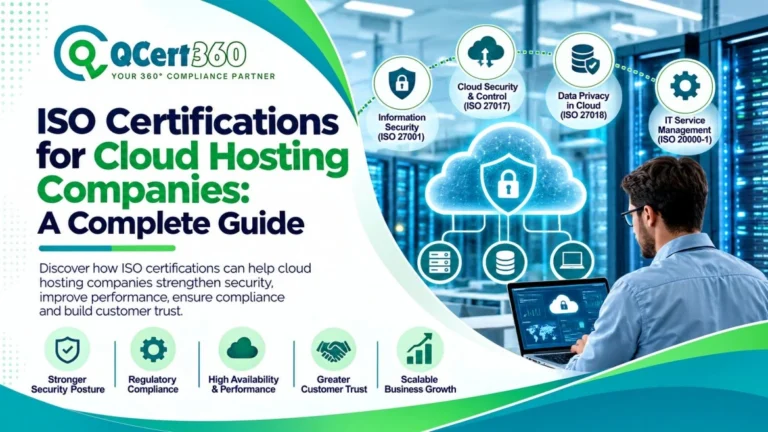
ISO Certifications for Cloud Hosting Companies: A Complete Guide
Cloud hosting customers hand providers their applications, databases and daily operations. In return, they expect protected data, dependable service and fast recovery when something breaks. ISO management system standards give cloud hosting companies a recognised way to structure information security, cloud security, privacy, service management and business continuity. Independent certification then lets customers verify the result.
The right standards depend on what you sell. A SaaS startup, a managed cloud provider, a data center operator and a web hosting company carry different risks, infrastructure and contractual duties. ISO certification for cloud hosting companies usually begins with ISO/IEC 27001, then adds cloud-specific guidance, privacy, service management, continuity, quality or energy management as customer needs and risk justify.
This guide covers ISO standards for cloud hosting companies, their requirements and benefits, the certification process, costs, timelines and common obstacles. QCert360 provides ISO consulting and implementation support. Independent certification bodies issue certificates. Consultants do not, and neither does ISO itself.
What Is ISO Certification for Cloud Hosting Companies?
It is an independent audit result showing that a provider’s management system meets a chosen ISO standard within a stated scope. A certification body reviews documented processes, interviews staff and samples evidence, then confirms whether the system conforms and works in practice.
For cloud hosting, that system covers how you protect customer data, run and change infrastructure, handle incidents, keep services available and communicate with customers. It turns good intentions into repeatable, auditable operations, which is what customers’ security teams look for.
Scope matters. A certificate covers only the services, sites and processes listed on it. It does not automatically cover every product, data center, application or customer workload.
Four terms are often confused:
Term | What it means |
ISO standard | An international specification published by ISO, often jointly with IEC. ISO does not certify companies. |
Legal obligation | A requirement set by law or contract. A certificate does not automatically prove you meet every one. |
Certification | An independent body’s assessment of your management system against a standard. |
Accreditation | Formal recognition that a certification body is competent within a defined scope. |
Why Is ISO Certification Important for Cloud Hosting Providers?
Because hosting is a trust business, and certification replaces promises with evidence. Why should cloud hosting companies obtain ISO certification? Mainly because it shows that risks, access, changes, incidents and suppliers are handled through defined processes that are reviewed and improved.
In practice, that means better management of information security risks, stronger protection of customer data and more consistent service delivery. It also means tighter access and change management, better incident response and recovery planning, clearer oversight of suppliers, and better documentation and accountability.
Certification also prepares you for enterprise customer assessments and supports contractual and procurement requirements, while giving you a structured route to continual improvement.
It has limits. Certification does not prevent every security incident, eliminate downtime or automatically satisfy every customer or legal requirement. It shows that you manage these risks systematically.
Which ISO Certifications Should a Cloud Hosting Company Choose?
Most cloud hosting companies should evaluate ISO/IEC 27001 first because it establishes an information security management system for identifying and managing security risks. Depending on customer requirements and business activities, providers may also consider ISO/IEC 27017 for cloud security controls, ISO/IEC 27018 for personal data protection in public cloud processing, ISO/IEC 27701 for privacy management, ISO/IEC 20000-1 for IT service management, and ISO 22301 for business continuity.
The right combination depends on your services, infrastructure, data processing responsibilities, contractual obligations and certification scope. Not every cloud provider needs every standard.
Which ISO Certifications Are Best for Cloud Hosting Companies?
For most providers, ISO/IEC 27001 is the strongest starting point. ISO/IEC 27017 and ISO/IEC 27018 follow when customers ask about cloud-specific controls or personal data. Which ISO standard is best for cloud service providers depends on your services, the data you handle and what buyers demand. No provider needs everything below.
Standard | Focus | Consider it when |
Information security management system | You host or process customer data | |
Cloud security control guidance | You sell cloud services with shared responsibilities | |
Personal data protection in public clouds | You act as a PII processor | |
Privacy information management system | Customers expect structured privacy governance | |
IT service management | You offer managed services with SLAs | |
Business continuity management | Customers depend on rapid recovery | |
You want consistent delivery and complaint handling | ||
Environmental and energy management | You operate energy-intensive data centers |
ISO/IEC 27001 Certification for Information Security
An information security management system (ISMS) helps providers find and manage risks affecting infrastructure, customer data, administrative accounts, cloud consoles, APIs, backups and supporting processes. ISO/IEC 27001:2022, with Amendment 1:2024, requires risk assessment and treatment, access management, supplier security, incident response, monitoring and continual improvement. Most other cloud security standards build on it.
ISO/IEC 27017 for Cloud Security
ISO/IEC 27017 gives cloud-specific security guidance to providers and customers. Its second edition, published in 2026, updates the 2015 guidance and builds on ISO/IEC 27002:2022. It addresses shared responsibilities, cloud administration, virtual environments, customer isolation and who secures what. It is guidance, not a standalone management system standard. Providers normally apply it within an ISO/IEC 27001 ISMS, so confirm with your certification body how it is assessed.
ISO/IEC 27018 for Personal Data Protection in Public Clouds
ISO/IEC 27018:2025, the third edition, is a code of practice for protecting personally identifiable information (PII) when a public cloud provider acts as a PII processor. It is aligned with ISO/IEC 27002:2022 and complements an ISO/IEC 27001 ISMS. It covers privacy safeguards, transparency, handling of temporary files and erasure, and notification of disclosures.
ISO/IEC 27701 for Privacy Information Management
ISO/IEC 27701:2025, published in October 2025, is a standalone requirements standard for a privacy information management system. It supports organizations acting as PII controllers or processors that need structured privacy governance. Unlike the 2019 edition, it no longer depends on ISO/IEC 27001, though the two integrate well. Check transition arrangements for 2019-edition certificates with your certification body.
ISO/IEC 20000-1 for IT Service Management
ISO/IEC 20000-1:2018, with Amendment 1:2024, sets requirements for a service management system. It covers incident handling, service requests, change management, service levels, capacity and continual improvement. It suits hosting providers that deliver managed services under formal service-level agreements.
ISO 22301 for Business Continuity Management
ISO 22301:2019, with Amendment 1:2024, supports business impact analysis, continuity planning, recovery arrangements and exercises. It maps directly to hosting outages, data center incidents, supplier disruption and service recovery. It does not guarantee uninterrupted service or remove every disaster recovery risk.
ISO 9001 for Quality Management
ISO 9001 supports consistent service delivery, customer satisfaction, complaint management, process control and continual improvement. ISO 9001:2026 was published on 16 September 2026, and ISO 9001:2015 certificates remain valid through a transition period running to September 2029. Plan new projects with your certification body accordingly.
ISO 14001 and ISO 50001 for Data Center Environmental and Energy Management
ISO 14001:2026 (published April 2026) addresses environmental management. ISO 50001:2018, with Amendment 1:2024, addresses energy management. Both matter most when you operate or manage energy-intensive data centers, where cooling, resource use, energy performance and environmental objectives shape operations. Neither promises specific savings, and few providers need both.
ISO Certification Requirements for Cloud Hosting Companies
Requirements depend on the standard you choose and the scope you define. Scope comes first, because every requirement applies to what you place inside it. The standards also address different disciplines:
Discipline | Requirement focus | Typical evidence |
Information security (ISO/IEC 27001) | Risk-based controls for confidentiality, integrity and availability | Risk register, access reviews, logs |
Cloud security and privacy (27017, 27018, 27701) | Cloud responsibilities, PII handling, privacy governance | Responsibility matrices, PII processing records |
Service management (ISO/IEC 20000-1) | Delivering and improving services to agreed levels | Incident, change and SLA records |
Business continuity (ISO 22301) | Preparing for and recovering from disruption | Impact analysis, recovery plans, exercise results |
Across these, auditors commonly look at:
- Scope and assets: the management system scope, plus cloud services, infrastructure and information assets.
- Governance: risk assessment and treatment, policies and management responsibilities.
- Technical and operational control: access and privileged account management, customer data protection and encryption keys, configuration, vulnerabilities, system changes, and monitoring of infrastructure and security events.
- Third parties and people: supplier and subcontractor management, and training for employees and contractors.
- Service and resilience: incident and complaint handling, backups and recovery, and service-level monitoring.
- Assurance: documented information, internal audits, management reviews and correction of nonconformities.
Not every control applies identically to every standard, so treat each standard’s requirements on their own terms.
ISO 27001 Requirements for Cloud Hosting Providers
ISO 27001 requires a risk-based ISMS, not a fixed checklist. You define scope, assess risks, select controls, prove they operate and review results regularly. What are the requirements for ISO 27001 certification? In practice, they translate into these elements:
- Scope and context: define the services, locations and interested parties covered.
- Policy and responsibilities: leadership sets security policy and assigns roles.
- Assets and classification: inventory systems, data and cloud accounts, and classify information.
- Risk assessment and treatment: identify risks, decide treatments and record them.
- Statement of Applicability: list the controls you apply, those you exclude and why.
- Identity and access management: least privilege, strong authentication, privileged access control and regular reviews.
- Secure configuration and change management: baselines, approvals and tested changes.
- Supplier and cloud service security: assess upstream providers and define responsibilities.
- Incident detection, response and escalation: monitoring, clear escalation paths and lessons learned.
- Backup, recovery and continuity interfaces: tested restores linked to continuity plans.
- Awareness and competence: training for staff and contractors.
- Internal audit and management review: independent checks and leadership decisions.
- Corrective action and continual improvement: fix causes, not just symptoms.
Keep evidence that controls operate, not merely exist. Access review sign-offs, change tickets, log review records, restore test results and incident reports all count. A generic checklist cannot replace a risk-based assessment, because two providers with similar services can face very different risks. A cloud hosting information security management system works only when it reflects how you actually run your environment.
ISO 27001 vs ISO 27017 vs ISO 27018
ISO 27001 provides the ISMS framework, ISO 27017 adds cloud-specific security guidance, and ISO 27018 focuses on protecting personal information in public cloud processing. What is the difference between ISO 27001 and ISO 27017? The first tells you how to run an ISMS. The second helps you interpret and extend controls for cloud services.
ISO/IEC 27001:2022 | ISO/IEC 27017:2026 | ISO/IEC 27018:2025 | |
Purpose | Establish and improve an ISMS | Guide cloud security controls | Guide PII protection in public clouds |
Main focus | Risk-based information security | Shared responsibility, cloud administration, isolation | Privacy safeguards, transparency, PII processing |
Intended users | Any organization | Cloud providers and customers | Public cloud providers acting as PII processors |
Relationship | Certifiable requirements standard | Builds on ISO/IEC 27002:2022; applied within an ISMS | Builds on ISO/IEC 27002:2022; complements an ISMS |
Typical hosting use | Core framework for infrastructure and data | Defining provider and customer responsibilities | Customers entrusting personal data to the provider |
More than one standard may apply. A provider selling virtual infrastructure may need 27017 to explain isolation and responsibilities. One that processes customers’ personal data may add 27018.
Illustration (hypothetical): a managed hosting provider stores customer databases. Its largest prospects ask about administrator access, tenant separation and personal data handling. It certifies its ISMS to ISO/IEC 27001, then applies 27017 and 27018 guidance within that system.
How to Get ISO Certified as a Cloud Hosting Company
Build a management system that meets your chosen standard, prove it works through internal audit and management review, then pass an independent certification body’s audits. How can a cloud hosting company get ISO certified? Follow these steps:
- Identify business objectives and customer requirements.
- Select the relevant ISO standard or combination of standards.
- Define the organizational, service and infrastructure scope.
- Conduct a gap analysis.
- Assess risks and identify required controls.
- Develop or improve policies and operational procedures.
- Implement security, service management and continuity processes as applicable.
- Train employees and relevant contractors.
- Collect implementation evidence and maintain records.
- Conduct internal audits.
- Complete management review and address identified issues.
- Select an appropriate independent certification body.
- Complete the required certification audits.
- Resolve nonconformities where necessary.
- Maintain the system through surveillance and recertification.
Audit stages and arrangements vary by standard and certification scheme, so confirm them with your chosen body, including its accreditation scope.
Documents Required for ISO Certification in Cloud Hosting
Required documents depend on the standard and scope, but all of them show that the system is planned, operated, checked and improved. Typical documents and records include:
- Management system scope and policies
- Risk assessment and treatment records
- Asset inventories and information classification
- Access control and privileged access procedures
- Supplier assessment records
- Change and configuration management records
- Security incident records
- Vulnerability management evidence
- Backup and restoration test records
- Business continuity and recovery plans
- Service-level and performance reports
- Employee training and competence records
- Internal audit reports and management review records
- Corrective action records
- Statement of Applicability, where ISO/IEC 27001 applies
Documentation must reflect real operations. Skip paperwork nobody uses, and do not assume one document set satisfies every ISO standard.
Benefits of ISO Certification for Cloud Hosting Companies
The practical benefits come from better-run operations and credible evidence for customers. The commercial value depends on customer expectations, scope, effective implementation and your business model. The benefits of ISO certification for cloud hosting companies typically include:
- Stronger customer confidence
- Better information security risk management and clearer cloud security responsibilities
- More consistent service delivery
- Better privacy governance where applicable
- Improved incident response and recovery planning
- Clearer supplier oversight
- Greater readiness for enterprise procurement and customer due diligence
- Better operational accountability
- Support for service expansion and growth
- Continual improvement of management systems
Certification does not guarantee contracts, revenue growth, complete regulatory compliance or the end of cyber incidents.
ISO Certification Consulting for Cloud Hosting Companies
QCert360 supports cloud hosting companies in selecting relevant ISO standards, assessing existing controls, identifying implementation gaps and preparing for independent certification audits.
Our support can be tailored to your cloud infrastructure, service portfolio, information security risks and customer requirements. Depending on the project scope, this may include:
- ISO/IEC 27001 gap assessment and implementation support
- Cloud security and shared responsibility assessments
- ISO/IEC 27017 and privacy-related implementation guidance
- Information security policies, risk assessments and documentation
- Internal audit preparation and employee awareness training
- Integration of information security, service management and business continuity processes
- Certification readiness reviews and corrective action guidance
Planning ISO certification for your cloud hosting business? Contact QCert360 to discuss your current controls, required standards and intended certification scope. Request a tailored assessment or quotation based on your organization’s requirements.
QCert360 provides consulting and implementation support. The independent certification body conducts the certification audit and makes the certification decision.
Common ISO Implementation Challenges for Cloud Hosting Providers
Most providers struggle with scope, shared responsibility and evidence rather than with writing policies. These are the usual obstacles and practical responses:
Challenge | Practical response |
Unclear certification scope | Map services, sites, systems and boundaries before drafting documents |
Shared responsibility misunderstandings | Publish a responsibility matrix covering you, customers and upstream suppliers |
Inadequate cloud asset inventories | Pull inventories from cloud accounts and reconcile them regularly |
Excessive administrative access | Apply least privilege, strong authentication and scheduled access reviews |
Incomplete monitoring and logging | Define critical log sources, retention and review owners |
Weak supplier oversight | Assess critical suppliers, set contract requirements and review them |
Missing incident response evidence | Keep tickets, timelines and post-incident reviews; run exercises |
Untested backups and recovery plans | Schedule restore tests and record the results |
Inconsistent change management | Use one tracked workflow with approval, testing and rollback |
Incomplete employee awareness | Run role-based training and keep completion records |
Difficulty integrating multiple standards | Build shared processes first, then add standard-specific requirements |
Limited internal audit resources | Train auditors or use independent support, keeping auditors impartial |
Can Cloud Hosting Companies Integrate Multiple ISO Certifications?
Yes, and many providers do. ISO management system standards share a common structure, so risk assessment, document control, internal audits, management reviews, supplier evaluation, corrective actions and continual improvement can serve several standards at once. Integrated ISO management systems for cloud providers often combine:
- ISO/IEC 27001 with ISO/IEC 27017
- ISO/IEC 27001 with applicable privacy management standards
- ISO/IEC 27001 with ISO/IEC 20000-1
- ISO/IEC 27001 with ISO 22301
- ISO 9001 with service management standards
Integration reduces duplicated work, but each standard keeps its own requirements and evidence expectations. An incident log built for security, for example, may need extra service-level fields to satisfy ISO/IEC 20000-1.
ISO Certification Cost for Cloud Hosting Companies
There is no universal price. How much does ISO certification cost for cloud hosting companies? It depends on your size, scope, environment and the standards you select. Three cost types sit behind any project: consulting fees, certification body fees and internal implementation costs, such as staff time, tooling, remediation and training. They should be quoted and budgeted separately.
The main cost factors are:
- Company size and workforce
- Number of locations and data centers
- Services and infrastructure within scope
- Complexity of the cloud environment
- Existing security and service management controls
- Number of selected standards
- Supplier and subcontractor arrangements
- Audit duration
- Internal resource requirements
- Consulting and training needs
For a figure that fits your situation, request a quotation based on your service scope and requirements.
How Long Does ISO Certification Take for Cloud Hosting Companies?
There is no fixed timeline. How long does ISO certification take for cloud providers? It depends on readiness, scope, infrastructure complexity, number of sites, existing controls, selected standards and how long it takes to close gaps. A provider with mature controls and a narrow scope usually moves faster than a multi-site operation with many gaps.
Your processes must also run long enough to generate records, and you must complete an internal audit and management review before the certification audit. Implementing several standards needs extra planning and evidence, although compatible processes can be integrated. A readiness assessment gives the most realistic plan.
Current Trends in Cloud Hosting Security and ISO Certification
Customers are scrutinizing cloud providers more closely, AI workloads are widening both risk and energy demand, and buyers increasingly ask for independent assurance. Four dated signals stand out:
- Breach costs and AI-enabled attacks. IBM’s 2026 Cost of a Data Breach report put the global average at $4.99 million, a 12% rise, and found that one in four malicious breaches was AI-enabled (July 2026). Its 2025 edition found that 97% of organizations reporting AI-related breaches lacked proper AI access controls (July 2025).
- Cloud growth. Gartner projected public cloud services growth of 21.3% in 2026, driven by AI integration (September 2025). More providers means more comparison on assurance.
- Data center energy. The IEA estimated data centres used about 415 TWh in 2024, around 1.5% of global electricity, and projected roughly 945 TWh by 2030 (April 2025). That keeps energy and environmental management on the agenda.
- Standards refresh. ISO/IEC 27018:2025, ISO/IEC 27701:2025, ISO 14001:2026, ISO/IEC 27017:2026 and ISO 9001:2026 all arrived within about a year, so transition planning now matters.
Other themes include cloud configuration and identity security, shared responsibility and third-party risk, security monitoring, recovery testing and integrated security, privacy and service management systems. These are directions, not mandates. No single certificate is required by every enterprise customer.
How QCert360 Can Help with ISO Certification for Cloud Hosting Companies
QCert360 helps cloud providers choose the right standards, close gaps, build evidence and prepare for audit. Our role is consulting and implementation support. Independent third-party certification is performed by a certification body you select, and we do not present consulting as certification. Our ISO certification services for cloud hosting companies include:
- ISO standard selection guidance
- ISO 27001 implementation support and ISO 27001 consulting for cloud hosting companies
- Cloud security gap assessment
- ISO 27017 and related cloud security guidance
- Privacy management implementation support, where applicable
- IT service management implementation support
- Business continuity management support
- Documentation and risk assessment guidance
- Employee awareness and training
- Internal audit preparation
- Corrective action guidance
- Certification readiness support
Not sure where to start? Contact QCert360 for a tailored assessment, or ask for an implementation plan or certification quotation based on your service scope.
Frequently Asked Questions About ISO Certifications for Cloud Hosting Companies
What ISO certifications do cloud hosting companies need?
No ISO certificate is universal. Most providers start with ISO/IEC 27001, then consider 27017 and 27018 guidance, 27701, 20000-1, 22301, 9001, 14001 or 50001 depending on services, customer demands and risk.
Is ISO 27001 important for cloud hosting providers?
It is a widely used foundation because it structures how you manage risks to infrastructure and customer data. Its importance for you depends on customer requirements, but it underpins most other cloud security work.
What is the difference between ISO 27001 and ISO 27017?
ISO 27001 sets requirements for an ISMS. ISO 27017 offers cloud-specific control guidance, including shared responsibilities, and is applied within that framework.
What is ISO 27018 used for in cloud services?
It guides public cloud providers acting as PII processors in protecting personal information, with attention to transparency, handling instructions, erasure and disclosure notification.
Does a cloud hosting company need ISO 20000-1?
Not necessarily. It is most relevant when you deliver managed services under formal service levels and want audited incident, change and service-level processes.
How does ISO 22301 support cloud service continuity?
It structures impact analysis, continuity planning, recovery arrangements and exercises so you can respond to disruption. It does not guarantee uninterrupted service.
What documents are required for ISO certification for cloud hosting companies?
They vary by standard, but usually include scope, policies, risk records, procedures and evidence such as audit reports, training records and management reviews.
How much does ISO certification cost for a cloud hosting company?
There is no fixed price. Consulting, certification body and internal costs each depend on scope, size and complexity, so request a quotation for your situation.
How long does ISO certification take for cloud hosting companies?
Timelines depend on readiness, scope, sites, existing controls and the number of standards. A readiness assessment gives a realistic estimate.
Can a cloud hosting company obtain multiple ISO certifications?
Yes. Shared processes like risk assessment, internal audit and management review can be integrated, but each standard keeps its own requirements.
Does ISO certification guarantee cloud security or regulatory compliance?
No. It shows your management system conforms to a standard within a defined scope. It does not prevent every incident or satisfy every legal obligation.
How can QCert360 help cloud hosting companies prepare for certification?
QCert360 supports standard selection, gap assessment, implementation, training, internal audit preparation and readiness. Independent certification bodies perform the certification audit.
Is ISO 27001 certification mandatory for cloud hosting companies?
ISO 27001 certification is not a universal legal requirement for every cloud hosting company. It may be required by particular customers, contracts, procurement rules or sector-specific arrangements. Providers should assess the applicable legal obligations and customer requirements before deciding whether certification is necessary.
Can a small cloud hosting company obtain ISO 27001 certification?
Yes. A small cloud hosting company can pursue ISO 27001 certification if it can establish and operate a conforming information security management system within a defined scope. The effort depends on the services covered, the complexity of the environment, existing controls and the evidence available.
Can a cloud hosting provider combine ISO 27001 and ISO 27017?
Yes. A provider can implement ISO/IEC 27001 alongside the cloud-specific guidance in ISO/IEC 27017. The provider should confirm the applicable assessment and certification arrangements with its chosen certification body rather than assuming that applying the guidance automatically results in a separate certificate.
What should a company check before choosing an ISO certification body?
Check the certification body’s competence, accreditation status where relevant, accreditation scope, experience with the selected management system standard, audit arrangements and certificate verification process. Confirm that the proposed scope covers the services and locations that matter to your customers.
Our Services
ISO Standards
- ISO 9001 Certification
- ISO 14001 Certification
- ISO 45001 Certification
- ISO 22000 Certification
- ISO 17025 Certification
- ISO 27001 Certification
- ISO 13485 Certification
- ISO 20000-1 Certification
- ISO 41001 Certification
- ISO 22716 Certification
- ISO 50001 Certification
- ISO 22301 Certification
- ISO 29993 Certification
Product Certifications
Other international standards
- FSSC 22000 Certification
- HIPAA
- HACCP Certification
- SA 8000 Certification
- GMP Certification
- GDPR
- GDP Certification
- GLP Certification
- Certificate of Conformity
QCert360 provides a wide range of services including ISO certification, audit support, compliance consulting, and training. They specialize in helping businesses achieve global standards and certifications like ISO 9001, ISO 27001, ISO 14001, and many others. Their team ensures a seamless experience from consultation to certification, supporting clients at every stage.
The time it takes to achieve certification can vary depending on the complexity of the standard and the readiness of your organization. On average, it takes about 3 to 6 months. QCert360 works closely with clients to streamline the process, ensuring that all requirements are met efficiently and within a reasonable timeline.
QCert360 is a trusted partner with years of experience in helping businesses obtain international certifications. Their expert consultants provide tailored solutions, ensuring your organization not only meets but exceeds industry standards. With a customer-centric approach, they focus on offering end-to-end support to simplify the certification journey.
QCert360 serves a wide range of industries including manufacturing, healthcare, information technology, education, and services, among others. They customize their certification solutions to meet the unique requirements of each industry, ensuring relevance and compliance with global standards.
Yes, QCert360 provides ongoing support even after certification. They offer services like surveillance audits, recertification guidance, and consultancy to help maintain and improve your certification status. Their team ensures that your organization stays compliant and up-to-date with any changes in certification standards.
Getting started with QCert360 is simple. You can contact them via their website to request a consultation. Their team will assess your needs, discuss the best certification options for your business, and outline the steps involved. From there, they’ll guide you through the entire process, ensuring you’re prepared for certification.
QCert360 stands out due to its customer-focused approach, industry expertise, and comprehensive service offerings. Their team doesn’t just help you obtain certification but works to ensure your organization thrives in compliance with international standards. They also offer personalized consultation, making the process smoother and more efficient, ensuring long-term success for your business.
The cost of certification varies depending on factors such as the type of certification, the size and complexity of your organization, and the specific industry requirements. QCert360 offers competitive pricing and provides tailored quotes based on your unique needs. They ensure transparency and work with you to find the most cost-effective solution for your certification goals.
Yes, QCert360 offers internal audit services to help assess and improve your organization’s processes. Their expert auditors conduct thorough reviews of your systems and operations to ensure they meet required standards. They also provide actionable recommendations to help enhance efficiency and compliance, making sure you’re fully prepared for external audits.
If your organization doesn’t pass an audit or certification assessment, QCert360 works with you to understand the reasons for non-compliance and provides support to rectify the issues. They offer guidance on corrective actions and help you prepare for a re-assessment. Their goal is to ensure your organization meets the necessary standards for certification, and they will be by your side to make the process as smooth as possible.