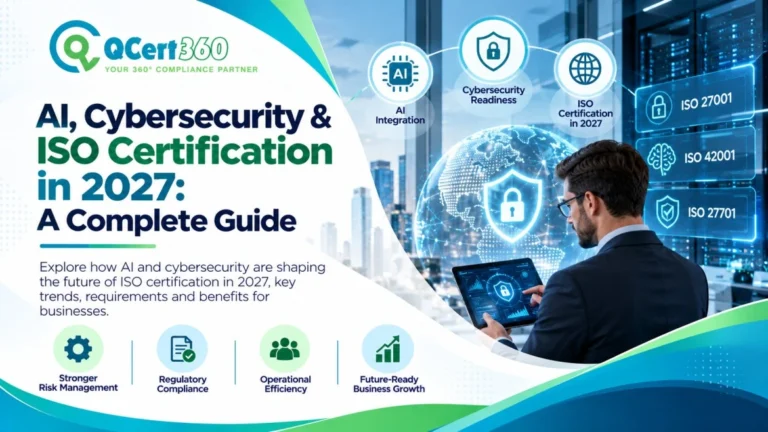
AI, Cybersecurity & ISO Certification in 2027: A Complete Guide for business
AI governance, cybersecurity and structured management systems matter in 2027 because AI now sits inside everyday business processes, and attackers are using the same technology to work faster. Organizations that can show who owns each AI system, how its risks are assessed and how security incidents are handled are better placed to answer customers, auditors and boards.
AI adoption brings real opportunity. It also brings risks to data security, system reliability, privacy, transparency, third-party services and accountability. A chatbot trained on customer records, a coding assistant with access to source code or a supplier’s AI feature switched on by default can each create exposure that traditional IT policies never anticipated.
ISO management system standards offer a practical way to organize the response. ISO/IEC 42001 covers AI management, and ISO/IEC 27001 covers information security. Other standards, such as ISO/IEC 27701, ISO 22301 and ISO 9001, add privacy, resilience and quality. No single certificate removes cyber risk or guarantees responsible AI outcomes. What a certified management system provides is a documented, audited and continually improving way of managing those risks.
QCert360 offers AI compliance consulting services, including support with ISO certification for AI companies and other technology businesses. As cybersecurity ISO certification consultants, the team helps organizations assess which standards fit, build the management system and prepare for independent certification. This guide to AI and cybersecurity certification explains the standards, the differences between them, the preparation steps and the questions buyers ask most often.
Why AI Governance and Cybersecurity Matter in 2027
They matter because AI use, AI-enabled attacks and customer scrutiny are all rising together, and informal controls rarely keep up. The business case rests on several practical pressures:
- Wider generative AI use. Staff adopt AI tools faster than policies are written.
- Sensitive data in AI tools. Confidential files, source code and personal information can be pasted into external services without approval.
- AI-assisted attacks. Phishing, social engineering and vulnerability research are becoming faster and more convincing.
- Security of AI assets. Models, datasets, applications and supporting infrastructure all need protection.
- Third-party and cloud dependencies. Many AI capabilities come from external providers, which extends the supply chain.
- Privacy, transparency and accountability. Customers increasingly ask how AI decisions are made and who answers for them.
- Resilience. AI-dependent services need continuity and incident response plans like any other critical service.
The evidence supports the direction of travel. The World Economic Forum’s Global Cybersecurity Outlook 2026, published in January 2026 and based on a survey of 804 leaders in 92 countries, reported that 94% of respondents expect AI to be the most significant driver of cybersecurity change in 2026. It also reported that 87% saw AI-related vulnerabilities rise during 2025, and that the share of organizations assessing the security of AI tools grew from 37% to 64%.
Looking forward, the UK National Cyber Security Centre’s assessment, Impact of AI on cyber threat from now to 2027 (May 2025), judged that AI will almost certainly make parts of cyber intrusion more effective and efficient. It also judged that fully automated, end-to-end advanced attacks are unlikely by 2027. These are forecasts, not certainties, and they describe an evolution of existing techniques rather than an entirely new kind of threat.
Weak governance rarely causes a dramatic single failure. More often it shows up as unknown AI tools, unclear ownership, slow incident response and audit questions nobody can answer quickly.
What Is AI Governance?
AI governance is the set of policies, responsibilities, controls and processes an organization uses to manage AI systems throughout their lifecycle, from idea and design to retirement. It turns good intentions about responsible AI into a responsible AI risk management framework of decisions that are assigned, recorded and reviewed.
In practice, effective AI governance includes:
- Accountability: named owners for each AI system and a defined escalation path.
- Acceptable use: clear rules on which AI tools and use cases are approved.
- AI inventory: a maintained list of AI systems, including those embedded in purchased software.
- Risk and impact assessment: a repeatable method to assess harm to individuals, customers and the business.
- Data governance: controls on training, input and output data, including quality and permissions.
- Human oversight: defined points where people review, override or approve AI outputs.
- Supplier assessment: due diligence on external models, APIs and platforms.
- Transparency and documentation: records of decisions, limitations and changes.
- Monitoring and incident management: performance tracking, drift checks and a route for reporting problems.
AI governance is not only for AI developers, and AI governance for SaaS companies is a good example of why. A company that only uses third-party AI tools for marketing, hiring support or customer service still carries responsibility for how those tools are used, what data they receive and what decisions they influence.
What Is ISO 42001 Certification?
ISO 42001 certification, the most direct form of AI governance certification available today, is an independent confirmation, by a certification body, that an organization’s Artificial Intelligence Management System (AIMS) meets the requirements of ISO/IEC 42001:2023. The standard was published in December 2023 as the first international management system standard for AI. At the time of writing, ISO lists it as Edition 1, 2023 and currently published.
The standard specifies requirements for establishing, implementing, maintaining and continually improving an AIMS. It applies to organizations that develop, provide or use AI-based products and services, in any sector and of any size.
Like other ISO management system standards, it follows the familiar structure: organizational context, leadership, planning, support, operation, performance evaluation and improvement. Its AI-specific elements include AI risk assessment, AI risk treatment, AI system impact assessment, defined responsibilities, documented information and operational controls across the AI system lifecycle. Annexes provide reference controls and implementation guidance that organizations select from based on their risks.
ISO/IEC 42001 is a management system standard. Certification shows that processes exist and operate. It does not prove that every AI output is accurate, unbiased, secure or legally compliant.
What Is ISO 27001 Certification?
ISO 27001 certification confirms that an organization’s Information Security Management System (ISMS) has been independently assessed against ISO/IEC 27001. The current edition is ISO/IEC 27001:2022, which includes 93 controls in Annex A and is supplemented by Amendment 1:2024, which added climate-related considerations to clauses on context and interested parties.
The ISMS is built on risk. The organization identifies information assets, assesses threats and vulnerabilities, chooses treatments and documents its choices in a Statement of Applicability. Core activities include risk assessment and treatment, information classification, access management, supplier security, incident response, business continuity considerations, internal audits and continual improvement.
The guiding principles are confidentiality, integrity and availability. For AI, confidentiality covers training data and prompts, integrity covers protection against tampering with data or models, and availability covers the services that depend on AI.
Implementing ISO 27001 and being certified are different things. An organization can build an ISMS aligned with the standard without an audit. Certification requires an independent assessment by a certification body, followed by surveillance audits and periodic recertification.
Other ISO Standards Relevant to AI, Cybersecurity and Privacy
Beyond the core ISO standards for artificial intelligence and ISO standards for cybersecurity management, several other standards can complement ISO 42001 and ISO 27001, depending on business objectives, risk exposure, customer expectations and applicable requirements. No organization needs all of them.
ISO/IEC 27701 for Privacy Information Management
ISO/IEC 27701 specifies a Privacy Information Management System (PIMS) for organizations that process personal information. The 2025 edition, published in October 2025, is now a standalone standard rather than an extension to ISO 27001, so organizations can pursue it without first holding an ISMS certificate. Privacy and security remain closely linked, and many organizations run both together. Check the transition rules with your certification body, as these were still being finalized by the accreditation community after publication.
ISO/IEC 27017 for Cloud Security
ISO/IEC 27017 gives guidance on information security controls for cloud services, for both providers and customers. It helps clarify shared responsibilities between a cloud provider and the organization using the service, which is especially relevant for SaaS businesses and AI platforms hosted in the cloud. Confirm the current edition before citing it.
ISO/IEC 27018 for Personal Information in Public Clouds
ISO/IEC 27018 provides guidelines for protecting personally identifiable information in public clouds where the provider acts as a processor. A third edition was published in August 2025. It is a code of practice used alongside an ISMS rather than a certifiable management system on its own.
ISO 22301 for Business Continuity
ISO 22301 specifies requirements for a business continuity management system. It covers business impact analysis, continuity planning, recovery arrangements and resilience. For AI-dependent and cloud-dependent services, it supports planning for cyber incidents and technology disruptions. The current edition is ISO 22301:2019, with Amendment 1:2024.
ISO 31000 for Risk Management
ISO 31000 offers guidelines on risk management principles and process. It is guidance rather than a certifiable requirements standard, so it informs how risk is handled but does not lead to a certificate. Many organizations use it as a foundation beside certifiable standards.
ISO 9001 for Quality Management
ISO 9001 helps organizations deliver consistent processes, customer satisfaction and continual improvement. Where AI affects product or service quality, a quality management system provides the process discipline AI governance depends on. ISO 9001:2026 was published on 16 September 2026, and certification bodies report a three-year transition period for organizations certified to the 2015 edition.
ISO 42001 vs ISO 27001: Key Differences
ISO 42001 focuses on managing AI-related responsibilities, risks and opportunities, while ISO 27001 focuses on managing information security risks. The two complement each other but are not interchangeable.
Area | ||
Primary purpose | Responsible development, provision and use of AI | Protecting confidentiality, integrity and availability of information |
Management system | AI Management System (AIMS) | Information Security Management System (ISMS) |
Main risks addressed | Bias, lack of transparency, unreliable outputs, societal and individual impact, AI lifecycle risks | Unauthorized access, data loss, disruption, misuse of information assets |
AI governance responsibilities | Central: policy, roles, impact assessment, oversight | Indirect: security ownership, not AI decisions |
Information security controls | Considers security as one aspect of trustworthy AI | Detailed control set in Annex A, selected through risk assessment |
Data and model considerations | Data quality, provenance, model lifecycle, monitoring | Data classification, access, protection of assets including datasets |
Documentation and assessment | AI risk and impact assessments, AI policy, lifecycle records | Risk assessment, treatment plan, Statement of Applicability |
Typical organizations | AI developers, AI service providers, heavy AI users | Any organization handling sensitive information |
Certification objective | Show structured AI governance | Show structured information security |
Integration opportunity | Shares leadership review, audits and improvement | Shares the same elements, plus a security foundation for AI |
An AI company with no ISMS may still have weak access control. A strong ISMS may still lack any process for assessing AI impact on individuals. Each standard fills a gap the other leaves.
Can ISO 42001 and ISO 27001 Be Implemented Together?
Yes. ISO 42001 and ISO 27001 integration is practical because both follow the same high-level structure used across modern ISO management system standards, which makes joint implementation practical. Organizations can share processes for leadership review, risk assessment methods, documented information control, internal audits, corrective action and continual improvement. This reduces duplicated meetings, records and audit effort.
Each standard still keeps its own requirements and assessment criteria. Integration saves effort, but it does not replace separate conformity to each one, and auditors will assess each standard on its own terms.
own terms.
Illustrative example (not a QCert360 customer case): A software company uses AI to summarize customer support tickets that contain personal information. Its ISMS defines who may access ticket data, how suppliers are vetted and how incidents are reported. Its AIMS adds an AI inventory entry for the summarization feature, an impact assessment on customers, human review rules for summaries used in decisions and monitoring for incorrect output. Both systems share one risk register structure, one internal audit programme and one management review. A supplier change to the underlying model triggers both a security review and an AI risk review.
ISO 42001 Requirements Explained
The main ISO 42001 requirements for AI companies, and for any organization using AI, follow clauses 4 to 10 of ISO/IEC 42001:2023, applied to the organization’s AI activities. Translating them into business processes looks like this:
- Context and interested parties. Identify internal and external issues and the expectations of customers, regulators, employees and others affected by your AI.
- AIMS scope. Decide which AI systems, activities and locations the system covers.
- Leadership and AI policy. Top management sets a policy aligned with organizational objectives and commits resources.
- Roles and accountability. Assign responsibility for AI risk, oversight and reporting.
- AI risk assessment and treatment. Use a defined method to identify, analyze and treat AI risks.
- AI system impact assessment. Assess consequences for individuals and groups where applicable.
- Resources, competence and awareness. Ensure people have the skills and understanding their roles need.
- Documented information. Create and control the records needed for effectiveness and audit evidence.
- Operational planning and control. Run processes for the AI system lifecycle, including design, data, testing, deployment and change.
- Monitoring and evaluation. Track performance, drift and incidents against defined measures.
- Internal audits and management reviews. Check conformity and effectiveness at planned intervals.
- Nonconformity and improvement. Correct problems, address root causes and keep improving.
The annexes list reference controls organizations may select based on risk. These are not all mandatory. Treat illustrative controls as options justified by your risk assessment unless the standard states a requirement.
ISO 27001 Requirements for Cybersecurity Management
ISO 27001 requirements for information security are met by establishing and maintaining an ISMS tailored to the organization’s own risks. The essential elements are:
- Scope and context. Define boundaries, issues and interested parties, including climate-related considerations introduced by Amendment 1:2024.
- Risk assessment and treatment. Identify threats to information assets, then select and justify treatments.
- Policies. Approve and communicate an information security policy and supporting rules.
- Asset and information classification. Know what you hold and how sensitive it is.
- Access control and identity management. Limit access based on need and verify identity.
- Supplier and cloud security. Set requirements for providers and monitor them.
- Vulnerability and change management. Find weaknesses and control changes to systems.
- Incident response. Detect, report, respond and learn from events.
- Business continuity interfaces. Plan for availability of critical information and services.
- Awareness and competence. Train people in security responsibilities.
- Internal audits and management review. Test and review the system.
- Corrective action and improvement. Fix nonconformities and refine controls.
Control selection depends on the risk assessment, applicability and the Statement of Applicability. Organizations do not have to implement every possible control in the same way. They must justify what they include and exclude.
How AI Changes Cybersecurity Risk Management
AI changes cybersecurity in two directions: it helps defenders analyze and respond faster, and it helps attackers scale some existing techniques. Risk management has to cover both, and the two tasks differ. Securing AI systems means protecting the models, data and applications. Using AI for security means applying AI to detection and response.
An AI security risk assessment should cover the cybersecurity risks of generative AI and other AI-powered services, including:
- AI-assisted phishing and social engineering. More convincing messages at lower cost.
- Sensitive data exposure. Staff entering confidential data into unapproved tools.
- Prompt injection and misuse. Manipulating AI applications through crafted inputs.
- Model and dataset security. Protecting training data, model files and pipelines from tampering or theft.
- Third-party AI dependencies. Inheriting risks from external models and APIs.
- AI-generated malicious content. Faster production of deceptive or harmful material.
- Vulnerability discovery and exploitation. AI-assisted research that can shorten the time between a flaw and its exploitation.
- Automated detection and analysis. AI helping security teams triage alerts and spot anomalies.
- Human oversight and verification. People confirming consequential AI outputs.
- Monitoring, testing and incident response. Regular testing and rehearsed response plans.
AI security and data protection still depend on fundamentals, and nothing here means attacks cannot be prevented. The NCSC’s assessment stresses that basic cyber hygiene remains essential and that organizations keeping pace with AI-enabled threats will fare better than those that do not. The NIST work on cybersecurity, privacy and AI and its AI Risk Management Framework provide additional reference material for risk-based programmes.
How to Prepare for ISO Certification in 2027
Preparation works best as a staged programme that links AI governance, security and certification. A practical sequence:
- Identify objectives. Clarify your AI, information security and privacy goals.
- Inventory. List AI systems, information assets and third-party services.
- Select standards and scope. Choose suitable ISO standards and define the certification scope.
- Run a gap analysis. Compare current practice with each selected standard.
- Assess risks. Identify risks and the controls needed.
- Establish documentation. Create policies, roles and processes.
- Implement controls. Operate them and keep evidence.
- Train people. Cover employees and relevant stakeholders.
- Audit and review. Conduct internal audits and management reviews.
- Fix nonconformities. Address findings before the external audit.
- Choose a certification body. Select an appropriate independent body.
- Complete certification. Take the assessment and resolve any findings.
- Maintain. Keep monitoring, and plan for surveillance audits and recertification as applicable.
Timelines depend on complexity, readiness, scope and the chosen standard. A single-site software team with existing controls will move differently from a multi-site organization starting with no documentation.
Common AI Governance and Cybersecurity Compliance Challenges
Most organizations face similar obstacles. Each has a practical remedy.
Challenge | Practical response |
Unapproved use of AI tools | Publish an acceptable use policy and offer approved alternatives |
Unclear accountability for AI decisions | Name an owner for each AI system and define escalation |
Weak data classification and access controls | Classify data and restrict what AI tools may receive |
Add AI and security questions to supplier reviews | |
Missing AI inventories and risk records | Build a register and review it on a schedule |
Insufficient employee awareness | Run role-based training with real examples |
Weak vulnerability and incident management | Test regularly and rehearse the response plan |
Incomplete audit evidence | Record decisions as work happens, not before the audit |
Difficulty integrating management systems | Share risk, audit and review processes where requirements allow |
Confusion between certification and legal compliance | Track legal duties separately and map them to your controls |
Benefits of ISO Certification for AI and Cybersecurity
The benefits of ISO 42001 certification and the benefits of ISO 27001 certification overlap, and certified management systems can offer several advantages when implemented well:
- Structured AI risk management and clearer accountability
- Improved information security processes
- Better documentation and audit readiness
- Stronger supplier risk management
- Greater customer and stakeholder confidence
- More consistent incident management
- Better alignment between business goals and risk controls
- Support for customer qualification and procurement requirements
- A structured approach to continual improvement
These are potential benefits, not guarantees. Certification does not guarantee breach prevention, regulatory approval, contract awards, revenue growth or complete AI safety.
ISO Certification Cost and Timeline in 2027
Cost and timeline depend mainly on scope, complexity and readiness, so no honest fixed figure applies to everyone. Factors that move cost include company size, workforce, number of sites, system complexity, existing controls, AI use cases, risk exposure and audit duration.
Three separate cost types are often confused when buyers compare ISO 42001 certification services:
- Consulting fees: support for gap analysis, design and implementation.
- Internal costs: staff time, tools, training and any technical improvements.
- Certification body fees: independent audit and surveillance costs, set by the body.
Timelines depend on readiness, resource availability, complexity and certification arrangements. Organizations with mature controls often move faster than those building from scratch. To understand your own position, request a scope-based quotation from QCert360.
Current AI and Cybersecurity Trends to Watch in 2027
These AI governance and cybersecurity trends for 2027 are drawn from published research, and forecasts are labelled as such.
- AI governance joins enterprise risk management. Organizations are assessing AI security more often; the WEF reported that share rising from 37% to 64% (January 2026).
- AI-enabled detection and response. Defenders are adopting AI to handle alert volume.
- AI-assisted attacks and vulnerability research. The NCSC (May 2025) forecasts that skilled actors will highly likely use AI automation for evasion and scale by 2027.
- Security of models, datasets and applications. Concern is growing; 34% of respondents in the WEF survey named data leaks linked to generative AI among key concerns.
- Third-party and cloud supply chain risk. External AI providers extend the attack surface.
- Oversight and transparency. Customers and regulators ask for evidence of human oversight.
- Integrated management systems. Combining AI and security management reduces duplication.
- Resilience and incident readiness. Planning for disruption is receiving more attention.
On regulation, voluntary standards and legal obligations differ. EU legislators agreed in 2026 to defer high-risk obligations under the EU AI Act to December 2027 and August 2028, according to legal commentary. ISO/IEC 42001 certification is voluntary and should not be assumed to prove compliance with any law.
Standards bodies, regulators and certification bodies each play a different role. International standards set requirements. Regulators enforce laws. Certification bodies audit against standards. Accreditation bodies assess the competence and scope of those certification bodies. ISO itself does not certify organizations.
What Evidence Should Businesses Prepare for ISO 42001 and ISO 27001 Certification?
Before an external certification audit, an organization should identify the documented information and operational evidence relevant to its chosen management system and scope.
For ISO/IEC 42001, preparation may include:
- AI management policy and defined responsibilities
- Inventory of relevant AI systems and use cases
- AI risk assessments and applicable impact assessments
- Records of AI system lifecycle controls and monitoring
- Supplier assessments, training records and internal audit results
For ISO/IEC 27001, preparation may include:
- Information security policy and defined ISMS scope
- Information security risk assessment and treatment records
- Statement of Applicability
- Relevant security policies, operational records and incident procedures
- Internal audit results, management review records and corrective actions
The exact evidence depends on the organization’s activities, scope, risk assessments and applicable requirements. A certification audit evaluates conformity with the relevant standard; the checklist above is a preparation aid, not a complete list of mandatory documents.
How QCert360 Can Support AI Governance and ISO Certification
QCert360 provides consulting and implementation support to help organizations prepare for certification. Support can include:
- ISO 42001 consultants, ISO 27001 implementation services, ISO 27001 certification support and ISO 27001 audit preparation
- AI governance consulting services, ISO 42001 gap analysis and information security gap assessments
- Management system documentation guidance
- Risk assessment and treatment support
- Employee awareness and training
- Internal audit preparation and corrective action guidance
- AI management system implementation and integrated AI and cybersecurity management systems
- Certification readiness assistance
Consultancy and implementation support are different from independent third-party certification. Certificates are issued by accredited certification bodies after an audit, and the scope and accreditation status of any chosen body should be checked directly.
Ready to start? Contact QCert360 for a tailored assessment, an implementation plan or a scope-based certification quotation.
Frequently Asked Questions About AI, Cybersecurity and ISO Certification
What is ISO 42001 certification?
Independent confirmation that an organization’s AI management system meets ISO/IEC 42001:2023. It covers governance, risk, impact assessment and operational controls for AI, and is issued by a certification body after an audit.
What is the difference between ISO 42001 and ISO 27001?
ISO 42001 manages AI responsibilities, risks and opportunities. ISO 27001 manages information security risk. They overlap in structure but address different subjects and are not substitutes.
Is ISO 42001 certification mandatory?
No. It is voluntary. Customers, partners or procurement processes may ask for it, and legal obligations for AI are separate from certification.
Which ISO standards are relevant to AI companies?
ISO/IEC 42001 and ISO/IEC 27001 are usually central. ISO/IEC 27701, 27017, 27018, ISO 22301, ISO 31000 and ISO 9001 may help depending on data, cloud use and customer expectations.
Can ISO 42001 and ISO 27001 be implemented together?
Yes. Shared structure allows combined risk, audit and review processes. Each standard still has its own requirements and is assessed separately.
What are the main ISO 42001 requirements?
Context, scope, leadership and AI policy, roles, AI risk and impact assessment, resources, documented information, operational control, monitoring, internal audit, management review and improvement.
How does ISO 27001 help manage cybersecurity risks?
It provides a risk-based system for identifying threats, choosing controls, responding to incidents and improving over time, with controls justified in a Statement of Applicability.
How much does ISO 42001 certification cost?
It depends on scope, size, complexity, existing controls and audit duration. Consulting, internal effort and certification body fees are separate. A scope-based quotation gives a realistic figure.
How long does ISO 27001 or ISO 42001 certification take?
Timelines vary with readiness, complexity, resources and scope. Organizations with mature controls usually progress faster than those starting from scratch.
Does ISO certification guarantee AI safety or cybersecurity?
No. It shows a management system is in place and audited. It does not prevent every breach or guarantee every AI output is accurate, fair or lawful.
How can businesses prepare for AI governance in 2027?
Start with an AI inventory and risk assessment, assign ownership, set acceptable use rules, assess suppliers, train staff and choose standards that fit your risk and customer needs.
How can QCert360 support ISO implementation and certification?
QCert360 offers gap assessments, documentation guidance, risk support, training, internal audit preparation and readiness assistance. Independent certification is carried out by a separate accredited body.
Which ISO Certifications Are Best for AI and Cybersecurity in 2027?
The most relevant ISO certifications for many AI and technology businesses are ISO/IEC 42001 for artificial intelligence management and ISO/IEC 27001 for information security management. ISO/IEC 27701 may be appropriate for privacy management, while ISO 22301 supports business continuity. The right combination depends on how an organization develops, provides or uses AI, the information it handles, customer requirements and applicable legal obligations. Certification is voluntary unless a separate contractual or regulatory requirement applies.
Our Services
ISO Standards
- ISO 9001 Certification
- ISO 14001 Certification
- ISO 45001 Certification
- ISO 22000 Certification
- ISO 17025 Certification
- ISO 27001 Certification
- ISO 13485 Certification
- ISO 20000-1 Certification
- ISO 41001 Certification
- ISO 22716 Certification
- ISO 50001 Certification
- ISO 22301 Certification
- ISO 29993 Certification
Product Certifications
Other international standards
- FSSC 22000 Certification
- HIPAA
- HACCP Certification
- SA 8000 Certification
- GMP Certification
- GDPR
- GDP Certification
- GLP Certification
- Certificate of Conformity
QCert360 provides a wide range of services including ISO certification, audit support, compliance consulting, and training. They specialize in helping businesses achieve global standards and certifications like ISO 9001, ISO 27001, ISO 14001, and many others. Their team ensures a seamless experience from consultation to certification, supporting clients at every stage.
The time it takes to achieve certification can vary depending on the complexity of the standard and the readiness of your organization. On average, it takes about 3 to 6 months. QCert360 works closely with clients to streamline the process, ensuring that all requirements are met efficiently and within a reasonable timeline.
QCert360 is a trusted partner with years of experience in helping businesses obtain international certifications. Their expert consultants provide tailored solutions, ensuring your organization not only meets but exceeds industry standards. With a customer-centric approach, they focus on offering end-to-end support to simplify the certification journey.
QCert360 serves a wide range of industries including manufacturing, healthcare, information technology, education, and services, among others. They customize their certification solutions to meet the unique requirements of each industry, ensuring relevance and compliance with global standards.
Yes, QCert360 provides ongoing support even after certification. They offer services like surveillance audits, recertification guidance, and consultancy to help maintain and improve your certification status. Their team ensures that your organization stays compliant and up-to-date with any changes in certification standards.
Getting started with QCert360 is simple. You can contact them via their website to request a consultation. Their team will assess your needs, discuss the best certification options for your business, and outline the steps involved. From there, they’ll guide you through the entire process, ensuring you’re prepared for certification.
QCert360 stands out due to its customer-focused approach, industry expertise, and comprehensive service offerings. Their team doesn’t just help you obtain certification but works to ensure your organization thrives in compliance with international standards. They also offer personalized consultation, making the process smoother and more efficient, ensuring long-term success for your business.
The cost of certification varies depending on factors such as the type of certification, the size and complexity of your organization, and the specific industry requirements. QCert360 offers competitive pricing and provides tailored quotes based on your unique needs. They ensure transparency and work with you to find the most cost-effective solution for your certification goals.
Yes, QCert360 offers internal audit services to help assess and improve your organization’s processes. Their expert auditors conduct thorough reviews of your systems and operations to ensure they meet required standards. They also provide actionable recommendations to help enhance efficiency and compliance, making sure you’re fully prepared for external audits.
If your organization doesn’t pass an audit or certification assessment, QCert360 works with you to understand the reasons for non-compliance and provides support to rectify the issues. They offer guidance on corrective actions and help you prepare for a re-assessment. Their goal is to ensure your organization meets the necessary standards for certification, and they will be by your side to make the process as smooth as possible.