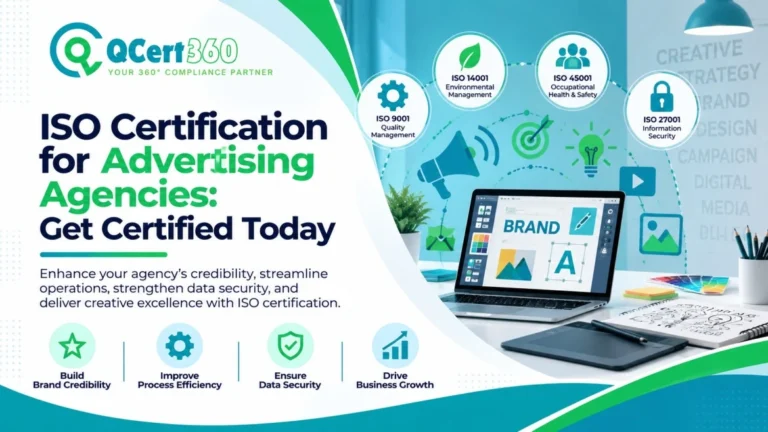
ISO Certification for Advertising Agencies: Get Certified Experts
ISO certification for advertising agencies gives a creative business an independently assessed way to run campaigns consistently, protect client information, manage operational risk and show clients that its processes are controlled. A certified management system will not write better ads. It does make briefs, approvals, access rights, supplier checks and corrective actions repeatable, so quality no longer depends on which account team happens to be on a project.
The right standards depend on what your agency actually does. A branding studio holding creative files has different exposure from a performance marketing team managing live ad accounts and audience data, and a production house running shoots faces risks a media planning desk never meets. Most agencies start with ISO 9001 for service quality or ISO/IEC 27001 for information security, then add standards as client requirements and operations demand.
QCert360 supports advertising agencies, creative studios, digital marketing firms and media buying companies with standard selection, gap analysis, implementation support and audit preparation. To find out which standards fit your agency, request an assessment and we will map your services, data and client obligations to the right management systems.
What Is ISO Certification for Advertising Agencies?
ISO certification is an independent assessment confirming that an organisation’s management system meets the requirements of a chosen ISO standard. A certification body carries out the assessment, not ISO itself. For an agency, the management system is the set of policies, processes, responsibilities and records that govern how work is planned, produced, approved, delivered and improved.
In practice it touches most of the agency: campaign planning needs a documented way to capture client requirements, creative development needs defined review and approval steps, media buying needs control over budgets and platform access, and digital marketing relies on client data, analytics accounts and automation tools. Client communications and production workflows need clear ownership and records.
Two boundaries matter. First, certification applies to a defined scope, such as “strategy, creative development and digital campaign management delivered from one office.” Services and locations outside that scope are not covered. Second, certification does not approve individual campaigns, creative assets or advertising claims. An auditor assesses whether your system for controlling those activities meets the standard and works in practice. ISO certification for advertising companies is about how you operate, not the creative output itself.
Why Should Advertising Agencies Get ISO Certified?
Advertising agencies get ISO certified to make delivery more consistent, protect confidential client information and give procurement teams verifiable evidence of how they work. Clients increasingly ask suppliers how they handle data, manage subcontractors and recover from disruption, and a certificate issued after independent audit answers those questions in a form buyers recognise.
The practical benefits of ISO certification for advertising agencies include:
- More consistent campaign delivery through defined briefing, planning and review steps
- Better client satisfaction and feedback management, with complaints following a recorded route to resolution
- Tighter creative approval workflows, with traceable versions and sign-offs
- Stronger protection of confidential client information, including campaign strategies, files and ad accounts
- Better management of suppliers and freelancers, whose access and confidentiality are controlled
- Improved business continuity for time-sensitive work
- Clearer responsibilities and fewer missed handoffs
- Stronger preparation for client assessments and procurement
- Better operational risk management and continual improvement in service delivery
Certification does not guarantee new contracts, campaign performance, legal compliance or the prevention of every security incident. Its value depends on how well the system is implemented and used.
Which ISO Certifications Are Best for Advertising Agencies?
The most relevant ISO standards for advertising agencies are ISO 9001 for service quality and ISO/IEC 27001 for information security, with ISO 22301, ISO 14001, ISO 45001 and ISO/IEC 27701 added where activities and clients call for them. ISO 31000 supplements these as risk guidance. Choose by looking at the services you sell, the data you hold, the activities you perform and what clients write into contracts.
ISO 9001 Certification for Advertising Agencies
ISO 9001 specifies requirements for a quality management system. It suits agencies of any size because it focuses on understanding customer requirements, controlling processes and improving results. ISO 9001 certification for advertising agencies typically shapes:
- Client briefing and requirements review: confirming scope, expectations and approvers before work begins
- Campaign planning and scheduling: defining resources, deadlines and dependencies
- Creative development and approvals: recording reviews, versions and client sign-offs
- Media buying and campaign execution: checking budgets, placements and settings against the approved plan
- Proofreading and deliverable quality checks: verifying final assets before release
- Client feedback and complaint handling: logging, investigating and closing issues
- Performance reporting and continual improvement: feeding results back into planning
Consider a familiar failure: a client approves a headline by email, a designer works from an older version, and the wrong copy goes live. A quality system cannot make mistakes impossible, but it defines where approved versions live, who checks the final file and how the error is corrected and prevented from recurring. That is how ISO 9001 quality management for advertising agencies reduces avoidable errors and manages client expectations.
ISO 9001:2026 was published on 16 September 2026, opening a transition period of about three years for organisations certified to ISO 9001:2015. Confirm exact dates and the edition applicable to your audit with your certification body.
ISO/IEC 27001 Certification for Advertising Agencies
ISO/IEC 27001 specifies requirements for an information security management system (ISMS). It helps an agency identify information security risks and apply proportionate controls to client information, campaign strategies, creative assets, analytics data, advertising account credentials and internal systems. An agency ISMS typically covers:
- Risk assessment: which assets matter, what could go wrong and which controls are justified
- Access management: who can open client folders, ad platforms and social accounts, with prompt removal for leavers
- Secure file sharing: approved tools and rules for sending files to clients and vendors
- Employee awareness: phishing, passwords and handling of confidential work
- Supplier security: assessment of freelancers, production partners and software vendors
- Incident response: a defined route for reporting, investigating and learning from events
How does ISO 27001 help protect client campaign data? It makes the agency decide where client data lives, who can reach it and what happens when something goes wrong, then audits that those decisions are followed. That is ISO 27001 information security for advertising companies in operational terms. The standard is especially relevant when you handle sensitive customer data, manage platform accounts for clients or serve enterprise clients with formal supplier security requirements. ISO/IEC 27001:2022 is the current edition, with a 2024 amendment on climate change considerations.
What is the difference between ISO 9001 and ISO 27001? ISO 9001 asks whether you consistently deliver what customers require. ISO 27001 asks whether you protect the confidentiality, integrity and availability of information. A creative agency can need both, and many implement them together because they share clauses on leadership, risk, internal audit and management review.
ISO 22301 Certification for Business Continuity
ISO 22301 specifies requirements for a business continuity management system. It prepares an agency for disruptions that affect campaign execution, client communication, creative production, access to advertising platforms or time-sensitive deliverables such as launches and seasonal campaigns. Core elements include a business impact analysis identifying which activities cannot stop for long, recovery plans, backup arrangements for files and systems, defined incident roles and continuity testing so plans are proven rather than assumed. ISO 22301 business continuity for advertising agencies suits firms whose clients depend on uninterrupted media delivery. ISO 22301:2019 is the current edition, also amended in 2024.
ISO 14001 Certification for Environmental Management
ISO 14001 specifies requirements for an environmental management system. Agencies have a smaller footprint than factories but still use energy, print materials, run production shoots, order promotional merchandise, travel to events and buy equipment. ISO 14001 for sustainable advertising operations means setting environmental objectives, tracking resource use, managing waste from production and events, and applying environmental criteria when choosing printers, venues and suppliers. This matters most where clients request sustainability evidence from their supply chain. ISO 14001:2026 was published in April 2026 and organisations certified to the 2015 edition have a transition period, so confirm the applicable edition when planning.
ISO 45001 Certification for Occupational Health and Safety
ISO 45001 specifies requirements for an occupational health and safety management system. It becomes relevant when agencies operate studios, run event teams, employ photography or film crews, build sets or send staff on location. ISO 45001 for advertising production teams covers hazard identification, risk controls for rigging, electrical equipment, travel and crowd environments, worker consultation, incident investigation and continual improvement. Office-only agencies often skip it; production-heavy agencies benefit. ISO 45001:2018 remains the published edition while a revision is in progress, so check current status before you plan.
ISO/IEC 27701 Certification for Privacy Information Management
ISO/IEC 27701 specifies requirements for a privacy information management system (PIMS). It helps agencies structure how personal information is handled in advertising, analytics, marketing operations and customer engagement, from lead lists and audience data to consent records. The current edition is ISO/IEC 27701:2025, published in October 2025. Unlike the 2019 edition, which extended ISO/IEC 27001, the 2025 edition is a standalone standard, so ISO 27701 certification for digital marketing agencies does not require holding ISO 27001 first.
Security and privacy are related but not interchangeable. Security protects information from unauthorised access, while privacy management governs why and how personal information is collected, used, shared and retained. Many agencies integrate the two. Certification arrangements for the new edition are still rolling out across certification bodies, so verify availability with the body you intend to use.
ISO 31000 for Risk Management Guidance
ISO 31000 provides guidelines for risk management. It is not a certifiable management system standard, so no agency receives an “ISO 31000 certificate.” Its principles still help with campaign delivery risk, client concentration, intellectual property disputes, vendor dependencies and reputational concerns, and many agencies use them to design the risk methods that ISO 9001, ISO 27001 and ISO 22301 require. Other standards apply only in specific cases; an agency building AI-driven tools might consider ISO/IEC 42001, noted under trends below.
ISO Certification Requirements for Advertising Agencies
The requirements depend on the standards you select and the scope you define, so no single checklist applies to every agency. Standards using the harmonised structure, including ISO 9001, ISO 14001, ISO 45001, ISO/IEC 27001 and ISO 22301, share a core of management system elements, and each adds subject-specific requirements. The shared elements cover:
- Organisational context and interested parties
- Management commitment and responsibilities
- Objectives for quality, security or environmental performance, as applicable
- Risk assessment and risk treatment
- Employee competence and awareness
- Documented policies and operational procedures
- Client requirements and approval controls
- Supplier and freelancer management
- Monitoring and measurement, internal audits and management review
- Corrective action and continual improvement
The standards differ in emphasis. ISO 9001 centres on customer requirements and process control. ISO/IEC 27001 centres on information security risk assessment and treatment. ISO 22301 requires business impact analysis and recovery planning. ISO 14001 requires identification of environmental aspects, and ISO 45001 requires hazard identification and worker participation.
Practical examples show how this plays out. A late campaign revision must be reviewed, scheduled and recorded. A missed deadline triggers investigation and corrective action. An ex-employee who still has access to a client’s ad account is treated as an incident, and the offboarding process is fixed. A media buy that ran on the wrong placement is traced to its cause, and the check is corrected. A supplier failure invokes a defined fallback.
Documents Required for ISO Certification in Advertising Agencies
The documents required for ISO certification depend on the standard and your scope, but most agencies maintain a core set of policies, procedures and records proving the system operates. Standards require documented information where they say so and otherwise leave the level of detail to the organisation. Typical examples include:
- Management system scope and policies
- Objectives and performance indicators
- Risk assessment and treatment records
- Client briefs and requirements reviews
- Creative approval and revision records
- Campaign delivery and quality review records
- Supplier and freelancer evaluations
- Information security procedures, access control and incident records
- Employee training records
- Business continuity plans, where applicable
- Internal audit reports and management review records
- Corrective action records
Not every agency needs every item. A small studio pursuing only ISO 9001 will not keep a continuity plan, and an agency with no production work will not keep shoot safety records. Good documentation describes what you actually do. Auditors test documents against real practice, so a polished manual nobody follows creates findings rather than avoiding them.
Benefits of ISO Certification for Digital Marketing and Creative Agencies
Digital marketing and creative agencies benefit mainly through better control of client data, workflows and suppliers, which supports client confidence. Because digital work runs through shared platforms, cloud tools and external contributors, process discipline matters more than it once did. Benefits include:
- Better management of client data and handling of confidential campaign information
- Improved control of campaign workflows and more consistent service delivery
- Stronger client and supplier confidence from independent audit
- Improved operational resilience
- More structured vendor management
- Better readiness for corporate procurement, where supplier questionnaires often ask about certification
- Improved accountability and continual improvement
These outcomes are not automatic. They depend on the standard chosen, implementation quality and daily use. That is why ISO certification for social media marketing agencies, media buying companies and creative studios works best when leadership treats it as an operating discipline rather than a badge.
How can ISO certification help an agency win corporate contracts? It can strengthen supplier qualification because enterprise buyers often request evidence of quality, security or continuity controls. It cannot guarantee selection, since price, creative quality and relationships still decide most pitches.
ISO Certification Process for Advertising Agencies
An advertising agency can obtain ISO certification by implementing a management system that meets the requirements of the selected ISO standard and successfully completing an independent certification audit. The process involves the following steps:
1. Identify the Relevant ISO Standards
Choose ISO standards based on your agency’s services and business goals. For example, ISO 9001 supports quality management, while ISO/IEC 27001 helps protect confidential client information and digital assets.
2. Define the Certification Scope
Determine which services, departments, processes, and locations will be covered by certification. An advertising agency may include digital marketing, branding, creative design, media planning, and campaign management.
3. Conduct a Gap Analysis
Review existing business processes against the selected ISO standard. Identify missing procedures, compliance gaps, and areas requiring improvement before starting implementation.
4. Develop Management System Documentation
Prepare the necessary policies, procedures, and records. These may include quality objectives, client communication procedures, project approval processes, risk assessments, and information security policies.
5. Implement Required Processes and Controls
Put the documented procedures into practice. Establish consistent processes for managing client projects, approving campaigns, handling complaints, protecting information, and monitoring service quality.
6. Train Employees and Relevant Contractors
Provide appropriate training so employees and relevant contractors understand their responsibilities. Training may cover quality management, client confidentiality, project documentation, and applicable security procedures.
7. Maintain Evidence of Implementation
Keep records demonstrating that the management system operates effectively. Examples include client approvals, project reports, training records, supplier evaluations, and corrective action reports.
8. Conduct Internal Audits
Perform internal audits to verify that processes comply with ISO requirements. Identify weaknesses, document findings, and take corrective action before the external certification audit.
9. Complete Management Review
Senior management should evaluate the management system’s performance, including audit results, client feedback, business risks, and improvement opportunities. Document decisions and necessary actions.
10. Address Identified Nonconformities
Correct any gaps identified during internal audits or management reviews. Investigate their causes and implement corrective actions to prevent similar problems from recurring.
11. Select an Independent Certification Body
Choose a competent certification body and verify that its accreditation covers the relevant standard and scope. Compare audit fees, experience, certification timelines, and surveillance requirements.
12. Complete the Certification Audit
The certification audit generally involves two stages. Stage 1 assesses documentation and readiness, while Stage 2 evaluates whether the management system is effectively implemented and meets the standard’s requirements.
13. Resolve Findings and Obtain Certification
Address any nonconformities raised during the certification audit and submit the required evidence. Once the certification body completes its review and approves certification, the agency receives its ISO certificate.
14. Maintain Certification Through Surveillance Audits
Continue following the management system requirements after certification. Conduct regular internal audits, management reviews, and improvement activities. Surveillance audits and periodic recertification help maintain certification validity.
How Can QCert360 Help Advertising Agencies?
QCert360 supports advertising agencies throughout ISO certification preparation, including standard selection, gap analysis, documentation, implementation, employee training, and audit readiness.
ISO develops international standards, independent certification bodies conduct certification audits and issue certificates, and accreditation bodies assess certification bodies’ competence. QCert360 provides consulting and preparation support, while certification decisions remain with the independent certification body.
Looking to get ISO certified? Contact QCert360 for expert guidance on selecting and implementing the right ISO standards for your advertising agency.
ISO Certification Cost for Advertising Agencies
The cost depends on agency size, scope and the number of standards, so no fixed price fits every case. Reliable figures come from a quotation based on your actual situation. The main factors are:
- Agency size and workforce, and number of locations
- Scope of services and complexity of campaign and production processes
- Types of client information handled
- Existing management system maturity
- Number of standards selected and resulting audit duration
- Internal implementation resources
- Consulting and training requirements
Keep three cost categories separate: consulting fees for implementation support, internal costs such as staff time and tools, and certification body fees for audits and surveillance. Mixing them leads to misleading comparisons between providers. To receive an ISO certification quotation for advertising agencies tailored to your situation, contact QCert360 with your services, headcount, locations and target standards.
How Long Does ISO Certification Take for an Advertising Agency?
The time needed depends on readiness, scope, existing processes, complexity, resource availability and the certification body’s audit schedule. Agencies that already document briefs, approvals and supplier checks usually need less preparation than those building a system from scratch, and single-standard projects with narrow scopes tend to move faster than multi-standard programmes. Resource availability matters as much as complexity, because implementation competes with client work. Be cautious of any provider promising one timeline for every agency; a realistic estimate follows a gap analysis.
Common ISO Implementation Challenges for Advertising Agencies
The most common challenges are inconsistent workflows, patchy records and uncontrolled access, and each has a practical fix.
- Inconsistent campaign workflows: define one short common workflow from brief to delivery and allow justified variations.
- Incomplete client approval records: agree one place for sign-offs and require it before release.
- Uncontrolled access to advertising accounts: use named accounts, least-privilege access and a leaver checklist.
- Poor management of freelancers and production partners: use a simple evaluation, confidentiality terms and project-limited access.
- Inadequate protection of client information: provide approved sharing tools and train people on them.
- Unclear responsibilities: assign named owners to each process and control.
- Weak internal audit practices: train auditors, plan around risk and sample real projects.
- Incomplete corrective actions: record root causes, verify effectiveness and review open actions in management review.
- Difficulty maintaining records across projects: use consistent folder structures and a minimal evidence checklist per project.
Most of these improve with simple, well-owned routines rather than heavy documentation.
Current Trends Affecting ISO Certification for Advertising Agencies
The main trends are widespread AI adoption, data protection pressure, credential and account security, platform dependency and rising client scrutiny of suppliers. Dates are shown so you can judge currency.
AI in creative production and campaign optimisation. Basis Technologies’ 2026 Advertising Agency Report, a survey of more than 200 advertising professionals, found AI in use at over 99% of agencies surveyed. A December 2025 survey of 50-plus US small and mid-sized agency executives by AI Digital Lab found 16.1% had comprehensive AI policies with regular training to safeguard client data, while 30.4% had done nothing on this front. The samples are modest but point to a governance gap. Agencies using AI at scale may look at ISO/IEC 42001, the AI management system standard.
Protection of customer and audience data. The Independent Media Agencies Australia 2026 Indie Census, released in June 2026, ranked data privacy and compliance concerns among the top barriers to wider AI use in media planning and buying. ISO/IEC 27701:2025 offers a way to structure privacy management.
Cybersecurity risks to advertising accounts and client assets. A February 2026 Martech Edge interview with a security specialist described a typical agency as managing logins for 50 or more client accounts across advertising, analytics, social and CRM tools. That is one practitioner’s estimate rather than survey data, but it shows why access control and supplier security belong in an ISMS scope.
Platform dependency and brand safety. Agencies rely on platforms, measurement vendors and SaaS tools they do not control, which business continuity planning and supplier management address. Basis’ 2026 report found 88.3% of respondents wanted more transparency in digital advertising, citing ad fraud and supply chain opacity, so documented campaign controls help agencies show how they respond.
Workflow automation, sustainability and client assessments. Automated reporting, bidding and content generation need change control and review. Clients increasingly ask about environmental performance in production, and large buyers send detailed supplier security questionnaires that certification evidence helps answer.
Standards updates. ISO 14001:2026 and ISO 9001:2026 have been published, ISO/IEC 27701 became standalone in 2025 and ISO 45001 is under revision. Align certification projects with current editions.
How QCert360 Can Help Advertising Agencies Get ISO Certified
QCert360 helps advertising agencies prepare for ISO certification through consulting, implementation support and audit readiness. We are a global ISO certification and management consulting firm headquartered in Bengaluru, India. For agencies, our support can include:
- ISO standard selection guidance matched to your services, data and client requirements
- Gap analysis and readiness assessments showing what to change
- Management system implementation support with workable processes and controls
- Documentation guidance that avoids unnecessary paperwork
- Employee awareness and training for teams and relevant contractors
- Internal audit preparation before the certification audit
- Corrective action support to close findings with evidence
- Integrated management system implementation, combining standards such as ISO 9001 and ISO/IEC 27001 so shared processes are built once
- Certification readiness assistance ahead of the independent audit
Consulting and implementation support is separate from independent third-party certification. Your certificate is issued by a certification body after its own audit, and you should check that body’s accreditation for your standard and scope before engaging it. We help you get ready; we do not guarantee audit outcomes.
Whether you need ISO certification services for advertising agencies in one standard or ISO implementation services for advertising companies across several, we start with your actual operations. If you are looking for ISO certification consultants for advertising companies who begin with a clear scope and honest advice, contact QCert360 for an assessment, implementation plan or quotation. ISO certification support for creative agencies scales to team size and service mix, and if a client or tender sets your deadline, tell us early so we can plan ISO audit preparation for marketing agencies around it.
Frequently Asked Questions About ISO Certification for Advertising Agencies
What ISO certifications are suitable for advertising agencies?
ISO 9001 and ISO/IEC 27001 suit most agencies. ISO 22301 helps where campaigns are time-critical, ISO 14001 and ISO 45001 suit production-heavy agencies, and ISO/IEC 27701 fits agencies processing significant personal data.
Why should an advertising agency get ISO certified?
Certification structures briefs, approvals, access control and corrective action, and gives clients independent evidence of how you work. It supports supplier qualification but does not guarantee new business or campaign results.
Is ISO certification mandatory for advertising agencies?
No law generally requires it. Some clients or tenders may make it a contract requirement, and legal obligations on privacy, advertising and intellectual property apply independently of any certificate.
How does ISO 9001 help creative agencies?
It creates a repeatable route from brief to delivered work, with defined approvals, deliverable checks, complaint handling and improvement actions. Creative freedom stays intact while avoidable errors and unclear expectations are reduced.
Why is ISO/IEC 27001 important for advertising companies?
Agencies hold strategies, unreleased creative, audience data and credentials to client platforms. The standard requires a risk-based approach to protecting that information, which supports client trust and enterprise security reviews.
What documents are required for ISO certification for Advertising Agencies?
Typically a defined scope, policies, objectives, risk records, key procedures, training records, internal audit reports, management review records and corrective actions. The exact set varies by standard and must reflect real practice.
How much does ISO certification cost for an advertising agency?
Costs depend on headcount, locations, scope, number of standards, audit duration and the support you need. Consulting, internal effort and certification body fees are separate items, so request a tailored quotation.
How long does certification take for Advertising Agencies?
Timelines vary with readiness, scope, complexity, resources and the certification body’s schedule. A gap analysis gives the most dependable estimate.
Can a small advertising agency obtain ISO certification?
Yes. Management system standards scale to organisation size, and a small digital marketing agency can define a focused scope with proportionate documentation that the team will actually follow.
Does ISO certification guarantee compliance with data protection laws?
No. Certification shows a management system meets a voluntary standard. It can support compliance efforts, but legal obligations remain separate and agencies need their own legal advice for the jurisdictions where they operate.
Can an agency obtain multiple ISO certifications for Advertising Agencies?
Yes. Many combine ISO 9001 with ISO/IEC 27001 in an integrated system with shared audits, reviews and records, subject to the certification body’s arrangements.
How can QCert360 help an advertising agency prepare for certification?
We guide standard selection, run gap analysis, support implementation and documentation, train teams, prepare you for internal audits and help close findings. A separate certification body carries out the independent certification.
Ready to Get advertising agency ISO Certified?
If you want clear guidance on ISO certification for advertising agencies, start with a conversation about your services, clients and risks. QCert360 will help you choose the right standards, build a system your team will use and prepare for audit. Request your assessment or ISO quotation for Advertising Agencies today.
Our Services
ISO Standards
- ISO 9001 Certification
- ISO 14001 Certification
- ISO 45001 Certification
- ISO 22000 Certification
- ISO 17025 Certification
- ISO 27001 Certification
- ISO 13485 Certification
- ISO 20000-1 Certification
- ISO 41001 Certification
- ISO 22716 Certification
- ISO 50001 Certification
- ISO 22301 Certification
- ISO 29993 Certification
Product Certifications
Other international standards
- FSSC 22000 Certification
- HIPAA
- HACCP Certification
- SA 8000 Certification
- GMP Certification
- GDPR
- GDP Certification
- GLP Certification
- Certificate of Conformity
QCert360 provides a wide range of services including ISO certification, audit support, compliance consulting, and training. They specialize in helping businesses achieve global standards and certifications like ISO 9001, ISO 27001, ISO 14001, and many others. Their team ensures a seamless experience from consultation to certification, supporting clients at every stage.
The time it takes to achieve certification can vary depending on the complexity of the standard and the readiness of your organization. On average, it takes about 3 to 6 months. QCert360 works closely with clients to streamline the process, ensuring that all requirements are met efficiently and within a reasonable timeline.
QCert360 is a trusted partner with years of experience in helping businesses obtain international certifications. Their expert consultants provide tailored solutions, ensuring your organization not only meets but exceeds industry standards. With a customer-centric approach, they focus on offering end-to-end support to simplify the certification journey.
QCert360 serves a wide range of industries including manufacturing, healthcare, information technology, education, and services, among others. They customize their certification solutions to meet the unique requirements of each industry, ensuring relevance and compliance with global standards.
Yes, QCert360 provides ongoing support even after certification. They offer services like surveillance audits, recertification guidance, and consultancy to help maintain and improve your certification status. Their team ensures that your organization stays compliant and up-to-date with any changes in certification standards.
Getting started with QCert360 is simple. You can contact them via their website to request a consultation. Their team will assess your needs, discuss the best certification options for your business, and outline the steps involved. From there, they’ll guide you through the entire process, ensuring you’re prepared for certification.
QCert360 stands out due to its customer-focused approach, industry expertise, and comprehensive service offerings. Their team doesn’t just help you obtain certification but works to ensure your organization thrives in compliance with international standards. They also offer personalized consultation, making the process smoother and more efficient, ensuring long-term success for your business.
The cost of certification varies depending on factors such as the type of certification, the size and complexity of your organization, and the specific industry requirements. QCert360 offers competitive pricing and provides tailored quotes based on your unique needs. They ensure transparency and work with you to find the most cost-effective solution for your certification goals.
Yes, QCert360 offers internal audit services to help assess and improve your organization’s processes. Their expert auditors conduct thorough reviews of your systems and operations to ensure they meet required standards. They also provide actionable recommendations to help enhance efficiency and compliance, making sure you’re fully prepared for external audits.
If your organization doesn’t pass an audit or certification assessment, QCert360 works with you to understand the reasons for non-compliance and provides support to rectify the issues. They offer guidance on corrective actions and help you prepare for a re-assessment. Their goal is to ensure your organization meets the necessary standards for certification, and they will be by your side to make the process as smooth as possible.