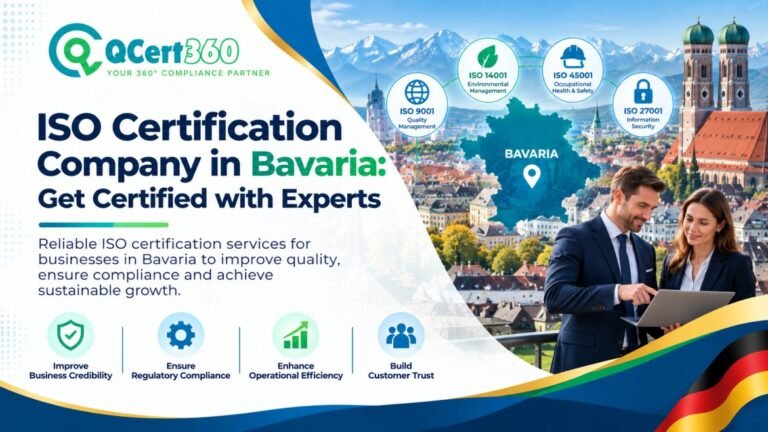
ISO Certification Company in Bavaria: Get Certified with Experts
ISO certification helps businesses in Bavaria demonstrate that their management systems have been independently assessed against the requirements of a recognized international standard. Companies use certification to improve consistency, manage risks, respond to supplier qualification requirements and provide customers with evidence of structured processes.
Whether you operate a precision engineering business near Ingolstadt, a technology company in Munich, a medical technology business around Erlangen or a logistics operation near Nuremberg, the right management system can help you demonstrate how your organization manages quality, environmental performance, occupational health and safety, information security or business continuity.
QCert360 is an ISO consulting and certification-support firm headquartered in Bengaluru, India, serving organizations internationally, including businesses in Germany. QCert360 does not claim to have a physical office in Bavaria or to be an accredited certification body. We help organizations identify applicable standards, assess gaps, implement management systems, train employees and prepare for independent certification audits.
Looking for an ISO certification company in Bavaria or ISO certification consultants for your business? Tell QCert360 which standard you need, your industry, company size and number of sites. We can help you understand the likely scope, preparation work and next steps before you approach an independent certification body.
Request ISO Certification Support
Request a scope-based discussion about your ISO requirements. To help us understand your needs, share your preferred standard, industry, approximate employee count, site locations and any customer or tender requirements. Certification fees and decisions remain with the independent certification body.
What Is ISO Certification, and Why Does It Matter in Bavaria?
ISO certification is a third-party confirmation that an organization’s management system conforms to the requirements of a specified ISO standard within a defined scope. The International Organization for Standardization (ISO) develops and publishes standards; it does not certify companies. Certification bodies conduct audits and make certification decisions. Accreditation bodies assess the competence and impartiality of certification bodies within defined scopes.
Bavaria has substantial activity in automotive supply chains, machinery, electronics, medical technology, software, food production and logistics. Businesses in these sectors may be asked to demonstrate that their processes are controlled and consistently managed. A relevant ISO certificate can help provide that evidence, although customers may also require sector-specific schemes, product approvals or contractual controls.
ISO certification is generally voluntary. It may become a commercial requirement when a customer contract, tender or industry scheme specifies it. Some laws also refer to management systems or related controls in particular circumstances. Legal obligations arise from the applicable legislation, not simply because an ISO standard exists.
Why Do Businesses in Bavaria Seek ISO Certification?
Businesses typically pursue ISO certification to respond to customer expectations, manage operational risks and improve how work is planned, performed and reviewed. Certification alone does not guarantee a contract, export access or regulatory compliance, but it may help a business meet a supplier qualification requirement.
Typical reasons include:
- Customer and supplier qualification: Buyers may request current certificates as part of supplier approval.
- Consistent quality: Defined processes and corrective action can reduce avoidable errors and rework.
- Operational control: Responsibilities, objectives and performance monitoring help management understand how processes are working.
- Environmental management: Structured controls can help organizations manage waste, resource use and environmental aspects.
- Occupational health and safety: Risk assessment and worker participation support a systematic approach to workplace safety.
- Information security: Documented risk management can help organizations demonstrate how they protect information.
- Business continuity: Planning and testing help organizations prepare for disruptive events.
- Supplier oversight: Clear criteria help organizations evaluate and monitor external providers.
- Continual improvement: Internal audits, management reviews and corrective actions create a structured improvement cycle.
The value of certification depends on the standard, the scope, the way the system is implemented and what customers actually require. Some buyers accept ISO 22000, for example, while others specify a GFSI-recognized scheme such as FSSC 22000. Confirm requirements with your customers before selecting a certification route.
Which ISO Certifications Are Relevant in Bavaria?
The most suitable standard depends on your activities, customer requirements, risks and contractual obligations. ISO 9001 is a common starting point for quality management. Organizations may also consider ISO 14001, ISO 45001 or ISO/IEC 27001 where environmental, workplace safety or information security requirements apply.
Standard | Main focus | Commonly relevant to |
Quality management | Manufacturing, engineering, logistics and services | |
Environmental management | Manufacturing, chemicals and industrial operations | |
Occupational health and safety | Factories, construction, workshops and warehouses | |
Information security management | IT, software, cloud services and suppliers handling sensitive data | |
Medical device quality management | Medical device manufacturers and relevant suppliers | |
Energy management | Energy-intensive operations and facilities | |
Business continuity management | Technology, logistics and organizations with critical services | |
Food safety management | Food production, processing and storage | |
Facilities management | Facilities service providers and organizations managing buildings |
Always confirm the current edition and transition arrangements with your certification body before setting a project plan.
ISO 9001:2026 transition: ISO 9001:2026 was published on 16 September 2026. Published transition guidance states that new initial accredited certifications may only be issued to the 2026 edition from 31 March 2028, while organizations certified to ISO 9001:2015 must complete transition by 30 September 2029. Confirm the applicable arrangements with your chosen certification body and accreditation scheme.
ISO 9001 Certification in Bavaria for Quality Management
ISO 9001 sets requirements for a quality management system focused on consistent outputs, customer requirements, process control and continual improvement. Organizations establish responsibilities, monitor performance, control nonconformities and evaluate whether their processes achieve intended results.
ISO 9001 certification in Bavaria may be relevant to automotive suppliers, engineering firms, manufacturers, logistics providers and professional service companies. For example, a precision machining business might formalize inspection steps, equipment calibration, supplier approval and corrective action so that customer requirements are handled consistently.
ISO 14001 Certification in Bavaria for Environmental Management
ISO 14001 provides a framework for identifying and managing the environmental aspects of an organization’s activities. It addresses environmental objectives, operational controls, compliance obligations, monitoring and continual improvement.
Manufacturers, chemical processors, industrial sites and other organizations with significant environmental aspects may consider ISO 14001 certification in Bavaria. The standard can support a structured response to customer sustainability questionnaires, but it does not certify products, replace environmental permits or guarantee compliance with environmental law.
ISO 45001 Certification in Bavaria for Occupational Health and Safety
ISO 45001 provides requirements for an occupational health and safety management system. It addresses hazard identification, risk assessment, worker consultation and participation, incident investigation, operational controls and continual improvement.
It may be relevant to factories, construction companies, engineering workshops, warehouses and other workplaces with material occupational risks. ISO 45001 supports systematic management, but it does not replace statutory duties under German occupational safety legislation.
ISO/IEC 27001 Certification in Bavaria for Information Security
ISO/IEC 27001 specifies requirements for an Information Security Management System (ISMS). Organizations assess information security risks, select and implement controls, maintain documented information and evaluate whether the system is effective.
Software companies, IT providers, cloud and hosting services, automotive technology suppliers and businesses handling sensitive customer or design data may consider ISO/IEC 27001 certification in Bavaria. It can support information security governance, but it does not by itself establish GDPR or NIS2 compliance. Organizations must assess their legal obligations separately.
ISO 13485 Certification in Bavaria for Medical Devices
ISO 13485 sets quality management system requirements for organizations involved in medical device design, development, production, installation, servicing and related activities within the standard’s scope. It emphasizes controlled processes, traceability, risk management and regulatory documentation.
ISO 13485 certification does not itself authorize a medical device for sale and does not replace conformity assessment under the EU Medical Device Regulation (MDR) or In Vitro Diagnostic Medical Devices Regulation (IVDR). Manufacturers should confirm the applicable regulatory route and the expectations of their notified body and customers.
ISO 50001 Certification in Bavaria for Energy Management
ISO 50001 supports systematic management of energy performance. Organizations review energy use, identify significant energy uses, establish baselines and objectives, implement action plans and monitor results.
Energy-intensive manufacturing sites and large facilities may find ISO 50001 useful. German energy efficiency legislation can impose energy or environmental management obligations on certain organizations depending on energy consumption and other statutory criteria. Confirm current legal requirements with official sources or qualified advisers before relying on a threshold.
ISO 22301 Certification in Bavaria for Business Continuity
ISO 22301 sets requirements for a business continuity management system. Organizations identify critical activities, assess disruption risks, conduct business impact analysis and establish, exercise and review continuity and recovery arrangements.
Manufacturers dependent on just-in-time supply, technology providers with service commitments and logistics businesses may consider ISO 22301 when customers ask how the organization would respond to disruption.
ISO 22000 Certification in Bavaria for Food Safety
ISO 22000 specifies requirements for a food safety management system, combining hazard analysis, prerequisite programmes, operational controls and communication across the food chain. It can be relevant to food manufacturers, processors, storage operators and other organizations within its scope.
ISO 22000 is not identical to FSSC 22000. FSSC 22000 includes additional scheme-specific requirements and is recognized by the Global Food Safety Initiative. Some retailers or customers specify a particular scheme, so check customer requirements before choosing a route.
ISO 41001 Certification in Bavaria for Facilities Management
ISO 41001 sets requirements for a facilities management system covering buildings, workplaces and related services. It focuses on aligning service delivery with organizational needs, managing risk and demonstrating consistent performance.
Commercial property managers, integrated facilities service providers and organizations with large site portfolios may consider ISO 41001 when clients expect a structured and auditable facilities management approach.
Other Industry-Specific Standards and Schemes
Some industries require schemes or technical standards beyond general ISO management system certification. IATF 16949 is an automotive quality management standard administered through the IATF scheme, rather than a general ISO certification route. The ISO 14644 series addresses cleanroom classification and related controls; it is not a generic management system certification.
Automotive customers may also request TISAX assessments for information security or VDA-related process audits. These schemes have their own rules and acceptance criteria. Confirm what your customer requires before investing in an assessment or certificate.
ISO Certification Requirements for Businesses in Bavaria
Requirements depend on the selected standard, certification scope, sites and activities. There is no separate Bavarian version of ISO standards. The applicable international standard is used, while local laws and customer requirements may affect how the management system is implemented.
Common management system activities include:
- Define the scope, sites, products and activities covered.
- Understand organizational context and relevant interested parties.
- Assign leadership responsibilities and establish appropriate policies.
- Identify risks, opportunities and applicable legal or customer requirements.
- Set measurable objectives and assign process owners.
- Ensure employees have the necessary competence and awareness.
- Create and control documented information required by the standard and the organization.
- Implement operational controls and manage outsourced activities.
- Monitor performance and maintain suitable records.
- Conduct internal audits and management reviews.
- Address nonconformities, determine causes and verify corrective action.
- Continually improve the management system.
These are common themes, not identical requirements across every standard. ISO 13485 includes medical-device-related quality and traceability requirements that ISO 9001 does not, while ISO/IEC 27001 requires a Statement of Applicability. Review the relevant standard and applicable sector requirements before assuming that one system covers another.
German and EU Regulations Relevant to ISO Certification
German and EU legislation operates alongside ISO standards. Applicability depends on sector, organization size, activities and other criteria. The following is general orientation, not legal advice. Check the current legislation and consult qualified advisers where necessary.
Area | Relevant source | Relationship to ISO |
Data protection | GDPR (Regulation (EU) 2016/679), German Federal Data Protection Act (BDSG) | ISO/IEC 27001 can support security controls but does not establish full GDPR compliance. |
Cybersecurity | NIS2 Directive (EU) 2022/2555 and Germany’s implementing legislation | ISO/IEC 27001 can support risk management, but applicability and legal compliance must be assessed separately. |
Medical devices | MDR (EU) 2017/745 and IVDR (EU) 2017/746 | ISO 13485 supports a quality management system but does not replace product conformity assessment. |
Energy | German Energy Efficiency Act (EnEfG) and related current legislation | Certain organizations may have energy management or other obligations depending on applicable statutory criteria. |
Environment | Applicable German and EU environmental, permitting and waste legislation | ISO 14001 can help manage obligations but does not replace permits or legal duties. |
Occupational safety | German Occupational Safety and Health Act (ArbSchG) and applicable rules | ISO 45001 supports systematic management but does not replace statutory duties. |
GDPR and ISO/IEC 27001
GDPR is a legal framework governing personal data. ISO/IEC 27001 is a management system standard for information security. Certification can provide evidence of a structured security management approach, but it does not confirm that every processing activity has a lawful basis or that all data subject rights and other GDPR obligations are met.
Privacy management may also involve ISO/IEC 27701, depending on the organization’s needs.
NIS2 and cybersecurity
Germany’s NIS2 implementation legislation entered into force on 6 December 2025. Whether an organization falls within scope depends on the law’s sector, size and other criteria.
Businesses should check current guidance from the German Federal Office for Information Security (BSI) and obtain legal advice where needed. ISO/IEC 27001 can support cybersecurity governance, but it is not automatic proof of NIS2 compliance.
Medical device rules
The MDR and IVDR apply across the EU. ISO 13485 may support the quality management system, but manufacturers must separately determine the applicable conformity assessment, technical documentation and other regulatory obligations.
Check EUR-Lex and the European Commission for current legal text and any adopted amendments.
Energy management
The EnEfG and related German legislation may impose obligations on organizations that meet specified energy consumption or other criteria. Because legal provisions and thresholds can change, do not rely on an old summary or a general ISO article to decide whether your company is covered. Verify the current statutory text and seek qualified advice.
Contractual requirements
Customer contracts, supplier codes, procurement conditions and tender documents may require certificates or schemes even when legislation does not. Review the exact wording of customer requirements before selecting a standard.
Accreditation and How to Choose an ISO Certification Body in Germany
Check a certification body’s accreditation status, standard coverage and relevant industry scope before engaging it. Do not rely solely on a certificate image or a sales claim.
Organization or role | Responsibility |
ISO | Develops and publishes international standards; does not certify companies. |
Accreditation body | Assesses the competence and impartiality of conformity assessment bodies within defined scopes. |
Certification body | Audits the management system and makes the certification decision. |
Consultant | Supports implementation, documentation, training and audit preparation; does not issue the certificate unless separately authorized in a distinct role. |
DAkkS (Deutsche Akkreditierungsstelle) is Germany’s national accreditation body. It accredits conformity assessment bodies; it does not issue ISO certificates to ordinary businesses. Management system certification bodies are assessed against applicable requirements, including ISO/IEC 17021-1, and their accreditation scopes identify the standards and sectors covered.
Before selecting a certification body:
- Search the official DAkkS database or the relevant national accreditation body’s directory.
- Confirm that the required standard is included in the body’s accredited scope.
- Check that the relevant industry or technical sector is covered.
- Review the current status and any restrictions or suspensions.
- Ask how the certificate will be recognized by your customers or in your target markets.
- Verify the issued certificate with the certification body.
A certification body accredited by another national accreditation body may be suitable where the accreditation and relevant recognition arrangements meet your needs. DAkkS is not the only possible route. The key is to verify current accreditation and scope for the specific standard and sector.
QCert360 does not claim DAkkS accreditation or accreditation to issue ISO certificates. We provide consulting and implementation support. Where certification is required, an independent certification body conducts the audit and makes the decision.
ISO Certification Process in Bavaria: Step by Step
The broad process is similar across Germany: select the right standard, implement the system, evaluate its performance and arrange an independent certification audit. The details vary by standard, scope, scheme and certification body.
- Identify the standard. Base your choice on customer requirements, activities and risks.
- Define the scope. Specify the sites and activities covered.
- Conduct a gap analysis. Compare current processes with the applicable requirements.
- Develop or improve documentation. Establish appropriate policies, procedures and operational controls.
- Train employees. Ensure relevant employees understand their responsibilities.
- Implement the system. Put the planned controls into practice and retain evidence.
- Conduct internal audits. Evaluate whether the system meets the requirements and operates effectively.
- Complete a management review. Review performance, risks, objectives and improvement opportunities.
- Address gaps. Correct identified problems and take appropriate corrective action.
- Select a certification body. Check that its accreditation and scope suit your organization.
- Complete the certification audit. Undergo the required audit stages.
- Resolve audit findings. Provide evidence and responses as required by the certification body.
- Receive the certification decision. The independent certification body determines whether certification can be granted.
- Maintain certification. Continue operating the system and complete surveillance and recertification activities as required.
The certification body confirms audit duration, evidence requirements, audit stages and certification arrangements. Avoid providers that promise a guaranteed certificate or fixed completion date before reviewing your scope and readiness.
ISO Certification Cost in Bavaria
ISO certification cost in Bavaria depends on the standard, organization size, number of locations, process complexity, existing system maturity and audit duration. There is no single price that applies to every business. A scope-based quotation is the most reliable way to understand the likely cost.
Cost category | What it may include |
Internal implementation | Staff time, process changes, tools, training and record preparation. |
Consulting and training | Optional gap analysis, implementation guidance, documentation support and audit preparation. |
Certification body fees | Application, audit, certification decision and applicable surveillance or recertification fees. |
Other cost factors include the number of standards being implemented, whether systems can be integrated, the number and location of sites, operational complexity, staff availability and travel requirements.
When requesting a quotation, provide the standard, scope, employee count, sites, activities and any customer deadline. QCert360 can help clarify the consulting and preparation scope; the independent certification body sets its own fees and certification arrangements.
How can you request an ISO certification quotation?
To receive a relevant proposal, prepare the following information:
- Required ISO standard or standards.
- Industry and principal business activities.
- Approximate number of employees.
- Number and location of sites.
- Current management system status.
- Customer or tender requirements.
- Target certification date, if applicable.
This information helps establish a realistic scope for implementation and certification planning.
How Long Does ISO Certification Take in Bavaria?
The time required depends on your current processes, scope, available staff, complexity and the certification body’s audit schedule. An organization with established procedures and reliable records may need less preparation than a business starting from scratch.
A gap analysis can help identify the work required and support a realistic project plan. Combining standards may reduce duplicated effort when their requirements can be integrated, but it does not remove standard-specific controls or audit requirements.
No completion date should be promised before the scope and readiness have been assessed.
ISO Certification for Small and Medium-Sized Businesses in Bavaria
reflect the organization’s size, activities and risks rather than create paperwork for its own sake. Start with the standard that customers require or that best addresses a clear business need.
Practical steps for SMEs include:
- Prioritize customer and operational risks. Focus on requirements that affect business performance and customer confidence.
- Assign clear responsibilities. Give suitable employees ownership of processes and records.
- Keep documentation useful. Create information that supports operations and meets applicable requirements.
- Train employees. Provide general awareness and role-specific training where necessary.
- Integrate compatible systems. Share common processes while retaining standard-specific controls.
- Plan internal audits and reviews. Evaluate the system regularly rather than waiting until the external audit.
- Allow sufficient resources. Budget for staff time, implementation and certification fees.
Certification can support supplier qualification and customer confidence, but it does not guarantee a contract or procurement approval. Buyers may apply additional technical, commercial and regulatory criteria.
Industry-Specific ISO Certification in Bavaria
The right standard depends on the sector, the business risks and the requirements of customers or regulators. Use the following as a starting point and confirm the precise requirements before choosing a route.
Sector | Potentially relevant standards or schemes | Additional considerations |
ISO 9001, ISO 14001, ISO 45001, ISO/IEC 27001 | IATF 16949, TISAX and customer-specific requirements where applicable. | |
ISO 9001, ISO 14001, ISO 45001, ISO 50001 | Product conformity, machinery-related rules and applicable safety requirements. | |
ISO 13485; ISO 14644 for relevant cleanroom needs | MDR/IVDR obligations and conformity assessment. | |
ISO 14001, ISO 45001, ISO 50001 | Environmental permits, hazardous substances and process safety. | |
ISO/IEC 27001, ISO 22301, ISO 9001 | GDPR and NIS2 where applicable, plus customer security requirements. | |
ISO 9001, ISO 22301, ISO 45001 | Customer commitments and applicable transport requirements. | |
ISO 22000, ISO 9001 | FSSC 22000 or retailer-specific schemes where required. | |
ISO 9001, ISO 45001, ISO 41001 | Statutory site safety and customer requirements. |
For automotive suppliers in Bavaria, ISO 9001 may be a starting point, with IATF 16949 or TISAX considered when customers require them. Engineering companies may also consider ISO 14001 or ISO 45001, while medical device manufacturers should evaluate ISO 13485 and their applicable regulatory route.
IT companies may prioritize ISO/IEC 27001 when customers expect evidence of information security management.
Common ISO Certification Challenges and How to Address Them
Challenge | Practical response |
Start with customer contracts, tender documents and business risks. | |
Unclear scope | Document sites, activities, products and boundaries before implementation. |
Incomplete records | Identify required documented information and assign owners. |
Limited staff capacity | Phase the work and reserve time for key employees. |
Employee resistance | Explain the purpose and involve people who operate the processes. |
Supplier control gaps | Set evaluation criteria and review supplier performance. |
Weak internal audits | Use competent auditors who are sufficiently independent of the work audited. |
Limited management involvement | Schedule reviews and connect objectives to business priorities. |
Ineffective corrective action | Identify root causes and check whether actions work. |
Confusing certification with legal compliance | Maintain a separate process for identifying and reviewing legal obligations. |
Duplicated management systems | Integrate common elements while keeping standard-specific requirements clear. |
Identifying these challenges early helps businesses plan implementation more effectively and avoid unnecessary delays.
Current Standards and Regulatory Developments to Monitor
Businesses should review standards editions and legal requirements before planning a new certification or transition.
As of this draft, ISO 9001:2026 was published on 16 September 2026. The published transition guidance gives a deadline of 30 September 2029 for organizations certified to ISO 9001:2015 to complete transition. Confirm the arrangements with your certification body.
Germany’s NIS2 implementation legislation entered into force on 6 December 2025. The EU Cyber Resilience Act also has phased application dates, including reporting obligations from September 2026 and wider application from December 2027 for products with digital elements. Confirm which provisions apply to your organization using current official guidance.
Energy management obligations under German legislation depend on the current law and the organization’s circumstances. Medical device rules may also change as EU institutions consider amendments. For any legal or regulatory point, check the latest official publication rather than relying solely on an older summary.
Digitalization, connected production, information security, supply chain resilience and integrated management systems are relevant planning considerations for many businesses. These are practical considerations, not a claim that every Bavarian company must obtain a particular certificate.
How QCert360 Supports Businesses in Bavaria
QCert360 supports organizations with ISO standard selection, gap analysis, management system implementation, documentation guidance, employee awareness, training and audit preparation.
QCert360 does not issue accredited certificates and does not claim to operate a physical office in Bavaria or hold DAkkS accreditation.
Our support may include:
- Guidance on selecting standards based on customer requirements and business risks.
- Gap analysis and readiness assessment.
- Management system implementation support.
- Documentation and process-control guidance.
- Employee awareness and training.
- Internal audit preparation and support.
- Corrective action planning.
- Certification readiness assistance.
- Integration support for compatible management systems.
- Guidance on selecting an independent certification body and checking its scope.
The certification body remains responsible for its independent audit and certification decision. Before beginning, clarify the standard, scope, number of locations, company size, target dates and the customer requirements that prompted the project.
Request an ISO Certification Quote
Ready to discuss ISO certification for your business in Bavaria? Contact QCert360 with your required standard, industry, approximate employee count, number of locations and certification goals.
We will help clarify the preparation scope and practical next steps without promising a certificate or audit date in advance.
Frequently Asked Questions About ISO Certification in Bavaria
How do I get ISO certified in Bavaria?
Choose a standard, define the scope, implement the management system, evaluate it through internal audits and management review, and engage a suitable independent certification body for the required external audits. A gap analysis can identify the work needed before the audit.
Which ISO certification is best for my company in Bavaria?
The best standard depends on your industry, customer requirements and business risks. ISO 9001 is commonly used for quality management, while ISO 14001, ISO 45001 and ISO/IEC 27001 address environmental management, occupational health and safety, and information security respectively.
Is ISO certification mandatory in Germany?
ISO certification is generally voluntary. It may be required by a contract, tender or sector scheme, and some legislation requires specified management systems or controls for organizations that meet defined criteria. Check the rules that apply to your business.
How much does ISO certification cost in Bavaria?
Cost depends on the standard, company size, number of sites, process complexity and audit duration. Total costs may include internal implementation, optional consulting and independent certification body fees. A scope-based quotation provides a more reliable estimate than a generic price.
How long does ISO certification take in Bavaria?
The timeline depends on your readiness, scope, available staff, complexity and audit scheduling. A gap analysis helps identify the work required. No reliable completion date can be promised without understanding these factors.
What is the difference between ISO certification and accreditation in Bavaria?
Certification is an independent assessment of an organization’s management system against a specified standard. Accreditation assesses the competence and impartiality of a certification body within a defined scope.
How can I verify an accredited ISO certification body in Germany?
Search the DAkkS directory or the relevant national accreditation body’s database. Check the body’s current status, standard coverage and industry scope. Verify the certificate with its issuing certification body.
Which ISO standards are relevant to automotive suppliers in Bavaria?
ISO 9001, ISO 14001, ISO 45001 and ISO/IEC 27001 may be relevant depending on customer and business requirements. Automotive customers may also specify IATF 16949, TISAX or their own supplier requirements.
Does ISO 27001 certification guarantee GDPR compliance in Bavaria?
No. ISO/IEC 27001 supports information security management, but GDPR includes additional requirements such as lawful processing, transparency and data subject rights. Organizations must assess and meet their applicable legal obligations separately.
Can small businesses in Bavaria obtain ISO certification in Bavaria?
Yes. A small business can implement a management system proportionate to its activities and risks. Clear responsibilities, useful documentation, employee awareness and a realistic plan help make the process manageable.
Can a company obtain multiple ISO certifications in Bavaria?
Yes. Organizations can hold several certifications and may integrate shared processes such as internal audits, objectives and management reviews. Each standard’s specific requirements must still be addressed.
Can QCert360 help a business in Bavaria if it has no local office there?
QCert360 is headquartered in Bengaluru, India, and provides international consulting and certification-support services, including support for organizations in Germany. It does not claim to have a physical office in Bavaria. The scope and delivery arrangements should be agreed before work begins.
What information should I provide to request an ISO certification quotation in Bavaria?
Provide the standard you need, your industry, approximate employee count, number and location of sites, activities within the proposed scope, current system maturity and any customer deadline. The independent certification body will determine its audit and certification fees.
How to Get ISO Certification for a Recycling Business?
To get ISO certified for Recycling Business, choose your standards, assess your gaps, build and run your system, audit it internally and then pass an external audit. How to get ISO certification for a recycling business follows the same ISO certification process for every standard:
- Select standards. Match them to customer requirements and business risks.
- Define scope. List materials, processes and sites.
- Run a gap analysis. Compare current practices with each requirement.
- Build the system. Write only the procedures and records you need.
- Train your people. Everyone must understand their roles.
- Operate the system. Gather records over several weeks or months.
- Complete an internal audit and management review. Fix problems early.
- Choose a third-party certification body for recycling companies. Pick an independent body that issues recognized certificates.
- Pass the Stage 1 audit. The auditor reviews documents and readiness.
- Pass the Stage 2 audit. The auditor verifies implementation on site.
- Receive your certificate. Maintain it with annual surveillance audits.
How Long Does ISO Certification Take for a Recycling Business?
Most recycling businesses need about three to nine months, depending on site size, existing controls and the number of standards. A single-site company with solid records moves faster. A multi-site operation handling hazardous streams needs more time to build and test controls.
Timeline depends on three factors:
- Starting maturity. Existing procedures and safety records save time.
- Site complexity. More materials, processes and locations require more sampling.
- Management commitment. Fast decisions keep the project moving.
How Much Does ISO Certification Cost for a Recycling Company?
ISO certification cost depends on employee numbers, sites, scope complexity and the standards you choose. How much does ISO certification cost for a recycling company? No fixed price fits everyone, so a quote based on your profile gives the only reliable figure.
Typical cost elements include:
- Stage 1 and Stage 2 certification audits
- Annual surveillance audits
- Recertification audit every three years
- Optional consulting and gap analysis
- Internal training and staff time
Integrated audits often reduce total cost compared with certifying each standard separately.
ISO Certificate Validity for Recycling Companies and Small Businesses
An ISO certificate stays valid for three years. Surveillance audits confirm your system still works, and a recertification audit renews the certificate at the end of the cycle.
Can small recycling businesses get ISO certified? Yes. Standards scale to company size. A small recycler can use lean documentation, short procedures and simple records while meeting every requirement. Auditors judge whether your system works for your business, not how many pages it contains.
Common Gaps in Recycling Companies
Gap assessments often reveal the same weaknesses. Fix them early:
- Inconsistent inspection of incoming loads
- Uncalibrated or unverified scales
- Weak segregation of batteries and flammables
- Generic risk assessments that ignore real tasks
- Poor contractor and visitor control in yards
- Missing records for downstream buyers
- Untested emergency and continuity plans
- Training files that do not prove competence
How QCert360 Supports Recycling Companies in getting ISO certification
QCert360 helps recycling companies achieve ISO certification with clear guidance and audit services aligned to international standards. We support operators handling plastics, metals, paper, glass, e-waste, batteries and industrial scrap across 195 countries.
Our support includes:
- Standard selection advice. We help you choose the right mix of ISO 14001, ISO 9001, ISO 45001 and supporting standards.
- Gap assessment. We compare your operations with each requirement.
- Implementation guidance. We help you build practical systems that fit real site work.
- Independent audit and certification. We assess conformity objectively.
- Ongoing support. We stay with you through surveillance and recertification.
Frequently Asked Questions
Which ISO standards do recycling companies need?
Most start with ISO 14001, ISO 9001 and ISO 45001. Larger operators add ISO 50001, ISO 22301, ISO/IEC 27001 or ISO 14064 based on customer demands and risks.
Is ISO certification mandatory for recycling plants?
Usually not. It is voluntary unless a customer, contract or program requires it.
Why is ISO 14001 important for the recycling industry?
It helps you identify environmental impacts, control them and prove continual improvement, which matches the purpose of the industry.
Does ISO 9001 help recycling businesses?
Yes. It improves grading accuracy, weighing control, traceability and customer confidence.
How does ISO 45001 make recycling yards safer?
It requires hazard assessment, training, isolation methods, emergency planning and incident learning, which reduce injuries and fires.
What is the difference between ISO 14001 and RIOS?
ISO 14001 is a general environmental standard. RIOS is a recycling-specific scheme combining quality, environment and safety.
How long does ISO certification take for a recycling business?
Typically three to nine months, depending on size, complexity and readiness.
How much does ISO certification cost for a recycling company?
Cost varies with employees, sites, scope and standards. Request a tailored quote for accuracy.
Can small recycling businesses get ISO certified?
Yes. Requirements scale to company size.
What does an ISO auditor check in a recycling facility?
They review inspection, weighing, storage, safety, environmental controls, training, supplier records, incidents and improvement actions.
Start Your ISO Certification Journey for Recycling business with QCert360
Recycling companies succeed when they combine performance with proof. ISO certification gives you that proof across environment, quality and safety. It helps you win contracts, protect your people and build trust with everyone who depends on your output.
Talk to QCert360 today for a free consultation and a certification quote tailored to your recycling business.
[Get Your Free ISO Certification Quote for Recycling Business]
Our Services
ISO Standards
- ISO 9001 Certification
- ISO 14001 Certification
- ISO 45001 Certification
- ISO 22000 Certification
- ISO 17025 Certification
- ISO 27001 Certification
- ISO 13485 Certification
- ISO 20000-1 Certification
- ISO 41001 Certification
- ISO 22716 Certification
- ISO 50001 Certification
- ISO 22301 Certification
- ISO 29993 Certification
Product Certifications
Other international standards
- FSSC 22000 Certification
- HIPAA
- HACCP Certification
- SA 8000 Certification
- GMP Certification
- GDPR
- GDP Certification
- GLP Certification
- Certificate of Conformity
QCert360 provides a wide range of services including ISO certification, audit support, compliance consulting, and training. They specialize in helping businesses achieve global standards and certifications like ISO 9001, ISO 27001, ISO 14001, and many others. Their team ensures a seamless experience from consultation to certification, supporting clients at every stage.
The time it takes to achieve certification can vary depending on the complexity of the standard and the readiness of your organization. On average, it takes about 3 to 6 months. QCert360 works closely with clients to streamline the process, ensuring that all requirements are met efficiently and within a reasonable timeline.
QCert360 is a trusted partner with years of experience in helping businesses obtain international certifications. Their expert consultants provide tailored solutions, ensuring your organization not only meets but exceeds industry standards. With a customer-centric approach, they focus on offering end-to-end support to simplify the certification journey.
QCert360 serves a wide range of industries including manufacturing, healthcare, information technology, education, and services, among others. They customize their certification solutions to meet the unique requirements of each industry, ensuring relevance and compliance with global standards.
Yes, QCert360 provides ongoing support even after certification. They offer services like surveillance audits, recertification guidance, and consultancy to help maintain and improve your certification status. Their team ensures that your organization stays compliant and up-to-date with any changes in certification standards.
Getting started with QCert360 is simple. You can contact them via their website to request a consultation. Their team will assess your needs, discuss the best certification options for your business, and outline the steps involved. From there, they’ll guide you through the entire process, ensuring you’re prepared for certification.
QCert360 stands out due to its customer-focused approach, industry expertise, and comprehensive service offerings. Their team doesn’t just help you obtain certification but works to ensure your organization thrives in compliance with international standards. They also offer personalized consultation, making the process smoother and more efficient, ensuring long-term success for your business.
The cost of certification varies depending on factors such as the type of certification, the size and complexity of your organization, and the specific industry requirements. QCert360 offers competitive pricing and provides tailored quotes based on your unique needs. They ensure transparency and work with you to find the most cost-effective solution for your certification goals.
Yes, QCert360 offers internal audit services to help assess and improve your organization’s processes. Their expert auditors conduct thorough reviews of your systems and operations to ensure they meet required standards. They also provide actionable recommendations to help enhance efficiency and compliance, making sure you’re fully prepared for external audits.
If your organization doesn’t pass an audit or certification assessment, QCert360 works with you to understand the reasons for non-compliance and provides support to rectify the issues. They offer guidance on corrective actions and help you prepare for a re-assessment. Their goal is to ensure your organization meets the necessary standards for certification, and they will be by your side to make the process as smooth as possible.